

What's on this page
- What community solar actually is
- How the bill credit actually works
- Virtual net metering explained
- Who community solar is genuinely for
- Why rooftop is not an option for many households
- Subscription versus ownership models
- What the discount actually means
- Sizing your subscription
- Contract terms that actually matter
- Moving cancelling and what happens next
- Community solar compared with rooftop solar
- Community solar compared with a utility green power plan
- What community solar does not give you
- Incentives and the honest position on tax credits
- Income qualified programmes
- How to evaluate an offer
- Common mistakes with community solar
- A worked example
- The bottom line
Short answer: Community solar is a subscription to credits from an off-site shared array. You pay the provider less than the credits are worth, and the gap is your saving, commonly a modest percentage rather than the large reduction rooftop ownership can deliver. It requires no roof, no equipment, and no upfront cost, and it provides no backup power whatsoever.
Almost everything written about home solar assumes a fact that is not true for a large share of households: that you own a building with a suitable roof. Renters do not. Condominium owners generally do not control the roof above them. Plenty of homeowners have a roof shaded by a neighbour’s tree, facing the wrong way, too small, or too old to take an array without a re-roof first. For all of those people, the entire genre of solar advice, including most of this site, has been quietly addressed to somebody else.
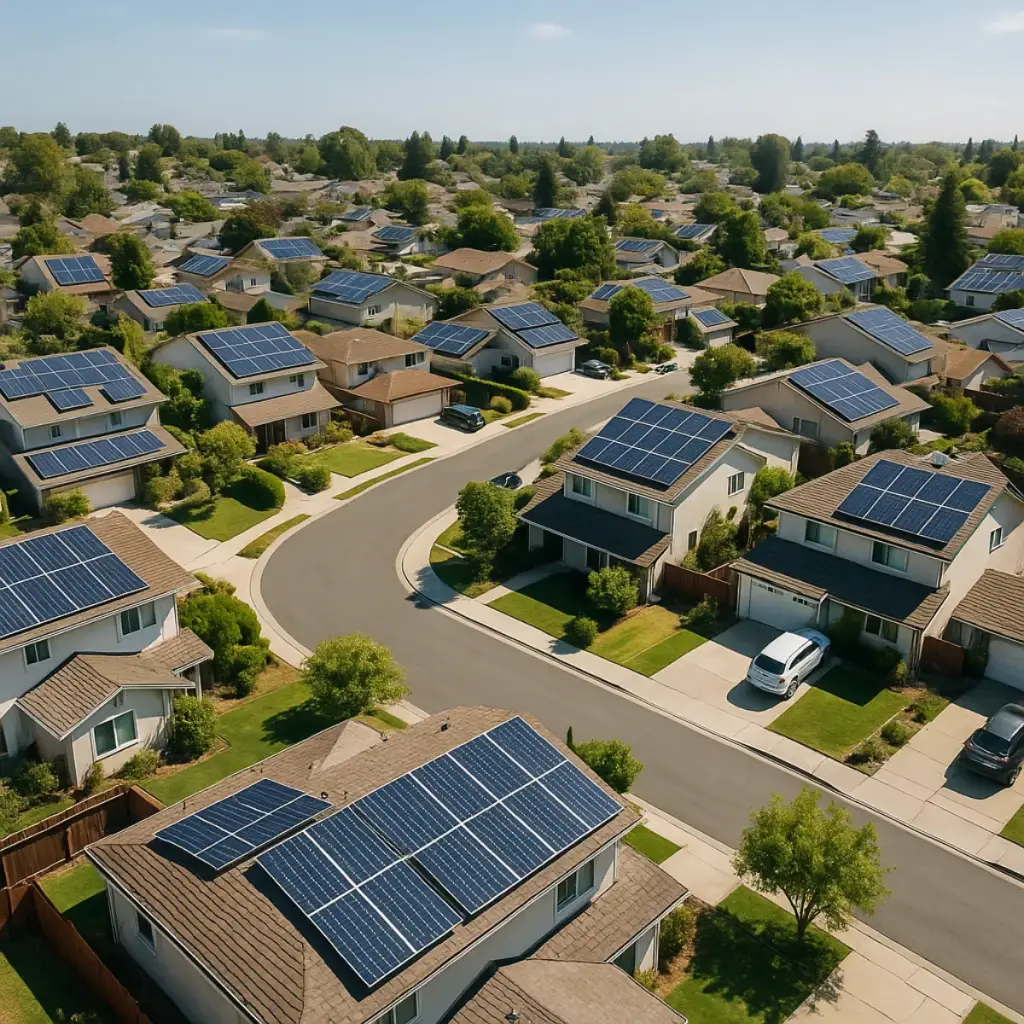
Community solar is the arrangement built for that group. An array is installed somewhere it makes sense, its output is shared among many subscribers, and each subscriber receives credits on their own electricity bill. Nothing is installed at your home and, in the usual model, you own nothing. This briefing covers how the credit mechanism actually works, what the subscription discount really is and why the saving is smaller than rooftop ownership, who the arrangement genuinely suits, and the contract terms that separate a good offer from a bad one. It is deliberately not a rephrasing of our briefing on solar lease versus buy, which is about financing an array on a roof you own. Run your own consumption through the savings calculator as you read, and the companion above works the subscription arithmetic from your bill.
Key takeaways
- Community solar credits your electricity bill for your share of an off-site array's output; nothing is installed at your home and you generally own nothing.
- The saving is a discount on credits, not free power, so the percentage is typically modest compared with owning a rooftop system outright.
- It works for renters, condo owners, shaded or small roofs, and anyone unwilling to commit capital, which is a large share of households.
- It gives no outage protection at all, because there is no equipment at your property to keep anything running.
- Availability is entirely state and utility dependent, and the contract terms, especially cancellation and portability, matter more than the headline discount.
What community solar actually is
Community solar is a shared generation arrangement. A developer builds a solar array at a single location chosen for good sun exposure, available land, and a suitable grid connection, then divides its output among many subscribers who live in the surrounding utility territory. Each subscriber is assigned a share, and each month the array’s production is allocated across those shares and converted into credits applied to subscribers’ electricity bills.
Three features define it. The generation is off-site, so nothing is installed at your property and no equipment, permits, roof work, or inspections are involved at your home. The relationship is contractual rather than physical, so what you hold is an agreement with a provider rather than an asset. And the benefit arrives as a credit on a bill you already receive rather than as electricity flowing into your house.
That third point deserves emphasis because it is the source of most misunderstanding. The electrons produced by the array go into the grid, not to your home. You continue to draw power from your utility exactly as you did before, and your usage is unchanged. What changes is the bill, which now carries a credit line reflecting your share of production, offset by a payment to the community solar provider.
Understanding it as a financial arrangement attached to an existing utility account, rather than as a way of getting solar power, gets every subsequent expectation right.
How the bill credit actually works
The mechanism is worth walking slowly because the two-line structure on the bill confuses almost everyone the first time.
Each month the array produces a quantity of electricity. Your share of that production is calculated according to the size of your subscription, and the utility converts it into a credit at a rate set by the programme, applying it to your account. So your electricity bill shows your usual usage and charges, then a solar credit reducing what you owe.
Separately, you receive an invoice from the community solar provider for those credits, priced at a discount to their value. Some programmes consolidate this into a single bill and some keep the two separate, which is worth asking about because two bills is administratively noisier than one.
Work it on illustrative figures. Your share produces credits worth $100 in a given month. Your utility bill falls by $100. The provider invoices you $90. You are $10 better off than you would have been, and you have paid a total of $90 to the provider plus whatever remained on the utility bill.
Two practical points follow. Credits generally cannot exceed what you owe in a useful way, which is why subscription sizing matters and gets its own section below. And production is seasonal, so summer months typically generate more credit than winter months, which means the monthly numbers swing even when the annual arithmetic works.

Virtual net metering explained
The regulatory mechanism that makes community solar possible is generally called virtual net metering, and knowing the term helps when reading a state’s rules.
Conventional net metering, which our briefing on what net metering is covers in detail, applies to a system physically connected at your own property: your meter tracks what you send to the grid and what you draw from it, and the accounting happens at that single connection. Virtual net metering severs the physical link. Generation occurs at one location, the array, and the credit is applied at another, your home, with the utility performing the allocation.
That is a regulatory construction rather than a technical one, which is why it exists only where a state has enacted rules permitting it. There is no way to arrange it privately between a developer and a household; the utility has to be required or permitted to apply credits from a remote generator to a retail account.
It also explains why the rules differ so much between states. The credit rate, whether credits are valued at the full retail rate or something lower, how excess credits are treated, how long they roll over, and what happens to unused credits at the end of a year are all set by the state’s programme design. Two subscribers in different states with identical arrays can receive materially different value.
The practical instruction is that when you evaluate an offer, the state programme rules matter as much as the provider’s discount, and the provider should be able to explain both.
Who community solar is genuinely for
The arrangement is not a general-purpose alternative to rooftop solar. It serves specific situations well and others poorly, and being clear about which is which saves a lot of disappointment.
It fits renters, because nothing is installed and no landlord permission is needed. It fits condominium and townhouse owners who do not control the roof or whose association prohibits installations. It fits homeowners whose roof is shaded, oriented away from the sun, too small, or structurally unsuitable, a set of constraints our briefing on how many solar panels you need covers from the sizing side. It fits people who expect to move within a few years and do not want to install an asset they will leave behind. And it fits anyone unwilling or unable to commit capital or take on financing.
It fits poorly for anyone whose main goal is the largest possible reduction in energy costs, because owning a rooftop system generally delivers a much larger saving over time. It fits poorly for anyone who wants outage resilience, because it provides none. And it fits poorly for anyone who wants an asset that adds to the value of their property, which our briefing on whether solar panels increase home value addresses for owned systems.
The honest summary is that community solar is the option for people for whom the better option is unavailable. That is not a criticism; it describes a genuinely large group.
Why rooftop is not an option for many households
It is worth spelling out the reasons, because people who cannot install often assume their situation is unusual when it is common.
Why a household might be unable to install rooftop solar
Illustrative split of the reasons a household could be ruled out of rooftop solar. Shares are a planning illustration rather than a measured survey.
This split is illustrative and chosen to show the shape of the problem rather than to report measured data. The point is that the largest single category is not technical at all: most people who cannot install rooftop solar are simply not the owner of the roof.
Each of those categories has a different relationship with community solar. Renting is the cleanest fit, because the constraint is ownership rather than physics and a subscription sidesteps it entirely. Shading and orientation are also clean fits, because an off-site array chosen for good exposure produces more than a compromised roof would.
Roof condition is more nuanced: a homeowner whose roof needs replacing before an array can go on it might reasonably subscribe to community solar now and revisit rooftop after the re-roof, provided the subscription can be cancelled without penalty. That is exactly the sort of situation where contract terms matter more than the discount rate.
Subscription versus ownership models
Community solar arrangements come in two broad shapes and the difference is substantial.
The subscription model is by far the most common. You sign up for a share of output, pay monthly for the credits it generates, and can generally exit under the terms of the contract. There is typically no upfront cost, you own nothing, and there is no asset at the end. This is what most people mean by community solar.
The ownership model has you buy specific panels or a defined share of the array outright, usually for a substantial upfront payment, and then receive the credits from that share for the life of the arrangement. This carries a real capital cost, may involve different tax treatment, and gives you an asset that can in some programmes be sold or transferred.
Two things to check on any ownership-style offer. First, what happens if you move, since an owned share may or may not be transferable outside the utility territory. Second, what happens at the end of the array’s operating life, because a share of a decommissioned array is worth nothing and the arrangement should say who bears that.
The subscription model dominates because it removes the capital barrier that makes rooftop solar inaccessible in the first place, which is the whole point. If a provider is pitching an ownership structure, understand that you are making an investment decision rather than a bill-reduction one, and price it with the same scepticism our briefing on solar panel payback period applies to rooftop systems.
What the discount actually means
The single number that determines whether a community solar subscription is worth having is the discount, and it is worth understanding precisely because providers describe it in several ways.
The discount is the percentage below face value at which you buy your bill credits. A 10 percent discount means you pay $90 for $100 of credits. Your saving is the 10 percent, not the $100.
That framing matters because marketing frequently emphasises the credit figure rather than the net saving. A provider saying you will receive $1,200 of solar credits a year is describing the gross, and the number that belongs in your decision is the net, which on a 10 percent discount is an illustrative $120.
Illustrative net annual saving by discount rate
Net saving for a subscription whose share generates an illustrative $1,000 of bill credits a year, at different discount rates.
All figures are illustrative arithmetic on a single hypothetical subscription, not offers or market rates. Discount rates vary by programme and by state, and some are guaranteed for the term while others are not, which is a question to put to any provider in writing.
Two follow-up questions separate a solid offer from a vague one. Is the discount fixed for the term of the contract or can it change. And is there any escalator, meaning a clause that raises what you pay by a set percentage each year, which can quietly erode the discount over a long term. Both should be answerable from the contract rather than from a salesperson’s summary.
Sizing your subscription
Subscription sizing is the practical decision that most affects whether the arrangement works smoothly, and it is more consequential than it sounds.
The principle is to size your share so that the credits it generates roughly match your annual electricity consumption, rather than exceeding it. Over-subscribing generates credits you cannot use, and what happens to unused credits varies by programme: some roll forward indefinitely, some expire at the end of a period, and some are effectively lost. Under-subscribing simply means a smaller saving.
The input you need is your annual consumption in kilowatt hours, which appears on your utility bills. Our briefing on reading your electric bill explains where to find it, and pulling twelve months of bills gives a far better figure than extrapolating from one. Households whose usage is about to change, because of a new electric vehicle, a heat pump, or a new occupant, should size for the expected usage rather than the historical one.
Seasonality is the complication. Solar production peaks in summer and troughs in winter, while household consumption often does the opposite, particularly in heating-dominated climates. That mismatch means a subscription sized correctly on an annual basis will still generate surplus credits in summer and insufficient ones in winter, which is fine if credits roll over and less fine if they do not.
Ask the provider two questions: what size subscription they recommend for your annual usage, and what happens to credits you do not use in a given month. The second answer tells you how much the seasonality matters.
Contract terms that actually matter
The discount gets the attention and the contract decides the experience. Six clauses are worth reading before signing anything.
Term length. Community solar contracts range from short arrangements to commitments measured in many years. A long term with a good fixed discount can be excellent; a long term with an escalator and a termination fee is a different proposition entirely.
Cancellation. Look for the notice period required, whether a termination fee applies, and whether it is a flat fee or calculated from remaining payments. A programme that allows exit with a modest notice period and no fee is far more forgiving of changed circumstances.
Portability. What happens if you move within the utility territory, and what happens if you move outside it. Good contracts transfer within the territory and cancel without penalty outside it.
Escalator. Whether what you pay rises annually by a set percentage. An escalator paired with a fixed credit valuation can shrink the discount over time.
Credit guarantee. Whether the provider guarantees a level of production or a level of savings, and what happens if the array underperforms.
Assignment. Whether the provider can transfer your contract to another company, which is common in this industry and worth knowing about in advance.
Read the actual document rather than the summary. This is a multi-year financial arrangement, and the same care our briefing on reading a solar quote recommends for rooftop proposals applies here.
Moving cancelling and what happens next
Because subscriptions are long and lives are not, the exit path deserves its own treatment.
Moving within the same utility territory is the easy case, and most programmes will simply transfer the subscription to your new address once you notify them, though there may be a gap while accounts are set up.
Moving outside the territory generally ends the subscription, because the credits cannot follow you to a different utility. What matters then is whether a termination fee applies and how much notice is required. Some providers waive fees for relocation specifically, which is worth asking about at the point of signing rather than at the point of moving.
Cancelling for other reasons, such as deciding to install rooftop solar after all, is governed by the same clauses. A homeowner planning a re-roof followed by an installation should specifically confirm that the subscription can be ended when the array goes live.
There is also a scenario people do not anticipate: the provider changing. Contracts in this industry are frequently assigned or sold between companies, and your subscription can end up administered by an entity you did not choose. That does not usually change the economics, since the contract terms carry over, but it does change who answers the phone.
Keep a copy of the signed contract somewhere you can find it. It is the only document that settles any of this, and it is remarkably easy to lose track of an arrangement that produces one line on a bill each month.
Community solar compared with rooftop solar
Setting the two side by side clarifies what each one is actually for.
On upfront cost, rooftop typically requires substantial capital or financing while community solar typically requires none. On saving, rooftop ownership generally delivers a much larger reduction over the system’s life, while community solar delivers a modest percentage. On asset value, rooftop produces something you own that can contribute to property value, while a subscription produces nothing. On commitment, rooftop is a decades-long fixture on a building you own, while a subscription can usually be exited under its terms. On outage resilience, rooftop with a battery can keep a home running, while community solar cannot do anything at all. On eligibility, rooftop requires a suitable roof you control, while community solar requires only a utility account in a participating territory.
The comparison is not really a competition, because the populations barely overlap. Somebody with a good south-facing roof, capital or access to financing, and a plan to stay put will almost always do better owning, and our briefings on how to go solar and what solar panels cost are the relevant reading. Somebody renting a fourth-floor apartment has no version of that decision available and community solar is the only route.
The genuinely interesting middle case is the homeowner who could install but has not, usually because of the capital or the commitment. For them the comparison is real, and the arithmetic strongly favours ownership over a long horizon, which our briefing on payback period works through.
Community solar compared with a utility green power plan
A second comparison confuses people because both arrangements let you support renewable generation without installing anything.
Many utilities offer a green power or renewable energy plan, in which you pay a premium on your bill and the utility procures renewable energy or certificates on your behalf. The defining feature is that it typically costs you more, not less, because you are paying for an attribute rather than buying a discounted product.
Community solar is the opposite in that respect: the point is to pay less than the credits are worth, so it is a savings arrangement with an environmental attribute rather than an environmental arrangement with a cost.
Both have legitimate places. Somebody whose priority is supporting renewable generation and who has no community solar programme available may find a green power plan is the only lever they have. Somebody whose priority is a lower bill should not confuse the two, because signing up for a green power plan expecting to save money produces exactly the wrong outcome.
The question that distinguishes them in a sales conversation is simple: will my total annual cost be higher or lower than it is today. A community solar provider should say lower and be able to show the arithmetic. A green power plan will say higher and should say so plainly.
What community solar does not give you
A short list of things people expect and do not get, because expectation mismatches account for most dissatisfaction with these programmes.
It does not give you backup power. When the grid fails, your home goes dark exactly as it would without a subscription, because there is no equipment at your property. If resilience is the goal, our briefings on home battery backup versus a generator and on whether solar batteries are worth it cover the products that actually address it.
It does not make your home solar powered in any physical sense. Your electricity continues to come from the grid and your usage is unchanged.
It does not add value to your property, because there is no asset attached to the property.
It does not usually deliver rooftop-scale savings. A modest percentage discount is a modest percentage discount.
It does not remove your utility bill. You still have an account, still pay fixed charges and delivery charges, and still owe whatever the credits do not cover.
And it does not insulate you from rate changes in the way an owned system does, since the credits are valued against utility rates that can move in either direction.
None of this makes the arrangement bad. It makes it a specific thing rather than a general one, and the people who are happiest with it are the ones who understood which thing it was before signing.
Incentives and the honest position on tax credits
This is an area where confident statements age badly, so the posture here is deliberately cautious.
In the ordinary subscription model, residential clean energy incentives are generally tied to owning a system rather than to subscribing to output from somebody else’s, so a subscriber typically would not claim them. Ownership-model arrangements, where you buy specific panels, may be treated differently, and the treatment depends on the structure.
The federal side of this is settled and settled at nothing. The federal Residential Clean Energy Credit under section 25D was terminated by Public Law 119-21 and, per the IRS, is not available for any property placed in service after December 31, 2025, with the operative test being when the original installation was completed rather than when it was ordered, contracted, or paid for. State and local programme rules do continue to change, and this briefing does not assert what your own state currently offers.
What is safe to say is procedural. If a provider makes a tax claim as part of a sales pitch, treat that as a prompt to verify rather than as a reason to sign, and get the claim in writing so it can be checked. Take your own state’s incentives to your state energy office and your own tax position to a qualified tax professional before assuming any benefit, and treat any pitch that still leans on a 30 percent federal credit as a reason to stop reading. And be particularly wary of any offer whose economics only work if a tax benefit materialises, because that puts the risk of a rule change entirely on you.
State-level programme design, including credit rates and any low income provisions, changes too, so check your state’s current programme rules rather than a summary.
Income qualified programmes
Many state community solar programmes include provisions specifically for lower income households, and they are worth knowing about because they are frequently better than the standard offer and are under-used.
The common features are a larger discount than the general programme offers, no credit check or a soft check only, no upfront cost, and simplified cancellation terms. Some states require a proportion of each project’s capacity to be allocated to income-qualified subscribers, which is why these slots exist.
Eligibility is typically established either by income relative to a threshold or by participation in another assistance programme, which can make verification straightforward if you are already enrolled in something.
Because these programmes are state specific and change, the reliable route is your state’s energy office or public utility commission rather than a provider’s website, and community action agencies frequently know which programmes are open locally.
The reason to raise it here is that a household for whom a 10 percent discount is marginal may find a materially better arrangement exists and is not advertised as prominently. It costs nothing to ask whether an income-qualified tier is available before signing up for the standard one.
How to evaluate an offer
A short procedure that turns a sales conversation into a decision.
First, confirm a programme legally exists in your state and that the provider is participating in it. State energy office and utility websites list participating providers, and a provider not on that list is a reason to stop.
Second, get the discount in writing, along with whether it is fixed and whether an escalator applies.
Third, get the recommended subscription size and the reasoning, and check it against twelve months of your own bills rather than one.
Fourth, read the cancellation, portability, and assignment clauses specifically, and ask what happens if you move out of state.
Fifth, ask whether billing is consolidated or separate, since two bills is a real administrative difference.
Sixth, ask what happens to unused credits.
Seventh, ask whether an income-qualified tier exists.
And finally, do not sign at the door or on the call. Community solar has attracted aggressive door-to-door and telephone marketing in some markets, and no legitimate offer requires an immediate decision. The same caution our briefing on choosing a solar installer recommends for rooftop applies here, and the savings calculator gives you a baseline to test any claim against.
Common mistakes with community solar
- Reading the credit figure as the saving. The saving is the discount, so $1,200 of credits at a 10 percent discount is an illustrative $120, not $1,200.
- Expecting backup power. There is nothing at your property. An outage affects you exactly as it would without a subscription.
- Over-subscribing. Credits beyond your usage may roll over, expire, or be lost depending on the programme. Size to twelve months of actual bills.
- Ignoring the escalator. A clause raising your payment annually can erode the discount over a long term.
- Not checking portability before moving. The cancellation and relocation terms decide what a move costs you, and they are far easier to read before signing.
- Signing at the door. Aggressive marketing exists in this space and no genuine offer requires an immediate answer.
- Assuming a tax benefit. Subscribers generally do not own the system, and incentive rules change. Verify any claim with a tax professional.
Each of these comes from treating community solar as a smaller version of rooftop solar rather than as the different arrangement it actually is.
A worked example
Theory into practice on illustrative figures throughout. Our subscriber rents an apartment, has an electricity account in her own name, and cannot install anything.
She starts with her bills. Twelve months of statements show an illustrative annual consumption she can hand to a provider, and an annual electricity spend of an illustrative $1,500. Our briefing on reading your electric bill shows where those figures sit.
She checks her state energy office site and confirms a community solar programme exists and lists participating providers. Two of the three companies that have called her are on the list; one is not, and she stops talking to that one.
She requests written offers from the two. The first offers a 10 percent discount with a five year term, an annual escalator, and a termination fee. The second offers an 8 percent discount with a one year rolling term, no escalator, and cancellation on thirty days notice.
On headline discount the first looks better. She works it through anyway. A subscription sized to her usage would generate roughly $1,400 of credits a year on illustrative figures, so the first offer nets about $140 in year one and less thereafter as the escalator bites, while the second nets about $112 with no erosion. Since she expects to move within two years, the termination fee and the lost portability on the first offer outweigh the $28 difference in year one, and she takes the second.
She asks the remaining questions before signing: unused credits roll forward, billing is consolidated into one bill, and the provider transfers subscriptions within the utility territory at no cost. She also asks whether an income-qualified tier applies to her and is told it does not.
Nothing about that process was sophisticated. She verified the programme existed, got both offers in writing, worked the net rather than the gross, and weighted the contract terms against her own likely circumstances. Run your own consumption through the savings calculator to build the same baseline.
The bottom line
Community solar is the solar arrangement for people whose roof is not available, which is a far larger group than the rooftop-focused conversation suggests: renters, condominium owners, shaded and small and ageing roofs, and anyone unwilling to commit capital. It works by crediting your existing electricity bill for your share of an off-site array’s output, and you pay the provider for those credits at a discount, so the saving is the discount rather than the credit value. Expect a modest percentage rather than the substantial reduction owning a rooftop system can deliver, expect no backup power whatsoever because there is no equipment at your home, and expect availability to depend entirely on whether your state has enacted the rules that make it possible. Once you have found a legitimate programme, the discount is the smallest part of the decision: the term length, the escalator, the cancellation terms, and what happens when you move matter more, and all four are answerable from the contract rather than the sales call. Size the subscription against twelve months of real bills, ask what happens to unused credits, ask whether an income-qualified tier applies, and never sign at the door. Build your baseline in the savings calculator, and the arrangement stops being a mystery and becomes a small, checkable saving on a bill you were already paying.
This briefing explains how community solar arrangements commonly work and is general information rather than financial, tax, legal, or energy procurement advice. Every dollar amount, percentage, discount rate, and saving figure used here is illustrative and chosen to demonstrate the arithmetic, not an offer, a market rate, or a prediction of what any programme would deliver. Community solar availability, virtual net metering rules, credit valuation, credit rollover treatment, consumer protections, and income-qualified provisions are set by individual states and utilities and are revised over time, so confirm the current rules where you live rather than relying on any general description. The federal Residential Clean Energy Credit under section 25D was terminated by Public Law 119-21 and is not available for property placed in service after December 31, 2025, so no figure above assumes a federal credit; state and local programme rules continue to change and this briefing deliberately does not state their current status where you live; verify any tax claim a provider makes with a qualified tax professional before it influences your decision, and read the full contract before signing.
Frequently asked questions
What is community solar?
Community solar is an arrangement where a solar array is built at a single off-site location and its output is shared among many subscribers, each of whom receives credits on their electricity bill for their share of what the array produces. The panels are not on your roof and you generally do not own them; you subscribe to a portion of the array's output and the utility applies the resulting credits to your account. It exists to serve households that cannot install rooftop solar, which is a much larger group than people assume. Availability depends entirely on whether your state and utility support the arrangement, so the first question is always whether a programme exists where you live.
How do you save money with community solar?
The saving comes from a discount rather than from free electricity. Your share of the array generates a quantity of bill credits, and you pay the community solar provider for those credits at a price below their face value, so the difference is your saving. If your share produces an illustrative $1,000 of credits in a year and you pay for them at a 10 percent discount, you spend $900 and receive $1,000 of credit, netting an illustrative $100. Discount rates vary by programme and by state, so the honest question to ask any provider is what the discount is and whether it is guaranteed for the term.
Can renters use community solar?
Yes, and renters are one of the main groups the arrangement was designed for. Because nothing is installed at your home, you do not need a landlord's permission, a suitable roof, or a long-term stake in the property. What you generally do need is an electricity account in your own name with the participating utility, since the credits are applied to a bill rather than paid to a person. That requirement is worth checking early if utilities are included in your rent, because in that case the bill is in the landlord's name and you may not be eligible.
Do you need good credit for community solar?
Many programmes run a credit check, because a subscription is a contractual commitment to pay for credits over a period, and providers differ in how strict the requirement is. Some set a minimum score, some perform only a soft check, and some income-qualified programmes are designed specifically to have no credit requirement at all. Because practice varies widely between providers and states, ask directly what the requirement is and whether the check is soft or hard before applying, so a rejected application does not leave a mark on your file unnecessarily.
What happens to a community solar subscription if you move?
It depends on where you move to and what the contract says. If you move within the same utility territory, most programmes will transfer the subscription to your new address, which is usually straightforward. If you move outside the territory or out of state, the subscription generally cannot follow you and has to be cancelled, which is where the contract's cancellation terms become the important text. Look specifically for the notice period required, whether any termination fee applies, and whether the provider will simply reassign your share to somebody on a waiting list.
Is community solar the same as rooftop solar?
No, and the differences matter more than the similarities. Rooftop solar is an asset you own or finance on your own property, which typically involves a substantial upfront cost or loan, can add value to the home, and produces power you consume directly. Community solar is a subscription to credits from somebody else's array, involves little or no upfront cost, produces a smaller percentage saving, and leaves you with no asset at the end. Community solar also provides no backup power during an outage, because there is nothing at your house to keep running when the grid goes down.
Does community solar give you backup power in an outage?
No. This is the most common misunderstanding of the arrangement and it is worth being explicit about. Community solar delivers a credit on your bill, not electricity to your house, so when the grid goes down your home goes down with it exactly as it would without a subscription. There is no equipment at your property to keep anything running. If outage resilience is what you want, the relevant products are a home battery or a generator, and our briefings on those cover the comparison honestly rather than treating solar of any kind as a substitute.
Can you claim solar tax credits on a community solar subscription?
Generally not in the ordinary subscription model, because residential clean energy incentives are typically tied to owning the system rather than to subscribing to output from somebody else's. Some community solar arrangements are structured as ownership of specific panels rather than as a subscription, and those can be treated differently. The federal residential credit is not the route in any case: the Residential Clean Energy Credit under section 25D was terminated by Public Law 119-21 and is not available for any property placed in service after December 31, 2025. State incentive rules in this area continue to change, so nothing here should be treated as a statement of current law where you live. If a provider makes a tax claim as part of its sales pitch, treat that as a reason to verify with a qualified tax professional rather than as a reason to sign.