
What's on this page
- How many solar panels to run an air conditioner
- Can solar panels run an air conditioner
- The wattage an air conditioner draws
- The sizing math that turns AC watts into panels
- Panels for a window AC unit
- How many solar panels to run a portable AC
- How many solar panels to run a central AC
- The startup surge and why AC needs extra capacity
- Do you need batteries to run AC on solar
- Grid-tied vs off-grid ways to run AC
- Sizing the inverter for an air conditioner
- How sun hours by region change the count
- Illustrative panel counts by AC type
- What a solar setup to run AC actually costs
- Efficiency tips that cut the panel count
- A worked example: running a central AC on solar
- Common mistakes sizing solar for AC
- Running watts versus starting watts
- Sizing a battery for overnight AC cooling
- Pre-cooling and thermal mass to shift the load
- Humidity, run time, and why energy use varies
- The bottom line
Short answer: It depends on the air conditioner's wattage and your sun hours: illustratively about 3 to 4 panels for a small window unit and 16 to 25 for a central system. The formula is running watts times hours per day, divided by what one panel makes in a day, roughly 1.5 kilowatt-hours for a 400 watt panel at 4.5 peak sun hours. A central system using 24 kilowatt-hours a day needs about 16 panels.
How many solar panels to run an air conditioner is one of those questions that sounds like it should have a tidy answer, and it does not, because the honest reply is that it depends on two things: how many watts your air conditioner draws and how much sun your location gets. A small window unit and a whole-home central system sit at opposite ends of a very wide range, so a single number would mislead almost everyone who read it. What does not change is the method. This briefing gives you the sizing formula, then walks it through window, portable, and central air conditioners with illustrative counts you can adjust to your own unit.
We will start with a direct answer and the one formula behind every count, pin down what different air conditioners actually draw in watts, and work the math for window, portable, and central units. Then we cover the startup surge that trips up naive sizing, whether you need batteries, how grid-tied and off-grid setups differ, inverter sizing, and how your region’s sun hours move everything. This is the air-conditioner-specific companion to our broader panel-count briefing; if you want the whole-house version of the sizing method, start there, then come back here for the cooling load. Drop your own unit into our savings calculator as you read.
Key takeaways
- The count depends on the air conditioner's wattage and your sun hours: illustratively about 3 to 4 panels for a small window unit and 16 to 25 for a central system.
- The formula is one line: AC running watts times hours per day, divided by what one panel makes in a day, gives panels needed.
- A window air conditioner is a light load and pairs easily with a small array; a central air conditioner is a heavy load that needs many more panels.
- The startup surge can be two to three times the running watts, so inverters and off-grid batteries need headroom or a soft-start device.
- Daytime cooling on a grid-tied system rarely needs a battery, but night, cloudy, outage, or off-grid cooling does, and a cooling battery bank is large.
How many solar panels to run an air conditioner
How many solar panels to run an air conditioner comes down to a short piece of arithmetic, not a lookup table. First you need the air conditioner’s energy use for a day, which is its running wattage times the hours it runs. Then you need what one solar panel produces in a day, which is its wattage times your daily peak sun hours times a real-world derate near 0.85. Divide the first by the second and round up, and you have the panel count for the cooling load alone.
Held at 400 watt panels and an average 4.5 peak sun hours, one panel makes roughly 1.5 kilowatt-hours a day. So a window unit using about 5 kilowatt-hours a day needs 3 to 4 panels, while a central system using 24 kilowatt-hours needs about 16. These counts sit on top of your home’s other usage, which is why the whole-house panel-count briefing matters if you are sizing a full array. For just the air conditioner, the sections below break the math out by type. Try your own unit in the calculator.
Can solar panels run an air conditioner
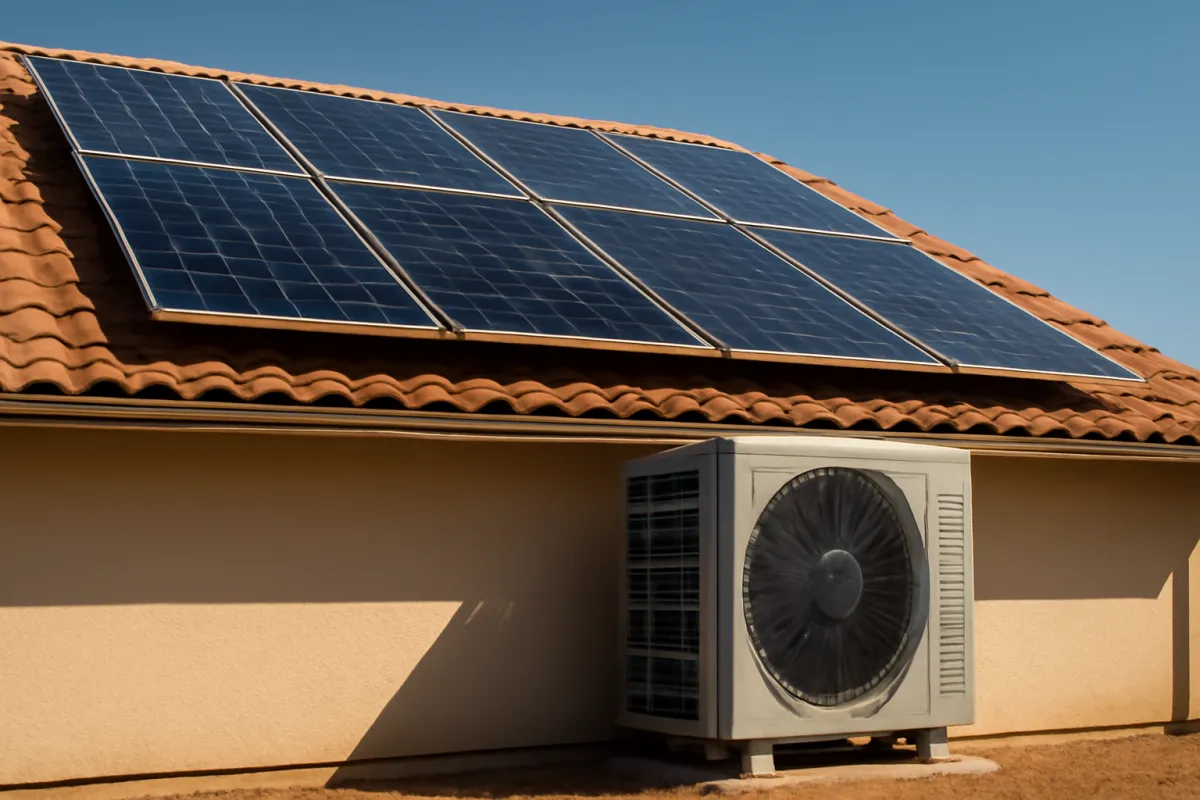
Yes, solar panels can run an air conditioner, and millions of homes already do it without the owner thinking of it that way. On a normal grid-tied system the panels do not wire directly into the compressor. They feed an inverter, the inverter feeds your electrical panel, and the air conditioner pulls from that shared supply exactly like your refrigerator or your dryer. On a sunny afternoon the panels may supply all of the cooling load and more; on a cloudy one the grid quietly fills the gap. The air conditioner neither knows nor cares where the electrons came from.
Where “can solar run an air conditioner” gets interesting is off-grid, with no utility to lean on. There the answer is still yes, but the setup has to be deliberate: enough panels to make the daily cooling energy, a battery to carry the load when the sun dips or sets, and an inverter big enough to survive the compressor’s startup surge. Running a compressor straight off raw panel output, with no storage and no grid, is impractical, because a passing cloud would drop the voltage and stall the motor. Storage or the grid is what makes cooling on solar stable. What that storage costs is its own question, one our Powerwall 3 cost briefing prices from hardware to installed.
The wattage an air conditioner draws
Everything downstream depends on this number, so it is worth getting right for your own unit rather than trusting a generic figure. Running wattage climbs with cooling capacity. A small window air conditioner commonly draws roughly 500 to 900 watts while the compressor runs. A larger window unit or a portable floor unit sits closer to 1,000 to 1,500 watts. A central air conditioner runs at about 2,000 to 5,000 watts, and the biggest whole-home systems on the hottest days can draw more. Those are all illustrative bands, and your specific model can land above or below them.
Two subtleties matter. First, air conditioners cycle: the compressor runs, satisfies the thermostat, shuts off, and restarts later, so the average draw over a day is lower than the peak running watts. Second, the nameplate often lists amps rather than watts, and watts equals amps times volts, so a 9 amp unit on a 120 volt circuit draws about 1,080 watts. If you can find your unit’s running watts or amperage, use that number in the calculator instead of an estimate, because the panel count scales directly with it.
The sizing math that turns AC watts into panels
Here is the formula written once so the rest of this briefing is just plugging in numbers. Panels needed equals the air conditioner’s daily energy use divided by one panel’s daily production. Daily energy use is running watts times hours of operation, divided by 1,000 to get kilowatt-hours. One panel’s daily production is its wattage divided by 1,000, times your peak sun hours, times a derate near 0.85 for heat, wiring, and inverter losses. Divide, round up, and you have the count for the cooling load.
Work a quick one. A 900 watt window unit running eight hours uses 900 times 8, or 7,200 watt-hours, which is 7.2 kilowatt-hours. A 400 watt panel at 4.5 sun hours makes 0.4 times 4.5 times 0.85, about 1.53 kilowatt-hours a day. So 7.2 divided by 1.53 is 4.7, which rounds up to 5 panels. That is the entire method, and it is the same one our whole-house panel briefing uses at the scale of a full home. The only inputs that change the answer are the air conditioner’s watts, its hours, your sun, and your panel wattage.
Panels for a window AC unit
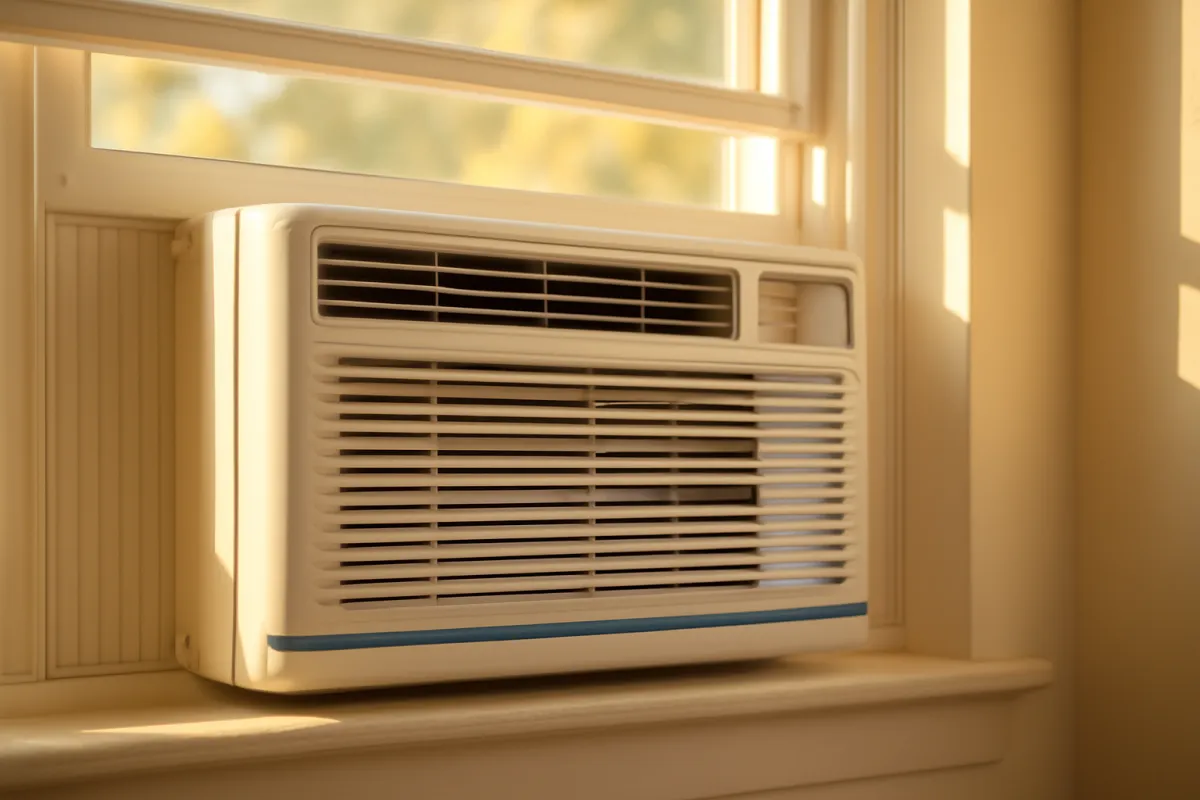
A window air conditioner is the easiest cooling load to put on solar, because it is small. Take a modest 500 to 700 watt window unit running about eight hours on a warm day: that is roughly 4 to 6 kilowatt-hours. At 1.53 kilowatt-hours per panel a day, you are looking at about 3 to 4 panels to cover it. Step up to a larger 1,000 to 1,200 watt window unit over the same hours and daily use rises toward 8 to 10 kilowatt-hours, pushing the count to about 6 or 7 panels.
The reason window units pair so well with solar is timing. Cooling demand peaks in the afternoon, which is exactly when a rooftop array produces most, so on a grid-tied system the panels often supply the unit directly with no battery involved. Run one or two window units only during solar hours and a small array can carry them cleanly. If you want the window unit to run into the evening on stored power, that changes things, and the battery section below covers it. For daytime cooling, though, a window air conditioner is the friendliest possible case.
How many solar panels to run a portable AC
Portable air conditioners, the wheeled floor units with a hose to the window, sit between window and central systems on the load scale, and they are usually less efficient per unit of cooling than a comparable window unit. A typical portable draws roughly 1,000 to 1,500 watts while running. Take 1,200 watts over eight hours: that is about 9.6 kilowatt-hours a day, or close to 7 panels at 400 watts and average sun. Single-hose designs pull conditioned air out of the room and can draw warm replacement air back in, which makes the compressor work longer and raises real energy use.
Because a portable unit works harder for the same cooling, it is often the least efficient way to spend your solar production. If you have a choice and want to minimize the panel count, a window unit or a mini-split of the same cooling capacity will usually need fewer panels than a portable. That said, portables are the only option in some rentals and rooms, and 7 panels of dedicated production is still a modest array. Size it with the same formula, and remember that running it only during peak sun keeps it off the battery and off the grid.
How many solar panels to run a central AC
A central air conditioner is the demanding end of the range and the reason a blanket answer is impossible. Running watts of 2,000 to 5,000 are the low bar; what matters for panels is daily energy, and central systems move a lot of it. A 3 ton system in a warm climate might consume roughly 24 kilowatt-hours on a hot day once you account for cycling, which at 1.53 kilowatt-hours per panel is about 16 panels for the cooling alone. A large 5 ton system burning nearer 38 kilowatt-hours could need around 25 panels.
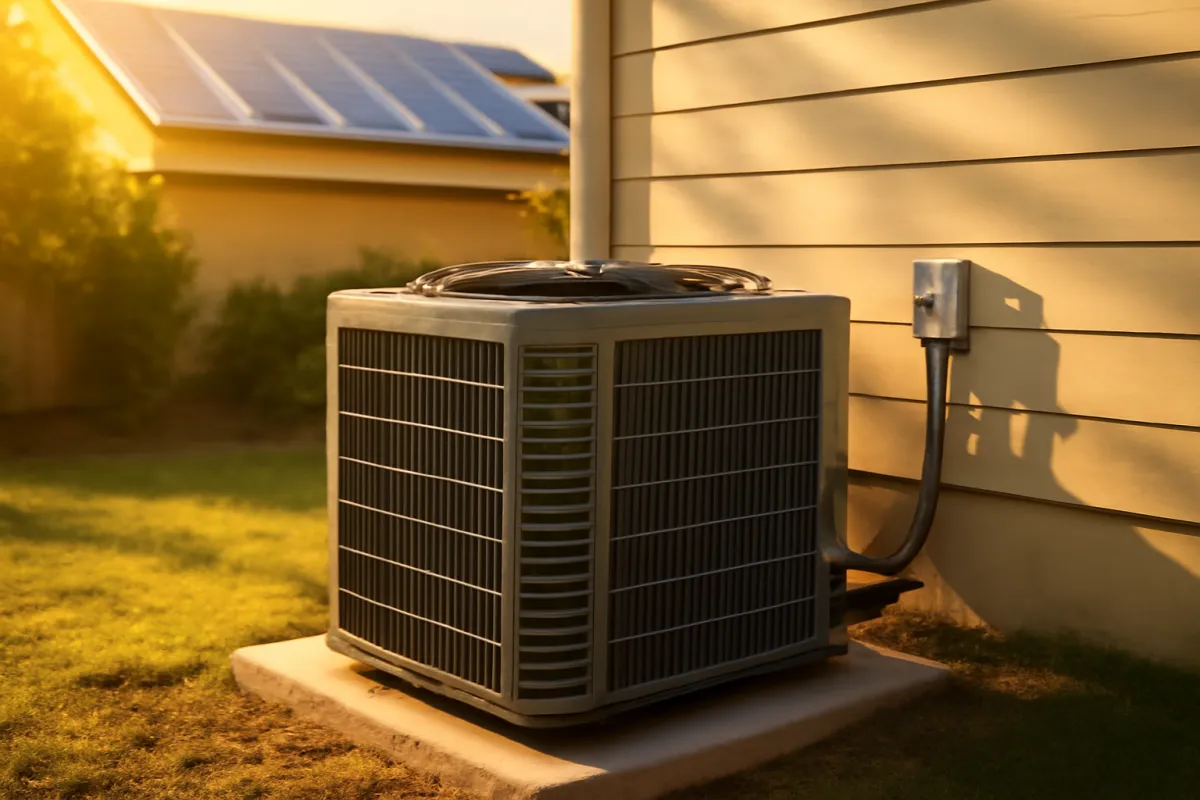
Those panels are additional to everything else your home uses, so a full array that also runs central air is much larger than one sized for lights and plugs. This is where the air-conditioner question folds back into whole-house sizing: add the cooling energy to your annual usage and re-run the panel-count briefing. The exact number swings hard with your climate, insulation, ductwork, and thermostat, so treat 16 to 25 as a shape, not a quote, and confirm your own daily kilowatt-hours from a summer utility bill.
The startup surge and why AC needs extra capacity
Air conditioners hide a spike that the running-watts number does not show. When the compressor motor starts, it briefly demands two to three times its running wattage for a fraction of a second, the inrush needed to overcome inertia and get the motor turning. A 1,000 watt window unit can surge past 2,500 watts on start; a central system running at 3,500 watts can spike toward 10,000. The grid absorbs this without complaint, which is why grid-tied owners never notice it. Off-grid, it is a design constraint you cannot ignore.
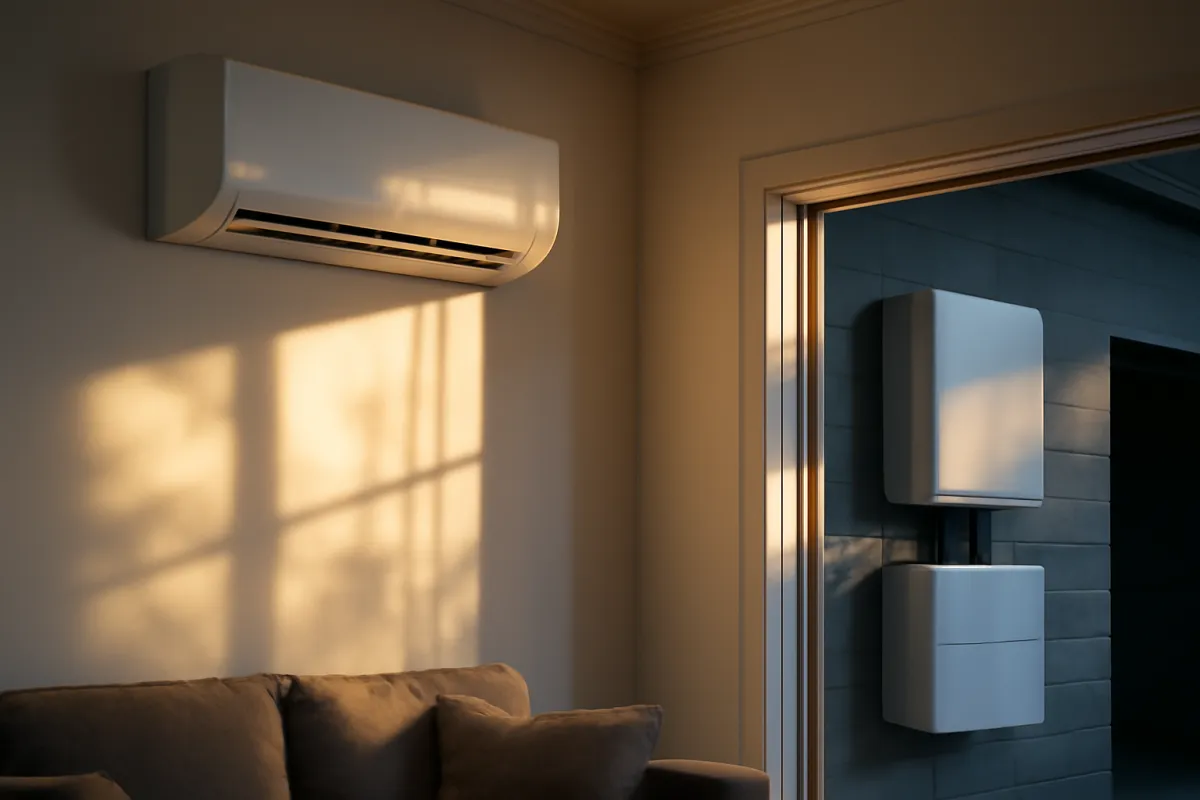
The surge sets the minimum size of your inverter and, on an off-grid system, stresses the battery’s output rating. Undersize either one and the compressor either refuses to start or trips the system every time it cycles. The common fixes are to oversize the inverter’s surge rating with headroom, or to fit a soft-start device on the compressor. A soft start ramps the motor up gradually, cutting the inrush dramatically, which can let a smaller inverter and a smaller battery run the same air conditioner. On off-grid and RV systems especially, a soft start is often the cheapest way to make cooling feasible.
Do you need batteries to run AC on solar
For daytime cooling on a grid-tied system, usually not. The panels make their peak power on sunny afternoons, which is exactly when the air conditioner works hardest, so production and demand line up naturally, and the grid covers any shortfall from clouds or startup. In that common case the panels run the air conditioner without a battery in the loop at all. You add storage when you want cooling the panels alone cannot supply.
You need a battery to run the air conditioner after dark, through a multi-day cloudy stretch, during a grid outage, or entirely off-grid. Cooling is a heavy, sustained load, so a battery bank sized to run air conditioning overnight is large and expensive, which is why off-grid cooling drives storage budgets so hard. Our briefing on whether solar batteries are worth it works through the economics, and the off-grid solar cost briefing shows how much a bank sized for real overnight loads adds. A frequent compromise is to cool hard during solar hours, pre-chill the house, then ease the thermostat back after sunset so the battery does less work.
Grid-tied vs off-grid ways to run AC
The two ways of running air conditioning on solar are so different that they almost deserve separate names. A grid-tied system treats the utility as an infinite, free battery: on a sunny day the panels can even push surplus back to the grid, and at night the home draws normal power, cooling and all. Sizing here is about energy over the year, not about surviving any single moment, because the grid smooths every gap. This is the setup most homeowners have, and running air conditioning on it is undramatic.
Off-grid is a closed system with no safety net, and cooling is the hardest load to serve there. Every kilowatt-hour the air conditioner uses at night has to come from a battery the panels charged during the day, and every compressor start has to be met by the inverter and battery alone. That is why off-grid cooling needs generous panels, a large bank, and often a backup generator for heat waves, all detailed in the off-grid solar cost briefing. If your goal is simply to lower a summer power bill, grid-tied is far cheaper; off-grid cooling is a lifestyle and a budget of its own.
Sizing the inverter for an air conditioner
The inverter is the piece that turns your panels’ or battery’s direct current into the alternating current the compressor needs, and it has to satisfy two ratings at once. Its continuous rating must exceed the air conditioner’s running watts with margin for everything else running at the same time. Its surge or peak rating must exceed the startup spike, which as noted can be two to three times the running figure. Miss either and the compressor will not start reliably.
Practically, a single window unit at 1,000 running watts surging to 2,500 wants an inverter comfortably above that surge, and larger central systems commonly call for a 6,000 watt or bigger inverter, sometimes more. A soft-start device changes this calculation by cutting the inrush, which can drop the required inverter size a full tier and shrink an off-grid battery too. On a grid-tied string or microinverter system the utility handles the surge, so inverter sizing follows the panels rather than the air conditioner. It is the battery-based and off-grid setups where inverter and surge sizing become the make-or-break decision.
How sun hours by region change the count
The same air conditioner needs a different number of panels in different places, because sun hours sit in the denominator of the formula. Peak sun hours measure how many hours a day your location delivers the equivalent of full-strength sunlight, and they range from around 5.5 to 6 in the sunny southwest, near 4 to 4.5 across much of the country, and down toward 3.5 in cloudy northern regions. Fewer sun hours means each panel makes less, so you need more of them to run the same compressor.
Run the window unit from earlier, using 7.2 kilowatt-hours a day, through two regions. At 5.5 sun hours a 400 watt panel makes about 1.87 kilowatt-hours a day, so the unit needs about 4 panels. At 3.8 sun hours the same panel makes about 1.29 kilowatt-hours, and the count rises to 6. Same air conditioner, same hours, decided by geography. This is also why hotter, sunnier regions get a partial break: the places that need the most cooling often have the most sun to run it, so production and demand rise together. Pick your sun band in the calculator to see your own count.
Illustrative panel counts by AC type
Putting the types side by side shows how wide the range really is. These counts assume 400 watt panels, average 4.5 sun hours, a 0.85 derate, and typical daily run hours for each type, and they cover only the air conditioner, not the rest of the home. Your own model, climate, and thermostat habits will move them, but the shape holds: window and portable units are light loads, central systems are heavy ones.
Illustrative panels needed by air conditioner type
At 400 W panels, 4.5 sun hours, 0.85 derate, typical daily run hours. Cooling load only, not the whole home.
Bar widths track panel counts against the 25-panel large-central reference (3, 6, 7, 16, and 25 of 25). A central air conditioner can need five to eight times the panels of a window unit, which is why the type of cooling drives the array size more than anything else.
What a solar setup to run AC actually costs
Panels are only one line in the bill for a setup that runs air conditioning, especially if you want night or off-grid cooling. On a grid-tied system that cools only during solar hours, the cost is essentially the incremental panels, which you can price per watt with our solar cost briefing. Add batteries for evening or off-grid cooling and the picture shifts, because storage large enough for a heavy overnight load is the most expensive component in the stack.
Where the budget goes in an off-grid solar-AC setup
Illustrative share of hardware cost for a battery-backed system that runs air conditioning. Sums to 100%.
On a battery-backed setup for cooling, the battery bank is the tallest bar, which is why grid-tied daytime cooling is so much cheaper than off-grid. A grid-tied array with no battery would drop the biggest slice out of this stack entirely.
For a grid-tied setup with favorable net metering, running the air conditioner during sunny hours can be close to free once the panels are paid off, since cooling peaks when production peaks. The battery-heavy off-grid version is a different budget, detailed in the off-grid cost briefing. Decide which setup you are pricing before you compare numbers, and run your bill through the calculator.
Efficiency tips that cut the panel count
The cheapest panel is the one you never have to install, so trimming the cooling load lowers the count directly. The single biggest lever is the air conditioner itself. An inverter-driven mini-split modulates its compressor speed instead of cycling fully on and off, and it commonly delivers far more cooling per kilowatt-hour than an old window shaker or a single-hose portable. Swapping a tired, inefficient unit for a high-efficiency mini-split can cut the energy, and therefore the panels, for the same comfort.
The rest is about not wasting the cooling you make. Better attic insulation, sealed ducts, weatherstripping, and shading west-facing windows all reduce how hard the compressor has to work, which shrinks the daily kilowatt-hours in the formula. A programmable thermostat that pre-cools during peak solar and eases back after sunset shifts load onto the panels and off any battery. Even keeping the condenser coils clean and the air filter fresh helps. Every kilowatt-hour you design out of the cooling load is one you never have to size panels, inverter, or battery to supply.
A worked example: running a central AC on solar
Take one household all the way through. The Okafor family runs a 3 ton central air conditioner in a warm climate, and a summer utility bill shows the cooling adds about 24 kilowatt-hours on a typical hot day. Their panels are 400 watts and their region averages 4.5 peak sun hours, so one panel makes about 1.53 kilowatt-hours a day. The cooling count is 24 divided by 1.53, which is 15.7, rounding up to 16 panels dedicated to air conditioning.
Those 16 panels are on top of the rest of the home. The Okafors already use about 18 kilowatt-hours a day for everything else, which needs roughly 12 more panels, so the full array to cover the house including central cooling is around 28 panels, an 11.2 kilowatt system. They stay grid-tied, so no battery is required for normal summer cooling: the panels carry the compressor through sunny afternoons and the grid handles nights and clouds. To price that array they use the solar cost briefing, and to sanity-check the whole-house count they re-run the panel-count briefing. Change any input and the calculator moves the numbers live.
Common mistakes sizing solar for AC
The same errors trip up most people trying to run air conditioning on solar, and each is avoidable.
- Using peak running watts as if the unit ran flat out all day. Air conditioners cycle, so daily energy is lower than running watts times 24; size to realistic run hours.
- Ignoring the startup surge. The compressor’s inrush can be two to three times its running watts, and skipping it undersizes off-grid inverters and batteries.
- Sizing only for the air conditioner. The cooling panels are additional to your home’s other usage; a whole-house array has to cover both.
- Assuming you need a battery for daytime cooling. On a grid-tied system, sunny-hour cooling usually needs no storage at all.
- Forgetting sun hours. The same unit needs more panels in a cloudy region than a sunny one, so use your local sun band, not a national average.
- Overlooking efficiency. A single-hose portable or an old window unit can need far more panels than an inverter mini-split of the same cooling capacity.
- Confusing tons and watts. A ton is a unit of cooling capacity, not power draw; pull real running watts or amps off the nameplate before you size anything.
Avoid these and the count you land on will match the cooling you actually run, on the array you actually build.
Running watts versus starting watts
Two wattage numbers describe every air conditioner, and confusing them is the most common sizing error. Running watts, sometimes shown on the nameplate as rated load amps, is what the compressor draws steadily once it is turning. Starting watts, tied to the locked-rotor amps figure, is the brief spike the motor pulls at the instant it kicks on, before it is up to speed. The first sets your daily energy and your panel count; the second sets your inverter and battery output.
The gap between them is large. A compressor motor can demand two to three times its running watts for a fraction of a second at startup, so a unit that runs at 1,000 watts might momentarily pull 2,500 or more. That spike does no meaningful work and adds almost nothing to daily kilowatt-hours, which is why you never size panels to it. You size panels to the running figure times the hours the compressor actually turns.
Where the starting figure bites is the equipment that has to deliver that instantaneous current: the inverter and, off-grid, the battery. Read both numbers off the nameplate if you can. If it lists only amps, multiply by the voltage to get watts, and look for a locked-rotor or LRA rating to gauge the surge. Getting these two numbers straight keeps you from the twin mistakes of oversizing the array to a spike that barely uses energy, and undersizing the inverter to a running figure that ignores the spike entirely.
Sizing a battery for overnight AC cooling
Running an air conditioner after dark means the battery, not the panels, carries it, and cooling is a heavy enough load that the bank sizes up fast. The math mirrors the off-grid autonomy calculation: overnight cooling energy divided by the battery’s usable depth of discharge gives the storage you need for the night.
Work an illustrative case. A midsize window unit drawing about 900 watts runs roughly six hours across a warm night, cycling, so call it four hours of actual compressor time, about 3.6 kilowatt-hours. At a lithium bank’s 0.8 usable depth, that needs about 4.5 kilowatt-hours of storage for the cooling alone, on top of whatever else runs overnight. A central system is far heavier: 3,500 running watts over four hours of real run time is 14 kilowatt-hours, needing roughly 17.5 kilowatt-hours of usable storage just to cool through one night.
That is why overnight and off-grid cooling drive storage budgets so hard, and why the off-grid cost briefing treats air conditioning as the load that breaks a small bank. The battery also has to deliver the compressor’s startup surge, so its output rating, not only its capacity, has to clear the spike. If you only need occasional evening cooling, a modest battery paired with pre-chilling the house at sunset does the job. If you want true overnight central air off-grid, size the bank deliberately and expect it to be the costliest part, exactly as our battery economics briefing frames storage generally.
Pre-cooling and thermal mass to shift the load
The cheapest way to run air conditioning after sunset is often to do most of the cooling before it, using the house itself as a battery. Pre-cooling means running the compressor hard during peak solar hours, dropping the indoor temperature a few degrees below your evening target while the panels are supplying the power directly, then easing the thermostat back once the sun drops.
The building’s thermal mass, the walls, floors, and furnishings, holds that coolness and releases it slowly, so the house coasts through the early evening with the compressor barely running. On a grid-tied system this shifts cooling onto free solar production and off the priciest evening grid hours. Off-grid, it shifts the load onto the panels and off the battery, which is the same as shrinking the bank you have to buy.
The effect is bigger in a well-insulated, well-sealed home, because a leaky house sheds its stored coolness quickly. That ties pre-cooling to the efficiency moves this briefing already covers: insulation, sealed ducts, and shaded windows all lengthen how long the house holds its charge. A programmable or smart thermostat automates the pattern, pre-cooling on a schedule that tracks your solar production. None of this changes the panel count for daytime cooling, but it can meaningfully cut the battery you need for comfort after dark, which is where the real money sits.
Humidity, run time, and why energy use varies
Two homes with identical air conditioners in identical climates can still burn different kilowatt-hours cooling, because how long the compressor runs depends on more than the outdoor temperature. Humidity is the quiet driver. An air conditioner does two jobs at once: it lowers the air temperature (sensible cooling) and it wrings moisture out of the air (latent cooling), and pulling water out of humid air takes real energy.
In a muggy climate the compressor runs longer to hit the same thermostat setting, because it is dehumidifying as well as cooling, so the daily kilowatt-hours, and the panel count, run higher than a dry-climate home with the same unit. This is why the illustrative daily-energy figures in this briefing are a shape rather than a promise: your climate’s humidity, your insulation, your ductwork, and your thermostat habits all move the real number.
The practical takeaway is to size from your own summer energy, not a generic band. Pull a hot-month utility bill, find the kilowatt-hours above your shoulder-season baseline, and that difference is roughly what cooling costs you per month. Divide by the days and you have a real daily cooling figure to feed the formula, far better than any table. A unit that seems small on paper can need more panels than expected in a humid region simply because it never gets to rest.
The bottom line
How many solar panels to run an air conditioner is a formula, not a fixed number: take the unit’s running watts times its daily hours, divide by what one panel makes in a day, and round up. Illustratively that is about 3 to 4 panels for a small window unit, 6 or 7 for a larger window or portable one, and 16 to 25 for a central system, all on top of whatever the rest of your home uses. Your sun hours, panel wattage, and the efficiency of the unit move every one of those figures.
Match the setup to the goal. Daytime cooling on a grid-tied system rarely needs a battery and can be close to free once the panels are paid off, because cooling peaks when the sun does. Night, cloudy, outage, or off-grid cooling needs storage, and a battery bank sized for a heavy overnight cooling load is the expensive part, as the off-grid cost briefing and our note on whether batteries are worth it both show. Size the whole array with the panel-count briefing, price it with the solar cost briefing, and run your own unit through the calculator so the count fits your cooling, your sky, and your bill.
WattBarn publishes this briefing to help you frame questions for a solar installer and an HVAC professional, not to replace either one. The wattages, run hours, panel counts, sun hours, and dollar references above are illustrative examples chosen to teach the sizing method, not measurements of your equipment, and your real air conditioner, climate, insulation, and utility rules will produce different numbers that shift with the weather and over time. Air conditioning on solar involves high-current electrical work and refrigerant-charged equipment with genuine safety and code stakes, so let a licensed installer’s load calculation, surge assessment, and written estimate, not our sketches, decide the panels, inverter, and any battery you actually buy.
Frequently asked questions
How many solar panels does it take to run an air conditioner?
It depends almost entirely on the air conditioner's wattage and your local sun hours, so there is no single number. As an illustrative sketch at 400 watt panels and average sun, a small window unit might need around 3 to 4 panels, a midsize window unit about 6, a portable unit about 7, and a central air conditioner anywhere from 16 for a modest 3 ton system to 25 for a large 5 ton one. The method is the same in every case: take the air conditioner's running watts times the hours it runs each day, then divide by what one panel makes in a day. Run your own unit through our calculator to see the count for your model.
Can solar panels run an air conditioner directly?
Yes, solar panels can run an air conditioner, but rarely in a direct wire-to-compressor sense. In a normal grid-tied home the panels feed the inverter, the inverter feeds your main panel, and the air conditioner draws from that shared supply just like any other appliance, with the grid smoothing out clouds and startup surges. A pure off-grid setup can run an air conditioner too, but it needs a battery and a large enough inverter to handle both the steady running load and the brief startup spike. Running a compressor straight off raw panel output without storage or the grid is unstable, because a passing cloud would stall it.
How many watts does an air conditioner use?
Running wattage varies widely by type and size. A small window unit commonly draws roughly 500 to 900 watts, a larger window or portable unit around 1,000 to 1,500 watts, and a central air conditioner about 2,000 to 5,000 watts while the compressor runs, with the largest whole-home systems higher still. Those are running figures, and the startup surge can be two to three times higher for a fraction of a second when the compressor kicks on. Check the nameplate on your specific unit or its amperage rating, because a real model can sit well above or below these illustrative bands.
Do you need batteries to run an air conditioner on solar?
For daytime cooling on a grid-tied system you usually do not need a battery, because the panels make their most power during the same sunny hours the air conditioner works hardest, and the grid covers any shortfall. You need a battery when you want to run the air conditioner after dark, through a cloudy stretch, during an outage, or entirely off-grid, since panels make nothing at night. A cooling load is heavy, so an off-grid battery bank sized to run air conditioning overnight is large and expensive, which is covered in our off-grid cost briefing. Many owners compromise by cooling hard during solar hours and easing off after sunset.
How many solar panels do I need to run a central air conditioner?
A central air conditioner is the most demanding case. Illustratively, a 3 ton system that consumes roughly 24 kilowatt-hours on a hot day would need about 16 panels at 400 watts and average sun to cover just the cooling, while a large 5 ton system burning near 38 kilowatt-hours could need around 25. Those panels are on top of whatever the rest of your home uses, so a whole-home array that also runs central air is considerably larger than one sized for lights and plugs alone. Because the compressor cycles rather than running flat out, real daily energy depends on your climate, insulation, and thermostat habits.
How many solar panels to run a window AC unit?
A window air conditioner is the friendliest case for solar, because its load is modest. Illustratively, a small 500 to 700 watt window unit running about eight hours a day uses roughly 4 to 6 kilowatt-hours, which is about 3 to 4 panels at 400 watts and average sun. A larger 1,000 to 1,200 watt window unit running the same hours pushes the count toward 6 or 7 panels. If you run the unit only during peak afternoon sun on a grid-tied system, the panels often cover it directly without any battery, which is why window-unit cooling pairs so naturally with a modest rooftop array.
What size inverter do I need to run an air conditioner on solar?
The inverter has to handle two things: the steady running watts and the brief startup surge when the compressor spins up. A rough rule is to size the inverter's continuous rating above the running load and its surge rating above the startup spike, which can be two to three times the running figure. A 1,000 watt window unit that surges to around 2,500 watts wants an inverter comfortably rated past that surge, while a central system may need a 6,000 watt or larger inverter or a soft-start device to tame the spike. A soft start reduces the surge and can let a smaller inverter or battery run the same compressor.
Is it cheaper to run AC on solar than from the grid?
Over the life of the system, solar can lower the cost of running air conditioning, because cooling demand peaks on sunny afternoons exactly when panels produce most, and in many areas those are the priciest grid hours. The catch is the up-front cost of the panels, and, if you want night or off-grid cooling, a battery. On a grid-tied array with favorable net metering, daytime cooling is often close to free once the system is paid off. Add batteries for off-grid air conditioning and the economics change sharply, since storage for a heavy overnight cooling load is expensive. Price your own case with our solar cost briefing and calculator before deciding.