
What's on this page
- The formula that gives you a panel count
- Start with your kilowatt-hours, not your roof
- What a modern panel actually produces
- Sun hours: why the same house needs different counts
- The offset goal: 100 percent or partial
- System size in kilowatts vs panel count
- How many panels fit on your roof
- Orientation and the south-facing premium
- Shading and efficiency losses
- Illustrative panel counts for small, average, and large homes
- The derate factor, explained
- Oversizing vs net-metering caps
- Adding panels to charge a battery
- Microinverters vs string inverters
- Future-proofing for an EV or heat pump
- Degradation: panels get weaker with age
- What determines your panel count
- A worked example: one 11,000 kWh home
- Common sizing mistakes
- Tilt, azimuth, and seasonal production
- A second worked example: a low-use home in a cloudy region
- Ground mounts when the roof falls short
- The bottom line
Short answer: The panel count is a formula: annual kilowatt-hours divided by (panel watts times daily peak sun hours times 365 times a derate near 0.85). A 400 watt panel at 4.5 sun hours makes roughly 560 kilowatt-hours a year, so an 11,000 kilowatt-hour home needs about 20 panels; illustratively, a 6,000 kWh home needs about 11 and an 18,000 kWh home about 33. Use your bill's annual kilowatt-hours, not square footage.
Ask five installers how many solar panels your house needs and you can get five different numbers, because most of them are guessing from your square footage or your bill without showing the arithmetic. The honest answer is not a fixed number that comes with the house. It is the output of one short formula that takes three inputs you can find in a few minutes: how much electricity you use in a year, how much sun your location gets, and how much of your bill you want to erase. This briefing is that formula, worked all the way through, with the roof-space limits and the real-world losses that move the count in practice.
We will start with the sizing equation and where each input comes from, size a modern panel at an illustrative 400 watts, show why the same house needs a different count in Phoenix than in Portland, and settle the 100 percent versus partial offset decision honestly. Then we tie the panel count to the solar cost briefing so you can price it, and to the battery-count briefing if storage is in your picture. Before you finish, drop your own usage into our savings calculator, because the count is downstream of numbers only you have.
Key takeaways
- The count is a formula: annual kilowatt-hours divided by (panel watts times daily sun hours times 365 times a derate near 0.85) gives panels needed.
- Your annual kilowatt-hours come straight off your utility bill, and they matter far more than your square footage.
- The same house needs different panel counts in different regions, because peak sun hours can nearly double from the cloudy north to the sunny southwest.
- Illustratively, a small home near 6,000 kWh might need about 11 panels, an average 11,000 kWh home about 20, and a large 18,000 kWh home about 33.
- Roof space, orientation, and shading cap how many panels physically fit, so a full offset is not always possible on a small or cut-up roof.
The formula that gives you a panel count
Every credible panel count comes from the same equation, and it is worth writing once so the rest of this briefing is just the inputs. Panels needed equals your annual electricity use in kilowatt-hours, divided by the annual production of a single panel. The production of one panel is its wattage in kilowatts, times your daily peak sun hours, times 365 days, times a derate factor near 0.85 that accounts for real-world losses. Put together: panels equal annual kilowatt-hours divided by (panel watts over 1,000, times sun hours, times 365, times derate).
That is the whole method, and everything else is finding honest numbers to feed it. A 400 watt panel at 4.5 sun hours produces about 0.4 times 4.5 times 365 times 0.85, which is roughly 560 kilowatt-hours a year. Divide your annual usage by that per-panel figure and round up, because you cannot install a fraction of a panel. An 11,000 kilowatt-hour home divided by 560 lands near 20 panels. Our calculator runs this exact division live, so you can watch the count move as you change any input.
Start with your kilowatt-hours, not your roof
The single most common sizing mistake is starting with the roof and asking how many panels fit, when the right starting point is your energy use. Your annual kilowatt-hours are printed on your utility bill, and they are the anchor for the entire calculation. Most bills show the kilowatt-hours you used that month, and many show a rolling twelve-month total or a graph of the past year. Add up twelve months, or take a typical month and multiply by twelve, and you have the number the formula needs.
Why not square footage? Because floor area barely predicts electricity use. A 1,500 square foot home with electric heat, an electric water heater, and an EV can burn more kilowatt-hours than a 3,000 square foot home on gas heat with efficient appliances. Habits, climate, and what you plug in drive usage far more than walls do. If you only have a single month’s bill, be careful: summer air conditioning or winter electric heat can make one month wildly unrepresentative, so a full year is always better. Get the annual kilowatt-hours honest and the panel count follows.

What a modern panel actually produces
To turn energy use into a count, pin down what one panel is. A modern residential panel commonly falls in the range of roughly 390 to 440 watts, and we use 400 watts throughout this briefing as a clean illustrative figure. Wattage is the panel’s rating under standard test conditions, essentially its output at full, clean, cool midday sun. You will rarely see that exact number in the field, which is why the formula applies a derate: real panels run hot, get dusty, and lose a little to wiring and the inverter.
The wattage of panels has climbed steadily. A decade ago a typical residential panel was closer to 250 watts, so the same roof holds far more capacity today than it used to, and older online rules of thumb undercount modern arrays. Because panels come in a fairly tight physical size, higher wattage mostly means higher efficiency: more watts squeezed out of the same rectangle. That matters when roof space is tight, a point we return to below. For the math here, hold 400 watts as the unit and remember that a higher-wattage panel simply lowers the count for the same production.
Sun hours: why the same house needs different counts
Here is why an identical house needs a different panel count in different places. Peak sun hours measure how many hours per day your location delivers the equivalent of full-strength sunlight, and they vary enormously by region and season. The sunny southwest can average around 5.5 to 6 peak sun hours, much of the country sits near 4 to 4.5, and cloudy northern regions can drop toward 3.5. Because sun hours sit in the denominator of the formula, fewer of them means each panel produces less and you need more panels to hit the same target.
Run the same 11,000 kilowatt-hour home through two regions and watch it move. At 5.5 sun hours a 400 watt panel makes about 680 kilowatt-hours a year, so the home needs roughly 16 panels. At 3.8 sun hours the same panel makes about 470 kilowatt-hours, and the home needs closer to 24. Same house, same appliances, eight panels apart, decided entirely by geography. This is why national averages are only a starting point, and why our calculator asks you to pick your sun band rather than assuming one.
The offset goal: 100 percent or partial
The third input is a choice, not a measurement: how much of your electricity do you want the panels to cover? Sizing for a full 100 percent offset means the array is built to produce, across a typical year, as many kilowatt-hours as you consume, so your net energy charges trend toward zero. It is the most satisfying target and the most expensive up front, and it demands the most roof. Many buyers assume it is the only option, but it is simply the top of a range.
A partial offset, commonly 70 to 85 percent, sizes a smaller, cheaper array that erases most of your bill while leaving a modest residual. This often captures the best value per panel, because the last chunk of offset can run into diminishing returns, tight roof space, or net-metering rules that pay little for exported surplus. Sizing the offset goal is where budget, roof, and utility policy meet. Slide the offset target in our calculator and the panel count moves with it, which is the fastest way to see the trade between coverage and cost.
System size in kilowatts vs panel count
Two numbers describe the same array, and it helps to keep them straight. Panel count is how many physical panels you install. System size, quoted in kilowatts, is the total wattage of those panels added up and divided by 1,000. Twenty 400 watt panels make an 8 kilowatt system, because 20 times 400 is 8,000 watts. Installers and quotes usually lead with the kilowatt figure, while homeowners tend to think in panels, so translating between them prevents confusion.
The reason both exist is that kilowatts let you compare systems built from different panel wattages on equal footing. A 7.6 kilowatt system might be 19 panels at 400 watts or 18 panels at 422 watts; the kilowatts are nearly the same, the panel counts differ. When you read the solar cost briefing, prices are quoted per watt precisely because it normalizes across panel sizes. So size your array in kilowatts from the formula, then divide by your panel wattage to get the count you will actually see on the roof.

How many panels fit on your roof
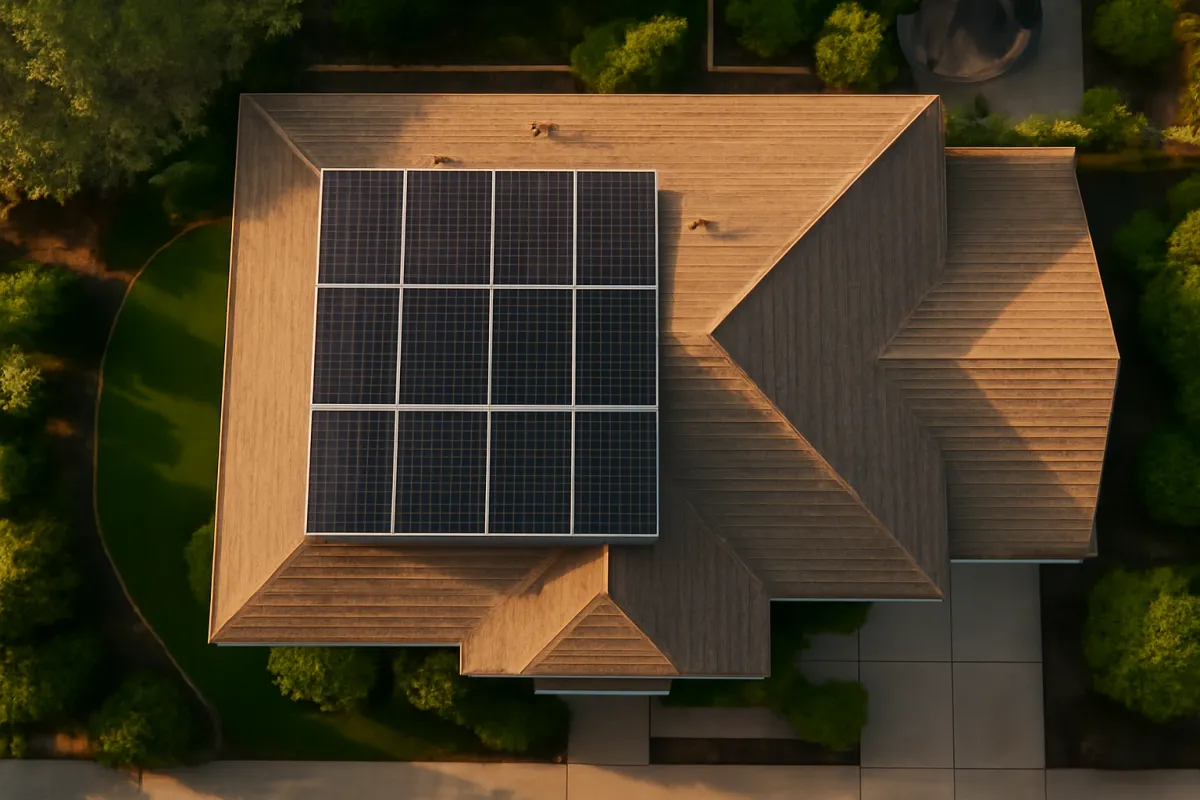
Once the formula gives you a target count, the roof gets a vote, and this is where “how many can I fit” becomes the binding question. Each modern residential panel occupies roughly 18 square feet once you include the frame and the small gaps between rows. So 20 panels need on the order of 360 square feet of usable roof, and a 30 panel array closer to 540. That sounds modest against a typical roof, but usable area is always smaller than total area.
Real roofs surrender space to plumbing vents, chimneys, skylights, dormers, and the fire-code setbacks that keep panels a required distance from ridges and edges. A complex roof with many small planes fits far fewer panels than one big rectangle of the same total area. If your target count does not fit, you have three honest moves: switch to higher-wattage panels to get more production from the same footprint, accept a partial offset, or add a ground-mount array if you have yard space. Measure your usable planes before you fall in love with a full-offset number.
Orientation and the south-facing premium
Not all roof space is equal, because the direction a plane faces changes how much each panel produces. In the northern hemisphere a south-facing roof is the premium real estate, capturing the most sun across the day and the year. East and west faces are still productive, commonly giving up something like 10 to 20 percent versus south, with east favoring morning production and west favoring the afternoon peak that many utilities now value most. North-facing planes are the weakest and are usually skipped unless nothing else is available.
This matters for your count because panels on a less-ideal orientation produce less, which effectively raises the number you need to hit a target. If half your usable roof faces south and half faces east, the east panels each pull a little less weight, and the array has to be slightly larger than a purely south-facing one would be. A good installer models each plane separately rather than treating the whole roof as one surface. Tilt matters too, though most residential roofs are close enough to ideal that orientation, not pitch, is the bigger lever.
Shading and efficiency losses
Shade is the variable that quietly wrecks more sizing estimates than any other, because a shaded panel produces far below its rating exactly when you are counting on it. A tree that clips the array for two hours each afternoon, a neighbor’s roofline, a chimney, or even a single plumbing vent can each carve into production. Crucially, in older wiring a shaded panel could drag down every other panel wired in the same string, so one bad shadow cost far more than one panel’s worth of output.
Modern hardware softens this. Microinverters and power optimizers let each panel operate independently, so a shaded panel only loses its own share rather than the whole string’s. That does not make shade free, but it limits the damage. When shading is heavy and permanent, the honest options are trimming or removing trees, relocating the array to a clearer plane, or sizing for a partial offset and accepting the shortfall. The derate factor in the formula bakes in ordinary losses, but severe site shading needs a real per-panel shade study, which a quality installer provides.
Illustrative panel counts for small, average, and large homes
To make the formula concrete, here are three illustrative homes at an average 4.5 sun hours, 400 watt panels, and a full offset. A low-use home around 6,000 kilowatt-hours a year needs roughly 11 panels. An average home near 11,000 kilowatt-hours, close to the rough national mean, needs about 20 panels. A large, all-electric home past 18,000 kilowatt-hours can need around 33 panels. These are sketches, not quotes, and your sun hours and offset goal will move them, but the shape is reliable: usage drives the count almost linearly.
Panels needed by home energy use
Illustrative counts at 400 W panels, 4.5 sun hours, 0.85 derate, full offset. Your sun and offset goal move these.
Bar widths track panel counts against the 33-panel large-home reference (11 of 33, 20 of 33, 33 of 33). Tie these counts to installed price with our solar cost briefing: more panels means a bigger kilowatt system and a proportionally larger bill.
The derate factor, explained
The derate factor is the least intuitive part of the formula, so it earns its own section. It is a single multiplier, commonly around 0.80 to 0.85, that shrinks a panel’s ideal lab output down to what it really delivers on a roof over a year. Panels are rated under standard test conditions: bright, cool, clean, and perfectly aimed. The real world is none of those things for most of the day, so the derate collects all the ordinary losses into one honest haircut.
What goes into it? Panels run hotter than the test temperature and lose a bit of output when hot. A little energy is lost in the wiring and again when the inverter converts direct current to the alternating current your house uses. Dust, pollen, and snow shade the glass at times. Panels are rarely aimed at the perfect angle. None of these is large alone, but together they typically pull real production 15 to 20 percent below the lab number, which is exactly the 0.80 to 0.85 the formula uses. Skip the derate and you undercount your panels, a classic optimistic error.
Oversizing vs net-metering caps
It is tempting to add a few extra panels for safety, but oversizing runs into a rule that can make those panels earn little: net metering. Net metering is the arrangement that credits you for surplus energy your panels export to the grid, and its generosity varies enormously by utility. Under full retail net metering, an oversized array’s surplus is credited at the same rate you pay, so extra production still has value. Under the newer, stingier arrangements spreading in many areas, exports are credited at a low wholesale-style rate, so surplus is worth far less.
Some utilities also cap system size relative to your historical usage, refusing to interconnect an array built well past what you consume. The practical takeaway: size to your actual usage plus modest, justified growth, not to a fantasy of covering the whole roof. If your utility pays little for exports, every panel beyond your own consumption earns pennies, which is a poor return on real hardware. Check your utility’s current net-metering terms before you size up, because that policy quietly decides whether the last few panels are worth installing.
Adding panels to charge a battery
A frequent question is whether adding a home battery means adding panels, and the answer is usually no, which surprises people. A battery does not consume energy of its own; it stores energy your panels already make and hands it back later. If your array is sized for a full offset, it typically produces a daytime surplus that would otherwise export to the grid, and a battery simply captures that surplus for evening or outage use instead. In that common case the existing panel count is enough.
You would only add panels if you want to store meaningfully more than your array currently spills, for instance to carry a disciplined load across a multi-day outage on daily solar recharge. Then the panels have to generate the extra energy the battery banks each day. The clean way to think about it: size the panels to your annual usage with this formula first, then size the battery to what you want to hold, as our battery-count briefing works through step by step. The two decisions are linked but separate, and conflating them oversizes both.
Microinverters vs string inverters
The inverter choice does not change your panel count directly, but it changes how much each panel is worth on a real roof, so it belongs in a sizing discussion. A string inverter wires panels together in series and converts the whole string’s output at once, which is simple and cost-effective on a clean, unshaded, single-orientation roof. Its weakness is that the string tends to perform to its weakest panel, so shade or a bad orientation on one panel drags on the rest.
Microinverters, and their cousins the power optimizers, put electronics on each panel so every one operates independently. On a shaded, multi-plane, or complex roof, that independence recovers production a string would lose, which can mean fewer panels needed to hit the same target. The trade is cost and more components on the roof. For a simple south-facing roof, a string inverter is often the value pick; for a cut-up or partly shaded roof, per-panel electronics frequently pay for themselves. Either way, tell your installer to model production with the hardware you actually plan to buy.
Future-proofing for an EV or heat pump
Sizing to today’s bill can undersize you for tomorrow’s, because the big electrification decisions add load fast. An electric vehicle commonly adds roughly 3,000 to 4,000 kilowatt-hours a year for an average driver, which alone can mean five to eight extra panels. Swapping a gas furnace for an electric heat pump, or a gas water heater for a heat-pump water heater, adds more. If any of these is likely within a few years, sizing the array only to your current usage means a smaller-than-ideal system and a possible second install later.
The counterweight is net-metering caps and up-front cost: you do not want to build a huge array for loads that may never arrive. The balanced move is to add the load you can genuinely foresee, an EV you plan to buy, a heat pump already on the calendar, rather than every hypothetical. Because panels are cheaper to add during the original install than as a later expansion, a modest amount of deliberate future-proofing is usually cheaper per watt than retrofitting. Estimate the new annual kilowatt-hours, add them to your usage, and re-run the formula.
Degradation: panels get weaker with age
Panels do not produce the same amount forever, and honest sizing accounts for the slow fade. Solar panels degrade gradually, commonly losing something like 0.4 to 0.5 percent of their output per year, so a panel might produce around 88 to 90 percent of its original rating after 25 years. This is why manufacturers offer production warranties that guarantee a minimum output decades out, rather than promising the panel never weakens.
For sizing, the effect is modest but real: the array that just covers your usage in year one will fall slightly short in year twenty as both the panels age and, often, your usage creeps up. Some buyers add a small margin for this, sizing perhaps a few percent above today’s need so the system still covers most of the bill late in its life. It is not a reason to add many panels, but it is a reason not to size to the razor’s edge of exactly 100 percent in year one. The derate factor handles first-year losses; degradation is the multi-decade version of the same honesty.
What determines your panel count
Step back and the panel count is really the product of four levers, and it helps to see their rough weight. Your energy use is the largest single driver, because it is the numerator of the whole formula. Sun hours come next, capable of swinging the count by a third between regions. The offset goal is a deliberate choice that scales the whole system up or down. Roof limits then cap what is physically possible, sometimes forcing a partial offset even when the math wants more.
What determines your panel count
Illustrative share of the sizing decision for a typical home. Sums to 100%.
Energy use dominates, which is why the utility bill, not the roof, is the right starting point. Sun hours and the offset goal reshape the count from there, and roof limits set the ceiling on what physically fits.
A worked example: one 11,000 kWh home
Take one home all the way through. The Nguyen family uses 11,000 kilowatt-hours a year, close to the rough national average, and lives where the average is 4.5 peak sun hours. They want a full 100 percent offset with standard 400 watt panels. First, per-panel production: 0.4 kilowatts times 4.5 sun hours times 365 days times a 0.85 derate is about 558 kilowatt-hours a year per panel. Then the count: 11,000 divided by 558 is 19.7, which rounds up to 20 panels.
Now translate. Twenty 400 watt panels make an 8 kilowatt system, since 20 times 400 is 8,000 watts. At roughly 18 square feet per panel, they need about 360 square feet of usable, well-oriented roof. The array produces about 20 times 558, or roughly 11,200 kilowatt-hours a year, just clearing their usage as intended. If they later add an EV that draws 3,500 kilowatt-hours, their need climbs past 14,500, pushing the count toward 26 panels and an 10.4 kilowatt system. Same family, one lifestyle change, six more panels. Price that swing with the solar cost briefing, and run your own numbers in the calculator.
Common sizing mistakes
The same handful of errors accounts for most panel-count regret, and every one is avoidable before you sign a contract.
- Sizing by square footage. Floor area barely predicts electricity use; pull annual kilowatt-hours off your bill and size to the energy, not the building.
- Using one month’s bill. A single summer or winter month can be wildly unrepresentative; use a full twelve months to anchor the count.
- Ignoring the derate. Lab wattage is not real-world output; skipping the 0.80 to 0.85 haircut undercounts your panels by roughly a fifth.
- Assuming any roof works. Orientation, shade, and vents cut usable space and per-panel output, so a target count does not always fit.
- Oversizing past net-metering value. If exports pay little, panels beyond your own use earn pennies; size to usage plus justified growth.
- Forgetting future load. An EV or heat pump can add thousands of kilowatt-hours; if either is likely soon, size for it now rather than re-install later.
- Chasing exactly 100 percent in year one. Panels degrade and usage creeps up, so a razor-thin full offset drifts short over the decades.
Avoid these and the count you land on will fit the energy you actually use, on the roof you actually have.
Tilt, azimuth, and seasonal production
The orientation section weighs which direction a roof faces; tilt is the other half of aiming an array, and together the two set how much a panel actually makes. Azimuth is the compass direction the panels face, with south the premium in the northern hemisphere. Tilt is the angle off horizontal, and it shifts production across the seasons more than most homeowners expect.
A steeper tilt favors winter, when the sun sits low in the sky, and a shallower tilt favors summer, when it rides high. A common rule of thumb sets the tilt near your latitude for the best year-round average, but the right angle depends on when you need the energy. A home that uses more power in winter benefits from a steeper array; one dominated by summer air conditioning may prefer a shallower one.
Most residential roofs are already close enough to a workable tilt that you take what the roof gives you, which is why azimuth usually matters more than pitch on a rooftop array. Where tilt becomes a real lever is a ground mount, where you can set the angle deliberately, or a flat commercial-style roof, where panels are racked at a chosen tilt. For sizing, the point is that a panel on a poorly aimed plane produces less, which quietly raises the count you need to hit your target. A good installer models each plane’s tilt and azimuth rather than assuming every panel makes its full share.
A second worked example: a low-use home in a cloudy region
The main worked example runs an average home in average sun; a contrasting case shows how far the count moves when both inputs change. The Alvarez household is careful with energy: gas heat, efficient appliances, no electric vehicle, and about 6,500 kilowatt-hours a year. They live in a cloudy northern region averaging 3.8 peak sun hours, and they want a full offset with 400 watt panels.
Per-panel production first: 0.4 kilowatts times 3.8 sun hours times 365 days times a 0.85 derate is about 472 kilowatt-hours a year per panel. Then the count: 6,500 divided by 472 is 13.8, rounding up to 14 panels. That is a 5.6 kilowatt system, needing roughly 250 square feet of usable roof.
Now see the two forces pulling against each other. Their low usage pushes the count down, but their weak sun pushes it back up: the same 6,500 kilowatt-hours in a 5.5 sun-hour region would need only about 10 panels, four fewer, for identical appliances. Geography costs them four panels here. Had they added an electric heat pump for winter, their usage might climb toward 10,000 kilowatt-hours in the exact season their sun is weakest, a reminder from our note on whether panels work in winter that cold-climate sizing has to respect the darkest months. Run your own usage and sun band through the calculator to see where the two forces leave your count.
Ground mounts when the roof falls short
When the formula asks for more panels than the roof can hold, a ground-mounted array is the usual answer, and it is worth knowing how it changes the sizing picture. A ground mount sits on a rack in the yard rather than on the house, which frees you from the vents, chimneys, and code setbacks that eat into usable roof, so the count is limited by land and budget rather than by roof geometry.
The advantages go beyond space. You can set the tilt and azimuth deliberately, aiming the array for the best production instead of accepting whatever the roof offers, and a ground mount is easy to reach for cleaning and to keep clear of snow, which matters in the cloudy regions where every kilowatt-hour counts. The trade is cost: a ground mount adds its own foundation, racking, and a trench to run wiring back to the house, so it typically costs more per watt than bolting the same panels to an existing roof.
For sizing, the ground mount removes the roof ceiling this briefing keeps flagging, which means a full offset stays on the table even when the roof cannot host it. It also pairs naturally with the future-proofing question: if an electric vehicle or heat pump is coming, land gives you room to grow the array that a full roof does not. Price the extra per-watt cost against a partial offset or premium high-efficiency panels, and let the solar cost briefing frame the comparison.
The bottom line
How many solar panels you need is not a fact about your house; it is the output of one short formula. Take your annual kilowatt-hours off your utility bill, divide by the annual production of one panel (its watts times your sun hours times 365 times a derate near 0.85), and round up. Illustratively that is about 11 panels for a low-use home, 20 for an average 11,000 kilowatt-hour home, and 33 for a large all-electric one, though your sun hours and offset goal move every one of those. System size in kilowatts is just the panels times their wattage, and roof space, orientation, and shade set the ceiling on what physically fits.
Start with the energy, not the roof, respect the derate and the net-metering rules, and add only the future load you can genuinely foresee. Then run your own usage, sun band, panel wattage, and offset goal through our savings calculator to see your count, and read it alongside the solar cost briefing to price it and the battery-count briefing if storage is next, so the number you install is sized to your bill, your sky, and your roof, not to a salesperson’s guess.
WattBarn publishes this briefing to inform your questions for an installer, not to replace one. The panel counts, wattages, sun hours, square-footage figures, and dollar references above are illustrative examples built to teach the formula, not measurements of your home, and your real usage, roof geometry, shading, utility net-metering rules, and local codes will produce different numbers that shift over time. A rooftop solar array is a permitted electrical and structural project, so let a licensed installer’s on-site shade study, roof assessment, and written production estimate, not our sketches, decide the system you actually buy.
Frequently asked questions
How many solar panels do you need to power a house?
There is no single number, because the count follows your electricity use, your local sun, and how much of your bill you want to erase. As an illustrative sketch, a home using around 11,000 kilowatt-hours a year, the rough national average, often lands near 20 modern panels at 400 watts each for a full offset. A low-use home near 6,000 kilowatt-hours might need only 11 or so, while a large all-electric home past 18,000 kilowatt-hours can pass 30. Run your own annual usage, sun hours, and offset goal through the formula and the count falls out as arithmetic rather than a guess.
How many solar panels do I need for a 2,000 square foot home?
Square footage is a weak guide, because two homes of identical size can use wildly different amounts of electricity depending on their heating, cooling, and habits. What actually sets the panel count is annual kilowatt-hours, not floor area. A 2,000 square foot home on gas heat with efficient appliances might use 9,000 kilowatt-hours and need around 16 panels illustratively, while the same size home with electric heat, a hot tub, and an electric vehicle could use double that and need twice as many. Pull your kilowatt-hours off your utility bill first, then size to the energy, not the building.
How many solar panels can I fit on my roof?
As a rough rule, each modern residential panel occupies roughly 18 square feet once you account for the frame and the spacing between rows, so an array of 20 panels needs on the order of 360 square feet of clear, well-oriented roof. Real roofs give up space to vents, chimneys, skylights, and code-required setbacks from the edges, so usable area is always less than total area. South-facing planes are the most valuable, followed by east and west. If your roof cannot hold enough panels for a full offset, a partial offset or a ground mount are the usual answers.
How many kilowatt-hours does one solar panel produce?
A single 400 watt panel produces roughly 500 to 650 kilowatt-hours a year in typical conditions, and the range is driven almost entirely by how much sun your location gets. The rough math is the panel's kilowatts times your daily peak sun hours times 365 days times a real-world derate of about 0.85 for losses. At 4.5 sun hours that works out near 560 kilowatt-hours a year per panel, at 3.8 hours closer to 470, and at 5.5 hours past 680. Those figures are illustrative and drift with weather, shading, and the age of the panel.
How many watts does a solar panel produce?
A modern residential solar panel is commonly rated between roughly 390 and 440 watts, and this briefing uses 400 watts as a clean illustrative figure. That wattage is the panel's output under standard test conditions, essentially full, clean, cool midday sun, so a real roof rarely sees the exact number: heat, dust, wiring, and inverter losses pull actual output a little below the rating, which is why the sizing formula applies a derate near 0.85. A decade ago a typical panel was closer to 250 watts, so the same roof holds far more capacity today, and a higher-wattage panel simply produces more from the same rectangle, which lowers the count you need for a given system size.
Should I size for 100 percent of my bill or less?
That is a real decision, not a default. Sizing for a full 100 percent offset erases the energy portion of your bill in a typical year, but it costs the most up front and can run into net-metering caps or diminishing credit value in some areas. Sizing for a partial offset, say 70 or 80 percent, trims a smaller system's cost and often captures the best value per panel, leaving a modest residual bill. The right target depends on your roof space, your budget, your utility's rules, and whether you expect your usage to grow. Our calculator lets you slide the offset goal and watch the count move.
Do more efficient panels mean I need fewer of them?
Yes, higher-wattage or higher-efficiency panels let you reach the same production with fewer physical panels, which matters most when roof space is tight. A 430 watt panel produces roughly eight percent more than a 400 watt panel of the same size, so a roof that fits 18 panels can host a slightly larger system with premium hardware. The trade is usually price: higher-efficiency panels cost more per panel, so on a large, unobstructed roof the cheaper standard panels can win on total cost. On a small or cut-up roof, paying up for efficiency to fit the production you need is often worth it.
How does shading affect how many panels I need?
Shade is one of the biggest hidden variables, because a panel in partial shade for part of the day produces far less than its rating, which effectively raises the count you need to hit a target. A tree that clips the array for two hours each afternoon, a neighbor's chimney, or a plumbing vent can each pull production down. Microinverters or power optimizers reduce the damage by letting each panel work independently, so one shaded panel does not drag down a whole string. If shading is heavy, the honest fix is often trimming trees, relocating the array, or accepting a partial offset.
How many extra panels do I need to charge a home battery?
Charging a battery does not automatically require more panels, because a battery stores energy your panels already make rather than consuming new energy of its own. If your array is sized for a full offset, it typically produces a daytime surplus that can charge a battery for evening use without adding hardware. You would only add panels if you want to bank significantly more energy than your current array spills, for example to ride multi-day outages on solar recharge. Size the panels to your annual usage first, then size the battery to what you want to store, as our battery-count briefing walks through in detail.