
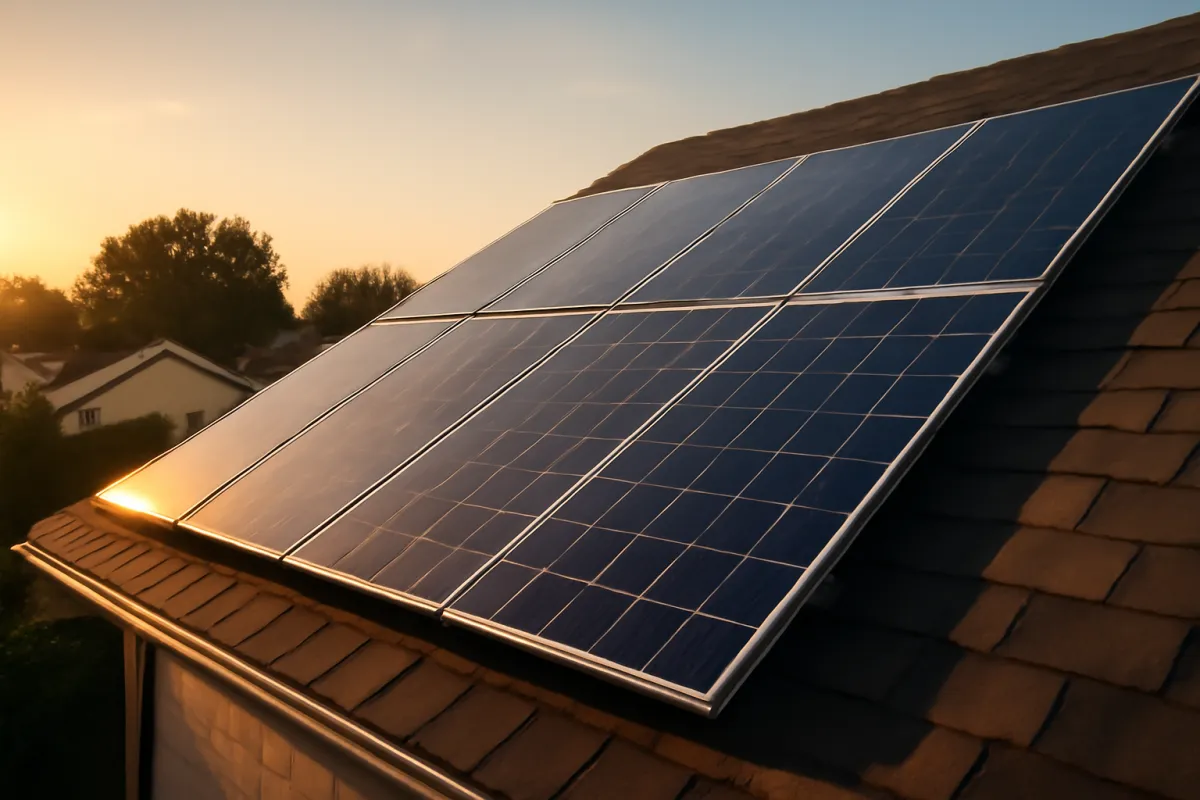
What's on this page
- The three main types of solar panels
- Monocrystalline solar panels
- Polycrystalline solar panels
- Thin-film solar panels
- How each panel type is made
- Efficiency by panel type
- Cost by panel type
- Lifespan and warranties by type
- How each type looks on a roof
- Temperature performance by type
- Which panel type fits which home
- Bifacial solar panels
- PERC, TOPCon, and HJT cell technology
- N-type vs P-type cells
- Half-cut and shingled cell formats
- Solar shingles vs standard panels
- Portable and flexible panels
- What installers actually quote today
- How panel type changes your panel count
- A worked example: one home, three panel types
- Questions to ask about panel type
- The bottom line
Short answer: There are three main types of solar panels: monocrystalline (about 20 to 23 percent efficient, black, the residential standard), polycrystalline (about 15 to 17 percent, blue, fading from home quotes) and thin film (about 10 to 13 percent, specialty and utility roles). Monocrystalline has effectively won the home market as its price fell, so the real choices now sit inside that family: cell architecture such as PERC, TOPCon or HJT, wattage class and warranty strength.
Types of solar panels sort into three families, monocrystalline, polycrystalline, and thin film, and the differences between them decide how much roof a system needs, what it looks like, and how the price shakes out. The good news for anyone shopping today is that the menu is simpler than the brochures suggest: one family has effectively won the residential market, and most of the decisions left worth making live inside it.
This breakdown walks through all three types, how each is made, and how they compare on efficiency, cost, lifespan, heat behavior, and looks. It then goes where modern quotes actually differ: bifacial designs, the cell architectures behind the acronyms on a datasheet, solar shingles, and the panel-count math that connects type to your roof. Illustrative numbers throughout are typical ranges rather than specs for any particular model, so verify the datasheet on your own quote. For the sizing arithmetic that pairs with this breakdown, keep our solar sizing reference handy, and the savings calculator will turn your bill into a target system size before you compare panel options against it.
Key takeaways
- The three main types are monocrystalline (~20% to 23% efficient, black, the residential standard), polycrystalline (~15% to 17%, blue, fading from home quotes), and thin film (~10% to 13%, specialty and utility roles).
- Monocrystalline has effectively won the home market: the old poly price discount thinned as mono manufacturing costs fell, leaving little reason to give up roof efficiency.
- The real choices today sit inside the mono family: standard vs premium cell architectures (PERC, TOPCon, HJT), wattage class, and warranty strength.
- Panel type sets your panel count: an illustrative 8.2 kW home system is about 20 mono panels, 26 poly, or 37 thin film, a roof-space spread of hundreds of square feet.
- Judge quotes on cost per installed watt, module datasheet numbers, and the year-25 warranty floor, not on the type label or marketing acronyms.
The three main types of solar panels
Every mainstream solar panel converts light to electricity the same basic way: photons knock electrons loose in a semiconductor, and the panel’s wiring collects them as current. The three types differ in how that semiconductor layer is built. Monocrystalline panels slice their cells from single, continuous silicon crystals. Polycrystalline panels cast theirs from many silicon fragments melted together. Thin-film panels skip wafers entirely and deposit a light-absorbing layer, sometimes silicon, sometimes other chemistries, directly onto glass, metal, or plastic.
Those manufacturing differences ripple outward into everything a buyer notices: efficiency, color, price, weight, lifespan, and heat behavior. A useful mental model is a spectrum of order. The more ordered the crystal structure, the more freely electrons move and the more of the light’s energy survives as electricity, which is why mono leads on efficiency, poly trails it, and most thin films trail further. Order costs manufacturing effort, which is why the ranking once ran the other way on price. The sections ahead take each type in turn, then compare them head to head. One framing note before the tour: this is not a three-way decision for most readers. Residential quotes today are overwhelmingly monocrystalline, so treat the poly and thin-film sections as context for used equipment, budget channels, and specialty uses rather than live options for a typical roof.
Monocrystalline solar panels
Monocrystalline panels are the residential standard, and the name describes the manufacturing feat inside them. Each cell is sliced from a single cylindrical silicon crystal grown slowly from a seed, a process that yields a highly ordered atomic structure with few defects to trap electrons. That order is why mono cells convert more of the light that hits them, with module efficiencies typically around 20% to 23% today and premium designs slightly higher.
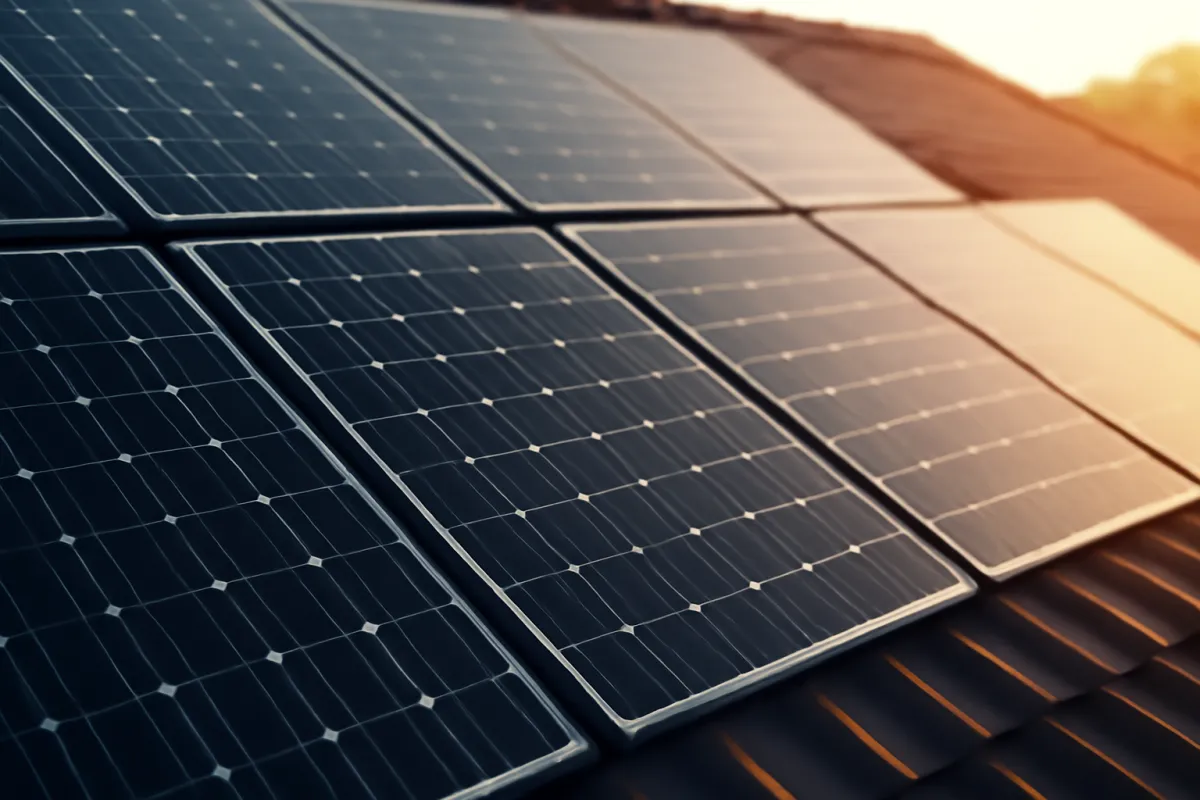
The practical portrait: mono panels are uniformly dark, usually all black, which is the low-profile look most homeowners want on a visible roof. They deliver the most watts per square foot, commonly around 400 to 440 watts from a standard residential-size module, which keeps panel counts and roof coverage down. They handle heat comparatively well, with temperature coefficients commonly around -0.3% to -0.35% per degree Celsius. And they carry the strongest warranty structures in the market, typically 25 years or more with a guaranteed output floor near 85% to 90% at the end. Their historical drawback, price, has largely dissolved as manufacturing scaled. Within the mono family there is real variety, standard versus premium architectures, different wattage classes, black-frame versus silver, and that internal menu is where the rest of your shopping will actually happen.
Polycrystalline solar panels
Polycrystalline panels, also called multicrystalline, take a shortcut through the expensive part of mono manufacturing. Instead of growing one large perfect crystal, the process melts silicon fragments together and casts them into blocks, which are then sliced into cells. The result is a patchwork of many small crystals, and the boundaries between them scatter and trap some electrons that would otherwise become current. That is the physics behind poly’s lower typical efficiency, commonly around 15% to 17% at the module level.
You can identify poly on sight: the multi-crystal structure catches light unevenly, giving cells a blue, speckled, almost mosaic appearance rather than mono’s uniform black. For years that trade, a visible blue roof and more panels in exchange for a meaningfully lower price, made poly the sensible value choice, and millions of systems installed in the 2010s carry it. What changed is the denominator: mono manufacturing costs fell hard, the price gap narrowed to slivers, and installers consolidated their offerings around the better product. Today poly survives mainly in budget channels, some off-grid kits, and the used market. If you own a poly array already, nothing is wrong with it; it will keep producing for decades at its rated pace. But if a new residential quote features poly, ask what the discount is, because it needs to be real to justify the extra roof area.
Thin-film solar panels
Thin-film panels abandon the silicon wafer entirely. A light-absorbing layer, orders of magnitude thinner than a crystalline cell, is deposited directly onto a backing of glass, metal, or flexible plastic. Several chemistries live under the thin-film umbrella, including cadmium telluride, which is a major player in utility-scale farms, CIGS, and amorphous silicon, each with its own cost and performance profile.
The family’s shared traits: low weight, potential flexibility, a sleek uniform appearance, strong tolerance of heat and partial shade, and the lowest efficiencies of the three types, commonly around 10% to 13% for products a consumer might encounter. That efficiency figure is the reason you rarely see thin film on houses. A home needing an illustrative 8.2 kilowatts would require roughly twice the roof area with thin film as with mono, and residential roofs do not have that area to spare. Where thin film thrives is where its strengths matter and its weakness does not: utility-scale ground arrays, where land substitutes for roof space and cost per watt at enormous volume rules the decision; weight-limited commercial roofs; and mobile uses like RVs and boats, where flexible panels conform to curved surfaces. For a homeowner, thin film is the answer to specific niche questions, not a third option in the main decision.
How each panel type is made
The manufacturing story explains nearly every difference a buyer sees, so it is worth two minutes. All crystalline panels start with refined silicon. For mono, the Czochralski process dips a seed crystal into molten silicon and pulls it upward slowly while rotating; a single cylindrical crystal grows around the seed, and it is later sliced into thin wafers. The cylinder’s shape is why mono cells historically had clipped corners, and the slow, energy-hungry pull is where mono’s old cost premium came from.
Poly skips the pull: molten silicon is cast into square blocks and cooled, forming many crystals with visible boundaries, then sliced the same way. Cheaper, faster, less ordered, less efficient. Thin film is a different universe: chemical deposition lays the absorber layer onto a substrate in a continuous process more like coating glass than growing gems, which is why it can be light, flexible, and inexpensive per panel while collecting less energy per square foot.
From wafer to module, the crystalline paths converge: cells are doped to form the junction, printed with conductive fingers, strung together, laminated between glass and backsheet, framed, and fitted with a junction box. Modern refinements, better surface treatments, thinner wires, cleverer cell layouts, are where the premium architectures covered later earn their keep. Manufacturing quality control, not type, drives most real-world defect rates, which is one more reason the manufacturer’s track record and warranty matter as much as the family name.
Efficiency by panel type
Efficiency, the share of incoming sunlight converted to electricity, is the headline difference between the families, and the gap is wide enough to be decisive for roof-limited buyers. Illustrative typical module ranges: premium mono around 23%, standard mono around 20% to 22%, poly around 15% to 17%, thin film around 10% to 13%.
Typical module efficiency by panel type
Illustrative typical ratings; specific models vary. Bars scaled to the premium mono figure.
Efficiency is watts per square foot, so these gaps translate directly into panel count and roof coverage for the same system size.
Two readings of that chart matter. First, between families, the gap compounds into real square footage: the difference between 21% and 12% roughly doubles the roof area a given system needs, which is covered in numbers later in this breakdown. Second, within the mono family, where your actual decision lives, the spread is a couple of points, and a couple of points changes panel count by one or two panels, not by roof-fitting amounts, on most homes. Efficiency percentages describe the module under standardized test light; real output also depends on heat, angle, soiling, and system losses. Our teardown on solar panel efficiency unpacks the rating in full, including why paying a premium for density only makes sense when roof space is genuinely tight.
Cost by panel type
Panel-level pricing once ranked the families in reverse order of efficiency, and the story of the past decade is that ranking collapsing. As illustrative hardware figures, standard mono modules commonly fall somewhere around $0.70 to $1.00 per watt through consumer channels, premium architectures add perhaps 10% to 25% on top, and poly, where still available, undercuts standard mono by margins too thin to matter for most buyers. Thin-film pricing varies too much by chemistry and channel to summarize honestly in one number.
The more useful lens is installed cost, because hardware is only a slice of a residential quote. Once labor, racking, inverters, wiring, permits, inspection, and installer overhead are stacked on, commonly cited all-in figures land somewhere around $2.50 to $3.50 per illustrative watt, gross, and the panel choice moves that total less than buyers expect. Read every figure in this section as a gross price: a quote or estimator still showing a number after a 30 percent federal deduction is working from superseded rules and should be re-quoted. Swapping standard for premium panels on an 8.2 kilowatt system might add an illustrative $1,500 to $2,500, real money, but a modest percentage of the project, while differences in installer overhead and design quality can swing more. That is why the durable advice is to collect multiple written quotes, normalize each to cost per installed watt at the same system size, and let the payback math arbitrate. Our cost coverage for 2026 tracks the fuller pricing picture, and the savings calculator turns any quote’s numbers into a break-even estimate.
Lifespan and warranties by type
Longevity is a quiet strength of crystalline silicon generally rather than a differentiator between mono and poly. Both degrade at a commonly cited rate of roughly half a percent of output per year, and both routinely carry 25-year performance warranties guaranteeing somewhere around 85% to 90% of original output at the end of the term. Physical lifespans often outrun the paperwork; arrays from the 1990s are still producing, just at a reduced pace. Premium mono lines sometimes sweeten the terms, with longer product warranties and slightly flatter degradation schedules, a compounding edge that is worth something over decades.
Thin film is the family where lifespan deserves scrutiny. Warranties are frequently shorter, degradation has historically run faster for some chemistries, and flexible consumer products in particular lead harder lives on vehicles and boats than glass modules do on roofs. Quality varies enough by manufacturer that the specific warranty document matters more than the category’s reputation.
Two practical notes for any type. First, read both warranty layers: the product warranty, covering defects, and the performance warranty, guaranteeing the output floor; they differ in length and fine print. Second, remember that the component most likely to be replaced during your system’s life is the inverter, not a panel of any type, which belongs in your lifetime budget. Our coverage of how long solar panels last and our maintenance cost note put illustrative numbers on both.
How each type looks on a roof
Looks are a legitimate factor on the most visible surface of your house, and the types are easy to tell apart. Monocrystalline panels read as uniform deep black, especially in all-black trim where cells, backsheet, and frame match; on a dark shingle roof they recede into the roofline, which is exactly what most homeowners want. Polycrystalline panels read unmistakably blue, with a speckled, crystalline shimmer that varies cell to cell, and silver frames were common in their era, so an older poly array announces itself. Thin film is the sleekest of all, a smooth, uniform dark surface without visible cell gridlines, one reason it appeals for architectural applications.
Beyond color, layout drives curb appeal more than people expect. Fewer, higher-wattage panels in clean rectangular blocks look better than the same wattage scattered around vents and dormers, which quietly favors higher-efficiency modules on complicated roofs: density buys layout freedom. Black racking and skirting, hidden conduit runs, and keeping panels off street-facing planes where production allows are the installer-side choices worth asking about. None of this changes the electrons, and this breakdown will not pretend aesthetics should outrank production or price. But a system you will look at for 25 years is allowed to be a system you like looking at, and with mono’s price parity, the good-looking option and the high-performing option are now usually the same panel.
Temperature performance by type
Heat is the everyday stress test of a solar panel, and the types respond differently in ways a datasheet line captures: the temperature coefficient of power, the percentage of output lost per degree Celsius the cells run above the 25°C test benchmark. Illustrative typical figures: premium mono architectures around -0.25% to -0.30%, standard mono around -0.30% to -0.35%, poly around -0.35% to -0.40%, and several thin-film chemistries better still, in the neighborhood of -0.20% to -0.30%.
Those decimals compound in real weather. Rooftop cells commonly run 20°C to 30°C above the benchmark in summer sun, so at -0.35% a panel gives up roughly 7% to 10% of its rated output exactly when the sky is clearest, while a -0.25% panel gives up meaningfully less. Across a hot-climate summer, that spread between two otherwise similar mono panels can matter as much as a half point of headline efficiency, which is why the coefficient belongs on your quote-comparison checklist, particularly in the Southwest and South.
Thin film’s excellent heat behavior is real but does not rescue its efficiency deficit on a roof; it is part of why the technology suits desert utility farms. Installation choices matter too: panels racked a few inches off the roof shed heat into the airflow beneath, while flush or integrated mounting runs hotter. In cool climates, coefficients matter less and this whole section drops down your priority list, a regional nuance our winter solar explainer covers from the cold side.
Which panel type fits which home
Match the family to the situation and the decision mostly makes itself. A typical suburban home with decent roof area and grid connection: standard monocrystalline, full stop. It fits, it looks right, it carries the strong warranty, and it costs little more than the alternatives that would spend more of your roof. A small, complicated, or partly shaded roof that struggles to fit your target system size: premium mono, where the extra density per square foot is buying something you concretely need, per the roof-space math in our efficiency teardown.
A tight budget with a large open roof: standard mono still wins new, but this is the one scenario where discounted poly, from a clearance channel or a reputable used source, can pencil out, because roof area is free in this house’s math and the panels are proven technology. An off-grid cabin, RV, or boat: mono for fixed mounts where space is tight, flexible thin film where curves and weight rule; our off-grid cost coverage works those setups in detail. A weight-limited or architectural application, curved roofs, facades: thin film’s territory.
The honest summary is that “which type?” is mostly a solved question, and the live decisions are within mono: architecture tier, wattage class, warranty, and installer. Where the sizing reference tells you your target kilowatts, the type conversation is just how those kilowatts get packaged.
Bifacial solar panels
Bifacial panels put active cells on both faces, letting the rear side harvest light that bounces off whatever sits beneath the array. The gain depends entirely on that surface’s reflectivity: over white commercial roofing, pale gravel, sand, or snow, rear-side contributions commonly cited around 5% to 15% of extra energy are plausible, and at utility scale, where arrays stand high over engineered ground, bifacial has become routine.
On a typical home roof, the story deflates. Residential panels sit a few inches above dark asphalt shingles, a surface that reflects little light into a gap that admits less, so the bifacial bonus over an ordinary roof shrinks toward a rounding error. Where bifacial earns a place in residential settings is off the roof: ground mounts over light gravel, carports, and pergolas, where the panel doubles as a canopy, elevated with reflective surroundings and open air beneath. There the rear face genuinely works, and the glass-glass construction bifacial modules typically use brings a durability side benefit, since glass on both faces resists moisture and mechanical stress well, and such modules often carry long warranties.
Buyer guidance in one line: on a shingle roof, treat bifacial as a nice module that should win on its front-side numbers alone, and treat any quote leaning on projected rear-side gains over dark shingles as a red flag worth questioning. Ask what rear-side irradiance assumption the production estimate uses; an honest answer for a rooftop is “almost none.”
PERC, TOPCon, and HJT cell technology
The acronyms crowding modern datasheets are generations of cell architecture within the mono family, each one a clever answer to the same question: how do we lose fewer electrons? PERC, the workhorse of the late 2010s and early 2020s, adds a passivated reflective layer on the cell’s rear, bouncing unabsorbed light back through the silicon for a second chance at conversion and tidying up electron behavior at the back surface. It pushed mainstream modules over 20% at low cost, and became the baseline it is now yielding.
TOPCon adds an ultra-thin tunnel oxide and a polysilicon layer that let current pass while blocking the electron-hole recombination that wastes energy at surfaces. Built on n-type wafers, it delivers roughly a point more efficiency than PERC with better temperature behavior and lower degradation, and it has become the mainstream successor across major manufacturers’ lines. HJT, heterojunction, laminates thin-film amorphous silicon onto a crystalline wafer, marrying the two technologies’ strengths: top-tier efficiency, excellent temperature coefficients around -0.25%, and low degradation, at a manufacturing cost that keeps it in the premium tier. Back-contact designs move all wiring behind the cell for the cleanest look and the highest densities yet, at the highest prices.
What should a buyer do with this? Nothing acronym-specific. The architecture’s benefits are already priced into the datasheet lines you should be comparing anyway: module efficiency, temperature coefficient, first-year and annual degradation, and warranty. Read the numbers, not the branding.
N-type vs P-type cells
One more datasheet distinction earns a plain-English translation because it quietly underlies the architecture generations: the silicon wafer’s doping type. P-type wafers, doped with boron, powered the industry for decades and still sit under most PERC production. N-type wafers, doped with phosphorus, cost more to make but carry two structural advantages: fewer of the impurity-related defects that sap efficiency, and immunity to the boron-oxygen reaction responsible for light-induced degradation, the small one-time output dip p-type panels take in their first weeks of sun.
That is why the industry’s premium architectures, TOPCon, HJT, and back-contact designs, are built on n-type silicon, and why n-type modules typically post lower first-year degradation, flatter long-term degradation schedules, often around 0.4% a year versus 0.5% or more, and slightly better temperature coefficients. Compounded over a 25-year warranty term, a flatter degradation line is worth real cumulative energy, which is why n-type warranties often guarantee a higher year-25 floor, commonly around 87% to 90% versus the mid-80s for p-type lines. These remain illustrative typical figures; specific models vary.
As with the acronyms, the buyer’s move is not to demand n-type by name but to notice where its benefits surface: the degradation schedule and the warranty floor printed on the datasheet. If two quotes differ there, the wafer type is probably why, and the difference is legitimate, priced, and worth weighing like any other spec.
Half-cut and shingled cell formats
Beyond chemistry and architecture, manufacturers also rearrange the cells themselves, and two formats dominate modern modules. Half-cut designs slice each cell in two and wire the panel as twin half-arrays. Halving each cell halves its current, and since resistive losses scale with the square of current, the panel wastes less energy as heat in its own wiring, a fraction of a percent recovered for nearly free. The twin-array layout adds a practical bonus: shade falling on the panel’s lower half can leave the upper half producing, softening the shade penalty that plagued older full-cell modules. Half-cut construction is now effectively standard, and you can spot it by the seam line across a panel’s middle.
Shingled formats go further, slicing cells into narrow strips and overlapping them like roof shingles, bonded edge to edge with conductive adhesive rather than visible wire ribbons. The overlap eliminates the gaps between cells, packing more active silicon into the same frame, and the ribbon-free face gives the sleekest look short of back-contact designs. Costs run higher, placing shingled modules in the premium tier.
Neither format is a decision you make separately; like the cell architectures, they arrive baked into whatever module your installer quotes, their benefits already reflected in the datasheet’s efficiency and shade behavior. They are covered here so a quote’s marketing page reads as engineering rather than mystery: each format is a small, real answer to wiring losses, shade, or wasted glass area.
Solar shingles vs standard panels
Solar shingles, and building-integrated photovoltaics generally, replace roofing material itself with power-producing tiles rather than racking panels above an existing roof. The pitch is real: no visible array, one integrated surface, and a roof replacement and solar install combined into a single project. For design-sensitive homes, historic districts, or homeowners who simply refuse the look of panels, shingles are the option that makes solar possible at all.
The trade-offs are equally real, and they stack. Efficiency per square foot typically trails good mono panels, so the same energy target claims more roof. Installed cost per watt commonly runs well above racked panels, frequently by 50% to 100% in illustrative terms, because the product is both roof and generator and the installation is specialized. Heat behavior suffers because integrated tiles cannot shed warmth into an air gap beneath. Repairs entangle roofing and electrical trades. And the installer network is thinner, which matters for service over a multi-decade life.
The sober comparison: if the roof needs replacing anyway and aesthetics carry heavy weight in your household, shingles deserve a quote alongside a conventional replace-then-rack option, with both normalized to cost per watt and projected production. If your existing roof has life left, racked mono panels deliver the same electrons for meaningfully less money. Run both scenarios through the payback math before romance decides.
Portable and flexible panels
A quick word on the panels that never touch a roof, because the type trade-offs invert there. Portable folding panels, the briefcase-style kits paired with power stations for camping and backup, are usually monocrystalline, since packing the most watts into the least fabric and weight is the whole job. Illustrative capacities run from 100 to 400 watts, and the practical shopping points are weight, fold size, stand angles, and connector compatibility with your power station rather than headline efficiency.
Flexible panels, thin-film or thin-cut crystalline laminates a few millimeters thick, trade efficiency and lifespan for the ability to conform to curved surfaces and weigh almost nothing. They are the standard answer on RV roofs, boat biminis, and vans, where racked glass modules are impractical or forbidden by weight. Expect lower efficiency than rigid mono, faster degradation under the flexing and heat of vehicle life, and shorter warranties; treat them as a consumable measured in years, not the decades a rooftop module lasts.
Neither category feeds your house meter directly, but they answer adjacent questions readers bring to a solar search, and they illustrate the family traits in miniature: mono wherever space is precious, thin film wherever weight and curvature rule. For whole-home backup comparisons, our battery backup versus generator coverage picks up where portable kits leave off.
What installers actually quote today
Walk into the current market and the brochure’s three-way choice collapses into what installers actually carry: monocrystalline modules, overwhelmingly in modern n-type architectures, in wattage classes commonly around 400 to 440 watts for residential sizes, from a rotating cast of major manufacturers. Poly has effectively exited new home quotes, and thin film never really entered them. The illustrative split below shows the shape of the residential market.
Share of new residential installs by panel type
Illustrative split of the current home-install market; shares sum to 100%.
Illustrative proportions to show market shape, not a measured statistic: the practical takeaway is that a new home quote today is almost certainly monocrystalline.
Two consequences follow. First, brand matters less than buyers fear: modules from established tier-one manufacturers cluster tightly on specs and warranty structure, so an unfamiliar name on a quote is a prompt to check the datasheet and warranty terms, not a crisis. Second, the quote lines that genuinely differ between proposals are elsewhere: system size, inverter choice, racking, workmanship warranty, and price per watt. Panel type has become the most standardized line on the page. Our walkthrough on reading a solar quote shows where the real variation hides, and our installer-choosing walkthrough covers vetting the company behind the paper.
How panel type changes your panel count
Here is the arithmetic that turns type differences into something you can see from the street. Panel count is system size divided by panel wattage, rounded up; roof area is panel count times a panel’s roughly 20 square feet. Take an illustrative home needing 8.2 kilowatts, a size the savings calculator or sizing reference can derive from a bill of around $150 a month at typical rates.
With standard mono at about 420 watts per panel: 20 panels, about 410 square feet. With poly at about 325 watts: 26 panels, about 530 square feet. With thin film at about 230 watts: 37 panels, about 760 square feet, which is why that row exists only on paper for houses. Same 8.2 kilowatts, same annual energy of roughly 10,800 kilowatt-hours at 4.5 peak sun hours and a 0.8 derate, radically different roofs.

Within the mono family the count still moves at the margins: stepping from a 400 watt standard module to a 440 watt premium one trims the example by one to two panels, which matters on a cramped roof and not at all on an open one. Work the count both directions, from usage to panels and from your measured roof back to maximum wattage; our panel-count walkthrough and the interactive helper on this page run both.
A worked example: one home, three panel types
Assemble everything into one decision. A household uses about 10,800 kilowatt-hours a year in a region with 4.5 peak sun hours; at a 0.8 derate the target is roughly 8.2 kilowatts. Their usable roof, measured after setbacks, vents, and a dormer, is about 480 square feet of well-oriented area. Illustrative installed pricing: a standard mono quote at $2.80 per watt, a premium mono quote at $3.05, and a hypothetical discounted poly quote at $2.65.
Standard mono, 420 watt panels: 20 panels, 410 square feet, fits with margin, at a gross installed cost of about $23,000. There is no federal credit to deduct from that, since section 25D was terminated for property placed in service after December 31, 2025, so $23,000 is the figure this household budgets. Premium mono, 440 watt panels: 19 panels, 390 square feet, fits with slightly more margin, at about $25,000 gross, buying about $2,000 of premium for density this roof does not need, though its flatter degradation returns some of that over 25 years. Poly, 325 watt panels: 26 panels, 533 square feet, does not fit; capped at 23 panels the system shrinks to about 7.5 kilowatts, covering roughly 91% of usage, and the annual shortfall of about 900 kilowatt-hours costs an illustrative $150 a year at typical rates, promptly erasing the cheaper price.
Standard mono wins this house cleanly, and that is the usual verdict. But notice what decided it: the roof’s square footage and the usage target, not the type labels. Change the roof and the ranking reshuffles, which is why the worked method, target size first, fit check second, cost per watt last, travels better than any fixed recommendation.
Questions to ask about panel type
A short list of questions extracts everything that matters from an installer’s panel choice, and none of them require memorizing an acronym. What is the exact module model on my quote, and can I see its datasheet? This one request surfaces efficiency, wattage, temperature coefficient, degradation schedule, and warranty in their official form. Is it an n-type or p-type cell, and what is the year-25 warranty floor? The answer tells you which generation of equipment you are buying and what the manufacturer will stand behind.
What are the product and performance warranty terms separately, and who services a claim if the manufacturer exits the market? Panel makers come and go; the installer’s answer reveals how much thought stands behind the paper. Why this module for my roof specifically? A good installer connects the choice to your constraints, density for a tight roof, value for an open one, coefficients for a hot climate, rather than reciting a brand pitch. What would the quote look like with a standard-tier module instead, at the same system size? Pricing the delta directly beats guessing at it. And if bifacial, shingles, or any specialty product appears: what concrete assumption in the production estimate justifies it on my house?
Fold these into the broader vetting in our installer walkthrough and the panel-type line of your quote becomes one of the easier ones to judge.
The bottom line
The types of solar panels sort into three families with honest, physical differences: monocrystalline’s ordered crystals deliver roughly 20% to 23% efficiency in an all-black package with decades-long warranties; polycrystalline trades order for cost at around 15% to 17% and a blue speckle, a trade that stopped paying when mono prices fell; thin film gives up efficiency, around 10% to 13%, to gain flexibility, light weight, and heat tolerance that suit farms, vehicles, and curved surfaces rather than houses. For a home roof in the current market, the three-way choice has resolved: monocrystalline, almost always in a modern n-type architecture, is what belongs on and dominates new quotes.
That settles the family and relocates your attention to where quotes genuinely differ: system size first, module datasheet numbers second, cost per installed watt third, warranty floors and installer quality throughout. Density is worth paying for only when your measured roof says so; acronyms are worth exactly what their datasheet lines show; and the panel-count math, 20 versus 26 versus 37 panels for the same illustrative 8.2 kilowatts, is the fastest way to feel why the market chose the winner it did. Start from your own usage with the savings calculator, let the sizing reference set your target, and judge every panel offered against the roof you actually have.
This breakdown is educational reading, not product, engineering, or financial advice, and it recommends no specific manufacturer or model. Every efficiency range, wattage, price, market share, degradation rate, and worked figure above is an illustrative typical value chosen to teach comparisons, not a specification, quote, or measured statistic for your project; real equipment and pricing vary by model, region, installer, and year and change quickly in this industry. Datasheets, written warranties, and itemized installer proposals for your specific address are the documents that govern an actual purchase. Have structural and electrical questions answered by licensed professionals, confirm current incentive rules with official sources, and let a qualified installer’s site-specific design, rather than these teaching examples, decide what is mounted on your home.
Frequently asked questions
What are the three main types of solar panels?
The three main types are monocrystalline, polycrystalline, and thin film, and the names describe how the light-converting layer is made. Monocrystalline panels are cut from single silicon crystals, look uniformly black, and typically rate around 20% to 23% efficient. Polycrystalline panels are cast from melted silicon fragments, carry a blue speckled appearance, and typically land around 15% to 17%. Thin-film panels deposit a light-absorbing layer onto glass or flexible backing and commonly run around 10% to 13%, which keeps them mostly in utility-scale and specialty roles. For new home installs, the practical menu has narrowed: monocrystalline dominates what installers actually quote today.
Which type of solar panel is best for a home?
For nearly all homes today, monocrystalline is the default answer, which simplifies the shopping more than buyers expect. Mono panels offer the highest efficiency per square foot of roof, all-black looks, strong warranties, and prices that have fallen to where the old poly discount mostly evaporated. Polycrystalline still appears in budget or off-grid contexts but has largely left mainstream residential quotes. Thin film suits curved surfaces, RVs, and huge ground arrays rather than house roofs. The real decisions left are within the mono family: standard versus premium cell designs, panel wattage, and warranty terms, which is where quotes genuinely differ.
Is monocrystalline really better than polycrystalline?
Better per square foot, yes; better per dollar depends on pricing that has mostly settled the argument anyway. Mono's single-crystal structure lets electrons move more freely, which shows up as roughly 20% to 23% module efficiency versus poly's typical 15% to 17%, plus generally better performance in heat. Poly's advantage was manufacturing cost, and a decade ago the price gap made it a sensible value pick. Mono manufacturing costs have since fallen so far that the discount thinned to the point where most installers stopped carrying poly for homes. If you are comparing a specific pair of quotes, judge them on cost per watt, warranty, and fit for your roof rather than the type label alone.
Are thin-film solar panels any good?
They are good at jobs house roofs do not have. Thin film's strengths are flexibility, light weight, uniform dark appearance, and strong tolerance of heat and partial shade, which suit curved surfaces, vehicles, boats, and some commercial roofs that cannot bear weight. The weakness is efficiency, commonly around 10% to 13%, meaning a home system would need roughly twice the roof area of a mono array for the same output, and typically shorter lifespans than crystalline panels. On a standard residential roof, that space penalty is disqualifying. At utility scale, where land replaces roof area and cost per watt rules, certain thin-film chemistries compete seriously, which is why the technology thrives there while staying rare on houses.
What are bifacial solar panels and do they help on a house?
Bifacial panels have active cells on both faces, so the back can harvest light reflected off the surface beneath the panel. Over a white commercial roof, light gravel, or snow, that rear-side gain is commonly cited in the range of 5% to 15% extra energy, which is meaningful at scale. On a typical home install, panels sit a few inches above a dark shingle roof, leaving little reflected light to collect, so the bifacial bonus mostly evaporates. They can pay off on ground mounts, pergolas, and carports with reflective ground beneath. If a home quote leans on projected bifacial gains over an ordinary roof, treat the projection skeptically and ask what rear-side irradiance assumption is being used.
What do PERC, TOPCon, and HJT mean on a solar panel datasheet?
They are names for successive generations of cell architecture within the monocrystalline family, each squeezing more electricity from the same silicon. PERC adds a reflective rear layer that gives light a second pass through the cell. TOPCon adds a thin tunneling layer that reduces electron losses at the cell's surfaces and has become the mainstream successor. HJT layers thin-film silicon over a crystalline wafer, delivering top-tier efficiency and excellent heat behavior at a premium price. As a buyer you do not need to pick a favorite acronym; the datasheet's module efficiency, temperature coefficient, degradation schedule, and warranty already capture what the architecture achieves. Treat the acronym as the reason behind the numbers, not a separate feature.
How much do the different types of solar panels cost?
As illustrative panel-level figures, standard monocrystalline equipment commonly falls somewhere around $0.70 to $1.00 per watt for the hardware itself, with premium cell designs adding perhaps 10% to 25% on top, while the remaining thin-film and poly products vary widely by chemistry and channel. Installed system pricing tells the fuller story: hardware is only a fraction of a residential quote once labor, racking, inverters, permitting, and overhead are added, with commonly cited all-in figures somewhere around $2.50 to $3.50 per watt before incentives. Because the panel slice is modest, choosing premium panels moves total system price less than expected, and installer efficiency and overhead move it more. Get multiple written quotes and compare cost per installed watt rather than panel price alone.
Do different panel types last different lengths of time?
Crystalline silicon panels, both mono and poly, are the marathon runners, with performance warranties typically guaranteeing around 85% to 90% of original output at year 25 and physical lifespans that often run past the warranty. Their commonly cited degradation is roughly half a percent of output per year. Thin-film products vary more by chemistry, with warranties frequently shorter and degradation historically faster, though quality varies by manufacturer. In practice, the component most likely to be replaced during a system's life is the inverter rather than any panel. Whatever type is on your quote, the warranty document, both the product term and the year-25 performance floor, is the number that matters more than the category average.