

What's on this page
- The plain-English definition of a kilowatt-hour
- Watts vs kilowatts vs kilowatt-hours
- The lightbulb math: seeing a kWh in real life
- How your electric meter counts kilowatt-hours
- What a kilowatt-hour costs
- Finding kWh on your electric bill
- How many kWh a typical home uses
- What common appliances use in kWh
- How to estimate any appliance’s kWh
- Where a month of kWh actually goes
- kWh and solar: sizing a system around your usage
- What one solar panel produces in kWh
- kW vs kWh on a solar quote
- Batteries: kWh as stored energy
- EV charging in kilowatt-hours
- Time-of-use rates: when a kWh costs more
- Practical ways to cut your kWh usage
- A worked example: one day of home life in kWh
- kWh vs BTUs and therms
- Mistakes people make with kWh
- The bottom line
Short answer: A kilowatt-hour, or kWh, is the energy used when 1,000 watts of power runs for one hour. Watts measure the rate of energy flow, like speed; kilowatt-hours measure the accumulated total, like distance, and your utility bills you by that total. A typical US home uses a commonly cited 900 kWh a month, at somewhere around $0.10 to $0.35 per kWh depending on the state. Solar production and battery capacity use the same unit.
What is a kilowatt-hour? It is the unit your entire relationship with the electric company is denominated in: one kilowatt-hour, or kWh, is the energy used when 1,000 watts of power runs for one hour. Every appliance you own, every line of your bill, every solar panel’s output, and every battery’s capacity can be expressed in this one unit, which makes it the single most useful piece of energy literacy a homeowner can pick up. Learn it once and bills, quotes, and spec sheets all snap into focus.
This explainer covers the kilowatt-hour from the ground up: the difference between watts and watt-hours, what a kWh looks like in real household life, how your meter counts them and your bill prices them, how many a typical home burns through, and which appliances do the burning. It then connects the unit to the decisions that likely brought you here, sizing solar, judging batteries, charging an EV, because all of that math is just kWh arithmetic. The formulas live in our solar sizing reference if you want them in one place, and the savings calculator will run your own bill’s kWh through the solar math in seconds.
Key takeaways
- A kilowatt-hour is energy: 1,000 watts of power sustained for one hour. Watts are the rate; kWh are the accumulated total, like speed versus distance.
- A typical US home uses a commonly cited 900 kWh a month (about 30 a day), and electricity commonly costs somewhere around $0.10 to $0.35 per kWh by state.
- Heating, cooling, water heating, and EV charging dominate usage; lighting and electronics are nearly negligible in comparison.
- Your effective rate is your bill's total dollars divided by its kWh, and it is the number that prices every appliance habit and solar decision.
- Solar runs on the same unit: one modern panel makes roughly 1.5 kWh a day under typical assumptions, and a system is sized by matching annual kWh production to annual kWh usage.
The plain-English definition of a kilowatt-hour
Start with the watt, the basic unit of electrical power. Power is a rate: how fast energy is being drawn at this instant, the way miles per hour describes how fast a car is moving right now. A phone charger draws a handful of watts, a laptop a few dozen, a microwave around a thousand. A kilowatt is simply 1,000 watts, a convenient size for household appliances.
Energy is what accumulates when power runs for time, the way distance accumulates when speed runs for time. The kilowatt-hour is that accumulation unit: one kilowatt of power sustained for one hour. The formula could not be shorter: energy in kWh equals power in kilowatts times hours. A 1 kW appliance for 1 hour is 1 kWh. A 0.5 kW appliance for 2 hours is also 1 kWh. A 2 kW appliance for 30 minutes, 1 kWh again.
Notice what the unit is not. It is not “kilowatts per hour,” a phrase that appears constantly and means nothing useful; the unit multiplies power by time rather than dividing it. It is also not a measure of how “hard” electricity works or a percentage of anything. It is a quantity of energy, as concrete as a gallon of gasoline, and your utility sells it by the each. When your bill says 900 kWh, it means your home accumulated nine hundred of these units over the billing period, and every one of them has a price.
Watts vs kilowatts vs kilowatt-hours
The three terms trip people up constantly, so here is the sorting in one place. Watts (W) and kilowatts (kW) both measure power, the instantaneous rate of energy flow; they differ only by scale, with 1 kW equal to 1,000 W. Kilowatt-hours (kWh) measure energy, the total that flows over time. The speedometer-odometer analogy carries the whole thing: kW is the speedometer reading, kWh is the odometer, and you are billed by the odometer.
The distinction turns commercial the moment you talk to a solar installer, because the industry uses both units in the same sentence. A solar system’s size is quoted in kW: an 8.2 kW array can produce at most about 8.2 kilowatts at any instant, its speedometer maximum. Its production is measured in kWh: that same array might log 29 to 30 kWh on a typical day, its odometer reading. A battery’s capacity is kWh, the energy it can hold, while its power rating in kW caps how fast it can charge or discharge. An EV charger is rated in kW, what it adds to the car each hour, and the car’s battery in kWh.
A quick self-test: if a 9.6 kW electric oven element runs for 15 minutes, that is 9.6 times 0.25, or 2.4 kWh. If that arithmetic feels comfortable, every spec sheet in the home-energy world just became readable, and the rest of this explainer is applications.
The lightbulb math: seeing a kWh in real life
Abstract units stick better with furniture attached, so here is one kilowatt-hour translated into household moments. An old 100-watt incandescent bulb burns for 10 hours to use 1 kWh. Its modern LED replacement, drawing about 10 watts for the same light, takes 100 hours, four solid days of continuous glow, to use the same unit; that 10x gap is the entire story of why LED conversion mattered.
Moving up the power scale compresses the time. A 1,500-watt space heater uses 1 kWh in 40 minutes. A microwave at roughly 1,000 watts does it in an hour of actual cooking time. A central air conditioner drawing an illustrative 3,500 watts burns a kWh every 17 minutes of compressor runtime, which is why summer bills balloon while phone charging, at perhaps 0.01 kWh per full charge, never shows up at all. A refrigerator cycles on and off to average around 1 to 2 kWh across a full day. A load of laundry through an electric dryer commonly runs 2 to 4 kWh.
Priced at an illustrative $0.17, each of those kWh costs about a sixth of a dollar, so the space heater running all evening costs about 75 cents while a year of nightly phone charging costs less than a dollar. The pattern to internalize: wattage times hours is the whole game, and heat-making appliances with big wattages dominate it.
How your electric meter counts kilowatt-hours
The meter on the side of your house is a single-purpose odometer: it accumulates kilowatt-hours as energy flows through your service line, and the utility bills on the difference between two readings. Old analog meters did this with an aluminum disc spun by the passing current, geared to dials; modern smart meters do it digitally and report automatically, but the accounting is identical: end reading minus start reading equals the billing period’s kWh.
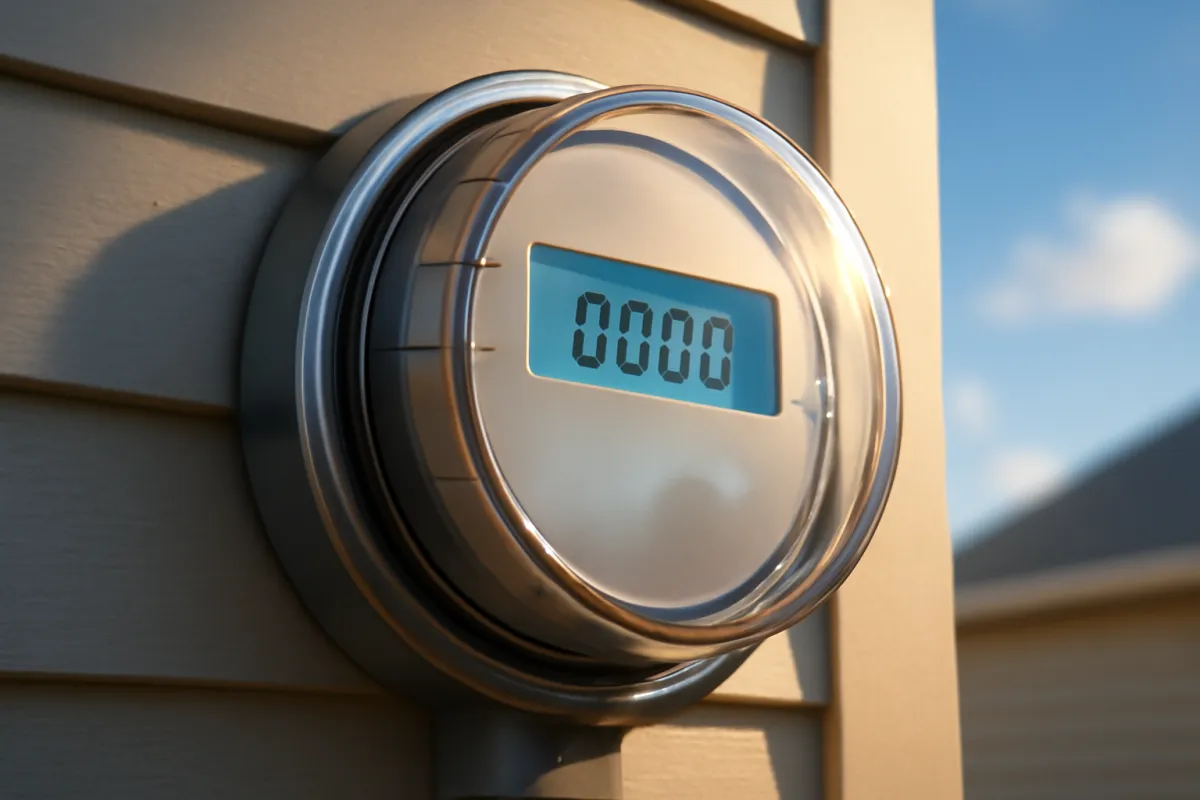
Smart meters add resolution rather than a new principle. They log usage in short intervals, commonly every 15 minutes or hour, which is what powers the daily and hourly charts in your utility’s app and makes time-of-use pricing possible, since the utility can now see when your kWh were consumed, not just how many. Those interval charts are quietly one of the best free energy tools you own: a mysterious overnight baseline reveals an always-on load, and a spiky afternoon reveals the AC’s duty cycle.
Homes with solar get a bidirectional meter that keeps two odometers, one for kWh imported from the grid and one for kWh your panels exported to it. That two-way ledger is the machinery beneath net metering, which our net metering explainer covers in full. Whatever the hardware, the unit never changes: the meter speaks kWh, and learning the unit means you can audit the conversation.
What a kilowatt-hour costs
Electricity pricing varies more across the US than almost any other household staple. Residential rates commonly fall somewhere around $0.10 to $0.35 per kWh depending on state and utility, as the EIA’s table of average electricity prices by state shows month by month, with inexpensive hydro-rich and gas-rich regions at the low end and parts of the Northeast, California, and island grids at the high end. An illustrative national middle figure of about $0.17 gets used throughout WattBarn’s math, including the savings calculator, but your own number is the one that matters.
Finding that number takes one division. Your bill’s headline “energy charge” rate understates reality, because bills stack supply charges, delivery charges, riders, and fixed fees; some of those scale with usage and belong in your per-kWh price. So compute the effective rate: total bill dollars divided by total kWh. If a $153 bill covered 900 kWh, your effective rate is $0.17 even if the tariff sheet says $0.13. That effective rate is what an appliance habit actually costs and what each solar-produced kWh actually saves, which makes it the most consequential number in this explainer.
Two wrinkles complicate the single-price picture. Time-of-use plans price a kWh differently by hour, covered later in this explainer. And tiered plans price marginal usage higher after a monthly threshold, meaning the kWh you cut, or offset with solar, are often your most expensive ones. Both wrinkles reward knowing not just how many kWh you use, but which ones.
Finding kWh on your electric bill
Your bill is a kWh document wearing a costume of line items, and it undresses quickly once you know where to look. Find the usage section: it states the meter’s previous reading, current reading, and the difference, your billing period’s kWh, often beside a 12-month bar chart of usage history. That chart is your home’s energy fingerprint, and its summer or winter humps tell you immediately whether cooling or heating rules your budget.

The charges section then multiplies those kWh through the tariff: supply or generation charges for the energy itself, delivery or distribution charges for the wires, and assorted riders and fees, some flat, some per-kWh. Seeing the same 900 kWh billed twice, once for making the energy and once for moving it, surprises many readers, and it matters for solar math, because a kWh you generate on your own roof avoids both halves. Fixed monthly charges, by contrast, survive any amount of solar, which is why bills rarely hit zero.
For the line-by-line tour, our field guide on reading your electric bill walks a real statement top to bottom. For this explainer, the takeaways are two: your kWh number and your effective rate live on every bill, and twelve months of those numbers is the exact dataset solar sizing starts from.
How many kWh a typical home uses
A commonly cited benchmark for a typical US home is roughly 900 kWh a month, which unpacks to about 10,800 a year or 30 a day. Hold the benchmark loosely, because the spread around it is enormous and mostly explainable by four factors. Climate leads: cooling-heavy Gulf states and heating-heavy electrified northern homes both run high, while mild coastal climates run low. Home size follows, more volume to condition and more rooms running loads. Then the appliance mix, where electric heat, electric water heating, a pool pump, or an EV each move the number by three or four digits per year. Habits close the list, thermostat settings, laundry patterns, and the always-on loads humming in the background.
Real homes illustrate the spread: a small gas-heated apartment might log 300 to 500 kWh a month, a mid-size all-electric suburban home 1,100 to 1,500, a large house with a pool and two EVs north of 2,000. None of these are wrong or wasteful by definition; they are different houses living different lives, denominated in the same unit.
For any decision that matters, replace the benchmark with your own record. Twelve months of bills, or the usage chart in your utility app, gives your annual kWh, and that number, not the national average, is the foundation solar sizing is built on. Our walkthrough on sizing a solar system starts from exactly that step.
What common appliances use in kWh
Household loads span four orders of magnitude, and seeing them ranked recalibrates most people’s instincts about what is worth worrying over. The figures below are illustrative monthly totals for typical usage patterns; your models and habits will shift them.
Illustrative monthly kWh for common household loads
Typical usage patterns; actual figures vary by model, climate, and habits. Bars scaled to the largest load.
The pattern: anything that heats, cools, or moves a car dominates; anything that makes light or computes barely registers. Target the top of the chart, not the bottom.
The chart’s lesson generalizes. Resistance heating and compressors are the currency-sized loads: AC, electric water heaters, space heaters, dryers, ovens. An EV joins that club the day it arrives, adding an illustrative 250 kWh a month at moderate mileage, and our air conditioner coverage shows how the summer AC load alone reshapes solar math. Meanwhile the loads people guilt over, lights left on, chargers plugged in, TVs on standby, sum to single-digit dollars monthly in most homes. Energy attention, like money, compounds best when spent at the top of the list.
How to estimate any appliance’s kWh
Any device’s energy appetite yields to the same two-step estimate, no gadgets required. Step one, find its wattage: printed on the nameplate label, in the manual, or on the wall charger’s fine print. Where a range is given, actual draw is usually below the maximum. Step two, multiply kilowatts by daily hours of real operation, then by 30 for a month: kWh = watts ÷ 1,000 × hours. A 1,200-watt dishwasher cycle running one hour daily is 1.2 kWh a day, 36 a month, about $6 at an illustrative $0.17.
Two subtleties sharpen the estimate. Cycling appliances, refrigerators, AC, water heaters, run their compressors or elements only part of the time, so use realistic duty hours rather than clock hours; a fridge plugged in 24 hours may compress for 8. And always-on loads deserve special attention precisely because their hours are 720 a month: a modest 50-watt cluster of routers, DVRs, and standby electronics quietly accumulates 36 kWh monthly, which is why “phantom load” audits often pay better than they sound.
For loads you cannot reason about, measure: inexpensive plug-in meters read a device’s true cumulative kWh, and a smart meter’s overnight baseline reveals your home’s total idle draw in one glance. The skill compounds fast; after estimating five appliances you will price a sixth in your head, and the interactive helper on this page does the arithmetic from any wattage, hours, and rate you give it.
Where a month of kWh actually goes
Zoom out from individual appliances and a typical home’s monthly total sorts into a few large buckets. The split below is illustrative for a roughly 900 kWh month in a home with electric water heating; all-gas homes shift the shares toward cooling and appliances.
Where a typical home's monthly kWh go
Illustrative shares of a ~900 kWh month; shares sum to 100% and vary by climate and appliance mix.
Climate control plus hot water commonly claim over half the month's energy, which is why thermostat and water-heater settings move bills more than any lighting habit can.
The shape of that bar explains most household energy advice. More than half the month’s energy typically goes to conditioning air and water, so the levers that matter are thermostat setpoints, insulation and sealing, water-heater temperature, and appliance efficiency at replacement time. The appliances slice, refrigeration, laundry, cooking, responds to habits modestly and to equipment age strongly. The final slice, lighting and electronics, is where attention is most commonly spent and least rewarded, a mismatch worth correcting in your own home.
The bar also previews the solar conversation: a system sized to a home’s annual kWh is, in effect, sized to reproduce this whole bar from sunlight, which is why usage reduction and solar sizing are the same project run in opposite directions. Cut 100 kWh a month of waste and the array you need shrinks by nearly a kilowatt.
kWh and solar: sizing a system around your usage
Solar sizing is kWh matching: estimate the kWh your home uses in a year, then build an array whose annual kWh production matches it. Usage comes off your bills, as covered above. Production per kilowatt of panels depends on your region’s sunlight, expressed as peak sun hours, the equivalent hours per day of full-strength sun, commonly around 3.5 to 6 across the US, discounted by a derate factor, commonly around 0.8, for real-world losses like heat, wiring, and inverter conversion.
The chain in one line: system kW × peak sun hours × 0.8 × 365 = annual kWh. Run it backward to size a system: annual usage ÷ (sun hours × 0.8 × 365) = kW needed. A home using 10,800 kWh a year at 4.5 sun hours needs 10,800 ÷ (4.5 × 0.8 × 365), about 8.2 kW. That one division is the core of every honest solar proposal you will receive, and it is why this explainer keeps insisting your own annual kWh is the foundational number: get it wrong and everything downstream inherits the error.
Refinements layer on without changing the skeleton: net-metering rules decide what surplus summer kWh are worth, panel wattage turns kW into a panel count, and roof constraints test the fit. The solar sizing reference holds every formula with worked tables, our system-sizing walkthrough applies them step by step, and the savings calculator automates the whole chain from your monthly bill.
What one solar panel produces in kWh
Bringing production down to a single panel makes the numbers tangible. A modern residential panel rates around 420 watts, 0.42 kW. At 4.5 peak sun hours and a 0.8 derate, its average day yields 0.42 × 4.5 × 0.8, about 1.5 kWh, which compounds to roughly 550 kWh a year. Twenty such panels, an 8.2 kW array, produce about 29 to 30 kWh on that average day and roughly 10,800 kWh a year, matching the typical home’s usage from earlier, which is not a coincidence; that correspondence is what “sized to usage” means.
Geography scales the figure. The same panel might average about 1.2 kWh daily at 3.5 sun hours in the Pacific Northwest and about 1.9 at 5.75 in the desert Southwest, a spread of more than 50% for identical hardware, which is why sizing always starts from local sun rather than a national number. Season swings it further: the “average day” blends long bright June days that might double the mean with short December ones at a third of it, a rhythm our winter and cloudy-day explainers quantify.
Per-panel kWh also gives you a sanity check on any quote: divide the proposal’s claimed annual production by its panel count, and if a panel is credited with much more than about 600 kWh a year outside genuinely sunny regions, ask what assumptions produced the optimism. A one-line division catches inflated estimates before a contract does.
kW vs kWh on a solar quote
A solar proposal is written in both units, and reading it well means knowing which unit answers which question. The system size in kW, say 8.2 kW DC, describes the hardware’s capacity; it sets the price, since installed cost is quoted per watt, and caps instantaneous output. The estimated production in kWh per year describes what the hardware should deliver; it drives every dollar of savings, since each produced kWh offsets one you would have bought at your effective rate.
The ratio between the two numbers is where quote quality shows. Annual kWh divided by system kW gives production per kilowatt, commonly around 1,100 to 1,600 kWh per kW depending on region and design, sun hours × 0.8 × 365 from the earlier formula. A quote claiming production far above that band for your region is assuming heroic sunlight or ignoring losses; one far below may be burying shade or a poor roof orientation without saying so. Either way, the ratio is the question to ask about.
Savings then price the kWh, not the kW: estimated annual kWh × your effective rate, adjusted for what your utility pays for exported surplus under its net-metering rules. Two 8.2 kW quotes can imply meaningfully different savings purely through production and export assumptions, which is why our quote-reading walkthrough treats the kWh lines as the ones deserving scrutiny. The kW line prices the system; the kWh lines justify it.
Batteries: kWh as stored energy
A home battery is a bucket for kilowatt-hours, and both of its headline specs are the units from this explainer. Capacity in kWh is the bucket’s size, how much energy it holds; power in kW is the spigot, how fast energy can flow out. A commonly cited home unit holds about 13.5 usable kWh and delivers up to about 10 kW or more, meaning it could run a heavy 5 kW household load for a bit under three hours or a light 500-watt essentials load for more than a day. That reference unit’s price tag, hardware versus fully installed, is worked through in our Tesla Powerwall 3 cost briefing.
Backup planning is therefore kWh budgeting. List what must run during an outage, convert each load to daily kWh with the estimating method from earlier, and compare the total to the battery’s capacity: a refrigerator (1 to 2 kWh a day), lights and internet (about 1), a furnace fan (2 to 3) fit one battery comfortably for a day; add central AC at 20 or more daily kWh and the same battery empties in hours, which is why whole-home backup usually means multiple units or ruthless load trimming. Our Powerwall count walkthrough runs that budget in detail.
Beyond backup, batteries do daily kWh arbitrage: store your solar surplus instead of exporting it cheaply, or charge overnight at off-peak prices and discharge through the evening peak, earning the spread between hourly rates. Whether that arithmetic pays depends on your utility’s rules, worked through in our coverage of whether solar batteries are worth it; the unit it is computed in never changes.
EV charging in kilowatt-hours
An electric vehicle is the largest new kWh consumer most households will ever add, and it speaks the unit natively. The battery’s capacity is quoted in kWh, commonly around 60 to 80 for mainstream models, and the car’s efficiency in miles per kWh, commonly around 3 to 4. Those two numbers turn driving into electricity arithmetic: a 40-mile daily commute at 3.5 miles per kWh draws about 11.4 kWh, call it 12 from the wall after charging losses, roughly the energy of running a central AC through a summer afternoon, every night.
Monthly, moderate driving of about 1,000 miles adds an illustrative 250 kWh to the household total, about $43 at an illustrative $0.17 effective rate. The same 1,000 miles of gasoline at illustrative prices commonly costs three to four times that, which is the EV operating-cost story in one comparison. Charging hardware sets only the speed: a standard outlet trickles about 1.4 kW, adding perhaps 5 miles of range per hour, while a 240-volt home charger at 7 to 11 kW refills a commute in an hour or two, and either way the kWh consumed are identical for identical miles.
For solar owners the EV reframes system size: covering 250 monthly kWh of charging takes roughly 2 kW of additional array, five extra panels, under typical assumptions. Time-of-use owners get a matching lever, scheduling charging into cheap overnight windows, which the next section prices.
Time-of-use rates: when a kWh costs more
On a flat-rate plan every kWh costs the same; on a time-of-use plan the price depends on the hour, and the spread is large enough to change behavior. The pattern is consistent across utilities: peak pricing through late afternoon and evening, commonly 4 p.m. to 9 p.m., when regional demand crests; discounted overnight hours; and shoulder pricing between. Illustrative spreads run from $0.12 overnight to $0.35 at peak, meaning the same dryer load costs nearly three times as much at 6 p.m. as at 6 a.m.
The household response is load shifting: dishwashers on delay timers, laundry in the morning, EV charging scheduled into the overnight trough, where its large kWh appetite becomes an asset, and pre-cooling the house before peak so the AC can coast through the expensive window. A home that moves even a third of its flexible usage out of peak commonly trims the bill by a noticeable margin with zero reduction in total kWh, purely by repricing them.
Solar and time-of-use interact in a way worth flagging: panels produce midday, often a shoulder-priced window, while home demand peaks in the evening at top prices, so what your exported midday kWh earn versus what evening imports cost becomes the pivotal question. That spread is precisely what makes batteries interesting under time-of-use plans, and it is governed by the export rules our net metering explainer covers. Whether your utility’s clock rewards or punishes solar depends on those local terms; check them before assuming either.
Practical ways to cut your kWh usage
Energy literacy pays its first dividend in reductions, and the kWh lens ranks the moves by actual yield rather than folklore. Start where the earlier chart said the energy lives. Thermostat discipline leads: each degree of summer cooling setpoint commonly moves AC energy by a few percent, and a smart thermostat that widens setbacks while you sleep or work captures the saving automatically. Sealing and insulation follow, cutting the kWh the conditioned air leaks away. Water heating rewards a temperature check, 120°F is the commonly cited setting, insulation on older tanks, and shorter hot showers, each worth real monthly kWh.
Appliance strategy is about replacement timing more than daily guilt: when the fridge, dryer, or water heater dies, efficiency ratings on the successor lock in savings for a decade, with heat-pump versions of dryers and water heaters commonly cutting those loads by half or more. The always-on audit closes the list: measure the overnight baseline on your meter, hunt the standby loads with a plug-in meter, and put the worst offenders on switched strips.
What not to sweat: LED lighting is already near the floor, and unplugging phone chargers is a rounding error’s rounding error. A hundred kWh trimmed monthly is worth about $17 at illustrative rates, and it compounds with solar, since every kWh you no longer use is a kilowatt of array you never have to buy. Our electric bill field guide shows how to verify each change on the next statement.
A worked example: one day of home life in kWh
Follow a single illustrative summer day through the meter and the unit becomes muscle memory. Overnight, the always-on baseline, refrigerator cycles, router, standby electronics, a fan, draws about 300 watts on average: 2.4 kWh by 8 a.m. Morning routine adds bursts: electric water heater recovering from two showers, about 3 kWh; toaster, coffee maker, and a dishwasher cycle, about 1.6 more. Midday, the house idles warm and the AC begins cycling, 8 kWh across the afternoon, while laundry contributes a dryer load at 3.

Evening stacks the peak: cooking dinner on an electric range, about 2 kWh; AC pushing through the hot hours, 5 more; lights, TV, and dishes, about 1.5. After bedtime the EV charges its 40-mile day back, 12 kWh in the overnight trough. The tally lands near 30 kWh, and multiplied across a cooling season and a heating season it is exactly the roughly 900-a-month, 10,800-a-year profile this explainer has used throughout.
Now read the day like a rate plan: nearly half its energy, the AC and cooking cluster, lands in what would be a peak window, while the EV’s big block sits harmlessly overnight. That is why the same 30 kWh can cost meaningfully different amounts on different plans, and why an 8.2 kW array producing 29 to 30 kWh a day is, quite literally, this day reproduced from sunlight.
kWh vs BTUs and therms
Electricity is not the only energy your home buys, and comparing fuels means converting units. The two you will meet: the BTU, the heat unit on furnace, AC, and water-heater spec sheets, and the therm, the natural gas billing unit worth 100,000 BTU. The conversions are fixed: 1 kWh equals 3,412 BTU, and 1 therm equals about 29.3 kWh of raw energy.
The conversions matter because electrification decisions are price-per-useful-heat comparisons in disguise. Gas at an illustrative $1.50 per therm delivers raw energy at about 5 cents per kWh-equivalent, versus an illustrative 17 cents for grid electricity, which looks like a rout until efficiency enters. A gas furnace turns fuel into delivered heat at 80% to 95% efficiency, while an electric heat pump moves 2.5 to 4 units of heat per unit of electricity, an effective 250% to 400%. Run the division both ways and the contest is far closer than raw prices suggest, tilting with climate, rates, and equipment, and tilting further for homes generating their own kWh from solar.
Spec-sheet fluency helps daily too: an AC rated at 36,000 BTU per hour is moving about 10.5 kWh of heat per hour while consuming perhaps 3 to 4 kWh of electricity to do it, that ratio being its efficiency rating. And a water heater’s BTU input translates directly into the 15% water-heating slice from earlier. One unit, converted honestly, lets you audit every energy purchase the house makes, including the choice our solar water heater coverage weighs.
Mistakes people make with kWh
A few recurring unit errors cause most of the confusion this explainer exists to prevent, and naming them is half the immunity. “Kilowatts per hour” leads the list: power already is a rate, so the phrase is a category error, and when it appears in a sales pitch it signals a presenter fuzzy on their own product. Its sibling: comparing a solar array’s kW to a bill’s kWh directly, without the sun-hours math between them; an “8 kW system” does not mean 8 kWh, nor 8 × 24 a day.
Nameplate maximalism follows: multiplying an appliance’s maximum rated watts by clock hours, which triples the true usage of cycling machines like fridges and AC; duty cycle is the correction. Its opposite, ignoring always-on loads because each is small, misses that 720 monthly hours multiplies little numbers into real ones. On pricing, using the tariff’s headline rate instead of the effective rate, total dollars over total kWh, understates what usage and solar savings are actually worth, sometimes by a third.
Solar-specific errors round it out: judging a system by its best clear-June day rather than the annual average the sizing math promises, panicking at winter’s lower production as though it were a fault, and reading a quote’s kW line while skimming the kWh assumptions that carry all the savings. Every one dissolves under the same discipline: watts times hours makes kWh, kWh times rate makes dollars, and any claim that skips a step deserves a second look.
The bottom line
A kilowatt-hour is 1,000 watts of power sustained for one hour, and it is the unit the entire home-energy world settles its accounts in. Watts and kilowatts are the speedometer, the instantaneous rate; kilowatt-hours are the odometer your meter accumulates and your utility prices, commonly somewhere around $0.10 to $0.35 each depending on where you live. A typical home runs through a commonly cited 900 kWh a month, the figure the EIA’s household electricity use FAQ reports, dominated by whatever heats, cools, or charges a car, and your own twelve-month total, divided out of your bills, is the single most valuable number in any energy decision you will make.
That is because everything downstream is the same arithmetic wearing different clothes: appliance costs are watts times hours times rate; solar sizing is annual usage divided by what a kilowatt of panels produces locally, about 8.2 kW to cover 10,800 kWh at typical assumptions; batteries are buckets of kWh; EVs are commutes priced in them; time-of-use plans just reprice the identical unit by the clock. Master the odometer-speedometer distinction and no bill, spec sheet, or sales pitch can wrong-foot you again. Put the unit to work on your own numbers: the helper on this page prices any appliance habit, and the savings calculator turns your monthly kWh into the solar system that would produce them.
This explainer is educational reading about energy units and typical usage patterns, not financial, engineering, or utility advice. Every rate, appliance wattage, monthly kWh figure, fuel price, and worked example above is an illustrative typical value chosen for teaching, not a measurement of your home, a current price survey, or a guarantee of solar or battery performance; real usage, rates, tariffs, and equipment specifications vary widely by region, household, and year, and utility pricing structures change on their own schedules. Your own meter data, bills, and tariff sheet are the authoritative record for your address, and licensed electricians and qualified installers are the right source for load, wiring, and system-design decisions. Verify current rates and program rules with your utility before acting on anything computed here.
Frequently asked questions
What is a kilowatt-hour in simple terms?
A kilowatt-hour is the standard unit of electrical energy, and it equals using 1,000 watts of power for one hour. Run a 1,000-watt appliance, like a small space heater on a low setting, for exactly one hour and you have used one kilowatt-hour. The same energy stretches or compresses with power: a 100-watt device takes ten hours to use one kWh, while a 2,000-watt device uses it in thirty minutes. Every line of your electric bill's usage section is counted in this unit, so understanding it is the key to understanding what you pay. Power (watts) is the speed; energy (kilowatt-hours) is the distance traveled.
What is the difference between a kilowatt and a kilowatt-hour?
A kilowatt measures power, the instantaneous rate at which energy flows, while a kilowatt-hour measures energy, the accumulated total over time. The relationship mirrors speed and distance: a kilowatt is like miles per hour, and a kilowatt-hour is like miles driven. An appliance drawing 2 kW for 3 hours consumes 6 kWh; a solar array rated at 8 kW producing for the equivalent of 4 full-strength hours generates 32 kWh. Mixing the two up is the most common unit mistake in energy conversations, and it matters commercially: solar systems are sized and priced in kW, but your bill, your savings, and a battery's capacity are all denominated in kWh.
How much does a kilowatt-hour cost?
Residential electricity prices in the US commonly fall somewhere around $0.10 to $0.35 per kilowatt-hour depending on state and utility, with an illustrative middle figure near $0.17 often used for national math. Your true effective price can differ from the headline energy rate because bills layer on delivery charges, fees, and sometimes time-of-use pricing that makes an evening kWh cost more than an overnight one. The most honest number for your own home is calculated, not looked up: divide a recent bill's total dollars by its total kWh. That effective rate is the figure that matters for judging solar savings, appliance running costs, and whether shifting usage between hours is worth the effort.
How many kilowatt-hours does a typical house use?
A commonly cited figure for a typical US home is roughly 900 kWh per month, which is around 10,800 kWh per year or about 30 kWh per day, though the spread around that average is wide. Small apartments with gas heat can run a few hundred kWh a month, while large homes with electric heating, pool pumps, or electric vehicles can pass 2,000. Climate is the biggest driver, since cooling and heating dominate usage, followed by home size, appliance mix, and household habits. Your own history is printed on your bill, and most utilities chart 12 months of it; that personal baseline, not the national average, is the number to size solar or plan savings around.
What uses the most electricity in a home?
Heating and cooling almost always top the list, commonly around 40% of a typical home's usage combined, because moving heat takes far more energy than making light or running electronics. Central air conditioning alone can add an illustrative 300 to 400 kWh in a hot summer month. Electric water heating is typically the next tier at an illustrative 100 to 150 kWh monthly, followed by an EV if you charge at home, which can add 200 to 300 kWh with moderate driving. The refrigerator, dryer, and cooking cluster below that, while LED lighting and phone chargers are nearly negligible. The practical rule: anything that heats, cools, or moves a vehicle dominates; anything that makes light or computes barely registers.
How many kilowatt-hours does a solar panel produce?
A modern residential panel rated around 420 watts produces roughly 1.5 kWh on an average day under typical assumptions: about 4.5 peak sun hours and a 0.8 derate factor for real-world losses, which is around 550 kWh per year per panel. The figure scales with sunlight, so the same panel might make closer to 1.2 kWh daily in a cloudy northern region and 1.9 in the desert Southwest. A full system multiplies this: an illustrative 8.2 kW array at those same assumptions produces about 29 to 30 kWh a day, roughly 10,800 kWh a year, sized to match a typical home's usage. These are planning figures rather than guarantees, and real output varies day to day with weather and season.
How many kilowatt-hours does it take to charge an electric car?
A typical EV battery holds somewhere around 60 to 80 kWh, and charging from near empty to full takes slightly more than the battery's capacity because a few percent is lost as heat in the process. Most home charging is not empty-to-full, though: a commonly cited EV efficiency of about 3 to 4 miles per kWh means a 40-mile daily commute draws roughly 10 to 13 kWh per night, which is comparable to running a central AC for a summer afternoon. Over a month of moderate driving, home charging commonly adds an illustrative 200 to 300 kWh to a household's usage, at a cost of around $34 to $51 at an illustrative $0.17 rate. An EV is one of the loads that most often prompts homeowners to enlarge a planned solar array.
Is a kilowatt-hour the same as what my meter measures?
Yes. Your utility meter's only job is to accumulate kilowatt-hours as they flow into your home, spinning a dial on old analog units or incrementing a digital register on modern smart meters. The utility reads the register at the start and end of a billing period, subtracts, and bills you for the difference, which is why the usage line on your statement is stated in kWh. Smart meters record usage in short intervals as well, often every 15 minutes or hour, which enables time-of-use pricing and the daily usage charts in your utility's app. If you have solar, a bidirectional meter tracks kWh flowing in both directions, imports and exports, which is the accounting that net metering runs on.