
What's on this page
- Two philosophies: stored electrons vs on-demand combustion
- What each option costs upfront
- What each actually runs, and for how long
- The outage-length crossover
- Fuel logistics: the part people discover mid-outage
- Running costs per outage hour
- Maintenance: the quiet ledger
- Noise, neighbors, and where you can put it
- Permits, installation, and the transfer switch
- The solar interaction
- Daily value: what the hardware earns on normal days
- Lifespan and warranties
- Climate and grid reliability: fit the tool to the outage
- The hybrid answer: small battery plus portable generator
- Sizing a battery for backup
- Sizing a generator
- Two households, opposite verdicts
- Mistakes people make with backup power
- Ten-year cost, battery versus standby, side by side
- The bottom line
Short answer: Outage length decides it. A home battery wins short, frequent outages with silent, instant power and earns money on normal days by shifting cheap power into expensive hours; a generator wins multi-day events because fuel keeps arriving and stored electrons do not. Illustrative installed costs: a battery around $12,000 to $18,000, a whole-home standby generator around $9,000 to $15,000, a portable generator setup around $1,000 to $2,000. A modest battery plus a portable covers both.
Every backup power decision comes down to a question most sales pitches skip: what do your outages actually look like? A house that loses power four times a year for two hours needs a completely different machine than a house that goes dark for four days after an ice storm. Get the outage profile right and the choice between a home battery and a generator mostly makes itself; get it wrong and you either overspend on an engine that idles for a decade or watch a battery die on hour ten of a three-day event.
This briefing runs the comparison the way we ran the battery economics: with arithmetic instead of adjectives. We will price all three paths honestly, work the runtime math at real household loads, walk the fuel logistics people discover mid-outage, and finish with two worked households that reach opposite verdicts. On the battery path, our Powerwall 3 cost briefing breaks the installed figure used here into hardware, labor, gateway, and permits. If solar is part of your picture, start with our savings calculator, because panels change the backup answer more than any spec sheet.
Key takeaways
- Outage length decides the winner. Batteries dominate short outages with silent, instant power; generators win multi-day events because fuel keeps arriving and stored electrons do not.
- Illustrative installed costs: a home battery around $12,000 to $18,000, a whole-home standby generator around $9,000 to $15,000, a portable generator setup around $1,000 to $2,000.
- A battery earns money on the 360 normal days by shifting cheap power into expensive hours; a generator earns nothing until the grid fails, then starts burning fuel.
- Maintenance is lopsided: oil changes, exercise cycles, and annual service for the generator versus near-zero for the battery.
- The hybrid answer, a modest battery plus a portable generator, covers both outage shapes for less than a whole-home version of either.
Two philosophies: stored electrons vs on-demand combustion
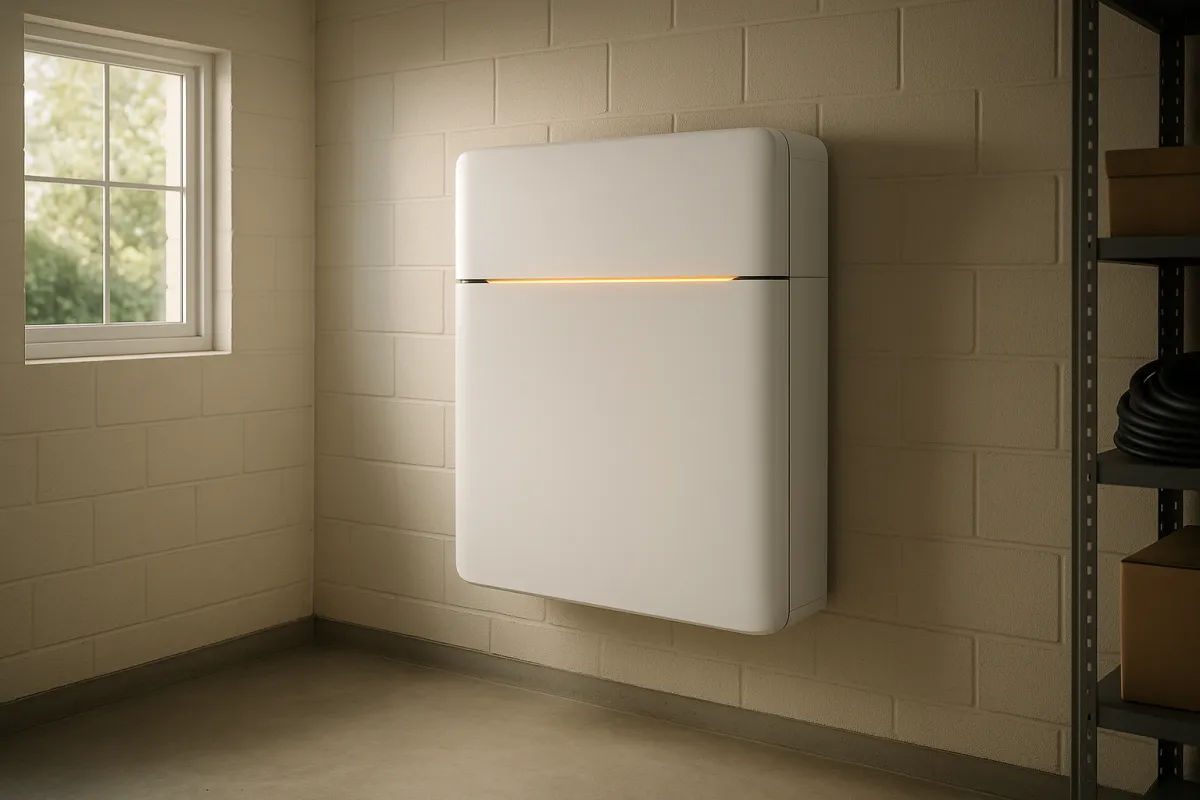
Strip away the branding and you are choosing between two philosophies of backup power. A battery stores electrons in advance: a fixed tank of energy, measured in kilowatt-hours, that sits on your wall fully charged and waits. When the grid drops, the transfer happens in milliseconds, the lights do not flicker, and the house runs on what is in the tank. The constraint is the tank itself. When the stored energy is gone, so is your power, unless something refills it.
A generator makes electrons on demand: a combustion engine, measured in watts of continuous output, that converts fuel into electricity for as long as fuel exists. It does not care whether the outage lasts two hours or two weeks; it cares whether the pipe, the tank, or the gas can is full. The constraints are different in kind: startup delay measured in seconds rather than milliseconds, noise, exhaust, moving parts, and a fuel supply chain that becomes your personal responsibility exactly when the neighborhood infrastructure is struggling.
Neither philosophy is better in general. One is better for your outages. Everything in this briefing is a method for figuring out which, and the first step is putting real numbers on three things: how long your outages run, how often they happen, and how many watts your household genuinely cannot do without.
What each option costs upfront
Honest sticker prices first, all illustrative and all installed, because hardware-only quotes hide half the bill.
A single home battery in the popular 10 to 15 kilowatt-hour class commonly lands between $12,000 and $18,000 installed, including the unit, integration hardware, a critical-loads panel, permits, and labor. Federal tax credits have applied to batteries, which can pull the net figure down meaningfully; our battery briefing walks that math in detail. Whole-home battery coverage usually means two or more units and roughly doubles the number.
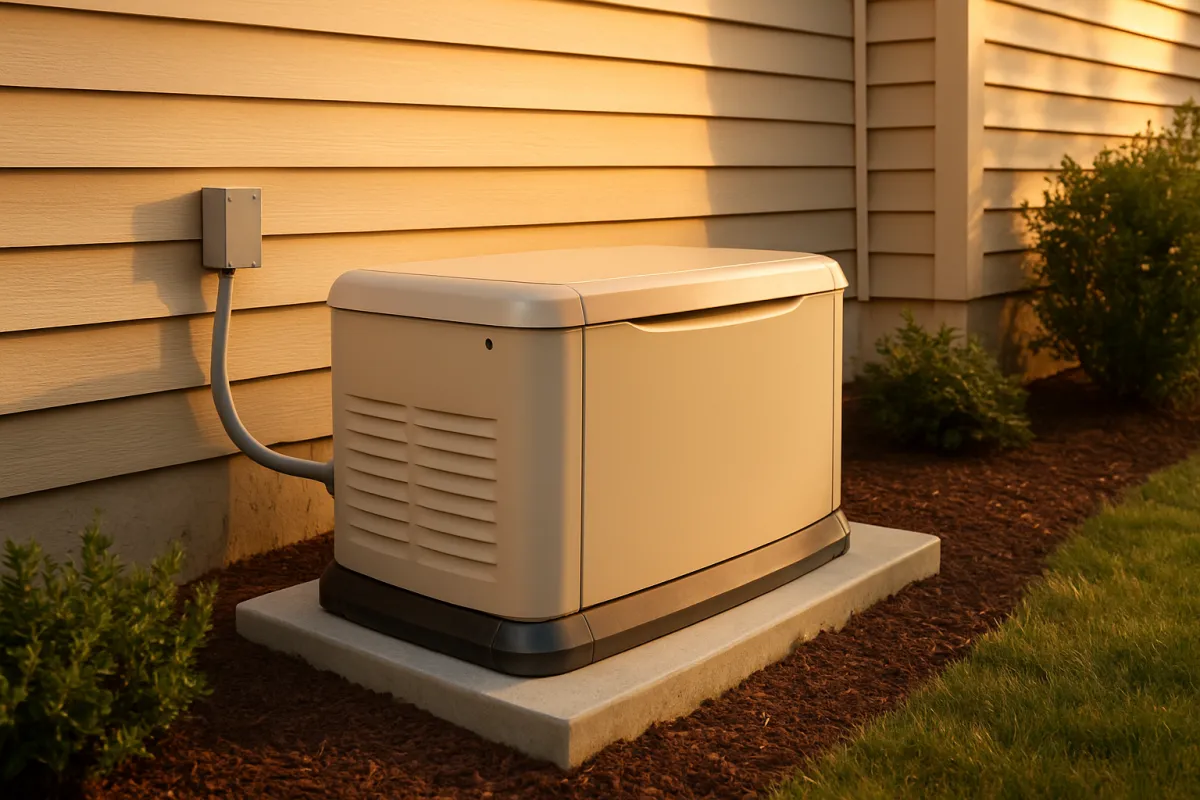
A whole-home standby generator, the permanently installed kind that starts itself, commonly runs $9,000 to $15,000 installed. The unit itself is often only $3,000 to $6,000 of that; the rest is the concrete pad, the gas line work, the automatic transfer switch, permits, and electrician time. Installation quotes vary as widely as solar quotes do, and for the same reason: labor and overhead are the negotiable half.
A portable generator is the budget path: roughly $500 to $1,500 for a decent unit, plus a few hundred dollars for a manual transfer switch or interlock kit installed at your panel so you can feed the house safely. Call it $1,000 to $2,000 all-in. It demands the most from you during an outage, wheeling it out, fueling it, starting it, and that labor is exactly what the standby premium buys away.
What each actually runs, and for how long
The two machines are rated in different currencies, and converting between them is the core math of this decision. A battery is a quantity of energy: kilowatt-hours in the tank. A generator is a rate of power: watts it can sustain. Your house consumes both, watts at any instant and kilowatt-hours over time, so each machine fails differently: overload a generator and it trips immediately; overdraw a battery and it simply empties early.
Work a real critical load. A refrigerator averages about 150 watts across its cycles. A sump pump draws roughly 800 watts while running, with a startup surge near double that. A gas furnace fan takes around 500 watts, internet gear maybe 50, and efficient lights another 100. Trimmed to essentials, that is roughly 1,500 watts of average load, the figure we will carry through this briefing.
Against that load, a 13.5 kilowatt-hour battery holds 13,500 watt-hours: nine hours flat out, and usually more in practice because the fridge and furnace cycle off. Add central air conditioning at 3,000-plus watts and the same battery can be empty before dinner. A generator flips the constraint: a unit rated above your load runs the house for as many hours as you can feed it. A five-gallon tank through a portable at that load is roughly ten hours; a standby on a natural gas line has no tank to empty at all.
Hours of backup at a 1,500 W critical load
Same trimmed household load, three different machines. Illustrative.
The standby bar is capped at 24 hours for display: on a natural gas line it simply keeps running, subject to brief oil-check pauses on multi-day runs. The battery bar assumes a flat 1,500 W draw; cycling loads stretch it, solar recharge can reset it daily, and heavy loads shrink it fast.
The outage-length crossover
Put runtime and refueling together and a crossover appears. For outages up to several hours, the battery is close to unbeatable: it switches over before your clocks notice, makes no noise, produces no fumes, asks nothing of you, and refills itself from the grid or your panels when power returns. The generator spends those same short outages proving its overhead: startup delay, engine noise for the whole neighborhood, and a fuel bill for an event the battery would have shrugged off.
Stretch the outage past the battery’s tank, though, and the logic inverts hour by hour. A 13.5 kilowatt-hour battery carrying 1,500 watts dies during the first night. Without solar recharge, day two belongs entirely to combustion. A gas-line standby is still running at hour 60 exactly as it was at hour six, and even a portable keeps going as long as someone keeps pouring fuel into it.

So the deciding question is not which machine is better but where your outages sit relative to that crossover. Utilities publish average outage duration by region, your own memory of the last five years is data, and neighbors are a surprisingly good outage database. Short and frequent points battery; long and rare points generator; long and frequent points generator or hybrid, and we will get to the hybrid.
Fuel logistics: the part people discover mid-outage
Generator marketing shows the machine; generator ownership is mostly about the fuel, and the three fuels behave very differently when the grid is down.
Natural gas is the aristocrat. If your street has a gas line, a standby generator taps it and the fuel question disappears: no tank, no deliveries, no trips. Gas service almost always survives electrical outages, though in earthquakes or major disasters it can be interrupted, which is worth knowing if that is your risk profile.
Propane is the rural workhorse: a 250 to 500 gallon tank on your property feeds the generator for days. The logistics are schedulable, keep the tank decently full during storm season, but real: you are managing inventory, and a long regional event can put you in a queue for delivery trucks along with everyone else.
Gasoline is the demanding one, and it is what portables drink. It stales in months without stabilizer, storing large quantities is genuinely hazardous, and the mid-outage failure mode is famous: gas stations pump with electricity, so the stations near a blacked-out neighborhood are often dark too, and the drive to a live one gets longer as the event gets bigger. A portable-generator plan is really a fuel plan: stabilized cans rotated seasonally, or it is not a plan at all.
Running costs per outage hour
The machines also differ in what each hour of backup costs while it is happening, and the gap is larger than most buyers expect. All figures here are illustrative; your fuel prices and rates will move them.
A standby generator at moderate load burns natural gas at a rate that commonly works out to roughly $2 to $4 per hour, and propane typically runs somewhat more per hour of the same output. A portable at our 1,500 watt load burns very roughly half a gallon of gasoline an hour: call it $1.75 per hour at $3.50 a gallon, climbing steeply as load rises. A 60-hour event can put a three-figure fuel bill on top of whichever generator you own.
The battery’s hour of backup, by contrast, was purchased earlier at your electricity rate. Refilling 13.5 kilowatt-hours at an illustrative $0.17 per kilowatt-hour costs about $2.30, for nine hours of coverage, and if panels do the refilling the marginal cost rounds to zero. Per protected hour, stored electrons are roughly an order of magnitude cheaper than combusted ones.
Running cost rarely decides the purchase by itself, upfront cost and outage shape dominate, but it compounds the pattern: the more hours per year you actually spend on backup power, the more the generator’s fuel bill argues for either a gas line or a battery doing the routine hours.
Maintenance: the quiet ledger
A home battery’s maintenance list is nearly empty: no moving parts beyond cooling, firmware updates that arrive over wifi, and a preference for mild temperatures. You can own one for five years and never touch it.
A standby generator is a car engine bolted to your house, and it wants what engines want. Oil and filter changes on a schedule measured in run-hours. Spark plugs and air filters. A starter battery of its own that must hold charge. And the exercise cycle: the unit starts itself weekly or monthly, runs for several minutes to keep seals wet and verify readiness, and burns a little fuel doing it. Annual professional service commonly runs $200 to $500, illustrative, and skipping it is how standby units become very expensive lawn ornaments that fail on the day they exist for. Portables need the same care in smaller doses, plus fuel rotation.
Over a decade, the ledger looks like this for a standby unit.
10-year standby generator cost, where it goes
Illustrative decade for a gas-line standby: about $12,000 installed, $400 a year of service and exercise, modest outage fuel.
Shares assume roughly $12,000 installed, $4,000 of maintenance, and $2,000 of fuel across ten years, about $18,000 total. Heavy outage years push the fuel slice up; the maintenance slice arrives whether the grid ever fails or not.
That last clause is the one to sit with: a third of the generator’s decade cost accrues even if you never have an outage. The battery’s equivalent slice is close to zero.
Noise, neighbors, and where you can put it
Backup power has a social dimension, and it only shows up at 2 a.m. during an outage. A standby generator at typical distances runs in the 60 to 70 decibel range, roughly a loud conversation to a vacuum cleaner, continuously, for the duration of the event. Portables are generally worse, and a cheap open-frame portable can dominate a silent, blacked-out street. Some municipalities and HOAs enforce noise limits and setback rules that constrain placement or even model choice, and multi-day events have strained more than one neighborly relationship.
A battery makes no sound worth mentioning. In an outage the only evidence your house has power is that it has power, which some owners in wildfire-shutoff regions describe as its own kind of luxury.
Placement follows the same split. Generators must live outdoors, several feet from openings, because exhaust includes carbon monoxide, and portable generators in garages or near windows are a genuinely lethal error that kills people every storm season. Batteries mount on a garage wall or exterior wall, subject to electrical code clearances rather than exhaust math. If your lot is small, your neighbors are close, or your outages tend to happen at night, weight this section more heavily than the brochures do.
Permits, installation, and the transfer switch
Neither machine is a plug-in appliance, and both converge on the same piece of hardware: a transfer switch that isolates your house from the grid before backfeeding it. Skipping that isolation can send power up the line and endanger utility crews, which is why every legitimate path involves permits and an electrician.
From there the projects diverge. The battery install is an electrical project: wall mounting, a critical-loads panel or smart panel to define what stays on, inverter integration, and utility interconnection paperwork, typically a day or two of site work. The standby generator install is a small construction project: a concrete or composite pad, trenched gas and electrical runs, a plumber or gas fitter for the line, the automatic transfer switch, and inspections on both the gas and electrical sides.
The portable path is the light version: an interlock kit or manual transfer switch installed at your panel, a few hundred dollars of electrician time, and a wall inlet where the generator cord lands. In every case, the three-quote discipline from our solar cost briefing transfers intact: installation is the negotiable half of the bill, and identical hardware routinely carries quotes thousands of dollars apart.
The solar interaction
If panels are on your roof or in your plans, the comparison tilts, because the two machines relate to solar completely differently.
Start with the fact that surprises new solar owners: standard grid-tied panels shut down during an outage. Inverters are required to stop exporting when the grid fails so line workers are not fighting live wires, which means a plain solar house goes dark like every other house. A generator does nothing to change this. It runs the house on fuel while your panels sit idle overhead, two power plants on one roof line, only one working.
A battery changes the physics. Battery systems designed for backup create a small island: the grid is disconnected, the house runs on the battery, and the panels wake up and recharge it in daylight. That loop, drain by night and refill by day, is how a modest battery stretches across multi-day events at a disciplined load, and it is the one capability no generator can imitate. Our battery briefing covers the equipment side of pairing storage with panels.
The practical rule: no solar and none planned, the generator loses nothing. Solar on the roof, and every backup dollar pointed at a battery buys coverage that improves itself every sunny morning of an outage.
Daily value: what the hardware earns on normal days
Here is the asymmetry that ten-year math keeps rediscovering: your grid probably works more than 99 percent of the time, and the two machines spend that time very differently.
The generator spends it idling. It exercises itself weekly, consumes a little fuel, accrues service costs, and produces nothing, because producing nothing is its job until the grid fails. Every dollar of its cost must be justified by outage hours alone.
The battery can work every day. Under time-of-use rates it buys or stores cheap midday energy and discharges into the expensive evening window; under weak net metering it stores solar you would otherwise export at a poor rate. That daily arbitrage, worked in full in our battery briefing, can return a meaningful share of the battery’s cost across a decade, with virtual power plant programs stacking on top where they exist. The backup capability then rides along on hardware the bill savings were already paying for.
This is why comparing sticker prices misleads. The generator’s $12,000 is all insurance; the battery’s $15,000 is part insurance, part investment, and the split depends on your utility’s rules. Run your rates through our savings calculator to see the daily-value side before you price the insurance side, because a battery that earns on normal days does not need to win the outage math outright.
Lifespan and warranties
The two machines also age in different currencies. Batteries age by cycles and years: warranties commonly run about ten years, typically guaranteeing a stated share of original capacity, often around seventy percent, at the end. Degradation is a slow shrinking of the tank rather than a failure. A battery cycling daily for bill savings spends its cycles earning; one held purely for backup barely cycles at all and ages mainly by calendar.
Generators age by engine hours. Air-cooled standby units are commonly rated for a few thousand hours of running life, which sounds small until you notice what it means: at 50 outage hours a year plus exercise cycles, the engine can serve for decades. Warranties commonly run around five years for standby units, less for portables, and, unlike batteries, generators are rebuildable: oil, parts, and service can extend an engine well past its warranty in a way no battery chemistry allows.
The planning consequence is symmetric. Judge the battery against its warranty decade and treat later capacity as upside. Judge the generator against its engine-hour rating divided by your honest annual outage hours, minus a maintenance discipline you must actually sustain. A neglected generator’s real lifespan is however long it takes you to skip two service visits.
Climate and grid reliability: fit the tool to the outage
Geography writes most of this decision before you do. The relevant data is your local outage profile: how often the grid fails, how long it stays down, and why.
Hurricane and ice-storm country produces the generator’s home game: infrequent but multi-day outages, sometimes with a week of restoration time, exactly the shape that outlasts any reasonable battery. Wildfire-shutoff regions produce the battery’s home game: planned outages announced in advance, lasting hours to a couple of days, in sunny weather that keeps panels recharging the battery daily. Dense suburbs with aging distribution gear tend to produce frequent short blips, battery territory again, while rural feeders at the end of long lines can see both shapes and often justify the hybrid.
Climate also acts on the hardware itself. Batteries dislike extreme heat and cold, and some limit charging below freezing, so harsh-climate installs belong in garages or need units with thermal management. Generators start reluctantly in deep cold without block heaters, and gasoline logistics get worse in exactly the blizzard that caused the outage. Match the machine to the failure mode your region actually produces, not to the disaster in the commercial.
The hybrid answer: small battery plus portable generator
The comparison so far treats the machines as rivals, but the strongest configuration for many households is a deliberately modest version of both: a single battery, sized for essential loads, plus a $1,000-class portable generator and a transfer inlet.
The division of labor is clean. The battery handles everything short: the two-hour blips, the overnight outages, the switchover so fast your sump pump never notices, all silent and effortless. The portable stays in the garage, fuel stabilized, and exists only for the rare event that outlasts the battery. And in those long events, the two cooperate: many battery systems accept generator input, so the portable runs a few efficient hours at steady load to recharge the battery, then shuts off while the battery carries the house quietly through the night. Less fuel, less noise, and no 3 a.m. refueling trips.
Priced illustratively, a $13,000 battery plus a $1,500 portable setup lands near the top of the standby generator range while covering both outage shapes, earning daily arbitrage on normal days, and pairing with solar for daytime recharge. The standby’s remaining advantages are automation and whole-home capacity: it starts itself when nobody is home and can carry central air. For households without those requirements, the hybrid is quietly the best value on this page. Confirm generator-input support for your battery brand before building the plan around it.
Sizing a battery for backup
Battery sizing for outages is one division problem plus one discipline. The division: usable kilowatt-hours divided by your average critical load in kilowatts equals hours of coverage. The discipline: deciding, before the outage, what counts as critical.
Walk your panel with fresh eyes. Refrigerator, sump pump or well pump, furnace fan, internet, some lights, phone charging, and a medical device if you have one: that basket typically averages 1,000 to 2,000 watts. At 1,500 watts, one 13.5 kilowatt-hour unit is roughly nine hours flat, longer with cycling, and a full day or more if you shed load aggressively. A critical-loads panel makes the discipline automatic by wiring only the chosen circuits to the battery.
What breaks battery sizing is heat and cold: central air conditioning, electric resistance heating, and electric water heaters each draw as much as the entire essential basket, which is why whole-home battery backup means multiple units and multiplied cost. If summer outages with a must-run AC are your reality, either budget for two or more batteries or accept that this specific load is the generator’s argument. Size to outage hours you actually experience: coverage for a six-hour outage is one unit; ambitions of 48-hour whole-home coverage are a different budget conversation entirely.
Sizing a generator
Generator sizing is a watts problem, and it is two numbers, not one: running watts, what the unit sustains, and starting watts, the brief surge it can supply when motors kick on. Motors are the whole game. A sump pump that runs at 800 watts may demand 1,600 for the second it starts; well pumps and AC compressors surge harder still. Add your running loads, then confirm the unit’s surge rating covers your largest motor starting while everything else runs.
The essential basket from the last section, about 1,500 running watts with surges, is comfortably handled by a 3,000 to 4,000 watt portable, which is why that class is the hybrid workhorse. Whole-home coverage with central air typically points at standby units in the high teens to low twenties of kilowatts, and this is where a load-management module earns its keep: it sheds the water heater while the AC starts, letting a smaller, cheaper unit behave like a bigger one.
Resist the bigger-is-better instinct. An oversized generator costs more upfront, burns more fuel per hour at every load, and runs less efficiently lightly loaded. The right size covers your real loads with modest headroom, and the sizing worksheet is the same arithmetic our savings calculator applies to solar: start from what you actually use, not from the biggest number on the shelf.
Two households, opposite verdicts
Two illustrative households, same question, opposite answers, and both are right.
Household one is suburban, in wildfire-shutoff territory, with solar already on the roof and time-of-use rates that make evenings expensive. Their outages: four or five a year, two hours to a day, usually announced, usually in sunny weather. A 13.5 kilowatt-hour battery covers their 1,400 watt essential basket for nine-plus hours and recharges from the panels every daylight stretch of a longer shutoff. On the other 360 days it arbitrages the evening rate spread, returning several hundred illustrative dollars a year against its cost. A standby generator here would burn $12,000 to sleep through short outages the battery handles silently. Verdict: battery, and it is not close.
Household two is rural, at the end of a long feeder in ice-storm country, on a propane tank, no solar, cheap flat-rate power. Their outages: one or two a year, but the bad ones run three to five days in freezing weather, with a well pump and a furnace that cannot stop. A battery here dies the first night, earns nothing daily against flat rates, and has no panels to refill it. A propane-fed standby with an automatic transfer switch runs the whole event, starts itself if the storm hits while they are away, and the tank in the yard is fuel security they already manage. Verdict: standby generator, and the battery brochure never had a chance.
Neither household bought the better machine. Each bought the machine shaped like its outages.
Mistakes people make with backup power
The same handful of errors accounts for most backup regret, and every one is avoidable before signing.
- Buying for the fantasy outage. Sizing whole-home coverage for a two-week grid collapse when your actual history is six-hour storm outages pays for capacity that will never once be used.
- Ignoring the crossover. A battery bought for ice-storm country or a standby bought for two-hour blips are both the right machine for someone else’s outages.
- Skipping the transfer switch. Backfeeding a house through a dryer outlet endangers line workers and is illegal everywhere; the interlock kit is cheap by comparison with everything about it.
- A portable with no fuel plan. Stale gasoline and dark gas stations turn a $1,000 machine into a paperweight at hour six; stabilized, rotated cans are the actual product.
- Running a generator near openings. Carbon monoxide from garage or window placement kills people every storm season; outdoors, far from openings, no exceptions.
- Skipping generator service. The exercise cycle and annual visit are what make a standby start on the one morning that justifies it.
- Forgetting the daily-value math. Comparing sticker prices ignores that a battery can earn arbitrage all decade while a generator only spends.
Avoid these and the hardware, whichever you pick, will do its job on the bad day.
Ten-year cost, battery versus standby, side by side
This briefing keeps insisting on ten-year math over sticker prices, so here it is assembled, every figure illustrative. Put a $15,000 installed battery next to a $12,000 installed standby generator and the stickers favor the generator by $3,000. The decade is where that lead erodes.
Start the generator’s running tab. Annual service and exercise cycles at roughly $400 add $4,000 over ten years, and they arrive whether or not the grid ever fails. Call outage fuel a modest $2,000 across the decade for a household with occasional multi-day events. That is $6,000 of spending stacked on the $12,000 sticker, for an $18,000 ten-year cost, and none of it earns a cent on the normal days.
Now the battery’s tab, which runs the other direction. Maintenance is essentially nothing beyond firmware, so the $15,000 barely grows. Against it, the battery can earn on the 360 working days: a household on a decent time-of-use spread might net several hundred illustrative dollars a year in arbitrage, say $500, which is $5,000 across the decade. Confirm any federal or state incentive too, since it changed recently and can cut the battery’s net figure further. Netting the earnings, the battery’s effective ten-year cost drops toward $10,000.
So the machine that looked $3,000 more expensive on the sticker can finish the decade roughly $8,000 cheaper once service, fuel, and arbitrage are counted, before any incentive. The generator does not claw that back, because producing nothing on the good days is its job. This is the whole reason the comparison rewards patience with a spreadsheet: the sticker is the smallest honest number on either side, and the ranking can invert once the quiet ten-year flows are added. Where your grid fails for days at a stretch, the generator still earns its place on runtime alone, but pay for it knowing what the decade actually holds.
The bottom line
Battery or generator is not a debate with a winner; it is a matching problem with your outage profile on one side. Batteries own the short outage: instant, silent, zero-maintenance coverage that pairs with solar to recharge mid-event and earns rate arbitrage on every normal day. Generators own the long outage: fuel keeps arriving after any battery is empty, and a gas-line standby will still be running on day four. The costs are closer than the brochures suggest once you add the generator’s decade of service and fuel, or the battery’s daily earnings, so price ten years, not stickers.
Count your outages honestly: hours per event, events per year, watts you truly need. Short and frequent, buy the battery. Long and rare with heavy loads, buy the standby. Both shapes on a budget, buy the hybrid: a modest battery for the blips and a portable with a fuel plan for the siege. Then run your own rates through our savings calculator, because if solar and arbitrage are in your picture, the battery was never just insurance to begin with.
WattBarn publishes this briefing to inform, not to advise. The prices, runtimes, fuel burn rates, and maintenance costs above are illustrative sketches: your loads, fuel prices, utility rates, outage history, and local codes will produce different numbers, and all of them drift over time. Backup power also carries real safety stakes, from carbon monoxide to backfeed hazards, so put a licensed electrician and, where fuel is involved, a qualified gas fitter between any idea here and your electrical panel, and let written local quotes and current code, not our sketches, settle your final decision.
Frequently asked questions
Is a home battery or a generator better for power outages?
It depends on the shape of your outages, not on the hardware in the abstract. A battery is silent, instant, and maintenance-free, and it handles short outages of a few hours beautifully, especially when solar panels can recharge it during the day. A generator burns fuel on demand, so it wins multi-day events where a battery would run dry. Count how long your outages typically last and how often they happen, and the answer usually declares itself.
How much does a home battery backup system cost compared to a generator?
As illustrative figures, a single installed home battery commonly runs $12,000 to $18,000, a whole-home standby generator commonly lands between $9,000 and $15,000 installed, and a portable generator with a proper transfer setup runs roughly $1,000 to $2,000. Upfront price is only part of the picture, though. Generators keep costing money in fuel and annual service, while a battery can actually earn money on normal days by shifting cheap power into expensive hours. Compare ten-year costs, not sticker prices.
How long will a 13.5 kWh battery run my house in an outage?
Divide the battery's usable energy by your load. At a trimmed critical load of about 1,500 watts, covering a refrigerator, sump pump, internet, some lights, and a furnace fan, 13.5 kilowatt-hours works out to roughly nine hours flat out, and often longer in practice because those loads cycle on and off. Run whole-home loads like central air conditioning and the same battery can be empty in two or three hours. Pair it with solar and the battery can recharge each day, stretching coverage across multi-day events at a reduced load.
How long can a standby generator run continuously?
A standby generator on a natural gas line can run for days at a time, since the fuel arrives by pipe and never runs out in a typical outage. Manufacturers generally recommend brief shutdowns for oil checks during extended runs, commonly somewhere around every 24 to 100 hours of continuous operation depending on the model. On propane, runtime is set by tank size: a typical 250 to 500 gallon tank can carry a modest load for several days. The engine, not the fuel, is usually the limiting factor in very long events.
Do generators work with solar panels?
They coexist but do not cooperate much. Standard grid-tied solar shuts down during an outage for line-worker safety, and a generator does nothing to change that, so panels sit idle while the engine runs. A battery changes the story: it gives the solar system a place to island, letting panels recharge the battery during the day even with the grid down. That recharging loop is the single biggest technical advantage batteries hold in extended outages, and it is why solar owners lean battery more often than generator.
What maintenance does a standby generator need compared to a battery?
A standby generator is a small engine living outdoors, and it needs what engines need: oil and filter changes, spark plugs, battery checks for its own starter, and a weekly or monthly self-test exercise cycle that burns a little fuel. Annual professional service commonly runs $200 to $500 as an illustrative range. A home battery has no moving parts beyond a cooling fan, and maintenance is essentially firmware updates and keeping the unit within its temperature range. Over a decade, that maintenance gap adds thousands of dollars to the generator side of the ledger.
Can I use a portable generator to charge a home battery?
In many setups, yes, and it is the quiet logic behind the hybrid approach. During a long outage, a portable generator can run for a few hours at an efficient, steady load to recharge the battery, then shut off while the battery carries the house silently through the night. You get the battery's instant, silent coverage for short outages and the generator's unlimited runtime for rare long ones, without paying for a whole-home standby installation. Confirm your battery system supports generator input before you count on this, since integration varies by brand.
Is a whole-home standby generator worth it if outages are rare?
Usually not on the numbers. A standby unit that costs $9,000 to $15,000 installed (illustrative) and then sits idle through one brief outage a year is very expensive insurance, and it still demands annual service and exercise cycles whether or not the grid ever fails. Households with rare, short outages typically get better value from a modest battery that also earns daily bill savings, or from a $1,000 portable setup kept for emergencies. The standby case strengthens sharply where outages run multiple days, or where medical equipment or home businesses cannot tolerate any gap.