
What's on this page
- Do solar panels work in winter: the direct answer
- Why cold weather actually makes panels more efficient
- More efficient, less total: the daylight problem
- Solar output in cloudy weather
- Generating without direct sunlight
- Snow cover and production
- Snow-shedding and the role of tilt
- The size of the winter production drop
- The seasonal production curve, month by month
- Net metering: banking summer credits for winter
- Sizing and oversizing for winter needs
- Batteries for shorter winter days
- Are solar panels worth it in cold climates?
- How winter output varies by region
- A worked example: one system’s summer vs winter
- Do solar panels work in the winter for your biggest bills?
- Common winter-solar myths
- Winter output by climate zone, three worked roofs
- How to sanity-check a winter production estimate
- The bottom line
Short answer: Yes, solar panels work in winter and in cloudy weather. They generate at reduced output, not zero, whenever daylight reaches the glass, and cold actually raises a panel's electrical efficiency. What shrinks is total energy, because days are shorter and the sun sits lower. Overcast skies commonly drop output to roughly 10 to 25 percent of a clear day, illustratively, and snow usually slides or melts off dark tilted panels within a day or two.
Do solar panels work in winter? Yes, they do, and the short version is that a rooftop array keeps generating clean power through cold, clouds, and even snow, just at a reduced output rather than a full stop. The worry behind the question is understandable: solar is powered by sunlight, and winter is the season of short, grey, snow-covered days. But the panels do not switch off when the temperature drops. In fact the cold end of the year holds a genuine surprise, because a solar cell converts light into electricity slightly better when it is cold than when it is baking on a summer roof. What actually shrinks in winter is the number of hours the sun is up and the angle it hits your roof, not the panel’s willingness to work.
This briefing separates those two ideas, because confusing them is the source of most winter-solar anxiety. We will cover why cold weather can make panels more electrically efficient while the season still delivers less total energy, what really happens on cloudy and overcast days, whether snow is a problem or a passing one, how much less a typical system makes month by month, and whether panels are worth buying in a cold or cloudy climate at all. Along the way we tie the seasonal swing to sizing in our panel-count briefing, to price in the solar cost briefing, and to the break-even question in the payback briefing. Drop your own numbers into our savings calculator as you read, because the seasonal picture is downstream of your latitude and your bill.
Key takeaways
- Solar panels work in winter and in cloudy weather; they generate at reduced output, not zero, whenever daylight reaches the glass.
- Cold actually raises a panel's electrical efficiency, but shorter days and a lower sun angle mean the season still collects less total energy.
- Overcast skies commonly drop output to roughly 10 to 25 percent of a clear day (illustrative), because clouds diffuse light rather than block it entirely.
- Snow usually slides or melts off dark, tilted panels within hours to a day or two, so annual snow losses are modest in most climates.
- Winter economics hinge on your electricity rate and net metering, not raw sunshine, which is why some cloudy regions are strong solar markets.
Do solar panels work in winter: the direct answer
Here is the answer in one place, since it is the reason you are reading. Solar panels work in winter. They generate electricity on any day light reaches them, including cold, cloudy, and snow-adjacent days, and they do it reliably for decades in freezing climates. What changes with the season is the quantity of energy, not the function. A panel is a light-to-electricity converter, and as long as photons land on the glass it produces current, whether that light is strong July sun or thin January overcast.
The number that drops in winter is total production, and it drops for reasons that have nothing to do with the panel breaking. Days are shorter, so the sun is above the horizon for fewer hours. The sun also sits lower in the sky, so its light passes through more atmosphere and strikes your roof at a shallower angle, both of which weaken the intensity that reaches the cells. Add more frequent cloud cover in many regions and the occasional snow day, and a winter month simply gathers less energy than a summer one. That is a real reduction to plan around, not a malfunction, and the rest of this briefing is about its size and how to design for it.
Why cold weather actually makes panels more efficient
The counterintuitive fact of solar is that panels prefer the cold. A photovoltaic cell is a semiconductor, and semiconductors convert light to electricity more efficiently at lower temperatures. As a panel heats up, the voltage it produces sags, and with it the power. Manufacturers publish this as a temperature coefficient, commonly around minus 0.3 to minus 0.4 percent of output for every degree Celsius above the standard test temperature of 25 degrees. Run the panel hot on a summer roof, where cell temperatures can climb well past 50 or 60 degrees, and it quietly gives up several percent of its rated output.
Winter flips that penalty into a bonus. On a cold, clear day the cells run near or below their rated temperature, so each panel delivers closer to, and sometimes above, its nameplate figure per unit of sunlight. This is why a crisp, sunny winter afternoon can post a surprisingly strong instantaneous output, occasionally spiking past what the same array manages in the summer haze. The physics is genuine and it is one of the most misunderstood points about solar: the enemy of panel efficiency is heat, not cold. What cold cannot do, unfortunately, is add hours to the day.
More efficient, less total: the daylight problem
So if cold panels are more efficient, why does winter still produce less? Because efficiency and total energy are two different things, and winter improves the first while gutting the second. Efficiency is how well a panel converts the light it receives at any instant. Total energy is that efficiency multiplied by how much light arrives across the whole day. Winter hands you a slightly better conversion rate but far less light to convert, and the light shortage wins by a wide margin.
The light shortage has two parts. First, day length: a location that gets fifteen hours of daylight in June might get nine in December, so the sun is simply up for far less time. Second, sun angle: in winter the sun tracks low across the southern sky, so its rays travel a longer path through the atmosphere and strike a typical roof at a glancing angle, spreading the same energy over more area and losing intensity along the way. The measure that captures both is peak sun hours, the number of full-strength-equivalent sunlight hours per day, and it can more than halve between summer and winter in northern regions. A modest efficiency gain cannot offset losing half your peak sun hours, which is why the season nets out lower. Our panel-count briefing uses those same sun hours to size an array, so the winter figure is worth knowing before you buy.
Solar output in cloudy weather
Clouds are the second half of the winter worry, and here too the answer is yes, panels keep working. The key is that clouds diffuse sunlight rather than switch it off. On an overcast day the sunlight does not vanish; it scatters through the cloud layer and arrives at the ground as soft, directionless light. You can still see perfectly well outdoors under heavy cloud, and that visible light is exactly what a panel harvests. So an overcast sky is a dimmer, not an off switch.
How much output survives depends on how thick the cloud is. As an illustrative range, a bright but hazy or lightly clouded sky might cut production only modestly, while a dark, heavy overcast can drop it to roughly 10 to 25 percent of a clear-day figure. Broken clouds produce a jumpy output that rises and falls as the sun ducks in and out. None of these is zero. This diffuse-light performance is precisely why regions with plenty of grey weather still run successful solar programs: over a year, the cloudy days are already counted in the sun-hour averages an installer uses, so a well-sized array is designed with them in mind, not blindsided by them.
Generating without direct sunlight
A related question hides inside the cloudy-day one: do panels need the sun to be directly, visibly shining on them? No. Panels respond to both direct beam sunlight and the diffuse skylight that surrounds it. Direct light, the kind that casts a sharp shadow, delivers the most power, but a real, meaningful fraction of what a panel collects over a year comes from diffuse light scattered by the atmosphere, clouds, and even reflection off bright surfaces like snow. That is why an array on a shaded-but-bright afternoon, or under a uniform grey sky, still puts out current.
The honest boundary is between low light and no light. Panels generate whenever there is daylight, however diffuse, but they cannot make useful power from true darkness or from indoor artificial lighting. So the seasonal story is really about how much daylight of any kind is available, not whether the sun is glaring down from a clear sky. A winter of many overcast days is a lower-production winter, but the panels are working on every one of those days. Night is the only genuine zero, and that is the gap a home battery or a grid connection fills, a point we return to in the storage section and in our battery briefing.
Snow cover and production
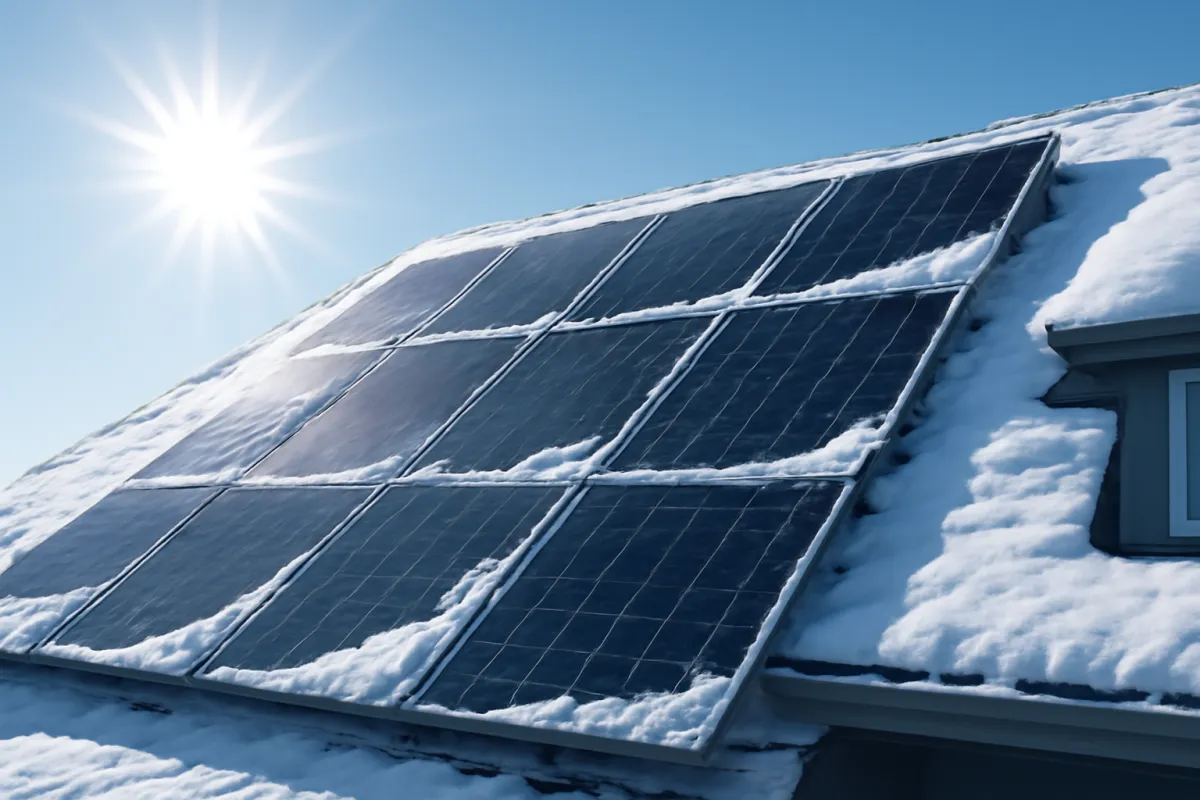
Snow is the one winter condition that can actually stop a panel, because opaque snow sitting on the glass blocks light from reaching the cells. If a panel is fully buried under a thick, solid snow layer, its output for that period is effectively nil. The important word, though, is temporary. Rooftop panels are dark, smooth-surfaced, and tilted, three properties that make them shed snow far better than the surrounding roof. They absorb sunlight, warm up, and the bottom layer of snow melts into a slick film that lets the rest slide off, often in a satisfying sheet.
A light dusting frequently does not stop production at all, since enough light filters through thin snow to keep the cells partly active, and that trickle of warmth speeds the melt. Because a covered panel clears itself within hours to a day or two in most conditions, the annual energy lost to snow tends to be small, commonly a single-digit percentage of yearly production in many climates. Heavy-snow regions and low-tilt or flat arrays hold snow longer and lose more, which is one reason tilt matters, covered next. In the vast majority of homes, snow is a brief interruption rather than a season-long shutdown.
Snow-shedding and the role of tilt
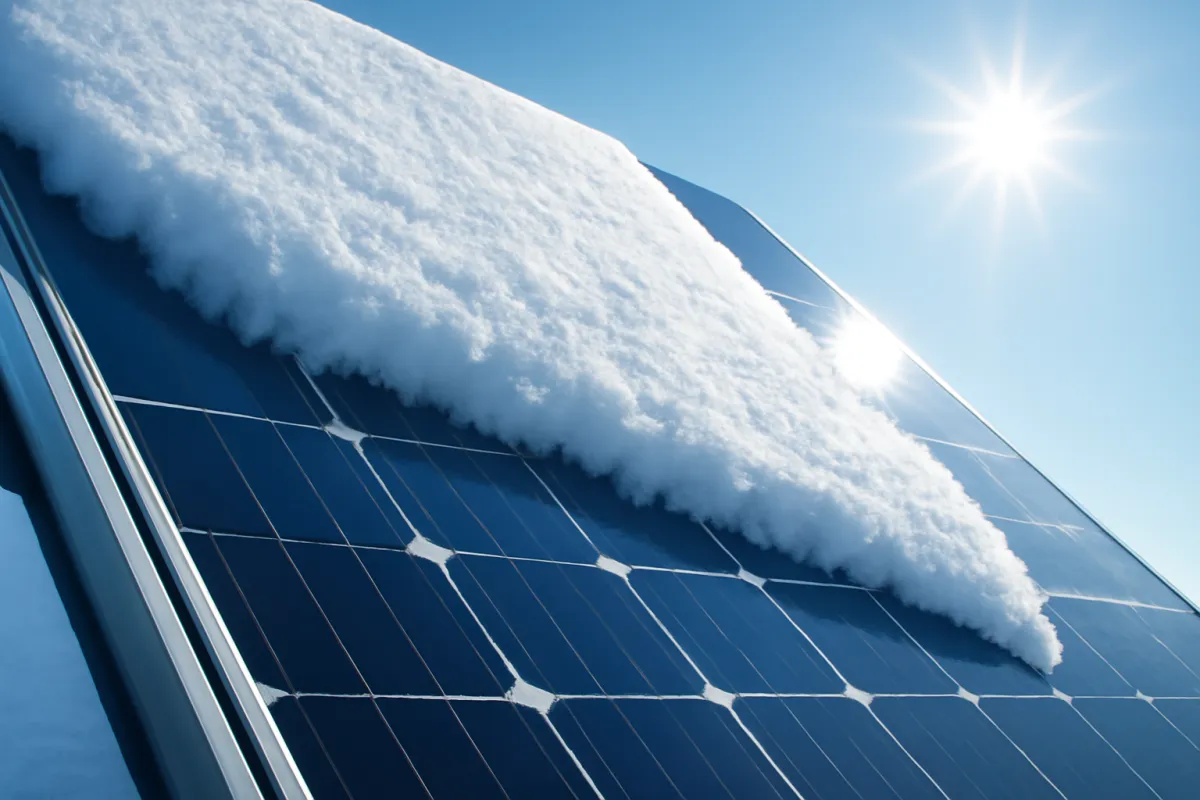
Whether snow is a non-issue or a nuisance comes down mostly to tilt. A steeply tilted panel sheds snow quickly, because gravity and the slick meltwater film work together and the snow has an obvious path to slide off. A shallow or flat-mounted array holds snow longer, since there is little slope to carry it away, and in a snowy climate that can mean days of reduced output after each storm. This is why ground mounts and flat commercial roofs in snow country are often set at an aggressive angle, and why a snowy-region homeowner should ask an installer how the planned tilt handles snow.
Tilt interacts with the sun angle too. A steeper tilt not only sheds snow better but also faces the low winter sun more squarely, recovering some of the intensity lost to that shallow winter angle. There is a trade, because the same steep tilt is less ideal for the high summer sun, so most fixed residential arrays settle on a compromise angle close to the local latitude. The practical takeaway for a cold, snowy region is that a slightly steeper tilt can pay off twice in winter, once by shedding snow and once by catching the low sun, though the summer give-back means it is a judgment call your installer should model. Either way, tilt is a lever you set once, so it is worth getting right.
The size of the winter production drop
Now the number everyone wants. How much less does a system make in winter than in summer? The honest answer is that it depends heavily on latitude, but an illustrative shape holds across most of the country. In the depths of winter, a typical rooftop array often produces somewhere near a quarter to a little under half of its peak summer month, with the midwinter trough commonly landing around 25 to 45 percent of the June or July high. Northern regions sit at the steep end of that range, southern and southwestern regions at the gentle end.
The reason the swing is so wide is that it stacks two effects that both worsen with latitude: shorter days and a lower sun. A home in the far north might see its December production fall to a third or less of June, while a home in the sunny southwest might only dip to half or a bit below. These are illustrative figures, not a promise about your roof, and local cloud patterns move them further. The design lesson is to think in annual totals rather than monthly ones, because a system sized to cover your yearly usage will overproduce in summer and underproduce in winter by design. Our savings calculator works in annual terms for exactly this reason.
The seasonal production curve, month by month
To make the swing concrete, picture the year as a curve. Production climbs from a low winter trough through spring, peaks in the long days of June and July, then falls back through autumn to the trough again. The illustrative monthly figures below trace that curve for a single mid-size array in a temperate climate, and while your own numbers will differ with latitude and weather, the shape is dependable: a tall summer hump and a shallow winter dip, with the shoulders of spring and fall in between.
Illustrative monthly solar production across the year
Sketch of one mid-size array in a temperate climate, in kWh per month. Your latitude and weather move these; the shape is the point.
Bar widths track each month against the July peak (~1,150 kWh set to 100%). December falls near 29 percent of July here, a typical temperate-climate swing; a northern roof dips deeper, a southern one less.
Net metering: banking summer credits for winter
If summer overproduces and winter underproduces, how does a home stay covered year round? For most grid-tied systems, the answer is net metering, the billing arrangement that credits you for surplus energy your panels export to the grid. On a long summer day your array often makes more than the house uses, and that surplus flows to the grid and earns a credit. In winter, when the panels fall short, you draw from the grid and spend those banked credits. The grid effectively acts as a seasonal battery, holding your summer surplus until the short days need it.
This is why annual sizing works. A system built to match your yearly usage is meant to bank credits in the sunny months and cash them in through the lean ones, smoothing the seasonal curve into a roughly flat annual bill. The catch is that net-metering rules vary enormously and many utilities have moved to less generous terms, crediting exports at a low wholesale-style rate or resetting credits each year so banked summer surplus can expire before winter fully spends it. Because those rules decide whether the summer-to-winter hand-off actually works in your favor, check your utility’s current policy before you size an array, a point our payback briefing weighs in dollars.
Sizing and oversizing for winter needs
Understanding the seasonal swing changes how you might size a system. The default approach sizes an array to cover your total annual usage and leans on net metering to move summer credits into winter. That is the most cost-effective path where net metering is generous, because you are not paying for extra panels that only matter a few months a year. Our panel-count briefing walks that annual-sizing method in full, and it is the right starting point for most homes.
Where net metering is stingy or absent, or where you rely heavily on winter production, a case emerges for a modestly larger array. Oversizing lifts the whole curve, including the winter trough, so the short days cover more of your load directly rather than depending on banked credits you may not fully recover. The trade is real: extra panels cost money and, under poor export rates, their summer surplus earns little, so oversizing purely for winter can be an expensive way to buy a few cold-month kilowatt-hours. The balanced move is to size to annual usage first, then add a measured winter margin only if your utility’s rules or your winter reliance justify it. Slide your numbers in the calculator to see how the annual total shifts.
Batteries for shorter winter days
Winter raises the storage question from two angles, and it is worth separating them. The first is daily: winter’s short days and long, dark evenings mean more of your usage happens after the sun is down, and a battery that stores the day’s production for evening use can shift more of your consumption onto your own panels. The catch is that the same short days give the battery less surplus to store, so a battery earns its keep in winter mainly where evening rates are high, not simply because the nights are long.
The second angle is backup. Winter storms are a leading cause of grid outages, and a battery can keep essentials running when the power drops, though a modest home battery is sized for hours, not for weeks of sunless heating. Sizing storage for winter means being honest about how little the panels recharge it on a grey December day, which is why cold-climate backup often pairs a battery with a generator or a disciplined critical-loads plan. Whether the numbers justify a battery at all comes down to your rates and your outage frequency, which our battery briefing prices out. Buy storage for a job you can name, evening rate savings or outage insurance, not for a vague sense that winter needs it.
Are solar panels worth it in cold climates?
The biggest myth about winter solar is that cold or cloudy regions are bad places to buy. They are often excellent ones, because solar economics ride on your electricity rate and incentives far more than on your sunshine. A kilowatt-hour of solar is worth whatever a grid kilowatt-hour costs you, and some of the cloudiest, coldest regions have the highest power prices in the country. When rates are high, every unit the panels make, summer or winter, offsets an expensive grid unit, and the payback can be quicker than in a sunny state with cheap power.
The sunshine does matter to sizing: a cloudier, higher-latitude location needs a somewhat larger array to reach the same annual production, which lifts the up-front cost captured in our solar cost briefing. But a high enough rate more than compensates, which is why cold-climate solar markets thrive. The cold, remember, even helps the panels run efficiently. The honest way to settle it for your own home is not a gut feeling about your climate but the arithmetic: run your rate, your usage, and your local sun band through the payback briefing and the calculator, and let the break-even year, not the weather forecast, decide.
How winter output varies by region
Region shapes the winter story more than any other single factor, so it is worth sketching the extremes. In the sunny southwest, winter is a mild dip: days shorten and the sun drops, but clear skies stay common and the midwinter trough might hold near half of the summer peak. These regions enjoy strong year-round production and the gentlest seasonal swing, though they also tend to have lower power rates, which cuts the value of each kilowatt-hour.
Move north and the swing steepens. Northern and cloudy regions combine short days, a low sun, and frequent overcast, so their December production can fall to a third or less of June, and snow adds a few more low days on top. Yet those same regions often carry high electricity rates, which is what keeps their solar economics attractive despite the deep winter dip. The pattern to hold onto is that geography sets the shape of your seasonal curve while your utility rate sets its value, and the two do not always point the same way. A cloudy, expensive-power region can be a better solar buy than a sunny, cheap-power one, which is why regional averages alone never settle the question.
A worked example: one system’s summer vs winter
Put real numbers on it with one array. Picture an 8 kilowatt system on a temperate-climate roof, the kind our panel-count briefing would size for a roughly average home. Across a full year it might make something like 9,000 to 10,000 kilowatt-hours, but that total is spread very unevenly. In July it could post around 1,150 kilowatt-hours for the month, its high point, while in December it might manage closer to 330, its low. That December figure is under a third of July, yet it is far from nothing: it still offsets a real slice of a winter power bill.
Summed the other way, the sunny half of the year (roughly April through September) does the heavy lifting, producing around two thirds of the annual total, while the darker half (October through March) contributes the remaining third. Net metering is what lets the summer two thirds cover the winter shortfall: the array banks credits in the long months and spends them in the short ones, so the homeowner sees a roughly steady bill rather than a feast-and-famine swing. The stacked view below shows that summer-versus-winter split for this illustrative system.
Annual production: summer half vs winter half
Illustrative share of yearly kWh for the 8 kW example. Summer half is April through September; winter half is October through March. Sums to 100%.
The bright half of the year makes about two thirds of the annual total here, the dark half about one third. Net metering banks the summer surplus to cover the winter shortfall, which is why annual sizing works.
Do solar panels work in the winter for your biggest bills?
People often ask whether solar works in the winter for the loads that spike in winter, above all heating. This is where honesty matters, because winter is exactly when production is lowest and, in an all-electric home, demand is highest. If you heat with a heat pump or electric resistance, your December usage climbs at the same moment your panels dip, so on a pure daily basis the array covers a smaller share of a bigger bill than it does in summer. That mismatch is real and it is why winter feels like solar’s weakest season for the homeowner.
The resolution is again the annual view and net metering. The summer surplus banked with your utility is meant to offset those heavy winter bills, so over a full year the panels can still cover a large share of even a heating-heavy home, just not month by month. Where net metering is weak, the winter heating gap is harder to close with panels alone, and the practical answer leans on efficiency (a well-insulated home and an efficient heat pump) plus a larger array if the economics support it. Solar does work in the winter for your biggest bills, but through the year’s accounting rather than a single cold day’s production.
Common winter-solar myths
A handful of persistent myths drive most of the winter worry, and each one falls apart against the physics above.
- “Panels stop working when it is cold.” The opposite is closer to true; cold improves a panel’s electrical efficiency. What falls is daylight, not function.
- “A cloudy region is a waste of money for solar.” Economics follow your electricity rate, not your sunshine, and many cloudy regions have high rates and strong solar markets.
- “Snow shuts a system down all winter.” Snow blocks light only while it sits on the glass, and dark, tilted panels usually shed it within hours to a day or two.
- “Panels need direct sun to do anything.” They harvest diffuse skylight too, which is why they generate under clouds and haze, just at reduced output.
- “You must climb up and clear snow off the panels.” Usually not, and it is dangerous; most snow clears itself, and the lost production is minor against the year.
- “Winter production is basically zero.” It is reduced, often to a quarter or so of the summer peak in northern regions, but a real, useful amount, not nothing.
Clear these away and winter stops looking like a reason to skip solar and starts looking like one predictable, plannable part of the year.
Winter output by climate zone, three worked roofs
Numbers you can picture help more than percentages, so put the same 8 kilowatt array from the worked example on three different roofs and read the December figure off each. All of these are illustrative sketches, and your latitude, cloud pattern, and tilt will move them, but the spread between zones is the lesson.
In the sunny southwest, that array might make around 1,050 kilowatt-hours in July and still hold near 550 in December, roughly half the peak. Clear winter skies and a sun that never drops too low keep the trough shallow, so a southwestern home sees the gentlest seasonal swing in the country. The catch, covered earlier, is that these regions often pair that steady output with lower power rates.
On a temperate roof, the same array traces the curve this briefing has used throughout: about 1,150 kilowatt-hours in July falling to roughly 330 in December, under a third of the peak. This is the middle case, a tall summer hump and a shallow winter dip, and it is the shape most of the country lives with.
In a northern, cloudier zone, July might reach 1,100 kilowatt-hours while December sinks toward 250 or below, closer to a fifth of the peak, with a handful of snow days trimming a little more. The swing is steep, yet these regions frequently carry the highest power rates, which is what keeps their solar economics attractive despite the deep winter dip.
Read the three together and the pattern from the regional section repeats in hard numbers: geography sets how deep your winter trough runs, while your utility rate sets what each of those winter kilowatt-hours is worth. Size to the annual total either way, and lean on net metering to move the bright half of the year into the dark half. Run your own zone through the savings calculator.
How to sanity-check a winter production estimate
When an installer hands you a monthly production table, you do not have to take the winter figures on faith. A few quick cross-checks catch the estimates that run too rosy, which matters because an optimistic winter number quietly inflates the annual total the whole payback rests on.
Start with the shape. A credible temperate-climate estimate shows December landing somewhere around a quarter to a little under half of the July peak, steeper in the north and gentler in the south. If a quote shows winter months holding two thirds of summer in a northern zone, the model is likely using a summer sun figure year round, and the annual total is overstated.
Next, check the trough against day length. December has fewer daylight hours and a low, glancing sun, so its production has to fall well below the summer months by simple physics. An estimate that keeps winter nearly flat with summer is ignoring the daylight problem this briefing opened with, and no efficiency gain from the cold can rescue it.
Then test the annual figure against the rule of thumb that each kilowatt of a well-oriented array makes something like 1,200 to 1,600 kilowatt-hours a year, depending on your sun. Multiply your system size by that band and confirm the quoted annual total sits inside it. A number above the band usually means an inflated sun figure or an ignored efficiency haircut.
Finally, make sure the estimate reflects your roof, not a generic one. Shading, an east or west orientation, and a shallow tilt all pull winter output down further than a clean south-facing model shows. Ask whether the winter figures account for your actual planes and any afternoon shade. If the numbers survive all four checks, they are worth trusting, and our panel-count briefing shows where those sun hours enter the sizing math; if they do not, ask the installer to show their sun hours and losses before you build a payback on them.
The bottom line
Do solar panels work in winter and in cloudy weather? Yes. They generate whenever daylight reaches the glass, and the cold end of the year even sharpens their electrical efficiency, because heat, not cold, is what saps a panel. What winter takes away is daylight: shorter days and a low, glancing sun mean less total energy, so production dips to an illustrative quarter to half of the summer peak depending on your latitude, with clouds trimming further and snow causing brief, self-clearing interruptions. None of that is a malfunction; it is the predictable shape of the solar year.
The way to live with that shape is to think annually, not daily. Size to your yearly usage, lean on net metering to move summer’s surplus into winter, and add a measured winter margin or a battery only where your rates, your utility’s rules, or your outage risk justify it. And judge whether solar is worth it in your climate by the numbers rather than the weather, since a cold, cloudy, high-rate region can beat a sunny, cheap-power one. Run your own usage, rate, and sun band through our savings calculator, then read it alongside the panel-count briefing to size it, the solar cost briefing to price it, the payback briefing to time it, and the battery briefing if the short winter evenings have you thinking about storage.
WattBarn publishes this briefing to explain how weather and season affect solar production, not to forecast your roof. The monthly figures, seasonal percentages, sun-hour ranges, and dollar references above are illustrative teaching examples, not measurements of any specific system, and your real output will vary with your latitude, local cloud and snow patterns, roof tilt and orientation, shading, equipment, and your utility’s net-metering rules, all of which shift over time. Rooftop solar is a permitted electrical and structural project in a climate that adds snow load and freeze-thaw stress, so let a licensed installer’s site-specific production model and structural assessment, not our sketches, decide the system and the winter performance you can actually count on.
Frequently asked questions
Do solar panels work in winter?
Yes, solar panels work in winter, and they can even run at higher electrical efficiency than in summer, because photovoltaic cells convert light better when they are cold. What falls in winter is not the panel's ability to work but the total energy it collects, because the days are shorter and the sun sits lower in the sky. A panel that makes a strong midwinter kilowatt-hour simply has fewer hours to do it in. As an illustrative sketch, a rooftop array often produces something like a third of its peak summer output in the depths of winter, which is a real reduction but far from zero.
Do solar panels work in cloudy weather?
Yes, panels keep generating on cloudy and overcast days, just at a fraction of their full-sun output, because clouds scatter and diffuse sunlight rather than block it completely. Illustratively, a heavily overcast sky might drop production to roughly 10 to 25 percent of a clear-sky day, while a light or broken cloud cover cuts far less. This is why solar works in famously cloudy regions: the panels harvest the diffuse light that still reaches the ground. Over a full year the cloudy days are already baked into the sun-hour figures installers use to size a system, so they do not come as a surprise to a well-designed array.
Do solar panels work in snow?
Panels do not generate while their glass is fully covered by opaque snow, because the snow blocks the light from reaching the cells, but that coverage is usually temporary. Panels are dark, smooth, tilted, and they warm in sunlight, so a snow layer commonly slides or melts off within hours to a day or two after a storm. A light dusting often lets enough light through to keep some production going and can slide off on its own. The annual energy lost to snow cover in most climates is modest, a single-digit percentage in many regions, though heavy-snow areas and low-tilt arrays lose more.
How much less do solar panels produce in winter?
It varies widely by latitude and local weather, but as an illustrative range a system's midwinter monthly production often lands somewhere near 25 to 45 percent of its peak summer month. The gap is driven mostly by day length and sun angle rather than cold: a December day in the northern United States offers far fewer peak sun hours than a June day. Southern and southwestern regions see a gentler swing, while northern regions see a steeper one. The right way to plan is around the annual total, since summer's surplus is meant to offset winter's shortfall, especially where net metering banks the credits.
Do solar panels work without direct sunlight?
Yes, panels respond to diffuse light as well as direct beams, which is exactly why they still generate under clouds, haze, and light shade. Direct sunlight produces the most, but a meaningful share of the energy a panel collects over a year arrives as diffuse skylight scattered by the atmosphere and clouds. What panels cannot do is generate in true darkness or from artificial room light at any useful scale. So an overcast winter day is a reduced-output day, not a zero-output day, while night is genuinely zero, which is where a battery or the grid takes over.
Are solar panels worth it in cold or cloudy climates?
They often are, because the economics depend far more on your electricity rate and local incentives than on raw sunshine. Some of the strongest solar markets are cloudy northern regions where power is expensive, since every kilowatt-hour the panels make offsets a costly grid kilowatt-hour. A cloudier location needs a slightly larger array to hit the same annual production, which raises the up-front cost, but a high enough rate can still deliver a reasonable payback. The honest test is to run your own rate, usage, and sun band through the payback math rather than assuming that only sunny states qualify.
Does cold weather damage solar panels?
No, cold itself does not harm solar panels, which are built and certified to operate across a wide temperature range well below freezing. Panels are tested to withstand hail, wind, snow loads, and thermal cycling, and their sealed construction handles cold and moisture without issue. The main winter stresses are mechanical rather than electrical: the weight of deep snow, ice at the roof edge, and the freeze-thaw cycle, all of which a proper mounting design accounts for. If anything, the cold helps the electronics, since photovoltaic cells lose a little efficiency when they run hot in summer heat.
Should I clear snow off my solar panels?
Usually it is not worth the risk, because most rooftop snow slides or melts off on its own within a day or two, and climbing onto a snowy, sloped roof is dangerous. Scraping panels with the wrong tool can also scratch the glass and void a warranty. If panels are easily reachable from the ground, a soft roof rake designed for panels can help, but for most homeowners the safest choice is patience. The small amount of production lost during a few snow-covered days is minor against a full year of generation, and it is already reflected in the annual estimates a good installer provides.