
What's on this page
- Solar lease vs buy: the four ways to pay
- How a cash purchase works
- How a solar loan works
- How a solar lease works
- How a PPA works
- How to compare a solar lease vs a solar purchase
- Who gets the tax credit and incentives
- Lifetime savings by payment method
- Monthly cost vs ownership: the real trade
- Escalator clauses: the fine print in a lease
- Where your money goes over 25 years
- What happens to a lease when you sell the home
- How ownership adds to home value
- A worked example: cash vs lease over 25 years
- Solar loan vs lease: why a loan usually wins
- When a lease or PPA actually makes sense
- Which option fits whom
- Questions to ask before you sign
- Common mistakes in choosing how to pay
- How financing changes your payback
- Solar lease vs buy calculator: run your own numbers
- The bottom line
Short answer: Buying home solar almost always saves more than leasing it, often three to five times more over the life of the system, because an owner adds a paid-off asset to the home and gets essentially free power after payback. A lease or power purchase agreement costs nothing upfront but hands ownership and most of the savings to the provider, usually with a yearly escalator. Leasing mainly fits homeowners who cannot carry a loan.
Solar lease vs buy is really one question about ownership, and the short answer is that buying home solar almost always saves more than leasing it, often three to five times more over the life of the system, because an owner adds a paid-off asset to the home and enjoys essentially free power once the system is paid back. A lease or a power purchase agreement (PPA) asks for nothing upfront, which is genuinely appealing, but it hands ownership and most of the lifetime savings to the company that owns the panels. One thing has changed about how you run this comparison: the federal residential credit under section 25D was terminated by Public Law 119-21 and is not available for property placed in service after December 31, 2025, so the cash price you weigh against a lease is a gross one, and a quote still showing a 30 percent deduction is working from superseded rules. This breakdown lays out the four ways to pay for solar, cash, loan, lease, and PPA, and shows exactly where the money goes in each.
The choice is not only about savings. It is about who owns the equipment, what your monthly cost looks like, and what happens when you sell the house. Those pieces pull in different directions, so the right answer depends on how long you plan to stay and how much upfront cost you can carry. If you want a figure for your own roof before reading further, our savings calculator turns your monthly bill into a system size, a net cost, and an estimated payback in about a minute. For the full price picture, see our coverage note on what home solar costs in 2026.
Key takeaways
- There are four ways to pay: cash, a solar loan, a lease, and a PPA. The first two mean you own the system; the last two mean a third party does.
- There is no homeowner federal credit left to win or lose here: section 25D ended for anything placed in service after December 31, 2025, so compare a gross cash price against the lease.
- Buying (cash or loan) captures the most lifetime savings and adds resale value. A lease or PPA saves far less and can complicate a home sale.
- Leases and PPAs cost $0 down but usually carry an escalator that raises your payment every year, quietly eroding the savings over a long term.
- Leasing mainly fits homeowners who want no upfront cost or cannot carry a loan, and even then the total savings are a fraction of owning.
Solar lease vs buy: the four ways to pay
Before comparing savings, it helps to name the options clearly, because solar leasing vs buying is really a choice among four distinct arrangements that split into two camps. In the ownership camp you have a cash purchase and a solar loan. In the third-party camp you have a lease and a power purchase agreement. The single line that separates them is who owns the equipment bolted to your roof, because ownership decides who banks the long-run savings and who is left holding an asset at the end.
With a cash purchase or a loan, you own the system outright and everything it produces is yours. With a lease or a PPA, the solar company owns the panels, and you either rent them (lease) or buy their output (PPA) under a long contract, commonly 20 to 25 years. The upfront cost, the monthly cost, the tax treatment, and the resale consequences all flow from that one distinction. The rest of this breakdown works through each option, then puts them side by side so you can see the trade in dollars. Our note on how to read a solar quote helps you spot which arrangement a proposal is actually offering, since the labels are not always obvious. If the roof itself is the problem rather than the financing, our briefing on community solar covers the off-site subscription route for renters, condo owners, and shaded roofs.
How a cash purchase works
A cash purchase is the simplest arrangement and the one that captures the most value. You pay the full installed price upfront and you own the system from the moment it is switched on. There is no interest, no dealer fee, no monthly payment to a lender or a provider, and no contract attached to your home. Every kilowatt-hour the panels make offsets power you would have bought from the utility, so your savings begin immediately and grow as rates rise.
The obvious drawback is the check. A typical residential system runs an illustrative $24,800, gross, and there is no federal credit to bring that down: section 25D is not available for property placed in service after December 31, 2025. Not every household has $24,800 sitting available or wants to tie it up, and a quote that still shows roughly $17,400 after a 30 percent deduction is working from superseded rules and should be re-quoted gross. For homeowners who can pay cash, though, the math is hard to beat: the lowest total cost, the cleanest payback, and the full ownership premium at resale. Our payback briefing shows how a cash purchase produces the shortest break-even of any option because there is no financing cost to recover.
How a solar loan works
A solar loan lets you own the system without writing a large check. The lender finances the installed price, you make monthly payments, and crucially you own the equipment from day one, the same as a cash buyer. That ownership is the important part: because you own it, you add the system to your home’s value, and once the loan is paid off the power is essentially free for the rest of the panels’ life. A loan is how a large share of homeowners buy solar, and it keeps almost all of the ownership benefits intact.
The catch is cost. Interest raises the total you pay over the loan term, and many “low APR” solar loans carry a dealer fee of 15% to 30% of the amount financed, buried inside a higher system price. That fee is why a financed quote often shows a larger sticker than a cash quote for the identical system. Two questions cut through it: what is the cash price, and what is the dealer fee on this loan. Compare the loan’s total cost, fees and interest included, against paying cash, and treat any headline monthly payment as marketing until you know the price behind it. Even with those costs, a loan usually beats a lease, because you still keep the ownership value that a lease gives away.
How a solar lease works
A lease flips the ownership model. The solar company owns the panels on your roof, and you pay a fixed monthly amount to use them, typically for 20 to 25 years, with little or nothing due upfront. Because the provider owns the equipment, whatever tax position comes with business ownership of it stays with them, not you. The homeowner credit that used to sit on the other side of this trade no longer exists for either of you. The pitch is straightforward and genuinely appealing to some households: no big check, no loan on your credit report, and a power bill that drops from day one because the lease payment plus your small remaining utility bill usually comes in a bit below what you paid before.
The trade sits underneath that convenience. Your lease payment is fixed to the equipment, not to how much power it makes, and it almost always includes an escalator that raises the payment every year. Over a long term, the provider collects far more than the system cost to install, which is exactly the ownership value you are giving up. A lease also attaches a long contract to your home that a future buyer has to deal with. It can still be a reasonable choice for a homeowner who wants zero upfront cost or cannot carry a loan, but it is important to see it for what it is: renting the panels, not owning them, and keeping only a slice of the savings.
How a PPA works
A power purchase agreement is the close cousin of a lease, with one difference in how you pay. Instead of a fixed monthly rental for the equipment, you pay a per-kilowatt-hour rate for the electricity the system actually produces, at a price set below your current utility rate, the structure the Department of Energy’s Homeowner’s Guide to Going Solar describes as a solar PPA. The solar company still owns the panels, still keeps whatever tax position that ownership carries, and still signs you to a long contract, usually 20 to 25 years. In months when the system produces a lot, you pay more; in months it produces little, you pay less. You are buying the output rather than renting the hardware.
For savings purposes, a PPA behaves almost identically to a lease. The provider keeps the incentives and the ownership value, your payments usually escalate each year, and the contract transfers to a buyer when you sell. The per-kWh framing can make a PPA feel like a simple swap of one power bill for a cheaper one, but the escalator and the long commitment deserve the same scrutiny as a lease. A PPA suits the same narrow set of homeowners a lease does: those who want no upfront cost, cannot raise or finance a gross purchase price, and value convenience over capturing the full lifetime savings. Our guide to choosing a solar installer covers how to vet the company behind any long contract you sign.
How to compare a solar lease vs a solar purchase
The way to compare a solar lease against a solar purchase for a home is to line the four options up side by side against the things that actually move your outcome: what you pay upfront, how much you save over the system’s life, who owns the hardware, and what happens at resale. Normalize every quote to a gross price first, then compare across the whole term rather than the first month. The table below is illustrative and generalizes across a typical residential system; your own numbers depend on your bill, your rate, and the specific terms you are quoted.
| Option | Upfront cost | Lifetime savings | Who owns the system | Effect on a home sale |
|---|---|---|---|---|
| Cash purchase | Full price (illustrative ~$24,800 gross) | Highest | You | Adds value; transfers cleanly |
| Solar loan | Often $0 down | High | You | Adds value; pay off or transfer the loan |
| Lease | $0 down | Low | The solar company | Buyer must assume the lease or you buy it out |
| PPA | $0 down | Lowest | The solar company | Buyer must assume the contract or you buy it out |
Every dollar figure in that table is gross. No federal credit comes off the cash column now, which is exactly why the upfront gap between owning and leasing feels wider than it did a year ago.
Read the table top to bottom and a pattern jumps out: the two ownership options sit on the left of every trade (higher upfront, higher savings, the asset stays with you, clean sale), while the two third-party options flip each one (zero upfront, low savings, the asset belongs to the provider, a contract to hand off). There is no arrangement that gives you zero upfront cost and the full ownership value; that trade is the whole decision. Where you land depends on which columns matter most to you.
Who gets the tax credit and incentives
This section used to carry the decisive argument for buying, and it no longer does. The federal residential clean energy credit under section 25D, the one that returned a share of the system cost against the federal taxes you owe, was terminated by Public Law 119-21. The IRS’s Residential Clean Energy Credit page states it is not available for any property placed in service after December 31, 2025, and the operative test is when the original installation was completed, not when it was ordered, contracted, or paid for. So there is no homeowner credit to keep by buying and none to hand over by leasing.
What that changes in practice is the shape of the comparison, not its direction. Buying still wins, but it wins on ownership rather than on a credit: the asset on your roof, the resale value, and free power after break-even. What remains on the provider’s side is a business tax question governed by different provisions, and it is theirs either way, which is part of why lease and PPA payments can still be priced below your old utility bill. Two practical rules follow. First, insist on a gross cash price: a quote, a proposal, or an online estimator still deducting 30 percent is working from superseded rules and flatters the buy side by thousands. Second, treat any state or utility program as the only incentive left to chase, confirm it with your own utility or state energy office, and take the tax question to a qualified tax professional. And if a salesperson tells you a credit “still benefits you” through a lease, that is a red flag about the whole presentation.
Lifetime savings by payment method
The savings gap between owning and leasing is not subtle. The chart below shows illustrative 25-year net savings for the same system under each of the four options, assuming a modest rate of utility inflation. Owning captures the large bars; the third-party options capture a fraction, because the provider keeps the hardware and collects escalating payments across the whole term. Every bar is figured on a gross purchase price with no federal credit deducted. Read the bars as dollars kept over 25 years, so longer is better.
Illustrative 25-year net savings by payment method
Same system, four ways to pay, assuming modest utility rate inflation. Bars show net savings kept over 25 years, so longer is better. Illustrative.
The hardware is identical in every row. The difference is ownership: cash and loan keep the asset and the post-payback free power, while a lease or PPA hands most of it to the provider. Figures are illustrative and assume typical rate inflation.
Monthly cost vs ownership: the real trade
Salespeople often frame the decision as monthly cost, because that is where a lease looks best. On a lease or PPA, your first-year payment plus a small residual utility bill usually lands just below your old power bill, so you see an immediate, if modest, monthly saving with nothing paid upfront. A loan payment might be higher, and a cash purchase has no monthly saving to point to at all until it is paid off. On the surface, the lease wins the monthly comparison.
The monthly frame hides the term. A lease payment continues, and escalates, for 20 to 25 years, and at the end you own nothing and can be asked to renew, buy the aging system, or have it removed. A loan payment ends, often in 10 to 15 years, after which the power is free and yours. Cash reaches that free-power state immediately. So the honest comparison is not this month’s payment; it is the total paid across the life of the system and what you own at the end. Judged that way, the lease’s early monthly edge is the most expensive convenience in the whole decision. Run your own bill through the savings calculator to see the ownership version of your monthly picture.
Escalator clauses: the fine print in a lease
If you read only one clause in a lease or PPA, make it the escalator. An escalator raises your payment by a fixed percentage every year, commonly somewhere around 2% to 4%. It sounds small annually, but it compounds. On a 25-year contract, a 2.9% escalator turns a payment that starts near $130 a month into one above $250 by the final year, nearly doubling what you pay for the same aging panels. The provider justifies the escalator by pointing to expected utility rate inflation, arguing your grid bill would have risen too.
That argument only holds if grid rates actually rise as fast as your escalator, and they may not. If your utility raises rates more slowly than your 2.9% escalator, your savings shrink every year and can vanish entirely in the later years of the contract, at which point you could be paying more for leased solar than you would have paid the utility. This is the quiet risk that makes long leases hard to evaluate: the deal that looked good in year one can turn negative in year fifteen. Two defenses matter. First, always ask for the escalator rate in writing and model the payment in the final year, not just the first. Second, prefer a flat, no-escalator contract if you lease at all, because a fixed payment is the only version you can actually price with confidence.
Where your money goes over 25 years
Here is the ownership gap in a single picture. Over a long lease, the utility cost the system helps you avoid gets split two ways: the slice you keep as savings, and the much larger slice that flows to the lease company as payments. The stackbar below shows an illustrative split for a typical escalating lease across 25 years. When you own instead, that large slice is yours.
A 25-year lease: where the avoided utility cost goes
Illustrative split of the utility cost a lease helps you avoid, across a 25-year escalating contract. Shares sum to 100%.
When you own the system, the large orange slice is money you keep instead of paying a provider. That is the ownership value a lease gives away, shown here illustratively.
What happens to a lease when you sell the home
The resale consequences are where third-party ownership bites hardest, and they surprise homeowners who signed a lease years earlier. Because the solar company owns the panels, you cannot simply sell the house and leave. You have two paths: the buyer qualifies and agrees to assume the remaining lease or PPA, or you buy out the contract before closing, which can cost several thousand dollars or more depending on how many years remain. Neither is a dealbreaker on its own, but both add friction to a sale that an owned system does not.
Buyer reactions vary widely. Some welcome a transferable lease with low payments and a working solar system they did not have to arrange. Others see a 20-year contract on the roof as a complication, worry about the escalator they would inherit, and either negotiate the price down or walk to a house without the entanglement. Mortgage lenders sometimes scrutinize the agreement too. An owned, paid-off system avoids all of this: it transfers with the house like any other fixture and generally supports the sale price. If there is any chance you will move during the contract term, read the transfer and buyout terms closely before you sign, because they can turn a convenient lease into an obstacle at exactly the wrong moment.
How ownership adds to home value
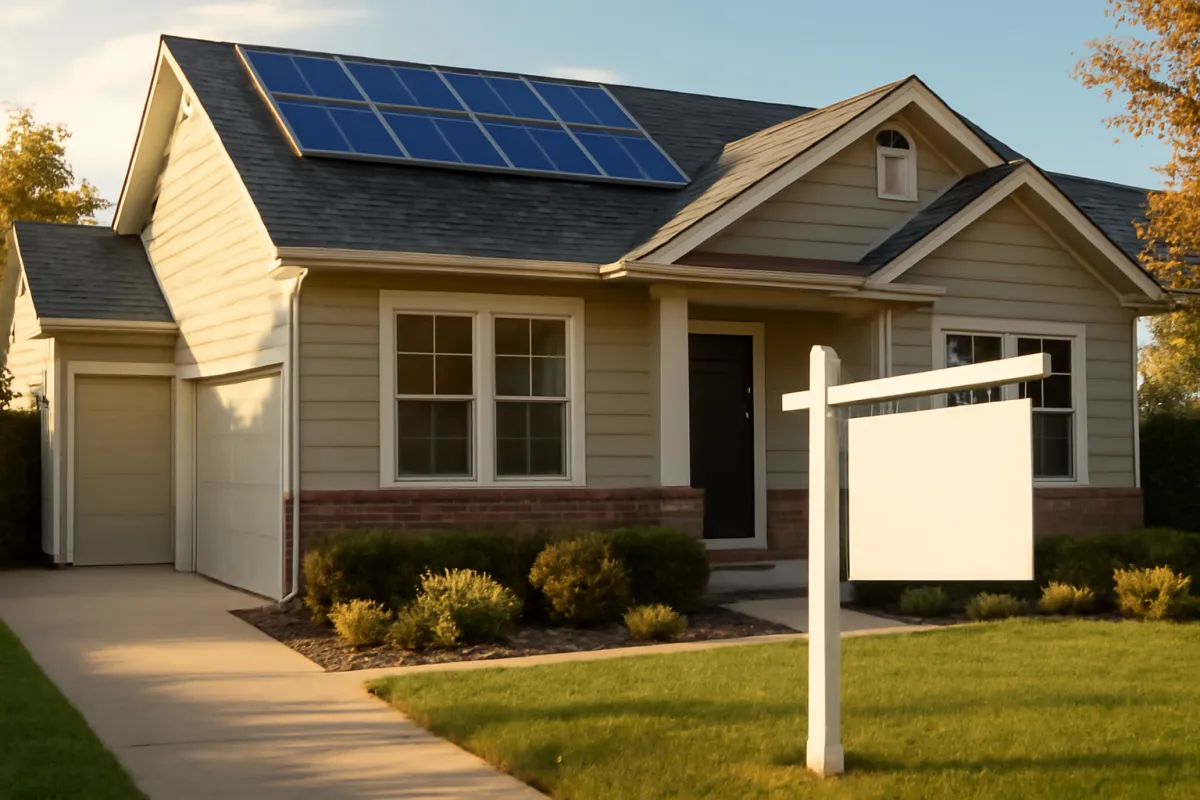
Owning solar does more than lower your power bill; it generally adds to what your home is worth, and that premium is a real part of the buy-versus-lease gap. A buyer inherits a paid-off asset on the roof and lower electricity costs for years, and appraisers and studies tend to reflect that in resale value, especially in regions where power is expensive. It is upside you cannot bank the way you bank avoided electricity, because it varies by market and by how much of the bill the system offsets, but the direction is consistent for owned systems.
Leased systems generally do not add appraised value the same way, because the seller does not own the asset, and the attached contract can even weigh on the sale. That asymmetry is one of the cleanest financial arguments for buying: ownership supports resale value, while a lease at best is neutral and at worst is a complication. Our briefing on whether solar panels increase home value works through what the resale premium looks like and why it applies to owned systems rather than leased ones. If home value factors into your decision at all, it points firmly toward owning.
A worked example: cash vs lease over 25 years
Numbers make the trade concrete, so here is one household carried through both paths. Treat every figure as illustrative.
A homeowner currently pays about $180 a month, or $2,160 a year, for electricity. They get two proposals for a system sized to offset most of that bill. The cash purchase installs for an illustrative $24,800 gross, with no federal credit to bring it down. The lease requires nothing upfront and starts at about $130 a month, escalating 2.9% a year over 25 years. In year one, the lease looks great: it is below the old bill, with no check written.
Now run the term. The lease payment grows from $130 to roughly $258 a month by year 25, and total lease payments across the contract come to an illustrative $56,000. The cash buyer, meanwhile, spent $24,800 once and then paid essentially nothing for power. Even accounting for the utility cost both households avoid, buying comes out roughly $31,000 ahead over the 25 years, because the difference between the two paths is simply the $56,000 of lease payments versus the $24,800 cash price. That gap is the ownership value the lease gave away, and it is narrower than the same example would have shown a year ago precisely because the buyer no longer has a credit softening the cheque. The lease won the first month and lost the quarter-century. Run your own bill and terms through the savings calculator to see where your version lands.
Solar loan vs lease: why a loan usually wins
Many homeowners who cannot pay cash frame their real choice as loan versus lease, since both require little or nothing upfront. It is worth being direct: a loan almost always beats a lease. The reason is ownership. A loan makes you the owner from day one, so you add the system to your home’s value, and your payments end after the term, leaving you with free power and a paid-off asset. A lease leaves the hardware with the provider, adds no resale value, and its payments never end within the contract; they escalate.
The lease’s only structural advantages are that it puts no debt on your credit report and shifts maintenance and performance risk to the provider. Those are real but modest benefits, and a good loan-financed installation comes with strong equipment warranties that cover most of the same risk. When you compare the total dollars, a loan with a fair rate and a disclosed dealer fee keeps most of the ownership value, while the lease keeps a small slice of it. The one place the comparison narrows is credit and cash flow: if you cannot qualify for a fair loan rate, or a dealer fee pushes the financed price far above the cash quote, a no-escalator lease becomes more competitive. Short of that, weigh the loan’s total cost against a cash quote using the questions in our note on how to read a solar quote, and treat the lease as the fallback rather than the default.
When a lease or PPA actually makes sense
It would be dishonest to say a lease never fits. There are specific situations where a lease or PPA is a reasonable choice, and pretending otherwise would be as misleading as the sales pitch that oversells them. The clearest case is cash and credit: if you cannot raise the gross price and cannot get a loan at a fair rate without a heavy dealer fee, the ownership path is closed to you in practice. In that situation, letting a provider own the system while you take a modest bill reduction can be rational.
Two other cases matter. Some homeowners simply will not take on any upfront cost or debt, and a $0-down lease is the only way they will ever get solar; a small saving beats none. Others value handing off all maintenance, monitoring, and performance risk to the provider and are willing to pay for that convenience. If you are in one of these groups, a lease can still cut your bill from day one. The discipline is to go in with eyes open: choose a flat or low-escalator contract, model the final-year payment, read the transfer terms in case you move, and accept that you are trading most of the lifetime savings and the ownership value for zero upfront cost and convenience. Even then, get at least one cash and one loan quote for comparison so you know exactly what you are giving up.
Which option fits whom
Matching the option to the household is the whole exercise, so here is a plain-language guide. None of these are rules, only starting points to check against your own situation and your own quotes.
- Pay cash if you have the funds available and want the lowest total cost and shortest payback. This captures the most value of any option.
- Take a loan if you want to own the system and keep the resale value but do not want to tie up a large sum. Insist on the cash price and the dealer fee before signing.
- Consider a lease if you want zero upfront cost, cannot carry a loan on fair terms, or value handing maintenance risk to a provider, and you accept far smaller savings. Prefer a no-escalator contract.
- Consider a PPA if the same conditions as a lease apply and you prefer paying per kilowatt-hour for output rather than a fixed rental. Scrutinize the escalator the same way.
Notice that the two ownership options share a requirement (you can raise or finance the gross price) and the two third-party options share a rationale (you cannot, or will not pay upfront). If you can cover that price and plan to stay in the home, the decision is really cash versus loan, and both keep you in the high-savings camp. Our guide on how to go solar walks the full process once you have chosen how to pay.
Questions to ask before you sign
Whichever direction you lean, a short list of direct questions protects you from the most common traps in each arrangement. Ask every one of these in writing before committing:
- What is the cash price for this exact system? This is your baseline. Every loan or lease quote should be compared against it.
- On a loan, what is the dealer fee? A “low APR” often hides a 15% to 30% fee inside a higher price. Ask for it as a dollar figure.
- On a lease or PPA, what is the escalator, and what is the payment in the final year? Model the last year, not the first, to see the real cost.
- Is this price gross, with nothing deducted? If a proposal shows a figure after a 30 percent federal credit, it is using superseded rules; ask for it re-quoted gross before you compare it with a lease.
- What are the transfer and buyout terms if I sell? Get the buyout schedule and the assumption requirements in writing.
- What performance guarantee or warranty backs the numbers? For a lease, this is who carries the risk; for a purchase, this is your protection.
If a salesperson resists putting any of these answers in writing, treat that as information in itself. A fair deal survives being written down; a deal that only works when it is spoken usually does not. These questions cost nothing and routinely save thousands.
Common mistakes in choosing how to pay
A few predictable mistakes push homeowners into the wrong arrangement, and all of them are avoidable. The most common is judging the deal by the first monthly payment. A lease is engineered to win that comparison, so anchoring on month one instead of the 25-year total is how a low escalator quietly becomes an expensive contract. Always compare lifetime cost and what you own at the end, not the opening payment.
A second mistake is assuming a homeowner federal credit is still on the table at all. It is not, on either path, for anything placed in service after December 31, 2025. If a pitch implies you get a credit through a lease, or shows a cash price already reduced by 30 percent, that is a red flag about the whole presentation. A third is ignoring the escalator, which turns a fair-looking year-one payment into an unfair year-twenty one. A fourth is overlooking resale, signing a 25-year contract without checking the transfer terms, then discovering the complication only when the house is on the market. A fifth is not getting a cash and a loan quote for comparison, which leaves you unable to see how much a lease is really costing you. Avoid these five and you will choose the arrangement that fits your situation rather than the one that fits the salesperson’s. Our payback briefing and our off-grid cost note both reinforce the same habit: price the whole life of the system, not the headline.
How financing changes your payback
Payback, the year the system flips from cost to pure savings, is not the same across the four options, and the difference is instructive. A cash purchase produces the shortest payback because there is no financing cost to recover; the net cost divided by annual savings is the clean break-even. A loan stretches payback modestly, because interest and any dealer fee raise the effective net cost, though it still reaches a defined break-even after which the power is free. Both ownership paths have a payback because both end in an owned, cost-free asset.
A lease or PPA does not have a payback in the same sense, and that is the point. You never make a large upfront investment to recover, so there is no break-even year and no moment when the power becomes free. Instead you pay an escalating amount for the entire term and own nothing at the end. That absence of a payback is not a feature; it is the sign that you never bought the asset in the first place. When someone tells you a lease “pays for itself immediately,” what they mean is that it costs a little less than your old bill, which is a different and far weaker claim than reaching break-even on an owned system. Our payback briefing works through the ownership math in full, and the savings calculator lets you see how cash versus a loan changes your own break-even year.
Solar lease vs buy calculator: run your own numbers
Illustrative figures settle the direction of the trade, but only your own bill and your own two quotes settle the size of it. The solar lease vs buy calculator on this site takes four things you can read off the paperwork in front of you: your current monthly electric bill, the gross cash price on the purchase quote, the first-year payment on the lease or PPA, and the escalator written into that contract. It then carries both paths across a 25-year term and reports what each one keeps.
Three habits make the result worth trusting. Enter the cash price gross, with nothing deducted, because there is no homeowner federal credit left to take off it. Enter the escalator the contract actually names rather than the one the pitch implies, since that single number moves the gap more than anything else on the page. And run the comparison twice, once at a flat escalator and once at the quoted one, to see how much of the lease’s appeal depends on rates rising the way the provider assumes. If the two runs disagree sharply, the escalator, not the hardware, is what you are really being asked to sign.
The bottom line
For most homeowners who plan to stay in their home, buying solar saves far more than leasing it, often several times more across the life of the system. Owning, whether with cash or a loan, adds a paid-off asset to your home’s value and ends in essentially free power once the system is paid back. A lease or PPA asks for nothing upfront, which is a genuine benefit for the right household, but it hands ownership and most of the lifetime savings to the company that owns the panels, carries an escalator that erodes the deal over time, and attaches a long contract that can complicate a sale.
The decision comes down to a few honest questions: How long will you stay? How much upfront cost can you carry, now that the gross price is the price? Can you get a loan on fair terms? If you can cover the price and plan to stay, your real choice is cash versus a loan, and both keep you in the high-savings camp. A lease or PPA is the fallback for households that cannot raise or finance that price, and even then a flat, no-escalator contract compared against real cash and loan quotes is the only version worth signing. Do the arithmetic with your own bill in the savings calculator, get itemized quotes for each path, and treat every dollar figure here as an illustration, not your number.
This breakdown is for education only and is not financial, tax, legal, or investment advice. The savings figures, lease payments, escalator effects, and 25-year totals shown above are illustrative examples built on typical assumptions: your actual outcome depends on your installed price, your utility’s rates, the specific lease, PPA, or loan terms you are offered, and state or utility incentive programs that change over time. No figure above assumes a federal residential credit, because section 25D is not available for property placed in service after December 31, 2025. Escalator clauses, dealer fees, and transfer or buyout terms vary by contract and can materially change the math. Before you sign any purchase, loan, lease, or power purchase agreement, verify the current tax treatment with a qualified professional and let itemized quotes from local installers, not our ranges, set the numbers you plan around.
Frequently asked questions
Is it better to lease or buy solar panels?
For most homeowners who plan to stay in the home, buying saves far more over the life of the system. When you own, whether with cash or a loan, you add the paid-off system to your home's value, and after payback the power is essentially free. A lease or PPA asks for nothing upfront but hands ownership and most of the lifetime savings to the company that owns the panels. The homeowner tax credit is no longer part of this comparison: section 25D was terminated by Public Law 119-21 and is not available for property placed in service after December 31, 2025, so buyers should compare a gross cash price against the lease, not an after-credit one. These are illustrative generalizations, not a recommendation for your specific situation.
Who gets the tax credit on leased solar panels?
Not you, either way. The homeowner credit that used to reward buying, section 25D, was terminated by Public Law 119-21 and is not available for property placed in service after December 31, 2025, and the test is when the installation was completed rather than when it was ordered or paid for. Under a lease or a power purchase agreement the solar company owns the equipment on your roof, and whatever tax position attaches to a business owning it stays with them. The practical effect is that buying no longer wins on a credit, it wins on ownership: the asset, the resale value, and free power after payback. Take any tax question to a qualified tax professional rather than to a salesperson.
What is the difference between a solar lease and a PPA?
A lease charges a fixed monthly payment for the equipment regardless of how much power it makes, while a PPA charges a per-kilowatt-hour rate for the electricity the system actually produces. With a lease you are renting the hardware; with a PPA you are buying the output at an agreed price that is usually below your utility rate. Both are third-party ownership arrangements, both typically require no money down, and both leave ownership, and any tax position attached to it, with the provider. Both also commonly include an escalator that raises what you pay each year. The practical difference for savings is small: neither captures the ownership value that buying does.
What is a solar lease escalator?
An escalator is a clause that raises your lease or PPA payment by a set percentage every year, often somewhere around 2% to 4%. On a 25-year contract, a 2.9% escalator can nearly double your monthly payment by the final year, so a payment that started near $130 could climb past $250. Providers justify escalators by pointing to expected utility rate inflation, but if grid rates rise more slowly than your escalator, your savings shrink year after year and can disappear entirely. Always ask for the escalator rate in writing and model the payment in the final year, not just the first. A flat, no-escalator contract is far easier to evaluate.
Can you sell a house with leased solar panels?
Yes, but it adds a step that an owned system does not. Because the lease or PPA company owns the panels, a buyer must either qualify to assume the remaining contract or you must buy out the agreement before closing, which can cost thousands. Some buyers welcome a transferable lease with low payments; others see a long contract on the roof as a complication and negotiate the price down or walk away. An owned, paid-off system is simpler: it transfers with the house and generally adds to the sale value. If you expect to move, factor the transfer or buyout terms into your decision before you sign.
Does a solar loan count as owning the system?
Yes. With a solar loan you own the system outright from day one, the lender just holds a claim until the balance is paid. That means you, not a third party, own the asset, you add the system to your home's value, and once the loan is paid off the power is essentially free for the rest of the panels' life. The trade is that interest, and often a hidden dealer fee baked into the price, raise your effective cost compared with paying cash. A loan still captures the ownership benefits a lease cannot, which is why it usually beats leasing over the life of the system.
Do leased solar panels add value to your home?
Generally no, and they can occasionally subtract from it. Studies and appraisers tend to credit added resale value to owned systems, because the buyer inherits a paid-off asset and lower bills. A leased system is not an asset the seller owns, so it does not add appraised value the same way, and the attached contract can complicate the sale if the buyer is reluctant to assume it. This is one of the clearest financial gaps between owning and leasing. If home value matters to your decision, ownership through cash or a loan is the path that supports it.
When does a solar lease or PPA make sense?
A lease or PPA can make sense in a few specific situations: you do not want any upfront cost or debt, you cannot qualify for or service a solar loan, or you want the provider to handle maintenance and performance risk. For a homeowner in those circumstances, a no-escalator or low-escalator lease can still cut a power bill modestly from day one with no cash outlay. The key is to go in knowing you are trading most of the lifetime savings and the ownership value for convenience and zero upfront cost. Compare at least one lease quote against a cash and a loan quote before deciding.