
What's on this page
- Solar inverter vs battery: the difference in one paragraph
- What a solar inverter does: DC to AC conversion
- What a solar battery does: storing energy for later
- Converter vs container: why one cannot do the other’s job
- kW vs kWh: the units tell the story
- String inverters: one converter for the whole array
- Microinverters and optimizers: conversion at the panel
- Hybrid inverters: where the two worlds meet
- AC coupling vs DC coupling: the battery’s own electronics
- What each costs, illustratively
- Do you need an inverter? Yes, every solar system has one
- Do you need a battery? Only if the math or the outages say so
- When a battery earns its keep
- When the inverter choice matters most
- Backup power: what actually keeps the lights on
- Lifespan and replacement: which one you will buy twice
- Adding a battery later vs planning it now
- Sizing the pair: matching kW and kWh
- A worked example: one home, with and without a battery
- Common mix-ups between inverters and batteries
- The bottom line
Short answer: An inverter and a battery do different jobs: the inverter converts the DC electricity panels produce into the AC your home and the grid run on, and every solar system needs one; a battery stores energy for use after sunset or in an outage, and is always optional. Illustratively, inverters cost in the low thousands installed while a full battery installation runs into the low-to-mid five figures. You need both only if storage pays.
Solar inverter vs battery is a comparison between two components that get bundled together in every sales pitch but do completely different jobs: the inverter converts electricity, and the battery stores it. One is mandatory in every solar system ever installed; the other is an optional add-on whose value swings entirely on your utility’s rules and your tolerance for outages. Confusing the two, or assuming one implies the other, is among the most common reasons homeowners misread a solar quote, over-buy storage they cannot use, or discover during their first blackout that panels alone do not keep the lights on.
This explainer separates the two cleanly: what an inverter actually does and why no system runs without one, what a battery actually does and why plenty of systems run without one, how the string, micro, and hybrid inverter designs differ, how batteries couple into a system, what each component costs illustratively, and the practical question underneath the comparison, whether your home needs both. The battery economics get their full treatment in our worth-it briefing on solar batteries, the retrofit path lives in our field guide to adding a battery, and the sizing formulas sit in our solar sizing reference; this piece is the map that connects them.
Key takeaways
- An inverter converts the DC electricity panels produce into the AC electricity homes and the grid run on; a battery stores energy for use after sunset or during an outage. Converter versus container.
- Every solar system requires inversion somewhere: a string inverter on the wall, microinverters on each panel, or a hybrid inverter that also manages storage. A battery is always optional.
- Batteries store DC too, so stored energy must also pass through an inverter: AC-coupled batteries carry their own, DC-coupled batteries share a hybrid unit with the panels.
- Illustratively, inverters cost in the low thousands installed while a full battery installation commonly runs into the low-to-mid five figures, so the battery decision moves the budget far more.
- Whether you need both comes down to your export credit and outage exposure: full retail net metering makes the grid a free battery, while weak credits and frequent outages build the storage case.
Solar inverter vs battery: the difference in one paragraph
Here is the whole comparison compressed. Solar panels produce direct current, DC, the one-way flow that batteries and electronics use internally. Your home’s outlets, your appliances, and the utility grid all run on alternating current, AC. The inverter is the translator between those two worlds: it takes the panels’ DC and produces grid-quality AC, continuously, whenever the sun is on the array. The battery is a warehouse: it banks surplus energy in DC form while the panels overproduce and releases it when they cannot, at night, in bad weather, or during an outage. The inverter handles form; the battery handles timing.
Everything else in this explainer unpacks the consequences of that one-paragraph split. Because homes cannot use DC directly, the inverter is non-negotiable: no inverter, no working solar system, full stop. Because the grid itself can absorb surplus and give it back through billing credits, the battery is negotiable: it competes against your utility’s export tariff, and it wins or loses on those terms plus the value you place on backup. And because batteries store DC, the two components are not rivals at all but neighbors on the same circuit: every stored kilowatt-hour passes through an inverter on its way to your toaster. Keep converter-versus-container in mind and no quote, spec sheet, or showroom pitch on this topic can tangle you up.
What a solar inverter does: DC to AC conversion
The inverter earns a closer look because it is the hardest-working electronics in the system. Its core task is conversion: panel output arrives as DC at a voltage that wanders with sunlight and temperature, and the inverter transforms it into AC synchronized to the grid’s waveform and voltage. It performs this thousands of times per second, all day, every producing day, for years. Alongside conversion it runs maximum power point tracking, continuously adjusting the electrical operating point of the array to harvest the most power the current sunlight allows, which is why inverter quality quietly shapes how many kilowatt-hours a given roof actually delivers.
The inverter is also the system’s brain and its safety officer. It is where production monitoring comes from: the app that shows your daily output is reporting what the inverter measures. It enforces grid-safety rules, disconnecting automatically when the grid goes down so line workers are not met by a backfeeding rooftop, which is exactly why a standard solar system without storage goes dark in a blackout. And it is the component a proposal describes when it lists conversion efficiency, commonly in the high-90s percent range, meaning only a few percent of the harvest is lost in translation. When our solar sizing reference applies a derate factor to panel ratings, inverter losses are one of the things that factor is absorbing.
What a solar battery does: storing energy for later
The battery solves a different problem entirely: the sun’s schedule does not match yours. A typical home’s array produces its surplus in the midday hours when the house is emptiest and demand is lowest, then produces nothing during the evening peak when cooking, cooling, and screens all run at once. Without storage, that midday surplus exports to the grid for whatever credit your utility pays, and the evening is purchased back at retail. A battery intercepts the surplus instead: it charges through the afternoon, then discharges through the evening, letting the home consume its own production hours after the sun made it.
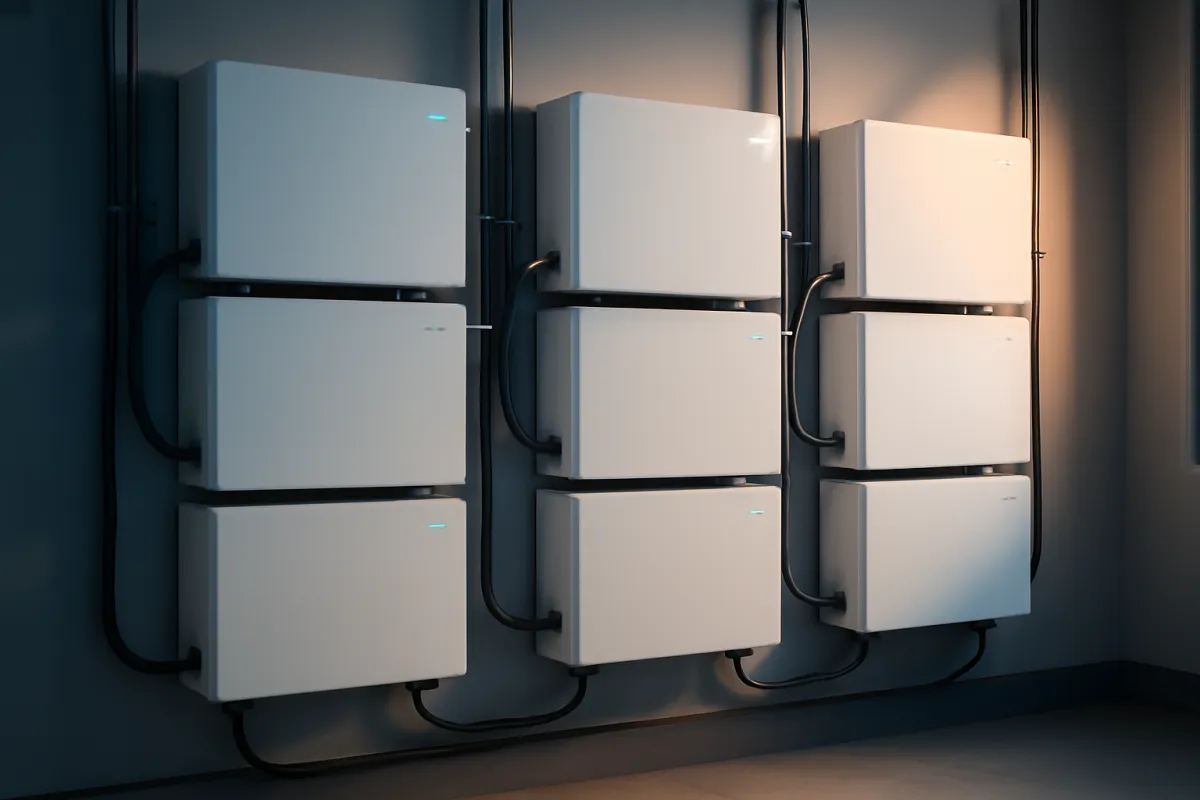
Physically, a modern home battery is a wall-mounted or floor-standing lithium unit, commonly holding an illustrative 10 to 15 usable kilowatt-hours per unit, with larger homes stacking several. Two ratings define it, and both matter: capacity in kilowatt-hours sets how much energy it holds, while its power rating in kilowatts caps how many appliances it can feed at once. Paired with a gateway that can island the home from the grid, a battery also provides the backup power bare panels cannot. What it does not do is convert anything for your outlets: the battery stores DC, and its stored energy still needs inversion before use, which is where the two components’ stories join. The economics of all this, cycling value versus cost, live in our worth-it briefing, and the dollars themselves, what one of these units costs on a real wall, are itemized in our Powerwall installed-cost briefing.
Converter vs container: why one cannot do the other’s job
The cleanest way to lock in the difference is to notice that neither component can substitute for the other, even partially. An inverter has no meaningful storage: it holds a trivial buffer of energy in its capacitors, measured in fractions of a second, and the moment the panels stop producing, a battery-free inverter has nothing to give. It cannot time-shift a single kilowatt-hour from noon to dinner. A battery, for its part, converts nothing on its own account: charge it with DC and it returns DC, and a home full of AC appliances can do nothing with that until an inverter intervenes. Park a charged battery next to your electrical panel with no inverter attached and you own a very expensive paperweight.
This is why the vs framing, while it matches how people search, is not really a purchase decision between rivals. Nobody chooses an inverter or a battery the way they choose between a string inverter and microinverters. The real decisions are sequential: every system includes inversion, chosen by type; storage is then added, or not, on its own merits. The pairing even runs in one direction only: an inverter without a battery is a normal, complete solar system, while a battery without an inverter is not a system at all. When a quote bundles the two into a single storage line, it is worth mentally unbundling them, because the mandatory converter and the optional container deserve different scrutiny.
kW vs kWh: the units tell the story
The spec sheets encode the same division of labor in their units, and reading them this way makes any quote clearer. Inverters are rated in kilowatts, kW, a unit of power: the rate at which energy can flow through them right now. A 7.6 kW inverter can pass at most 7.6 kilowatts of AC to the house and grid at any instant, no matter how large the array behind it. Batteries lead with kilowatt-hours, kWh, a unit of energy: the amount they can hold. A 13.5 kWh battery stores thirteen and a half of the units your bill is denominated in, our kilowatt-hour explainer covers that unit in full, and a battery’s secondary kW rating caps its instantaneous output.
The units answer different household questions. The inverter’s kW answers: how much can run at once? The battery’s kWh answers: for how long? A worked pairing shows the difference. An illustrative battery holding 13.5 kWh with a 5 kW power rating can carry a frugal 300-watt overnight baseline for the better part of two days, or feed a 5 kW cluster of appliances flat-out for under three hours, same container, different draw rates. Meanwhile the inverter’s kW never changes how long anything lasts; it only sets the ceiling on simultaneous flow. Speedometer and fuel tank, rate and quantity: once the units are sorted, the components sort themselves.
String inverters: one converter for the whole array
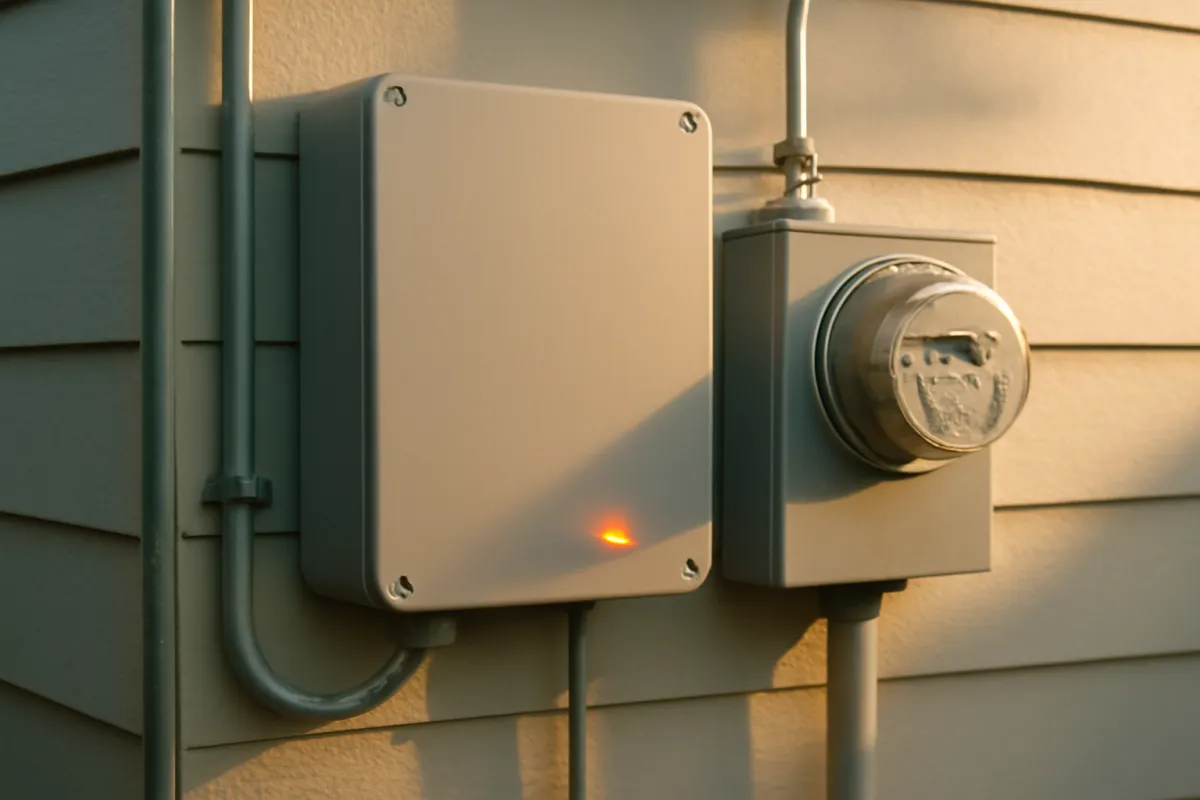
Inverters come in a few architectures, and the string design is the classic. The panels are wired in series into one or more strings, like holiday lights, and the combined DC feeds a single wall-mounted inverter, typically in a garage or on an exterior wall near the meter. One box performs the whole system’s conversion. The virtues are simplicity and cost: fewest components, one point of service, and commonly the cheapest architecture per watt, which is why string inverters remain the default across much of the world and a common sight on unshaded suburban roofs.
The trade-offs follow from the series wiring. Panels on a string behave somewhat like a team roped together: heavy shade or a fault on one panel can drag down the output of its companions, which makes the pure string design happiest on simple, unshaded roofs where every panel sees the same sun. Monitoring is system-level rather than per-panel, so a single underperforming module is harder to spot from the app. And the single box is a single point of failure with a commonly cited service life shorter than the panels’, a point the lifespan section returns to. None of these are disqualifiers, and a well-matched roof gives up little; they are simply the profile to weigh against the per-panel designs, framed generically here since brands and models change faster than the architecture does.
Microinverters and optimizers: conversion at the panel
The alternative architecture moves the electronics onto the roof. With microinverters, each panel gets its own small inverter mounted behind it, converting that panel’s DC to AC right at the source; the roof then sends ordinary AC down to the panel of breakers, with no high-voltage DC run and no central conversion box. A middle path uses power optimizers: small per-panel electronics that condition each module’s DC individually but still feed one central inverter for the actual conversion. Both designs exist to break the roped-together behavior of strings: each panel produces to its own potential, so shade on one module costs only that module’s output.
The commonly cited benefits stack up on complicated roofs: better harvest under partial shade or multiple roof orientations, panel-by-panel monitoring that makes a failing module obvious, easier expansion since panels can be added one at a time, and, for microinverters specifically, warranties commonly in the 25-year range that sidestep the mid-life replacement a string inverter implies. The costs are the mirror image: more electronics purchased up front, commonly the priciest architecture per watt, and any per-panel service call happens on the roof rather than at a wall box. The honest generic rule: simple unshaded roofs keep the string design competitive, while shade, dormers, and multiple faces push toward per-panel electronics. Your quotes will name specific products; the architecture beneath them is what this section describes.
Hybrid inverters: where the two worlds meet
The hybrid inverter is the component that makes the inverter-versus-battery question literal, because it is one box built to serve both masters. A hybrid, sometimes sold as a battery-based or multi-mode inverter, performs the normal solar conversion and additionally manages storage: it can route surplus panel DC straight into a battery, invert stored energy back to AC for the house, and orchestrate the daily choreography of charging through the afternoon and discharging through the evening. Installed with solar from day one, it collapses what would otherwise be two sets of electronics into a single point of conversion and control.
Two practical notes keep the hybrid in perspective. First, owning one does not obligate you to own a battery: plenty of homes install a hybrid inverter with an empty battery port precisely so a future storage addition is a wiring job rather than an electronics swap, the battery-ready posture our field guide to adding a battery recommends considering at the initial install. Second, a hybrid is not the only door into storage: the AC-coupled batteries in the next section bolt onto systems with ordinary inverters, which is how most retrofits happen. The hybrid’s sweet spot is the together-from-the-start project and the planned-soon addition; its cost commonly sits between a basic string unit and a full microinverter fleet, and quotes vary enough that written bids, not typical figures, should settle yours.
AC coupling vs DC coupling: the battery’s own electronics
Since stored energy must be inverted before use, every battery installation answers one question: whose inverter does the battery use? DC coupling shares. The battery sits on the DC side of a hybrid inverter, charging directly from panel DC and discharging back through the same box; energy stored at midday is converted once on its way to the evening’s appliances, which is the efficiency argument for the design, and the whole package is typically installed as one project. AC coupling brings its own. An AC-coupled battery contains a built-in inverter, so it connects on the house side as an ordinary AC appliance that happens to flow both ways: it charges by re-converting the home’s AC and discharges by inverting its stored DC back again.
The commonly cited trade: DC coupling saves a conversion step and suits new combined installs, while AC coupling trades a little round-trip efficiency for enormous compatibility, since it works alongside virtually any existing inverter, string or micro, without touching it. That compatibility is why the AC-coupled route dominates retrofits and why the most familiar home batteries ship with inverters inside. For the vs question this section is the punchline made hardware: the battery is so far from being an inverter’s rival that every battery either borrows an inverter or carries one. Which coupling fits your home is an installer conversation driven by your existing equipment; the architecture is what matters here, and it is the same under every brand name.
What each costs, illustratively
The budget gap between the two components is the practical fact that shapes most decisions, so here it is plainly. Inverter electronics, whatever the architecture, are a low-thousands line on a typical residential project: illustratively, a string inverter commonly lands around the low $2,000s installed, a hybrid somewhat above it, and a full microinverter fleet for a typical array somewhat above that. A home battery is a different tier entirely: hardware, gateway, and installation for a single typical unit commonly total into the low-to-mid five figures, before any incentive. The chart puts the illustrative figures side by side.
Illustrative installed cost: inverter options vs a home battery
Typical planning figures for a mid-size home system. Shapes, not quotes; brands, regions, and incentives move every bar.
The battery bar dwarfs every inverter option, which is why storage is the decision that moves a project budget. Inverter choice tunes a system; the battery choice re-prices it.
Read the gap strategically. Upgrading between inverter architectures moves a project by an illustrative one or two thousand dollars, a meaningful but survivable swing that buys shade tolerance, monitoring, or battery-readiness. Adding storage moves the same project by five figures, which is why the battery deserves the harder scrutiny: its payback depends on tariff details the inverter never touches. Incentives complicate the battery line in your favor, sometimes substantially, but they change by year and address, so confirm current programs rather than assuming any figure here. The savings calculator prices the solar core of the project from your own bill; the battery add-on math gets its worked example later in this explainer.
Do you need an inverter? Yes, every solar system has one
For completeness, the first half of the need-both question has a one-word answer: yes. There is no grid-tied solar configuration that skips inversion, because there is nothing in a standard home that consumes panel DC directly. The realistic question is never whether to buy an inverter but which architecture serves the roof: string for simple sun-drenched planes on a budget, per-panel electronics for shade and complexity, hybrid for storage now or soon. Even off-grid cabins, the one context where DC appliances exist, almost always include an inverter for conventional loads.
The buyer’s takeaway is about reading quotes. Because the inverter is mandatory, its line on a proposal is not optional equipment to trim; the savings between architectures are real but bounded, and cutting toward the cheapest box on a shaded or complicated roof can cost more harvest than it saves. The inverter line is also where a quote reveals battery-readiness: a hybrid unit, or conduit provisions for one, signals a system built for a storage future, worth noticing even if you never intend to use it, since the next owner might, a point our coverage of what solar does to home value touches from the buyer’s side. Judge the inverter on fit, warranty, and monitoring; the only wrong answer is imagining you can decline one.
Do you need a battery? Only if the math or the outages say so
The second half of the question is where real money and real judgment live. A grid-tied system without a battery is complete and normal: surplus flows out, credits flow back, and the grid plays warehouse. Whether to buy a physical warehouse instead turns on three questions. First, what does your utility pay for exports? Under full retail net metering, a midday kilowatt-hour exported buys back an evening one at even value, and a battery can barely improve on that; under weak export credits, every exported unit loses value, and a battery that shifts it to evening recaptures the spread. Second, how much do outages cost you, in spoiled food, lost work, medical equipment, or plain misery? Third, does your tariff price evening power at a premium a battery could dodge?
The pattern across those questions: the grid’s generosity is the battery’s competition. Where the grid banks surplus at even value and rarely fails, a battery is a five-figure solution to a problem you barely have. Where export credits are thin, time-of-use spreads are wide, or the lines go down every storm season, the case builds quickly, and in some utility territories it is now decisive. Our worth-it briefing works through the tariff math utility-type by utility-type; the worked example later in this explainer runs one illustrative home through both scenarios so you can see the swing in a single page.
When a battery earns its keep
Pulling the threads together, the battery case is strongest in a recognizable set of situations. Weak export compensation leads the list: utilities that credit exports at a fraction of retail create exactly the value spread a battery harvests nightly. Wide time-of-use spreads come second: where evening power costs a multiple of midday power, storage arbitrages your own roof’s production against the clock. Outage-prone territory is third, and it is the driver that needs no spreadsheet: for homes that lose power routinely, backup is the product and bill savings are the bonus. Households with heavy evening usage, and homes where an EV charges overnight, tilt the same direction because so much of their consumption happens after production stops.
The mirror-image list matters just as much. Full retail net metering, reliable grid, modest evening usage: a battery in that home mostly converts money into standby equipment. Between the poles sit judgment calls, and two honest observations help with them. Tariffs move in one direction lately, with full-retail programs steadily giving way to less generous successors, so a battery-hostile tariff today is not guaranteed to remain one, which is an argument for battery-readiness even where it is not yet an argument for a battery. And backup value is real but personal: price it by imagining your specific worst outage, not by a brochure’s adjectives. When the leans stack up on the first list, move to the sizing and retrofit questions; when they stack on the second, bank the five figures.
When the inverter choice matters most
The inverter decision never carries five-figure stakes, but a handful of situations raise its weight. Shade is the classic: chimneys, dormers, and trees turn the string architecture’s roped-together behavior into a real harvest tax, and per-panel electronics earn their premium precisely there. Complex roofs with panels facing multiple directions similarly favor per-panel conversion, since one string cannot chase two orientations’ sun at once. Planned expansion argues the same way: microinverters let an array grow panel by panel, while a string inverter sized for today’s array can become tomorrow’s bottleneck. And storage intentions pull toward the hybrid: if a battery is in your two-year picture, choosing the hybrid inverter now can spare you buying conversion electronics twice.
Monitoring preferences deserve a mention because they surface after installation: system-level monitoring tells you the array produced less this week, while per-panel monitoring tells you which module is the reason, a difference that matters more as systems age, a theme our production monitoring walkthrough develops. Finally, replacement logistics differ: a wall-mounted string inverter swaps out in an afternoon at ground level, while per-panel electronics fail rarely but fail on the roof. None of these considerations changes the mandatory nature of the component; they decide which mandatory component your roof deserves, and a good installer’s bid will explain its architecture choice in exactly these terms.
Backup power: what actually keeps the lights on
No topic in home solar produces more day-one surprise than backup, so the mechanics deserve their own section. A standard grid-tied solar system, panels and inverter, shuts itself off when the grid fails. This is not a defect: the inverter is legally required to stop backfeeding so utility crews can work on dead lines safely. The practical consequence is that sunshine on your roof during a blackout powers nothing. Keeping the lights on requires storage plus islanding: a battery to supply energy, and a gateway or transfer switch that disconnects the home from the grid so the system can safely energize the house alone. With that pair installed, an outage becomes a non-event: the home islands, the battery carries the loads, and the panels recharge it by day.
Backup design then becomes a sizing conversation. Whole-home backup lets everything run but drains capacity fast; a backed-up-loads panel carrying the refrigerator, lights, internet, and a few outlets stretches an illustrative 13.5 kWh unit across a day or more of frugal use. The battery’s kW rating matters here too, capping how many loads run simultaneously, and large motors like central air commonly demand either multiple units or exclusion from the backup panel. For homes weighing storage against a combustion alternative, our battery-versus-generator comparison prices that fork directly. The one-line summary for this explainer: panels alone never provide backup; the battery, plus its gateway, is what buys it.

Lifespan and replacement: which one you will buy twice
A 25-year solar project outlives some of its own components, and the two subjects of this explainer age on different curves. String inverters carry commonly cited service lives of roughly 10 to 15 years: working electronics, switching thousands of times a second in a hot box, simply wear. Most string-inverter owners should budget one replacement during the panels’ life, illustratively a low-thousands event when it comes. Microinverters, running cooler and spreading the work across many small units, commonly carry warranties in the 25-year range, effectively promising to match the panels; the trade is that the rare failure is a roof visit. Hybrid inverters age like their string cousins, with the same replacement planning.
Batteries age differently: they fade rather than fail. Every cycle stores and releases a little less than the last, and a unit commonly warranted for about 10 years typically guarantees some retained-capacity floor, often around the 70 percent mark, at the warranty’s end rather than promising day-one capacity forever. A battery owner’s second decade therefore holds a choice between living with a smaller warehouse and buying a new one. Planning takeaway: the inverter is the component you will most likely replace once; the battery is the component whose replacement is a fresh five-figure decision informed by whatever tariffs look like then. Warranty documents vary meaningfully by product and govern your actual equipment, so read yours rather than budgeting on typical figures alone.
Adding a battery later vs planning it now
Because the components are separable, their purchases can be too, and the sequencing question has honest arguments on both sides. Buying together is tidier: one permit, one crew, one interconnection application, a hybrid inverter doing double duty, and a single incentive claim; where the battery case is already clear, weak exports, wide evening spreads, or serious outage exposure, together is commonly the better price and certainly the shorter path. Adding later is humbler and often wiser: the solar system alone is the proven-payback half of the project, and a year of real bills under your actual tariff turns the battery decision from a projection into arithmetic. The AC-coupled architecture exists precisely to make the later addition routine on any system.
The middle path deserves the emphasis, because it costs the least and preserves the most: make the first install battery-ready. That can mean a hybrid inverter with an open battery port, or merely conduit runs, panel space, and a main panel with capacity, details that cost little during construction and hundreds to thousands to retrofit through finished walls. Battery-ready is the posture this explainer recommends for the ambivalent: it defers the five-figure decision without penalizing it. When the time comes, our field guide to adding a battery walks the retrofit end to end, from sizing and coupling choice through permits and commissioning, and the tariff math in the worth-it briefing tells you whether the time has come at all.
Sizing the pair: matching kW and kWh
Sizing the two components is two different exercises wearing one project’s clothes. The inverter sizes against the array: its kW rating is chosen to match the panels’ combined output, commonly at a ratio that slightly undersizes the inverter relative to the panels’ nameplate, because arrays rarely hit their lab-rated peak in the field; a modest ratio of panel watts to inverter watts is normal engineering rather than corner-cutting. The array itself sizes against your annual usage, the arithmetic our solar sizing reference tables in full: annual kilowatt-hours divided by local production per installed kilowatt, landing a typical US home around an illustrative 8 to 9 kW.
The battery sizes against your evenings. The relevant number is not annual usage but the slice of daily usage that happens after production stops, commonly the majority of a working household’s consumption: count the kilowatt-hours between sunset and sunrise on a typical day, or let a month of smart-meter data count them for you, and a battery sized near that figure cycles fully and earns fully. Oversizing wastes capital on capacity that rarely cycles; undersizing leaves surplus exporting at the weak credit you bought the battery to escape. Backup ambitions add their own floor, sized to the loads you refuse to lose. For the stacked-unit question, how many batteries a larger home needs, our Powerwall count walkthrough runs that specific arithmetic; the budget shape below shows where the whole project’s dollars land.
Where a solar-plus-battery budget goes
Illustrative share of total project cost for a mid-size system with one battery, summing to 100 percent.
One battery claims roughly a third of a combined project's illustrative budget while the inverter claims a tenth: the container, not the converter, is where sizing discipline pays.
A worked example: one home, with and without a battery
Put one illustrative home through both configurations. The house uses 30 kWh a day at a $0.17 retail rate, carries an 8.2 kW array feeding a string inverter, and does about 60 percent of its consuming after the panels stop producing. Scenario one: full retail net metering. The batteryless system exports its midday surplus at $0.17 and re-imports evenings at $0.17; the grid warehouses for free, the annual bill lands near zero either way, and a $14,000 battery would improve the bill by almost nothing. Its entire case would rest on backup, worth whatever outages cost this household, and on hedging future tariff changes. On pure bill math, the inverter-only system wins without breaking a sweat.
Scenario two: same house, but exports now credit at only a quarter of retail, $0.0425. Every midday kilowatt-hour exported and re-bought in the evening now loses about 12.75 cents. A 13.5 kWh battery cycling fully shifts roughly 4,900 kWh a year from weak-credit export to full-value evening use, recapturing an illustrative $630 annually, putting the $14,000 unit on a payback in the low twenties of years before incentives, backup value, or rate escalation, and meaningfully sooner where incentives apply or spreads are wider. That is the whole comparison in two paragraphs: identical hardware questions, opposite answers, decided entirely by tariff. Run your own rates through the companion beside this explainer, and the savings calculator will price the solar core the battery would sit beside.
Common mix-ups between inverters and batteries
A short catalog of the confusions this comparison generates, each with its correction. My solar will power the house in a blackout: not without storage; the inverter is required to shut down with the grid, and only a battery plus gateway islands the home. The battery replaces the inverter: never; stored DC still needs conversion, and every battery either shares a hybrid inverter or carries its own. A bigger battery means more power at once: capacity in kWh sets duration, while the power rating in kW sets simultaneous load; two units with identical capacity can differ in what they can run. The inverter stores a little energy for the evening: it stores effectively nothing; timing is entirely the battery’s department.
Three more from the sales floor. A hybrid inverter means I have a battery: it means you could have one; plenty of hybrids run with empty battery ports for years. Microinverters remove the need for storage: architecture and storage are orthogonal; per-panel conversion changes how DC becomes AC, not when you can use it. And the pair costs about the same, so get both: the battery commonly costs several times any inverter option, and the two purchases deserve opposite default postures, the inverter mandatory and chosen by roof, the battery optional and chosen by tariff. Every one of these corrections traces back to the first section’s one-paragraph split: form versus timing, converter versus container, kW versus kWh.
The bottom line
A solar inverter and a solar battery are teammates with different jobs, not rivals for one. The inverter converts the DC your panels make into the AC your home and the grid run on: mandatory in every system, priced in the low thousands, chosen by roof, string for simple sun, per-panel electronics for shade and complexity, hybrid when storage is now or soon. The battery stores energy to spend after sunset or during an outage: optional in every system, priced in five figures, chosen by tariff and outage exposure, and always paired with an inverter, its own or a shared hybrid, because stored DC is as unusable at your outlets as rooftop DC.
Do you need both? You need the inverter, full stop. You need the battery when your utility’s export credit is weak, when evening rates tower over midday ones, or when outages cost you more than standby equipment does; you can skip it, or defer it with a battery-ready install, when full-value net metering and a steady grid already do its job for free. Price the storage half honestly with our worth-it briefing on solar batteries, plan the retrofit with the field guide to adding a battery, size the array behind it with the solar sizing reference, and let the companion beside this explainer, running your own rates, tell you which side of the tariff line your address sits on.
This explainer teaches how two components work, not what your home should buy: it is educational reading, not engineering, electrical, or purchasing advice. Every cost, capacity, lifespan, efficiency, and payback figure above is an illustrative planning shape, because equipment pricing, utility export credits, incentive programs, and warranty terms differ by brand, address, and year, and all of them keep shifting. Inverter and battery selection, coupling, backup design, and interconnection are decisions for licensed electricians and qualified installers working from your actual roof, panel, and tariff sheet, so collect written local bids, confirm your utility’s current export and incentive rules, and read the specific warranty documents before any equipment decision, and treat everything computed here as context for that homework rather than a substitute for it.
Frequently asked questions
What is the difference between a solar inverter and a solar battery?
A solar inverter converts electricity from one form to another; a solar battery stores it for later. Panels produce direct current (DC), while your home's outlets, appliances, and the grid all run on alternating current (AC), and the inverter's job is that conversion, performed continuously whenever the panels are producing. A battery does no conversion of its own purpose: it is a container that banks energy when the panels make more than the house needs and releases it after sunset or during an outage. Every solar system must have an inverter or it cannot power anything; a battery is an optional addition whose value depends on your utility's rules and your appetite for backup.
Does a solar system need an inverter?
Yes, without exception. Panels generate DC electricity, and nothing in a normal home runs on it directly: outlets, appliances, and the grid connection all require AC, so every grid-tied solar system includes inversion somewhere. The only real design question is where it happens: one string inverter on the wall handling the whole array, microinverters performing the conversion at each panel, or a hybrid inverter that also manages a battery. When a quote lists an inverter, it is not an upsell; it is the component that makes the panels' output usable at all. The choice among inverter types affects shading tolerance, monitoring detail, expansion flexibility, and cost, but the function itself is mandatory.
Does a solar system need a battery?
No, and most grid-tied systems still run without one. When the panels overproduce, a batteryless system exports the surplus to the grid, and the utility credits it under net metering or a similar tariff; when the panels underproduce, the house draws from the grid. Whether a battery is worth adding depends mostly on how generous that export credit is: under full retail net metering the grid already functions like a free battery, while under weak export credits a physical battery lets you keep your surplus at full value. Outage protection is the other driver, since a standard solar system shuts down when the grid fails. Our worth-it briefing runs that math in depth.
Can a solar battery work without an inverter?
No. Batteries store DC electricity, just as panels produce it, so battery power must also be inverted to AC before your appliances can use it. The inversion happens in one of two places: AC-coupled batteries carry their own built-in inverter, which is why they can be added to almost any existing solar system, while DC-coupled batteries share a hybrid inverter with the panels, a design more common when solar and storage are installed together. Either way, an inverter stands between every stored kilowatt-hour and your outlets. This is a helpful way to see the relationship: the battery is never an alternative to the inverter, it is another customer of one.
What is a hybrid inverter and do I need one for a battery?
A hybrid inverter is a single unit that manages both the solar array and a battery: it converts panel DC to household AC, routes surplus DC into the battery, and inverts stored energy back out when the house needs it. You do not strictly need one to own a battery, because AC-coupled batteries bring their own inverter and bolt onto existing systems, but a hybrid inverter is often the cleaner design when you install solar and storage together or expect to add storage soon. Choosing one at the initial install is a commonly cited way to make a system battery-ready, so a later storage addition is a wiring job rather than an electronics replacement. Which route costs less depends on the specific equipment and your installer's quotes.
How much does a solar inverter cost compared to a battery?
The battery is usually the far larger line. Illustratively, a string inverter for a typical home array commonly lands in the low thousands of dollars installed, microinverter fleets somewhat more, and hybrid inverters between those points, while a full home battery installation commonly runs into the low-to-mid five figures once hardware, the gateway, and labor are counted. That order-of-magnitude gap is why a battery decision moves a project budget in a way an inverter decision does not. All of these figures vary widely by brand, region, and system size, and incentives can shift the battery math considerably, so treat them as planning shapes and compare written quotes for your own address.
Which fails first, the inverter or the battery?
Plan around the inverter, and treat the battery's fade as gradual rather than sudden. String inverters carry commonly cited lifespans of roughly 10 to 15 years, meaning most solar owners replace one during a 25-year panel life, while microinverters typically carry much longer warranties in the 25-year range. Home batteries are commonly warranted for about 10 years, but their normal aging is capacity fade, holding fewer kilowatt-hours each year, rather than outright failure. So a realistic long-term budget includes one inverter replacement and, for battery owners, either living with reduced capacity or a battery replacement in the second decade. Warranty terms differ meaningfully by product, and the warranty document, not a typical figure, governs your unit.
Should I buy a battery at the same time as solar or add it later?
Both paths are routine, and the honest answer depends on your utility and your budget. Installing together lets one crew, one permit, and one hybrid inverter cover the whole project, which is commonly the tidier and sometimes cheaper route per component, and it makes sense where export credits are already weak or outages are frequent. Adding later keeps the initial project affordable and lets you watch a year of real bills before spending five figures on storage; AC-coupled batteries make the retrofit straightforward on nearly any system. If you defer, it is worth making the first install battery-ready: conduit runs, panel capacity, and possibly a hybrid inverter. Our field guide on adding a battery walks the retrofit step by step.