
What's on this page
- Why nobody asks about the roof under the array
- Solar panels outlive asphalt shingles
- The roof age question to settle before you sign
- How to judge how much roof life is left
- What remove and reinstall actually involves
- What remove and reinstall costs
- The cost stack behind a removal quote
- Where the money goes, share by share
- What pushes your number up or down
- The original installer problem
- Who owns the roof penetrations
- What happens if a roofer touches the array
- The clean sequence: roof first, then solar
- Sequencing when the roof is already failing
- Doing both jobs as one project
- What happens to production while the array is down
- A worked example: an 8 kW array on a roof with six years left
- The break-even math behind the ten-year rule
- Storm damage and insurance claims
- Roof materials that change the math
- Partial reroofs and working around the array
- What to get in writing before work starts
- Questions to ask an installer before you sign
- Put your own numbers in
- The bottom line
Short answer: If your roof has under roughly ten years of service life left, replace it before an array goes on, because panels outlive asphalt shingles and removing and reinstalling them later is a real bill. Illustratively, a remove and reinstall on a twenty panel array runs around $4,200: about $150 per panel in handling labor plus roughly $1,200 in fixed electrical, permit, inspection and commissioning costs. Reroofing first usually wins.
The most expensive mistake in residential solar is not choosing the wrong panel or paying a dollar too much per watt. It is bolting a twenty five year array onto a roof with eight years left in it. Panels routinely outlast the shingles beneath them by a decade or more, and when the roof finally fails, every module, rail, and mounting foot has to come off, sit in a garage for a week or two, and go back up again. That job has a price, and almost nobody is quoted it before they sign.
This breakdown puts a number on that job and on the decision that avoids it. It covers why roof age is the single most important pre-installation question, what a remove and reinstall service actually includes and what drives the bill, the warranty problem that makes it risky to let a roofer handle the array, how to sequence the work when the roof is already failing, what the production outage really costs, how insurance claims treat the removal, and the arithmetic behind the common advice to reroof first even when the roof has a few years left. Every dollar figure below is an illustrative teaching number, and you can substitute your own in the companion calculator on this page.
Key takeaways
- Roof age is the first solar question, not the last: a roof with under roughly ten years of service life left should be replaced before an array goes on it.
- Removing and reinstalling a twenty panel array is illustratively around $4,200, built from about $150 per panel in handling labor plus roughly $1,200 in fixed electrical, permit, inspection, and commissioning costs.
- The roof penetrations are usually covered by the installer's workmanship warranty, and a roofing crew detaching the array can end that coverage on the exact components most likely to leak.
- Lost production during the outage is trivial next to the labor bill: an illustrative eight kilowatt array gives up roughly $4.90 a day, so even three weeks off costs about $103.
- Replacing a roof with six years left forfeits around $3,270 of prorated roof value against a $4,200 removal bill, which is why reroofing first usually wins.
Why nobody asks about the roof under the array
Solar sales conversations are organized around production and savings, because that is what the customer came to hear about. The roof enters the discussion as a surface: how many square feet, what pitch, which direction, how much shade. Its condition gets a quick visual check, and its remaining service life is often summarized as “looks fine” rather than measured against the twenty five to thirty year working life of what is about to be fastened to it.
That framing is understandable and it is also where the money leaks out. A salesperson is quoting a system, not a roof, and a roof replacement is somebody else’s revenue. The homeowner, meanwhile, has no reason to think of the two as one project, because they arrived asking about electricity bills. So the question that determines whether the array will ever have to come off gets thirty seconds of attention in a two hour conversation.
The result shows up years later as a phone call that starts with a leak or a roofer’s inspection and ends with a number nobody budgeted for. It is entirely avoidable, and avoiding it costs nothing except asking one question early and being willing to hear an inconvenient answer. Our breakdown of how to read a solar quote treats roof condition as a line to look for rather than a formality.
Solar panels outlive asphalt shingles
The mismatch is structural, not occasional. A modern crystalline silicon panel is a sheet of glass, encapsulant, and silicon in an aluminum frame, with no moving parts, and it is commonly specified with a working life in the range of twenty five to thirty years. The performance warranty attached to it typically runs a similar length. Our note on how long solar panels last works through what that number really promises and where the degradation curve sits.
Asphalt shingles do not run that long. Architectural shingles are commonly cited around twenty to twenty five years of service life in temperate conditions, three-tab shingles shorter, and both are shortened by heat, hail, ice damming, poor ventilation, and steep sun exposure. Manufacturer coverage on a shingle is not the same as its practical service life, and the practical number is what matters here.
Put the two spans side by side and the conclusion is arithmetic. If the roof is already ten years old when the array goes on, the shingles have perhaps ten to fifteen years left while the panels have twenty five or more. Somewhere in the middle of the array’s life, a roof job becomes unavoidable, and the array is in the way. That single overlap is the whole subject of this breakdown.
The roof age question to settle before you sign
Before any quote gets serious, answer one question honestly: how many years of service does this roof have left, and who says so. Not the age of the house, not the last time somebody looked at it from the driveway, but a real assessment of remaining life from someone whose job is roofs rather than panels.
The rule of thumb used across the trade is that a roof with fewer than about ten years of remaining life should be replaced before the array goes up. That is not a superstition, it is a rounded version of a break-even calculation worked through later in this breakdown, and the threshold moves with your own numbers. Larger arrays push it past ten years because removal cost scales with panel count. A cheap roof and a small array pull it below ten.
Many reputable installers apply the rule themselves and will tell you plainly to reroof first, sometimes declining the work otherwise or writing an exclusion into the workmanship warranty for a roof they consider near end of life. Treat that as a good sign rather than an upsell. An installer who cheerfully mounts an array on a fifteen year old roof without mentioning it has quietly moved a future cost onto you. Our checklist for choosing a solar installer puts this question in the vetting stage.
How to judge how much roof life is left
Age alone is a weak signal, so gather more than a number. A roofer’s inspection is the reliable route and typically costs little or nothing when a replacement is a live possibility. What they are looking for is granule loss in the gutters, curling or cupping at shingle edges, cracked or missing tabs, soft spots underfoot indicating decking damage, damaged or corroded flashing at valleys and penetrations, and any staining in the attic that suggests water has been getting in.
Documentation helps too. If you have the closing paperwork from when you bought the house, the roof’s installation date is often recorded there, and permits for a reroof are usually a matter of public record with the local building department. Knowing the shingle type matters as well, since a three-tab roof and an architectural roof of the same age are at different points in their lives.
Ventilation is the quiet factor. An underventilated attic bakes the underside of the shingles and shortens their life considerably, which is why two roofs installed the same week in the same neighborhood can be in very different condition. If the assessment comes back with fewer than ten years remaining, the decision is effectively made, and the useful next step is pricing the reroof rather than debating the rule.

What remove and reinstall actually involves
The service has a name in the trade, usually shortened to R and R, and it is a real project rather than an afternoon of unbolting. It begins with a system shutdown: the array is de-energized at the disconnect, the inverter is powered down, and the direct current side is isolated so nobody is working on live conductors. On a rooftop with microinverters or optimizers, each of those devices is also part of the removal.
Then the panels come off one at a time, are carried down, and are stacked somewhere protected. Glass is fragile at the edges and modules are awkward to handle, so the handling itself is skilled labor rather than general labor. Next the racking comes off: rails, clamps, and the mounting feet that are lagged into the rafters, along with whatever flashing surrounds each penetration. Conduit runs along the roof surface come off as well, and wiring is coiled and protected.
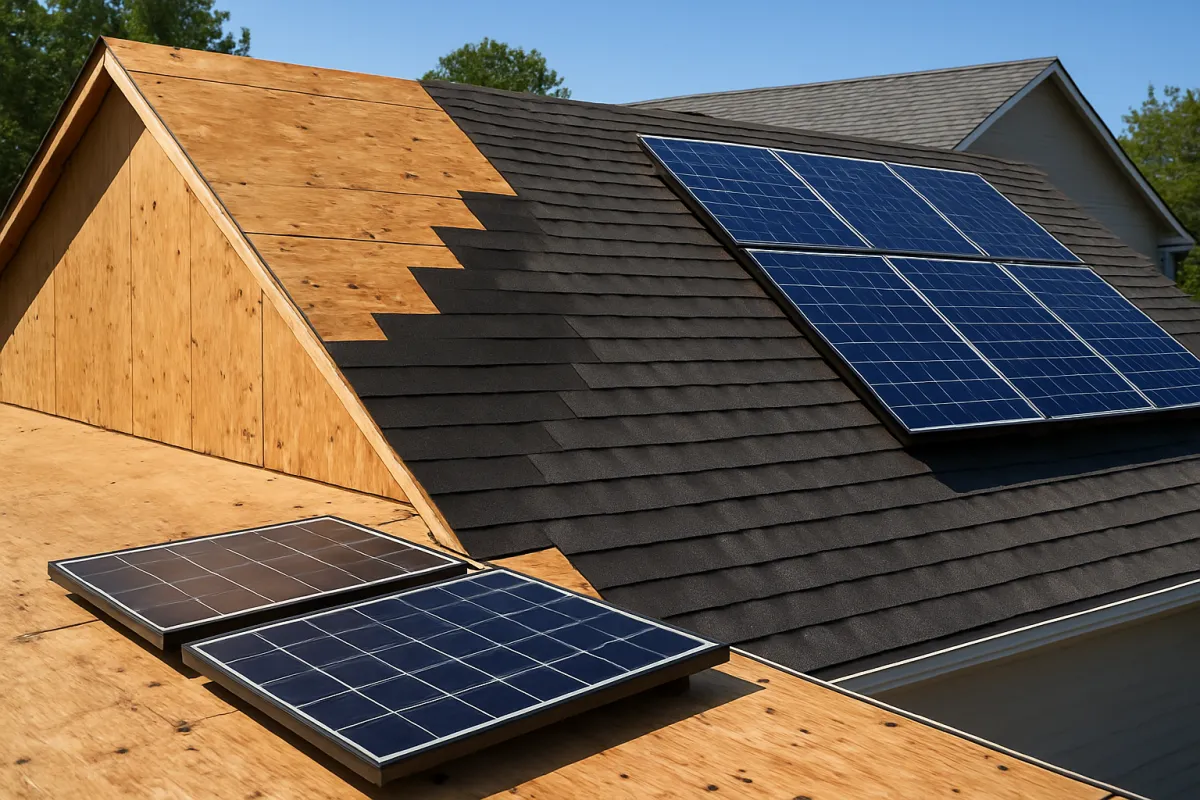
The roofers then do their work on a clear deck. When the new roof is finished, the whole sequence runs in reverse with new mounts, new flashing, and fresh sealant at every penetration, and the layout is usually reset from scratch rather than reusing old hole positions. Finally the system is reconnected, tested, and in most jurisdictions re-permitted and re-inspected before the utility allows it back online. The full cycle typically spans one to three weeks.
What remove and reinstall costs
The quote you receive is almost always built from two parts, and understanding the split is what lets you sanity check it. The first part scales with the size of the array: a per-panel rate covering the physical handling of each module, its clamps, and its share of the racking. The second part does not scale at all: the electrical work, the permit, the inspection, and the commissioning cost roughly the same whether the array has twelve panels or thirty.
As an illustrative shape rather than a quotation, take a per-panel handling rate of about $150 and a fixed block of about $1,200. A twenty panel array, which is roughly an eight kilowatt system at four hundred watt modules, prices out at twenty times $150 for $3,000 in handling labor, plus $1,200 fixed, for $4,200 in total. Spread across the array that is about $210 per panel all in, though the pure labor component is $160 per panel.
The fixed block is why small arrays look expensive per panel and large arrays look cheap. A twelve panel system on the same rates comes to $1,800 plus $1,200, or $3,000 total, which is $250 per panel. A thirty panel system comes to $4,500 plus $1,200, or $5,700 total, which is $190 per panel. Same rates, very different per-panel figures, and it is the total that matters to your budget.
The cost stack behind a removal quote
Breaking the illustrative $4,200 into its components shows where the labor actually goes. Reinstallation costs more than removal, which surprises people who assume taking things apart and putting them back are symmetrical tasks. Removal is fast and mostly destructive of hardware that is being replaced anyway. Reinstallation involves setting new mounts, laying new flashing into fresh roofing, aligning rails, torquing clamps to specification, and re-terminating every connection.
Illustrative removal and reinstallation cost stack, 20 panel array
Teaching numbers for an eight kilowatt system, totaling $4,200. Bars scale against the largest line.
Widths are computed from each value against the largest line: $1,800 reinstallation is 100%, so $1,400 removal is 78%, $500 electrical is 28%, $350 permitting is 19%, and $150 storage is 8%. The five lines sum to the $4,200 illustrative total used throughout this breakdown, which works out to roughly $210 per panel across twenty panels. These are teaching figures chosen to show proportions, not prices offered by any company, and your own quote will differ by region, roof, and array.
Note what is not on that list. New racking components, if the old rails are damaged or the layout changes, are an additional line. Any repair to the roof deck discovered once the shingles come off belongs to the roofing contractor. And if a panel is broken during handling, replacement of a discontinued module can be its own small saga, since matching an older model years later is rarely straightforward.
Where the money goes, share by share
Reading the same stack as shares of the whole makes the planning point obvious: about three quarters of the bill is skilled labor on your roof, and the administrative pieces, while genuinely required, are the smaller part. Anyone quoting you a figure that is mostly permits and fees has priced something unusual, and anyone quoting a figure with no permitting line at all may be planning to skip a step your jurisdiction requires.
Share of an illustrative $4,200 removal and reinstallation bill
Same teaching numbers, expressed as percentages of the total.
Shares are computed from the same illustrative dollar figures: $1,400 of $4,200 is 33.3%, $1,800 is 42.9%, $500 is 11.9%, and the combined $350 permit plus $150 storage is 11.9%, rounded to segments summing to 100. Labor on the roof is therefore about 76% of the bill. The percentages hold their shape across most array sizes, though the fixed administrative block takes a larger share on small systems and a smaller share on large ones.
The practical use of that split is negotiation and comparison. When two quotes differ sharply, the difference is nearly always in the labor lines rather than the fees, which means it is telling you something about roof complexity, crew day rates, or how much hardware the company intends to replace rather than reuse. Ask for the split before you ask for a discount.
What pushes your number up or down
Six factors move a removal quote more than anything else. System size is the obvious one, since panel count drives the labor half directly. Roof complexity is the next: a single unobstructed plane is quick, while multiple faces, dormers, steep pitch, hips, valleys, or an array split across several orientations slows every stage of the work and adds setup time for fall protection.
Access matters more than people expect. A two story roof with a tight side yard, no truck parking, mature trees over the drop zone, or a location that requires a lift rather than ladders adds real cost before a single panel moves. Whether the original installer still exists is a third factor, and a large one, covered in its own section below.
Equipment storage is a fourth: some companies include a week or two of secure storage in the price, others charge for it, and a few expect you to keep twenty modules in your garage. Re-permitting is a fifth, and it varies enormously by jurisdiction, from a simple over-the-counter reactivation to a full plan review. The sixth is scope creep on the electrical side, where an inverter near end of life, an outdated disconnect, or code changes since the original install can turn a reconnection into a partial upgrade. Our maintenance cost breakdown covers the ordinary upkeep side of the same budget.
The original installer problem
Who does the removal changes the price and the risk more than any technical factor. The best case is that your original installer is still in business, still services your area, and quotes the work. They know the layout, they own the workmanship warranty, and having them do it keeps that warranty intact. Many companies offer removal and reinstallation as a standard service and price it predictably.
The harder case is that the company has closed, been acquired, or exited residential work, which happens often enough in solar that it should be planned for rather than hoped against. Then you are hiring a third party solar company to work on somebody else’s installation, and they will price in the unknown: unfamiliar racking, undocumented wiring, missing as-built drawings, and no way to know what was done correctly the first time. Expect a higher quote and expect them to decline responsibility for pre-existing faults.
The third case is a solar company that will handle everything including the roof through a roofing partner, which simplifies coordination and gives you one contract to argue with if something goes wrong. That convenience usually carries a margin. Whichever route you take, the important question is not who is cheapest but who will stand behind the penetrations afterwards, and the answer belongs in writing.
Who owns the roof penetrations
Every mounting foot on your roof is a hole through the weatherproof layer, sealed with flashing and sealant and, if done well, as watertight as the surrounding roof for decades. Responsibility for those holes almost always sits with the solar installer under the workmanship warranty, not with the panel manufacturer and not with the roofer, because the installer is the party that made them. Our warranty breakdown walks through where penetration coverage sits inside the wider stack and how short its term often is.
That allocation is the reason the removal question is a warranty question first and a price question second. Workmanship warranties routinely exclude damage arising from work performed by parties the installer did not authorize, which is standard language rather than a trap. Once an unapproved crew has unbolted the mounts and rebolted them, the installer has a clean basis to decline any future leak claim at those points, and no reasonable company would agree to warrant work it did not supervise.
The practical consequence is a sequence, not a rule. Before scheduling anything, read the workmanship warranty, identify what it says about third party work, and then ask the installer in writing whether they will either perform the removal themselves or authorize a specific named contractor to do it while preserving coverage. Some will authorize; many will not. Either answer is useful, and getting it before the roofers arrive costs nothing.
What happens if a roofer touches the array
Roofing companies are often willing to handle panels, and some do it competently. The risk is not that they will drop a module. It is that the solar side of the job has requirements a roofing crew is not set up to meet: safe de-energization of a direct current array, torque specifications on clamps, correct grounding and bonding, conductor management that keeps wire off the roof surface, and flashing details specific to the mounting system in use.
Three failure modes recur. The first is water intrusion at reused or improperly integrated mounts, which may not show up for a season and can damage decking and ceilings before anyone sees a stain. The second is electrical: a loose connection or a compromised ground that either underperforms quietly or creates a hazard. The third is administrative, where the system goes back on without the re-inspection or utility notification the jurisdiction requires, which can complicate interconnection and any future claim.
None of that means a roofer can never be involved. It means the array work should be done by people licensed and insured for it, coordinated with the roofing, and documented. If cost pressure is pushing you toward letting the roofing crew handle everything, price the difference honestly against the warranty you would be giving up, then decide with the number in front of you rather than in the abstract.
The clean sequence: roof first, then solar
For anyone still in the planning stage, the cheapest version of this entire problem is to never have it. Replace the roof, let it be inspected and signed off, then mount the array on a new surface. The array then sits on a roof with a full service life ahead of it, and if the roof runs twenty two to twenty five years, the panels may reach the end of their own working life around the same time the roof needs attention again.
That sequence also improves the installation itself. Mounts go into sound decking, flashing integrates with new roofing rather than being worked into brittle shingles, and the installer has no reason to write roof exclusions into the workmanship warranty. It removes an entire category of future dispute about whether a leak came from the roof or from the array.
There is a coordination benefit as well. When the reroof happens first, you can ask the roofer to note rafter locations and any structural details, which helps the solar crew place mounts accurately. Our walkthrough of how to go solar treats the site assessment as the point where roof condition should already be settled rather than discovered.
Sequencing when the roof is already failing
If the array is already up and the roof is going, the order of operations is fixed and worth stating plainly. First, get a roofing assessment and a written scope, including whether decking repair is likely. Second, get a removal and reinstallation quote from a licensed solar company, ideally the original installer, and confirm in writing what happens to the workmanship warranty. Third, confirm what permits the jurisdiction requires for taking a system offline and putting it back, since this varies widely.
Fourth, schedule the three phases so the roof work sits inside the solar downtime with a buffer at each end, because roofing schedules slip with weather and a crew that arrives to a roof still covered in panels will charge for the wasted day. Fifth, agree where the panels will be stored and who is liable for damage while they sit there. Sixth, confirm that reinstallation includes new mounts, new flashing, and fresh sealant rather than reuse of weathered hardware.
Seventh, plan the reconnection: who calls for inspection, who notifies the utility, and how you will verify production once the system is back. Comparing the first full month after reconnection against the same month a year earlier is the simplest check that everything came back correctly, and monitoring data makes that comparison easy.
Doing both jobs as one project
When the roof is due and solar is planned, running both as a single coordinated project is the efficient path, though it is worth being precise about what it saves. It does not make the roof cheaper. It rarely produces a meaningful discount on the solar. What it saves is the entire removal and reinstallation bill you now never pay, which on the illustrative numbers here is the whole $4,200, plus the second round of scheduling, permits, and downtime.
Some companies offer roofing and solar together, which reduces coordination effort and gives you a single point of accountability if a leak appears. That is genuinely valuable, since the most common dispute in this whole area is two contractors each insisting the other caused the water. The tradeoff is that a bundled provider may not be the best price or the best crew on either half, so compare the bundle against separate bids rather than assuming it wins.
If you do split it, insist the roof is complete and inspected before mounting hardware goes through it. The temptation to have the solar crew start while roofing finishes on another plane is a false economy that produces exactly the ambiguity you were trying to avoid. Getting quotes for both at once also lets you see the full capital picture before committing, which is what the companion calculator on this page is built to help with.
What happens to production while the array is down
An offline array makes nothing, and the natural assumption is that weeks without production must cost real money. Run the number and the assumption collapses. Take the illustrative eight kilowatt system: at four and a half peak sun hours and a typical 0.8 derate, it makes about 28.8 kilowatt-hours on an average day. At a 17 cent per kilowatt-hour retail rate, that is roughly $4.90 of avoided electricity cost per day.
Five days offline therefore costs about $24. Ten days costs about $49. Even a drawn out three week outage costs around $103. Against a $4,200 removal bill, the lost production is noise, and it should not drive your scheduling decisions. What should drive them is the risk of the array sitting on the ground longer than planned, and the possibility of weather damage to an exposed roof between phases.
Two caveats are worth stating. If you are on a net metering arrangement where banked credits offset winter usage, taking the system down during your highest production months costs more than the same number of days in December, so schedule for a shoulder season if you have the choice. And if you have a battery configured for backup, understand that the array being offline changes what the battery can do during an outage, which our note on solar in a power outage explains in detail.
A worked example: an 8 kW array on a roof with six years left
Take a concrete case. A twenty panel, eight kilowatt array was installed six years ago on a roof that was already ten years old, an architectural asphalt roof with an assumed twenty two year service life. The roof therefore has roughly six years left. A reroof is quoted at an illustrative $12,000. The removal and reinstallation quote is the $4,200 worked through above.
Path one is to wait. In six years the roof is replaced for $12,000 in that year’s money, plus $4,200 to take the array off and put it back, plus a second round of scheduling and roughly $49 of lost production. Total outlay across the two events: $16,200 plus the disruption.
Path two is to reroof now, with six of twenty two years of roof life unused. The value given up is the prorated remainder: six divided by twenty two, times $12,000, which is about $3,270. Total outlay: $12,000 now, of which $3,270 represents life you did not use, and no removal bill ever. Compared against path one, reroofing now is ahead by roughly $930, which is $4,200 avoided minus $3,270 forfeited, and that is before counting the second disruption or the risk of a leak in a roof running past its life under an array.
The break-even math behind the ten-year rule
That comparison generalizes into a single line worth remembering. You should reroof first whenever the prorated value of the remaining roof life is less than the removal and reinstallation cost. Written as a formula, replace first when remaining years divided by total roof life, times roof cost, is less than the R and R total. Rearranged, the break-even remaining life is the R and R cost divided by the roof cost, times total roof life.
Run it on the illustrative figures: $4,200 divided by $12,000 is 0.35, times twenty two years, gives 7.7 years. So on those numbers the tipping point sits just under eight years, and anything below that clearly favors reroofing first. Push the array to thirty panels and the R and R total rises to $5,700, which gives 5,700 divided by 12,000, times twenty two, or 10.45 years. Larger arrays move the threshold past ten.
That is where the ten-year rule of thumb comes from. It is a rounded midpoint of a calculation that swings with array size, roof price, and local labor rates, and it is deliberately conservative because the non-financial costs of doing the job twice, scheduling, disruption, and warranty exposure, all point the same direction. Put your own three numbers into the companion calculator and it will compute your threshold rather than a generic one.
Storm damage and insurance claims
A large share of roof replacements on solar homes are not planned at all; they follow hail, wind, or a fallen limb, and the roof is being replaced on a claim. How the removal cost is treated in that situation depends entirely on your policy, your endorsements, and how the array is classified, so nothing here should be read as a statement about what your carrier will pay.
The mechanism, described generally, runs like this. A covered peril damages the roof. The insurer agrees the roof requires replacement rather than repair. Restoring the damaged surface physically requires removing what sits on it, so the removal and reinstallation is sometimes argued as a necessary cost of accessing the damaged property. Whether that argument succeeds, and whether the array itself is covered as part of the dwelling or requires a separate scheduled endorsement, is a policy question with a policy answer.
What you can do is practical rather than legal. Call the carrier before authorizing any work and get their position in writing. Keep the original installation contract, the permit records, and photographs of the array before and after the event. Ask the adjuster explicitly whether solar removal is within the scope being approved rather than assuming it is folded in. And if you are shopping insurance while planning solar, ask how a rooftop array is treated under the policy before you buy it rather than after a storm.
Roof materials that change the math
Everything above assumes asphalt shingles, which cover most residential roofs, but the material changes both halves of the calculation. Standing seam metal roofing is the friendliest surface for solar because mounting clamps attach to the seams without penetrating the roof at all, which removes the leak risk and much of the flashing work. Metal roofs also commonly last decades longer than asphalt, which frequently eliminates the mismatch entirely: the roof may well outlive the array.
Clay or concrete tile is the difficult case. Mounting on tile requires either tile replacement hooks or specialized flashing, tiles are brittle and break during handling, and both the original installation and any removal cost more as a result. A tile roof also often has a very long service life while its underlayment does not, so the relevant question on tile is the age of the underlayment rather than the age of the visible tiles.
Low slope and flat roofs bring membranes and ballasted or penetrating mounts, and membrane service life is typically shorter than a pitched asphalt roof. Wood shake is rare and generally poor for solar. In every case the same framework applies: find the remaining life of the weatherproof layer, price the removal, and compare. Only the numbers change.
Partial reroofs and working around the array
A frequent question is whether the whole array has to come off when only part of the roof needs work. Sometimes not. If damage is confined to a plane the array does not occupy, the roofing can proceed around it with care and no solar work at all. If the damage is at the edge of the array, a partial removal of the affected rows is occasionally workable, though it complicates the wiring since strings must be safely opened and reclosed.
Where partial approaches go wrong is when they are chosen to save money on a roof that is failing generally rather than locally. Reroofing half a roof under an array and leaving the covered half for later guarantees a second removal, and the fixed costs, the permit, the disconnect, the commissioning, get paid twice. If the whole roof is near end of life, doing it once is cheaper even when only one plane is currently leaking.
There is also a cosmetic and practical point about matching. Shingles weather, and a partial replacement rarely matches the surrounding roof, which matters at resale. If you expect to sell within a few years, a whole-roof replacement with the array reinstalled cleanly presents far better than a patched roof with a partially disturbed array.
What to get in writing before work starts
Verbal assurances evaporate the moment something leaks. Six items belong in writing before anyone starts. First, the total removal and reinstallation price with the labor and fixed components broken out, and a statement of what would trigger a change order. Second, an explicit confirmation from the solar company of what happens to the workmanship warranty, including whether third party roofing work affects it.
Third, the reinstallation scope: new mounts, new flashing, fresh sealant, and which racking components are being reused. Fourth, storage arrangements and who carries the risk of damage while the modules are off the roof. Fifth, the permitting and inspection responsibilities, naming which party files, which party schedules, and what happens if the inspection fails.
Sixth, a commissioning confirmation: a written statement that the system was tested and is producing at expected levels after reconnection, with a production reading you can compare against. That last item is the one most often skipped and the easiest to check yourself, since a month of data against the same month a year earlier tells you quickly whether every string came back online.
Questions to ask an installer before you sign
If you have not installed yet, the whole problem is preventable with a short list of questions during the quoting stage. Ask what remaining roof life the installer assessed and how they assessed it. Ask whether they would install on this roof today if it were their own house. Ask what the workmanship warranty says about roof penetrations, how long that specific coverage runs, and whether it is shorter than the headline workmanship term.
Ask what the company charges for removal and reinstallation as a current price for a system of this size, and get it in writing even though you will not need it for a decade. That number is useful twice: it tells you what a future reroof will cost you, and an installer who will not quote it is telling you something about how they think about long-term service.
Ask whether they will authorize a third party to remove the array without voiding coverage, and under what conditions. Finally, ask whether they offer or coordinate roofing, and if so, get separate bids to check the bundle. A company that answers all of those plainly is demonstrating exactly the qualities our installer selection checklist is built to identify.
Put your own numbers in
The figures throughout this breakdown are teaching shapes, and the point of them is the structure rather than the amounts. Your panel count, your local labor rates, your roof price, and your roof’s remaining life produce a different threshold and possibly a different answer. The companion tool on this page takes five numbers you already know or can get in a phone call and returns the four that matter: your removal and reinstallation total, your all-in cost per panel, the prorated roof value you would forfeit by replacing early, and your personal break-even remaining life.
Read the break-even number as the decision rule rather than a suggestion. If your roof has fewer remaining years than the threshold the calculator returns, replacing it before the array goes on is the cheaper path on pure arithmetic, and it also removes the warranty and scheduling risks that the arithmetic does not price. If your roof has more years than the threshold, waiting is defensible, though it is worth re-running the comparison every few years as the roof ages.
One honest caveat about the model: it treats future dollars as current dollars and ignores inflation in labor and materials, which generally works against waiting, since removal labor is unlikely to get cheaper. Treat the output as a decision aid rather than a forecast, and get real quotes before you commit to either path.
The bottom line
Panels last twenty five years or more, asphalt shingles usually do not, and that mismatch is the whole problem. If the roof under a planned array has fewer than roughly ten years of service left, replace it first. The break-even calculation behind that rule is simple enough to run yourself: compare the prorated value of the roof life you would give up against what a removal and reinstallation would cost, and the smaller number wins. On illustrative figures of $12,000 for a roof and $4,200 to take a twenty panel array off and put it back, the threshold lands just under eight years, and it climbs past ten for larger arrays.
If the array is already up and the roof is failing, the sequence matters more than the price. Get a roofing scope, get a removal quote from a licensed solar company, confirm in writing what the workmanship warranty survives, schedule the phases with a buffer, and insist on new mounts and new flashing on reinstallation. Do not let a roofing crew handle the array unless the solar company has authorized it in writing, because the roof penetrations are the one part of your system where a coverage gap turns into water inside the house. The lost production while the system is offline is worth about five dollars a day and should not influence any of these decisions.
WattBarn publishes this breakdown to help homeowners plan a roof and a solar array as one project, and it is not construction, engineering, insurance, tax, or legal advice. Every cost, service life, and percentage above is an illustrative teaching figure chosen to show how the arithmetic works, not a quotation from any roofing company, solar installer, or manufacturer, and real prices vary substantially by region, roof geometry, labor market, and the condition of what is found once the shingles come off. Warranty language, permitting requirements, and insurance policy terms differ by contract, jurisdiction, and carrier, and none of them can be determined from an article. Before you schedule anything, obtain written quotes for both the roofing and the solar work, read your own workmanship warranty, confirm your own permitting obligations with the local building department, and take questions about coverage to your own insurer and questions about your roof structure to a licensed professional.
Frequently asked questions
How much does it cost to remove and reinstall solar panels for a roof replacement?
Most homeowners are quoted a figure built from two parts: a per-panel labor rate for taking the modules and racking off and putting them back, plus a fixed block of costs that does not change with system size. An illustrative shape for a twenty panel residential array is roughly $150 per panel in handling labor plus around $1,200 for the electrical disconnect, the permit, the re-inspection, and the re-commissioning, which lands near $4,200 all in, or about $210 per panel once the fixed costs are spread across the array. Those figures are teaching numbers rather than quotes, and real prices vary widely by region, roof complexity, and how much of the racking has to be replaced rather than reused. Get the number in writing from a licensed solar company before you schedule the roofers, because it is usually the single largest surprise in the project.
Should I replace my roof before installing solar panels?
If the roof has fewer than roughly ten years of service life left, replacing it first is almost always the cheaper path, and many installers will decline the job or refuse to warranty the penetrations otherwise. The arithmetic is straightforward: reroofing early means giving up the prorated value of the remaining roof life, while reroofing later means paying to take the whole array off and put it back. On the illustrative numbers used in this breakdown, a roof with six years left on an assumed twenty two year life gives up around $3,270 of value against a removal and reinstallation bill near $4,200, so replacing first comes out ahead by roughly $930 before counting the second round of scheduling and disruption. Run the comparison with your own roof cost, your own remaining years, and your own removal quote rather than accepting the rule of thumb blindly.
Can a roofer just take the solar panels off?
Physically, yes, and some roofing companies will offer to do it. The problem is contractual rather than mechanical, because the mounting hardware, the flashing, the wiring, and the roof penetrations are normally covered by the solar installer's workmanship warranty, and that warranty typically excludes work performed by anyone the installer did not authorize. A roofing crew that detaches and reattaches the array can therefore end the coverage on exactly the components most likely to cause a leak, which leaves you with a new roof and no one to call when water appears at a mount. Read the workmanship warranty language before anyone touches the array, and ask the solar company in writing whether a named roofer is acceptable to them.
How long will my solar system be offline during a roof replacement?
The array is typically down from the day the panels come off until the reinstallation passes inspection and the utility permits reconnection, which is commonly a window of one to three weeks rather than the two or three days the roof itself takes. Scheduling is the usual cause of the gap, because the removal crew, the roofing crew, the reinstallation crew, and the inspector all have to line up in sequence. The financial cost of that downtime is smaller than most people expect: an illustrative eight kilowatt array making around 28.8 kilowatt-hours on an average day is giving up roughly $4.90 a day at a 17 cent rate, so ten days off costs about $49. The scheduling risk is the real cost, not the lost production.
Does homeowners insurance pay to remove solar panels after storm damage?
Whether removal and reinstallation is covered depends entirely on your policy language, your endorsements, and how the array is classified, so nobody can answer it for your house except your own carrier. The mechanism generally runs like this: if a covered peril damages the roof and the roof must be replaced to be repaired properly, the reasonable cost of accessing the damaged surface can form part of the claim, and solar removal is sometimes argued as an access cost. Whether the array itself is covered as part of the dwelling or needs a separate endorsement is a distinct question with its own answer. Call your carrier before you authorize any work, get the position in writing, and keep the original installation documents, because the claim is far easier to argue with paperwork than without it.
Do I need new roof penetrations and flashing when the panels go back on?
In most cases yes, because the old flashing is bonded to shingles that are being torn off, and reusing weathered mounting feet on a fresh roof surface undermines the point of replacing it. Good practice on a reinstallation is new mounts, new flashing, and fresh sealant at every penetration, laid into the new roofing rather than surface-sealed on top of it. Some racking rails and clamps can be reused if they are undamaged, which is where a reinstallation quote can legitimately come in lower than a new installation. Ask the quote to state plainly which components are being replaced and which are being reused, and ask what warranty covers the new penetrations.
Is it cheaper to reroof and install solar at the same time?
Doing both as one coordinated project is usually cheaper than doing them years apart, because the array never has to come off and go back on, and because the roofing crew and solar crew can plan around a single clean roof surface. It does not make the roof itself cheaper, and it does not usually produce a discount on the solar, so the saving is essentially the whole removal and reinstallation bill you never pay. The sequencing matters more than the bundle: the roof should be finished and inspected before mounting hardware goes through it. Ask both contractors to confirm in writing who is responsible for the penetrations once the work is done.
What happens to the solar tax credit or warranty when panels are reinstalled?
Reinstalling an existing array is maintenance work rather than a new energy property purchase, so it is not the kind of expenditure that federal residential energy credits are designed to cover, and rules around credits change over time. Confirm the current treatment with the official program guidance or a tax professional rather than relying on any figure quoted online, including this one. On the warranty side, the manufacturer coverage on the panels usually follows the equipment, while the installer's workmanship coverage is the piece most at risk from a removal performed by an unauthorized party. Get written confirmation from the original installer about what survives the work before the first panel comes off.