
What's on this page
- Why the array ends up on the ground
- What a ground mount actually is
- What a ground mount costs, illustratively
- The cost stack, line by line
- Where the money goes, share by share
- Racking is the first real adder
- Foundations, concrete piers against driven posts
- The trench is the line nobody quotes
- What a foot of trench actually costs
- Cost per watt by array size
- How much land a ground mount needs
- Setbacks, coverage and the building department
- What tilt actually buys you
- What orientation actually buys you
- The production advantage, quantified
- How big the advantage has to be to pay for itself
- Access is the quiet argument for the ground
- Snow, mowing and the nuisances at ground level
- The payback comparison against a roof system
- A worked example from quote to break even
- When a ground mount is the cheaper decision
- Incentives and what changed for 2026
- Ground mount against a solar carport
- Questions to put to a ground mount bidder
- Who a ground mount is actually for
- The bottom line
Short answer: A ground mount costs more than the same array on a roof: about $3.65 per watt all in on illustrative figures against roughly $2.80, so 8 kilowatts runs about $29,200 against $22,400. The premium is racking that must become a structure, concrete foundations, and the trench back to the house at an illustrative $30 a foot. Chosen tilt adds roughly 11 percent more production, not enough to repay the premium.
The site visit usually ends the same way. The installer walks the roof, looks at the chimney shadow, counts the usable feet between the ridge and the vents, and then turns around and looks at the yard. Half an acre of grass sitting in full sun, facing anywhere you like, with nothing on it but a mower track. The obvious question follows, and so does the less obvious answer: yes, the panels can go out there, and yes, it will cost more than the roof.
This cost breakdown prices that decision line by line. It covers what a ground mount actually is once the marketing is stripped away, how the racking, the concrete and the trench build the premium over a roof system, how much land the array really needs before setbacks are counted, what tilt and orientation genuinely buy in kilowatt-hours, how big that production advantage has to be before it repays the extra spend, and where a ground mount is simply the cheaper decision after all. The solar carport comparison and the general cost briefing cover the other two mounting choices, so this one links them rather than repeating them. Every dollar figure below is illustrative, and you can substitute your own in the companion calculator on this page.
Key takeaways
- A ground mount prices near $3.65 per watt all in on illustrative figures, against roughly $2.80 for the same array on a roof, so 8 kilowatts runs about $29,200 against $22,400.
- The premium is a fixed number of dollars, not a percentage: about $6,800 at 8 kilowatts, but only $0.60 a watt by the time the array reaches 12 kilowatts.
- The trench is the forgotten line. At an illustrative $30 a foot, 120 feet from array to panel adds $3,600 before a single module is bolted down.
- Chosen tilt and orientation are worth roughly 11 percent more production than a reasonable roof plane, but the premium needs about 30 percent to repay itself, so a good roof still wins.
- Against a genuinely compromised roof plane the arithmetic flips: payback near 16.3 years on the ground against 17.9 years on a shaded east and west roof, all computed with no federal residential credit.

Why the array ends up on the ground
Nobody sets out to put solar panels in the yard. The roof is the default because it is surface area you already own, already elevated above shade, already load rated and already outside the mower’s path. When the roof works, the ground never comes up.
The conversation starts when the roof fails one of four tests. Orientation is the first: the usable planes face north, or split east and west with nothing pointing anywhere near south. Shade is the second, whether from a neighbor’s oak, a chimney, a second storey or a dormer that takes a good plane out of service for three hours a day. Size is the third, since vents, skylights, valleys and hips can break a roof into fragments too small to hold the array you actually need.
Age is the fourth and the most expensive to ignore. A roof with eight years of shingle left will need the array detached and reset partway through its life, which is a real cost that a ground mount simply does not have. Our roof replacement piece works through that timing problem in detail.
Fail one of those tests and the array has to sit somewhere else. If you have open, sunny, unused land, the ground is the cheapest somewhere else available.
What a ground mount actually is
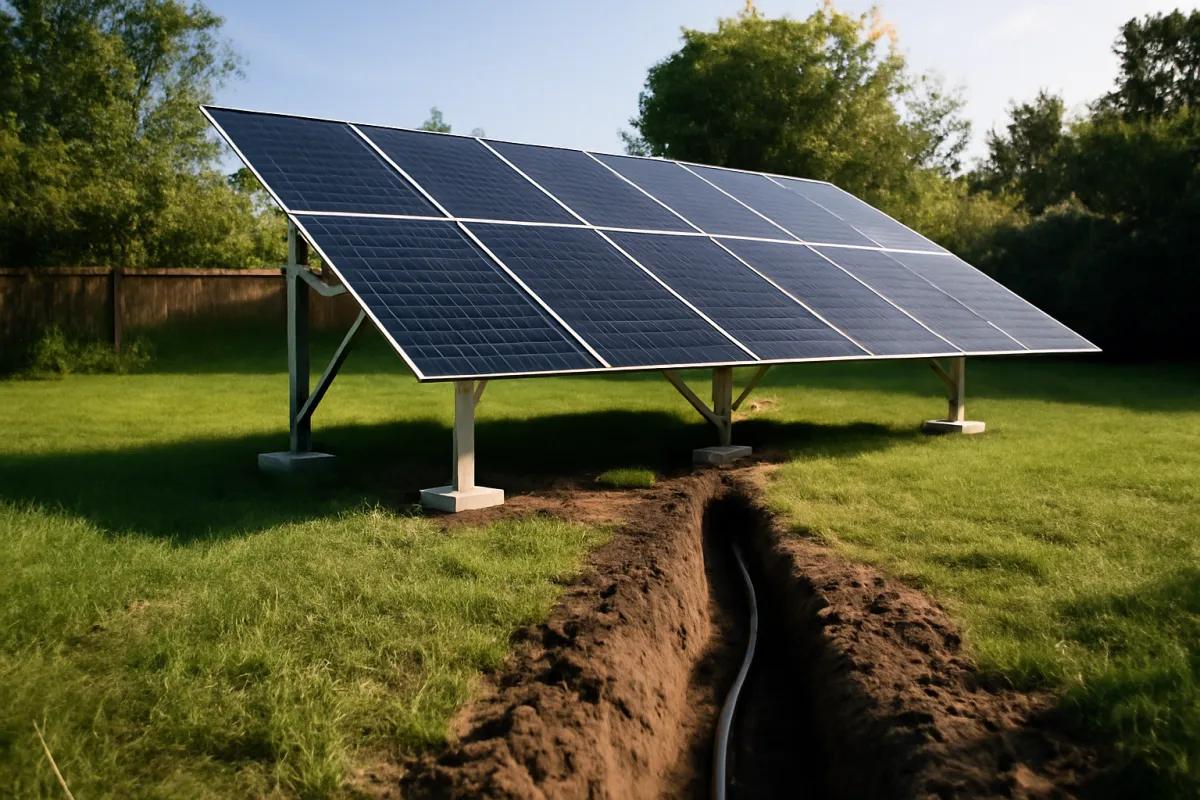
A ground mounted array is a racking system on legs. Posts go into the earth, either set in concrete piers or driven directly into soil, and a frame of rails and cross members spans between them at a fixed angle. The modules bolt to that frame exactly as they would bolt to roof rails. Nothing about the electrical design changes: same modules, same inverter choices, same conductors, same interconnection.
What changes is everything below the modules. On a roof, the structure is already there and already paid for, and the racking’s job is to attach to it without leaking. On the ground, there is no structure, so the racking has to become one. That means it carries the full dead load of the array, the full wind load in both directions, and the full snow load, and it transfers all of that into foundations you have to excavate and pour.
The second change is distance. A roof array is a few feet from the service panel through an attic or down a wall. A ground array is however far away the good part of the yard happens to be, and that distance has to be crossed underground.
Those two differences, a structure that did not exist and a run that has to be buried, are the entire ground mount premium. Everything else on the quote is ordinary solar.
What a ground mount costs, illustratively
There is no national price, and any single number offered as one is a marketing artifact rather than a measurement. What is useful instead is a shape you can test your own bids against.
Across residential scale arrays, an all in figure near $3.65 per watt is a reasonable teaching anchor for a ground mount, against roughly $2.80 per watt for the same array on an existing roof. Run those through a common size. Twenty modules at 400 watts each is 8 kilowatts. On the ground that is about $29,200. On a roof it is $22,400. The difference of roughly $6,800 is what the posts, the concrete and the trench cost you, net of the flashing and roof labor you avoid.
Hold both numbers, because every section below either breaks them apart or stress tests them. And treat dollars per watt as the comparison currency: a total tells you what one array costs, while the per watt figure tells you whether it is expensive. The habits in our quote reading walkthrough apply here with one extra step, which is separating the site work lines from the solar lines before comparing anything.
The cost stack, line by line
Splitting that $29,200 into parts is the single most useful thing you can do with a ground mount bid, because it shows immediately which half of the project a high price is coming from. Here is a plausible shape for the 8 kilowatt example used throughout this comparison.
Illustrative cost stack, 8 kW ground mounted array
Teaching numbers totaling $29,200. Bars scale against the largest line.
Widths are computed from each value against the largest line: $9,000 of equipment is 100%, so $6,200 is 69%, $4,300 is 48%, $3,780 is 42%, $3,600 is 40% and $2,320 is 26%. The six lines sum to the $29,200 illustrative total used throughout, which is $3.65 per watt across 8,000 watts. These are teaching figures chosen to show proportions, not prices offered by any company.
Read that list once and the ground mount premium explains itself. Racking and foundations together are $10,500, and on a roof those two lines would be a small fraction of that because the structure already exists. The trench adds $3,600 more, and the permit package is heavier than a roof array’s because a new structure with footings is being approved rather than just an electrical alteration.
Reconciling against the roof figure is worth doing explicitly. That $10,500 of racking and foundation work is offset by roughly $2,100 of roof specific cost you skip: flashing, penetrations, sealing, fall protection and the labor premium of working on a pitch. Ten thousand five hundred minus that twenty one hundred is $8,400, and the roof array’s own racking allowance of about $1,600 accounts for the rest of the gap down to the $6,800 premium quoted above.
Where the money goes, share by share
Expressed as shares of the whole, the same stack makes a planning point that a list of dollars hides. Only about half of a ground mount bill is the equipment that generates electricity.
Share of an illustrative $29,200 ground mount bill
Same teaching numbers, expressed as percentages of the total.
Shares are computed from the same illustrative dollars: $9,000 of $29,200 is 30.8%, $6,200 is 21.2%, the combined $3,600 trench plus $2,320 permit package is 20.3%, $4,300 is 14.7% and $3,780 is 12.9%, rounded to segments that sum to 100. Racking and footings together are 36% of the bill and are the part a roof mount largely avoids.
That 36 percent is the number to carry into any comparison. It is not waste and it is not markup. It is a genuine structure with a genuine cost, engineered to hold an array still through the worst wind your county publishes a design speed for. But it is 36 percent of your money doing something other than making kilowatt-hours.
The split is also diagnostic. When two ground mount quotes differ sharply, the gap is nearly always in the foundation and trench lines, and that usually reflects different assumptions about soil, frost depth and how far the run really is. Ask each bidder what they assumed before you decide the cheaper one is better value.
Racking is the first real adder
Ground racking is a different product from roof racking, and the price reflects that. Roof rails are short aluminium extrusions that carry load into rafters a few feet apart. Ground racking is a freestanding frame: vertical posts, a torque tube or horizontal beam spanning between them, and purlins running across that to receive the modules.
Because there is no building underneath, every force ends up in those posts. Wind pushing on the face of a tilted array becomes a bending moment at ground level. Wind lifting under the array tries to pull the posts out. Snow sitting on the face adds a downward load that the beam has to span. The frame is sized for the worst of those, not the average.
Two design families dominate residential work. Post and rail systems set individual posts under each column of modules, which suits smaller arrays and irregular ground. Torque tube systems run a single spanning member across the whole array on fewer, heavier posts, which suits longer rows and can reduce foundation count. Neither is universally cheaper, and the honest way to compare is to ask each bidder for the post count, the post size and the design loads.
The illustrative $6,200 racking line for an 8 kilowatt array is about $0.78 a watt, and it does scale with array size, which is why the racking share of the bill stays roughly constant as the array grows.
Foundations, concrete piers against driven posts
Under the racking sits the part you never see and the part most likely to move the price. Two approaches dominate. Concrete piers are augered holes, commonly a foot or more across and dug below the local frost line, with the post set and concrete poured around it. Driven posts are steel sections hammered straight into the ground by a machine, with no concrete at all.
Driven posts are usually faster and cheaper where the soil cooperates, because there is no excavation spoil, no concrete truck and no cure time. They stop being an option in rock, in very loose sand, or where a geotechnical assessment says the friction available is not enough. Concrete piers work almost anywhere but cost more in labor, material and schedule.
Frost depth is the variable that surprises people. In a mild climate a pier might be three feet deep. In a cold one the same pier can be five or six feet, which is roughly double the excavation and double the concrete for identical hardware above ground. That single local number can move a foundation line by thousands.
The illustrative $4,300 foundation figure assumes ordinary soil and a moderate frost depth. Ask what soil and what depth your bid assumed, and what happens to the price if the auger finds something else.
The trench is the line nobody quotes
Between the array and the house there is a distance, and that distance has to be crossed underground with conduit, conductors and usually a communications run for monitoring. It is the most commonly underestimated item on a ground mount bid, because homeowners think of it as a wire and installers price it as excavation.
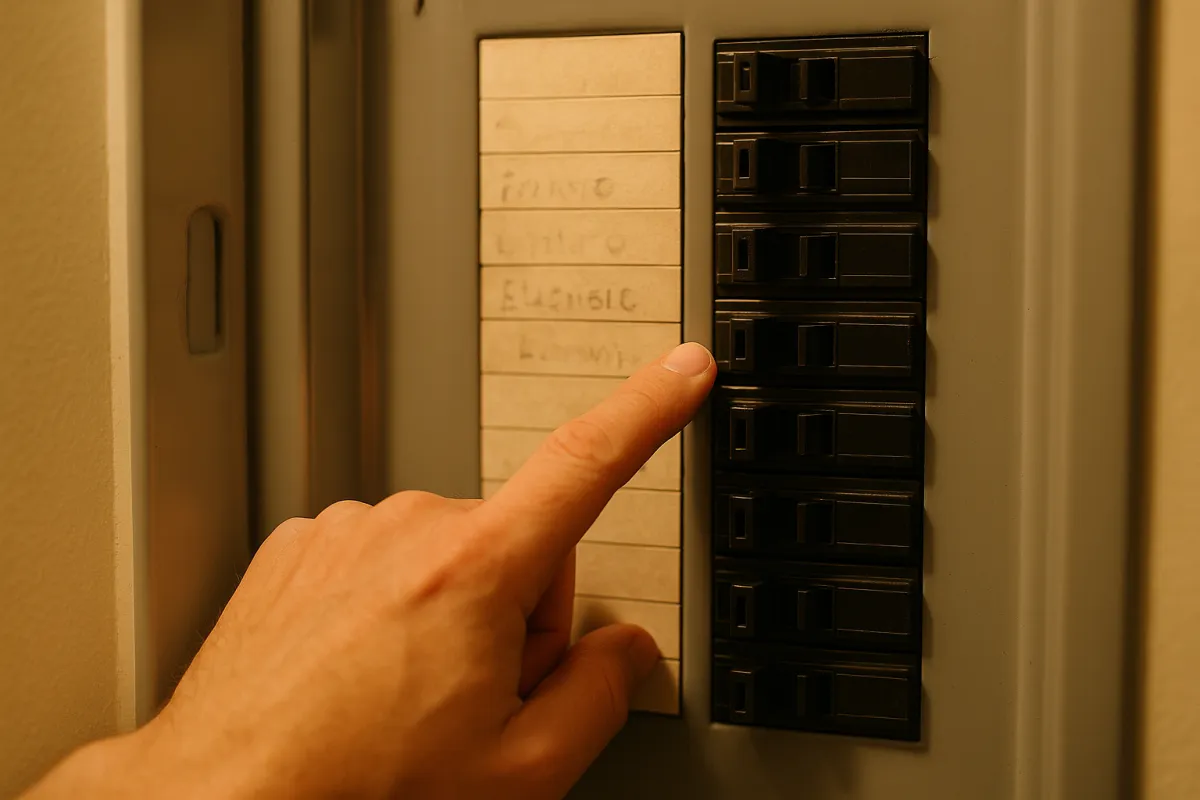
At an illustrative $30 a foot, a 120 foot run is $3,600. Move the array to the far corner of the property and 250 feet becomes $7,500, which is more than the entire foundation line. Bring it to 40 feet and the same item is $1,200. Nothing else on the quote responds so directly to a decision you control, which is why array placement deserves more thought than it usually gets.
Voltage drop is the technical reason distance matters twice. A longer run loses more energy as heat, and the standard fix is heavier conductors, which cost more per foot. So a long run is not simply more feet at the same rate. It is more feet at a higher rate.
What a foot of trench actually costs
The $30 a foot figure is a teaching average across a mixed run, and the real number varies enormously by what the trench passes through. Open lawn is the cheap case: a small trencher opens it, the conduit goes in, and the sod goes back. Anything else costs more.
A driveway or patio crossing means saw cutting, removing material, and restoring the surface afterwards, and restoration is often the larger half. Tree roots mean hand digging. Existing utilities mean locating first and then working carefully around gas, water, sewer, irrigation and communications lines. Rock means either a hammer attachment or a rerouted trench.
Depth is set by code and by what the conduit is. Direct buried cable goes deeper than conductors in rigid conduit, and a run under a driveway usually goes deeper still. These requirements are code and jurisdiction specific rather than universal, so let your electrician and your inspector settle the depth rather than assuming a number.
Two things are worth buying while the trench is open. A spare conduit for a future circuit costs very little when the ditch already exists and a great deal later. And a proper as built sketch of where the run goes will matter the first time somebody plants a tree.
Cost per watt by array size
The fixed half of a ground mount bill is what makes small arrays expensive. Splitting the illustrative $29,200 gives about $2.91 per watt that scales with the array, covering equipment, racking, foundations and labor, plus about $5,920 that does not: the $3,600 trench and the $2,320 engineering and permit package.
Apply that split across sizes and the pattern is stark. A 4 kilowatt array costs about $11,640 in scaling costs plus $5,920 fixed, which is $17,560, or $4.39 a watt. A 6 kilowatt array is $23,380, or $3.90 a watt. The 8 kilowatt case is $29,200, or $3.65. A 10 kilowatt array is $35,020, or $3.50. A 12 kilowatt array is $40,840, or $3.40.
Now compare each against the same kilowatts on a roof at a flat $2.80. At 4 kilowatts the premium is $6,360, or $1.59 a watt. At 8 kilowatts it is $6,800, or $0.85. At 12 kilowatts it is $7,240, or $0.60. The dollar premium barely moves across the whole range while the per watt premium falls by more than half.
That is the most actionable fact in this comparison. Ground mounts reward size. If you are already going to dig the trench and pull the permit, the marginal kilowatt is cheap. Our sizing walkthrough is the right place to decide how many of those marginal kilowatts you can actually use.
How much land a ground mount needs
Start with the array face. Twenty modules of roughly 3.3 feet by 6.5 feet, arranged two high and ten wide in portrait, give a face about 33 feet across and 13 feet up the slope. Tilt that face at 30 degrees and its horizontal footprint is about 11 feet deep, since the slope length shortens as it leans. The array itself therefore occupies roughly 370 square feet of ground.
That sounds modest, and the array alone is. The usable requirement is larger. Add three feet of working clearance on every side for assembly, maintenance and mowing, and the cleared area becomes about 39 by 17 feet, or roughly 660 square feet.
Multi row layouts change the picture. A 13 foot slope length at 30 degrees stands about 6.5 feet tall at the back, and the usual planning approach leaves a gap of roughly two to three times the array height so the front row does not shade the back one in winter. That is 13 to 20 feet of empty ground between rows, at this illustrative geometry, before anything else is considered. Row spacing tightens near the equator and stretches at higher latitudes.
Setbacks, coverage and the building department
Everything above is geometry. What actually decides where the array can sit is local rule, and this is the part that most often derails a ground mount plan late.
Ground mounts are frequently treated as accessory structures, which brings them under the same rules as a shed or a detached garage. That commonly means a minimum distance from every property line, a maximum height, and a cap on how much of the lot can be covered by structures. Some jurisdictions count a tilted array’s footprint toward coverage and some do not. Some apply front yard restrictions that push the array behind the house regardless of where the sun is.
There is no way to write down what applies to you, because these rules are set at municipal level and neighboring towns genuinely differ. Homeowner associations add another layer with their own review, and in some places that layer is the binding one.
The productive move is a phone call before a design. Ask the building department what a detached photovoltaic array of your footprint and height requires, what the setbacks are, whether a stamped foundation design is needed, and whether coverage limits apply. Our permitting and interconnection explainer covers the sequence those approvals follow.
What tilt actually buys you
Now to the reason people accept the premium. A roof array sits at whatever pitch the builder chose, which is a construction decision with no relationship to the sun. A ground mount sits at whatever angle you specify, which is the whole point.
The optimising principle is straightforward. A fixed array collects most when its face is square to the sun, and averaged across a year that favours a tilt somewhere in the region of the site’s latitude. Tilt shallower and you favour summer, when the sun is high. Tilt steeper and you favour winter, when it is low, which also helps snow slide off.
The size of the gain depends on how wrong the roof was. Moving from a very shallow pitch to a well chosen tilt in a northern location is worth a meaningful percentage. Moving from a roof that was already close to optimal is worth almost nothing. Anyone quoting a single universal number for the tilt benefit is guessing, because it is entirely a function of the starting point.
The honest framing is that tilt is a lever you gain rather than a bonus you receive. On a roof you have no lever at all. On the ground you can also point a steeper array at winter production if your bill is winter heavy, which the winter output piece works through.
What orientation actually buys you
Orientation matters more than tilt in most cases, and it is the one a roof most often gets badly wrong. In the northern hemisphere a south facing array collects the most over a year. Southeast and southwest give up a modest amount. Due east and due west give up considerably more. North facing planes are usually not worth using at all.
A ground mount lets you pick south regardless of how the house sits on the lot. That is the single biggest production reason to go to the ground, and it is why a house whose roof ridge runs north to south, leaving only east and west planes, is such a common ground mount candidate.
Orientation also interacts with what your electricity is worth rather than just how much you make. Where exports earn less than retail, a west leaning array that produces into the late afternoon peak can be worth more per kilowatt-hour than a south facing one that produces more kilowatt-hours. Our net metering explainer covers why that distinction changes the answer.
On the ground you can act on that. On a roof you take what the builder gave you.
The production advantage, quantified
Put numbers on it, with the caveat that these are illustrative and every one of them should be replaced with your own. Take 4.5 peak sun hours and a 0.8 derate, which is the convention used across this site and explained in the sizing reference. That gives roughly 1,314 kilowatt-hours per kilowatt per year at a well chosen tilt and a south facing azimuth.
An 8 kilowatt ground mount at that figure makes about 10,510 kilowatt-hours a year. Now model the roof alternative. A reasonable but imperfect plane, south southeast at a builder’s pitch with a little morning shade, might deliver 90 percent of that, or about 1,180 kilowatt-hours per kilowatt, which on 8 kilowatts is roughly 9,460 kilowatt-hours.
The ground mount advantage in that case is about 1,050 kilowatt-hours a year, or 11 percent. At $0.17 per kilowatt-hour that is worth about $179 a year.
Now model a genuinely bad plane instead: east and west facing, with a neighbouring tree taking the afternoon. Call that 70 percent of optimal, or about 920 kilowatt-hours per kilowatt, which is 7,360 kilowatt-hours on 8 kilowatts. Against that, the ground mount gains about 3,150 kilowatt-hours a year, worth roughly $536. Same array, same yard, three times the advantage, purely because the roof alternative got worse.
How big the advantage has to be to pay for itself
This is the section that decides the article, so it is worth doing carefully. The ground mount costs $6,800 more. The question is not whether it produces more. It is whether it produces enough more to justify $6,800.
Test it against payback parity. The roof array costs $22,400 and returns $1,608 a year at 9,460 kilowatt-hours and $0.17, which is simple payback of about 13.9 years. For the ground mount at $29,200 to match that timeline, it would need to return $2,096 a year, which is 12,330 kilowatt-hours, which is 1,541 kilowatt-hours per kilowatt. Against the roof plane’s 1,180, that is about 30 percent more production.
The tilt and orientation advantage over a reasonable roof plane is around 11 percent. The requirement is around 30 percent. The gap between those two numbers is the honest answer to whether better geometry pays for a ground mount, and the answer is no, not on its own, not against a roof that works.
What closes the gap is not better tilt. It is a worse roof. When the roof plane drops to 70 percent of optimal, its own payback stretches to 17.9 years while the ground mount holds at 16.3, and the ground mount becomes both the higher producing and the faster paying option. The decision therefore lives in the roof assessment, not in the racking catalogue.
Access is the quiet argument for the ground
The production case is often oversold and the access case undersold. Every task an array ever needs happens at chest height on a ground mount and at roof height on a roof system, and that difference compounds over twenty five years.

Cleaning is the obvious one. A ground array can be rinsed from the ground with a hose and a soft brush, which is the method our cleaning walkthrough recommends anyway, without the ladder that makes most people skip it. Snow can be pulled off with a soft roof rake from a standing position rather than left to melt.
Inspection and repair follow the same pattern. Checking connectors, spotting a cracked module, replacing a failed optimiser or diagnosing a string fault all happen faster when nobody has to set anchors first. Service calls are priced in labor hours, and access is a labor hour multiplier.
Quantifying it honestly is difficult, because published service rates are not comparable across markets. What can be said is directional: if typical annual maintenance runs a modest few hundred dollars, as our maintenance cost breakdown sets out, then avoiding an access premium on each visit shifts payback by a few tenths of a year, not by years. It is real, and it is small. The base case payback figures in this comparison exclude it deliberately.
Snow, mowing and the nuisances at ground level
Ground mounts trade roof problems for ground problems, and the ground problems are more frequent but less severe.
Vegetation is the constant one. Grass grows, and grass that reaches the bottom row of modules shades cells and drags production down out of all proportion to the area covered. Somebody has to mow or strim under and around the array several times a season, and a low mounted array makes that awkward. Raising the bottom edge of the array helps and costs a little more in post length.
Snow behaves differently on the ground. A steeper tilt sheds better, which is a genuine ground mount advantage, but the snow lands directly in front of the array and piles up there. A pile deep enough to reach the bottom row shades it, so an array set too low in heavy snow country can bury itself.
Then the small ones. Animals nest under a low array. String trimmers throw stones. Children and vehicles can reach the modules and the wiring in a way they cannot on a roof, which is why conduit runs and any exposed conductors need protecting. None of these is a reason to avoid a ground mount, and all of them are reasons to spend a few extra dollars on post height and wire management at build time.
The payback comparison against a roof system
Here is the whole comparison in one place, with zero incentives applied. All figures are illustrative and use $0.17 per kilowatt-hour, 4.5 peak sun hours and a 0.8 derate.
The ground mount costs $29,200 and makes about 10,510 kilowatt-hours a year, worth $1,787. Simple payback is about 16.3 years. The reasonable roof plane costs $22,400 and makes about 9,460 kilowatt-hours worth $1,608. Simple payback is about 13.9 years. On that comparison the roof wins by roughly 2.4 years.
Swap in the compromised roof plane and the ranking inverts. The same $22,400 now buys 7,360 kilowatt-hours worth $1,251, and payback stretches to about 17.9 years. The ground mount holds at 16.3 and wins by about 1.6 years while also making 43 percent more electricity.
A third case is worth naming. If the roof is sound but small, the comparison is not between two paybacks but between two array sizes, and the ground mount’s ability to host the system you actually need can matter more than either payback figure. Our payback period explainer covers why simple payback is a screening tool rather than a verdict, since it ignores rate escalation, degradation and the time value of money.
A worked example from quote to break even
Take a specific house and walk it through. The roof ridge runs north to south, leaving east and west planes, and a mature tree on the west side takes the last two hours of sun. The yard has a clear, unshaded rectangle about 120 feet from the service panel. The homeowner wants 8 kilowatts.
Ground mount cost. Scaling costs are 8,000 watts at $2.91, which is $23,280. The trench is 120 feet at $30, which is $3,600. Engineering, permits and interconnection are $2,320. Total is $29,200, which is $3.65 a watt.
Ground mount production and value. At 1,314 kilowatt-hours per kilowatt the array makes about 10,510 kilowatt-hours a year. At $0.17 that is $1,787 of avoided purchase. There is no federal residential credit to apply, so the figure that pays this back is the full $29,200. Simple payback is 29,200 divided by 1,787, which is about 16.3 years.
The roof alternative. Eight kilowatts at $2.80 is $22,400. On that shaded east and west roof, illustratively 70 percent of optimal, production is about 7,360 kilowatt-hours worth $1,251, and payback is about 17.9 years. The ground mount is $6,800 more expensive, makes 3,150 more kilowatt-hours a year, and breaks even 1.6 years sooner. Put your own distance, rate and roof quality into the companion calculator and watch which way it tips.
When a ground mount is the cheaper decision
Four situations turn the premium into a saving rather than a cost, and they are worth stating plainly because the headline per watt figure hides all of them.
The first is a compromised roof, as the worked example shows. When the roof plane is bad enough, the cheaper structure produces so much less that the more expensive one pays back faster. The threshold on these illustrative figures sits near 77 percent of optimal, below which the ground mount wins on payback alone.
The second is an ageing roof. An array installed over shingles with under a decade left will have to come off and go back on, and that detach and reset is a real four figure cost at some point in the array’s life. Fold an illustrative $3,200 of it into the roof option and the $6,800 premium shrinks to $3,600.
The third is a capacity ceiling. If the roof can only hold 5 kilowatts and you need 8, the roof option does not cost less. It buys less, and the missing 3 kilowatts keep costing you every year.
The fourth is a future roof project. Anything that will require the array to be removed, from a re roof to a dormer to a skylight, is a scheduling and cost problem a ground mount does not have.
Incentives and what changed for 2026
Every figure in this comparison is deliberately calculated with no federal residential tax credit, because there is none to apply. The federal Residential Clean Energy Credit under section 25D was terminated by Public Law 119-21 for property placed in service after December 31, 2025. A system installed now does not receive it, and any quote, calculator or salesperson still showing a 30 percent line for a residential purchase is working from expired rules.
That is why this comparison shows no after credit price and never asks whether you qualify. The gross price is the price. Our tax credit briefing is the canonical page on what changed and what the mechanism now looks like, and it is worth reading before you evaluate any bid.
State, local and utility programmes are a separate matter and continue to exist in many places, in forms that include rebates, performance payments, property tax treatment and sales tax treatment. What they are worth, who administers them and whether a ground mount qualifies differ by address and change without much notice, so no amount is quoted here. Check the programme administrator directly.
One structural point matters for ground mounts specifically. Some programmes and some assessments treat a detached structure differently from a roof array, which is worth confirming before you commit to the mounting type. Our property tax explainer covers the mechanism, and a tax professional covers your case.
Ground mount against a solar carport
The three mounting choices line up in a predictable order, and knowing why helps you stop comparing the wrong two.
A roof system is cheapest because the structure already exists and is already paid for. A ground mount is next because it buys a frame and foundations but nothing else. A carport is most expensive because it buys a building: clear spans over parking bays, taller posts, deeper footings and the engineering that comes with holding a roof above vehicles. On the illustrative figures used across this site, that ladder runs roughly $2.80, $3.65 and $4.50 a watt.
If your only goal is electricity and you have land, the ground mount is the better buy of the two detached options, since it does the same electrical job for roughly $0.85 a watt less. The carport breakdown prices the other side properly.
The carport earns its premium when the extra dollars buy something a ground mount cannot: covered parking, hail and sun protection for vehicles, a charger positioned where the car already sits, and a use of space that was already paved. If none of those matter to you, they are not worth paying for.
Questions to put to a ground mount bidder
Ask what foundation type the bid assumes, what soil and frost depth it was designed around, and what happens to the price if the excavation finds rock, fill or a high water table. Ask for the post count and post size, and ask which design wind speed, exposure category and ground snow load the racking is engineered to. Ask whether a stamped foundation design is included or extra.
Ask the exact trench length and the per foot rate, what surfaces it crosses, whether cutting and restoration are included, whether utility locating is included, and whether a spare conduit is in the price. Ask what conductor size the run uses and what voltage drop it was calculated to, since that is where a long run quietly gets expensive.
Ask who pulls which permits, whether fees are included or passed through, and whether the bid assumes any zoning relief. Ask what the array’s tilt and azimuth are and what production estimate they produce, then ask what that estimate assumed for shading.
Then ask the ordinary solar questions any bid should answer: module and inverter warranty terms, workmanship warranty length, what happens if production falls short, and who handles the interconnection application. Our installer selection walkthrough covers how to compare the answers.
Who a ground mount is actually for
Put it together and a fairly clear picture emerges.
You are a strong candidate if your roof planes face east and west or north, or carry shade for a meaningful part of the day, and you have a clear unshaded rectangle in the yard that clears local setbacks. You are stronger still if that rectangle sits close to the service panel, since the trench is the item most under your control. You are stronger again if the array you want is large, because ground mounts reward size and the fixed costs spread.
You are a strong candidate for different reasons if your roof is due for replacement inside the array’s life, if the roof cannot hold the capacity you need, or if you simply want an array you can clean, inspect and clear of snow without a ladder.
You are a weak candidate if the roof is sound, unshaded and well oriented with room to spare, because on those illustrative figures the same money buys the same electricity for $6,800 less. You are also weak if the yard is small, heavily used, or far from the panel, or if the array you need is only three or four kilowatts, since the fixed trench and permit costs then dominate the bill.
Between those poles is a genuine judgment call, and the way to make it is to price both properly with no incentive assumed, then decide what the non electrical benefits are worth.
The bottom line
A ground mount costs more than the same array on a roof, and the reason is neither markup nor mystery. You are buying a structure and an underground run that a roof array gets for free. On illustrative figures, 8 kilowatts lands near $29,200 or $3.65 a watt against $22,400 or $2.80 on a roof, a premium of about $6,800, of which the trench alone is $3,600 at 120 feet.
Better tilt and orientation are real but modest against a roof that works, worth roughly 11 percent more production when the premium would need about 30 percent to repay itself. Payback lands near 16.3 years on the ground against 13.9 on a reasonable roof plane, with no federal residential credit applied to either, because none is available for a system placed in service now.
The arithmetic flips when the roof is genuinely poor. Against a shaded east and west plane at 70 percent of optimal, the roof stretches to about 17.9 years while the ground mount holds at 16.3 and makes 43 percent more electricity. So the real decision is made on the roof, not in the yard. Assess the planes honestly, call your building department about setbacks and your utility about interconnection, price your own version in the companion calculator, and take three bids that separate the site work from the solar.
WattBarn publishes this cost breakdown so you can interrogate a ground mount bid rather than accept one. Every per watt figure, foundation allowance, trench rate, production estimate and payback period above is an illustrative teaching number chosen to show how the pieces relate, not a quotation, a measurement of your property or a forecast of your bill. Setback rules, lot coverage limits, frost depth, foundation requirements, trench depth, design wind and snow loads and interconnection terms are decided at your address by your building department and your utility, and neighbouring jurisdictions genuinely differ. Incentive programmes at state, local and utility level change without notice, so confirm any of them at their administrator rather than here. Let a licensed installer, a qualified engineer where foundations are involved and a tax professional where taxes are involved decide the specifics of what you build.
Frequently asked questions
How much does a ground mount solar system cost?
A workable teaching anchor is about $3.65 per watt all in for an 8 kilowatt array, which puts the total near $29,200. That figure splits into roughly $2.91 per watt of equipment, racking, foundations and labor that scales with array size, plus about $5,920 of fixed cost that does not: an illustrative $3,600 trench at $30 a foot over 120 feet, and $2,320 for engineering, permits, inspections and interconnection paperwork. Because the fixed half is fixed, a 4 kilowatt ground mount prices worse at about $4.39 a watt and a 12 kilowatt one better at about $3.40. Those are illustrative figures for comparing structures, not quotes, and real bids move with soil, frost depth, distance to the panel and local design loads.
Is a ground mount more expensive than a roof mount?
Yes, and the gap is a fixed number of dollars rather than a fixed percentage. On the illustrative figures used throughout this comparison, 8 kilowatts on the ground lands near $29,200 against $22,400 for the same array on a roof at $2.80 a watt, a premium of about $6,800 or $0.85 a watt. Run the same arithmetic at 12 kilowatts and the premium is about $7,240, which is only $0.60 a watt because the trench and the permit package barely move. The roof borrows a structure and a set of penetrations you already own. The ground mount has to buy posts, concrete and an underground run instead.
How much land does a ground mounted solar system need?
Less than most people expect for the array itself and more than they expect once clearance and setbacks are counted. Twenty modules of about 3.3 feet by 6.5 feet, arranged two high and ten wide, give a face roughly 33 feet across and 13 feet up the slope. Tilted at 30 degrees that face casts a ground footprint near 11 feet deep, so the array occupies about 370 square feet. Add three feet of working clearance on every side and you are clearing closer to 660 square feet. A second row needs a gap of roughly two to three times the array height to stay out of its own winter shadow, so multi row layouts grow quickly. Setbacks from property lines and lot coverage limits are set locally, so ask your building department before you measure anything.
Does a ground mount produce more electricity than a roof system?
Usually yes, because you choose the tilt and the azimuth instead of accepting whatever the house was built with, but the advantage is smaller than the marketing suggests. Against a reasonable south facing roof plane the gain is illustratively about 11 percent, which on an 8 kilowatt array at 4.5 peak sun hours and a 0.8 derate is roughly 10,510 kilowatt-hours a year on the ground against 9,460 on the roof. Against a genuinely compromised plane, east and west facing with afternoon shade, the gain can reach 40 percent or more. The size of the advantage depends entirely on how bad the roof alternative is, which is why the roof assessment has to happen before the ground mount is priced.
What is the payback period on a ground mount?
Longer than a decent roof and shorter than a bad one. Using illustrative figures of $29,200 installed, 10,510 kilowatt-hours a year and a $0.17 per kilowatt-hour rate, annual value near $1,787 puts simple payback around 16.3 years. The same array on a reasonable roof plane costs $22,400, makes about 9,460 kilowatt-hours worth $1,608, and pays back in about 13.9 years. Against a compromised roof plane making only 7,360 kilowatt-hours, the roof stretches to about 17.9 years and the ground mount wins. Every figure here is computed with no federal residential tax credit, because section 25D was terminated for property placed in service after December 31, 2025 by Public Law 119-21.
Do you need a permit for a ground mounted solar array?
Almost certainly, and typically more than one. A ground mount is a new structure with foundations, so it commonly needs a building permit covering the posts and footings on top of the electrical permit that any solar array needs, plus an interconnection application with your utility. Many jurisdictions also apply accessory structure rules, which can mean setbacks from property lines, height limits, lot coverage caps and in some cases a stamped foundation design. Requirements are local and vary sharply between neighboring towns, so call the building department and the utility early and ask what a detached array of your footprint actually triggers at your address.
Is a ground mount cheaper than a solar carport?
Yes, and usually by a wide margin, because a ground mount buys racking while a carport buys a building. On the illustrative figures used across this site, 8 kilowatts on the ground runs near $29,200 or $3.65 a watt, against roughly $36,000 or $4.50 a watt for the same array on a two bay canopy. The difference is clear span steel, taller posts, deeper footings and the engineering that goes with holding a roof over parked cars. A carport earns that extra money by covering vehicles and putting a charger where the car already sits. If you do not need covered parking, the ground mount does the same electrical job for less.
Is a ground mount worth it?
It is worth it when the roof is genuinely the weaker surface and you have land you are not otherwise using. A shaded, north facing, cramped or aging roof plane makes the ground mount the higher producing option, and against a bad enough plane it also becomes the faster payback. A ground mount is also easier to clean, inspect, repair and clear of snow, since every task happens standing on the ground. It is a poor choice when the roof is sound and sunny, when the yard is small or heavily used, when the array would sit far from the electrical panel, or when the array you need is small enough that the fixed trench and permit costs dominate the bill.