
What's on this page
- The short answer, and the chain behind it
- Sunlight is a stream of energy packets, not heat
- Why silicon is the material that does the work
- Doping and the electric field that sorts the charges
- The photovoltaic effect, one photon at a time
- Why one cell only makes about half a volt
- From cells to a module: series wiring and the nameplate watt
- Bypass diodes: why one shaded cell does not kill the panel
- From modules to strings: voltage is the design currency
- What the array sends down the wire: DC that never sits still
- Maximum power point tracking, the negotiation you never see
- What an inverter actually does to turn DC into AC
- String inverters, microinverters and optimisers
- Why your inverter shuts down when the grid does
- How the house takes solar first, without deciding to
- The meter, and what net metering actually measures
- Where your surplus actually goes
- Why heat makes panels produce less
- Why shade costs far more than its area
- Soiling, angle and the rest of the daily tax
- Why nameplate watts are a lab rating, not a promise
- Where the sunlight actually goes: the derate stacked
- A worked example: one roof from photon to bill
- What breaks in the chain, and where to look first
- The bottom line
Short answer: Sunlight frees electrons inside a treated silicon wafer, a built-in electric field forces those electrons to travel the long way around through your wiring, an inverter reshapes that one-way direct current into household alternating current, and your service panel hands it to whatever is switched on before sending the surplus through the meter to the grid. Cells are wired in series into modules and strings because a single cell makes only about half a volt.
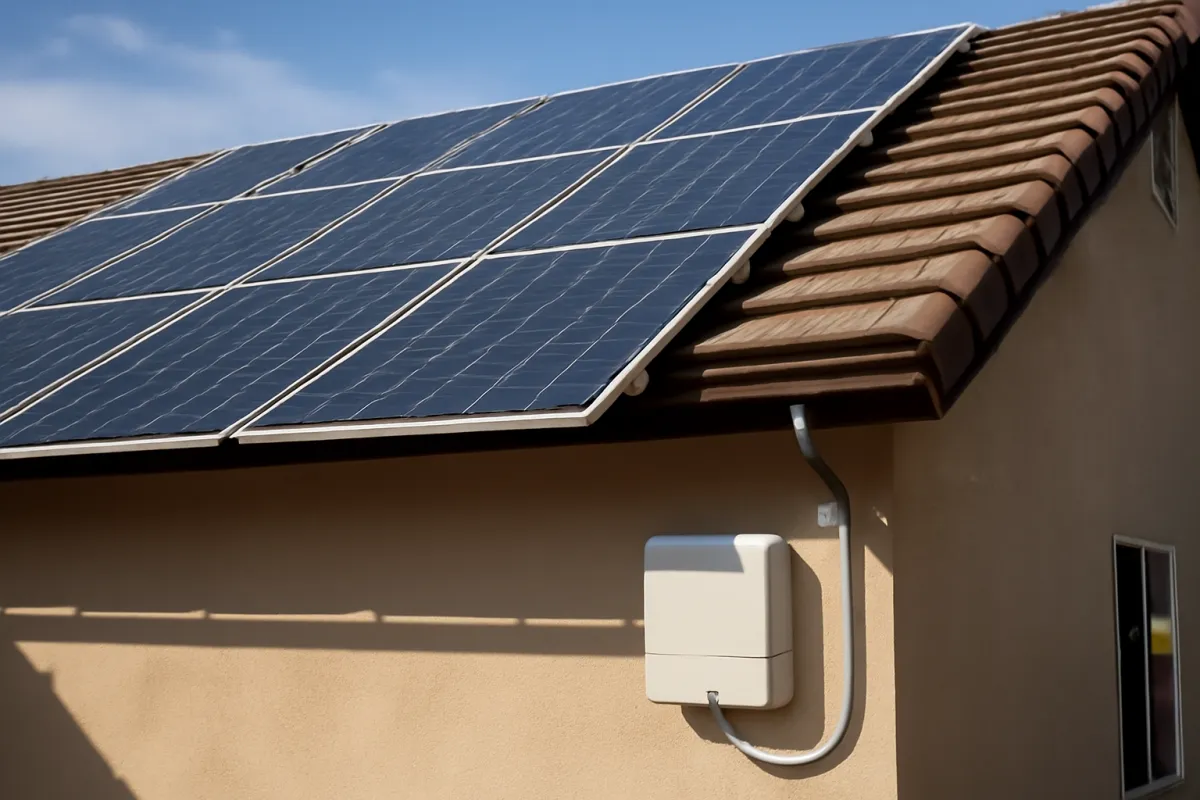
How do solar panels work? A solar panel is a slab of glass with no moving parts, no fuel and no sound, and it turns sunlight into the same electricity that comes out of a wall socket. That combination is strange enough that most explanations skip straight to the outcome: panels make power, the inverter changes it, the meter counts it. What actually happens is a chain of six or seven distinct handoffs, and every one of them explains something a homeowner eventually asks about, from why output sags in August heat to why a system with a working array can still send nothing to the house.
This explainer follows that chain end to end. It starts with what sunlight physically delivers to a piece of silicon, works through why the silicon has to be deliberately contaminated before it does anything useful, then follows the current out of the cell, up through modules and strings, into the inverter, through your service panel, past the meter and onto the grid. Along the way it accounts for the losses, because the gap between a panel’s printed watts and the energy on your bill is where nearly all the confusion lives. If you want the arithmetic that turns all of this into a system size for your own house, the savings calculator does it from your bill, and our solar sizing reference keeps every formula in one place.
Key takeaways
- A solar cell works because light packets knock electrons loose inside treated silicon, and a built in electric field sorts the loose charges so they have to travel through your circuit to recombine.
- Cells are wired in series into modules and modules into strings because a single cell makes roughly half a volt, which is useless until it is stacked into hundreds of volts.
- The inverter converts direct current into alternating current and continuously hunts for the operating point where the array makes the most power at that instant.
- Your house consumes solar first by simple physics, not by choice, and only the leftover passes the meter in the export direction.
- Nameplate watts are a laboratory rating at a fixed light level, a cool cell and a perfect angle, so real annual output runs meaningfully below it.
The short answer, and the chain behind it
If you want the whole thing in a sentence: sunlight frees electrons inside a treated silicon wafer, an internal electric field forces those electrons to travel the long way around through your wiring, an inverter reshapes that one way flow into household alternating current, and your service panel hands it to whatever is switched on before sending the surplus through the meter.
That sentence hides six handoffs, and each one has its own failure mode and its own losses. Light has to reach the glass, which is where shade, dust and sun angle do their damage. Light has to be converted in the cell, which is where the material’s physics sets a hard ceiling. Cell output has to be combined into useful voltage, which is where series wiring makes the whole chain only as strong as its weakest link. Direct current has to become alternating current, which costs a few percent in conversion. Alternating current has to reach a load, which is where your own consumption patterns decide the value. And whatever is left has to cross the meter, which is where utility rules rather than physics take over. The rest of this explainer walks those handoffs in order.
Sunlight is a stream of energy packets, not heat
The first thing to unlearn is the idea that panels harvest warmth. Sunlight behaves as a stream of discrete energy packets, and the energy each packet carries depends on its colour rather than on how many of them arrive. Blue and violet packets carry more energy than red ones, and infrared packets, which is what you feel as radiant warmth on your skin, carry the least.
This matters because the conversion inside a solar cell is a threshold event, not an accumulation. A single packet either carries enough energy to free an electron from its place in the silicon crystal or it does not. Three weak packets do not team up to do the job of one strong one. Packets below the threshold pass through or turn into heat, and packets far above the threshold free an electron and waste the excess as heat. That threshold behaviour is why a large slice of the incoming sunlight can never become electricity in a single material cell, regardless of manufacturing quality, and it is the physical reason behind every efficiency percentage you will read. Our breakdown of what solar panel efficiency actually measures works through what that ceiling means when you are comparing datasheets.
Why silicon is the material that does the work
Silicon dominates because its threshold sits in a useful place relative to the sun’s output, it is abundant, and the industry that already knew how to grow ultrapure silicon crystals for computer chips could be pointed at solar wafers. But a perfectly pure silicon crystal on its own is close to useless as a generator.
In a pure crystal, every silicon atom shares its outer electrons with its neighbours in a tidy, complete arrangement. Light can still knock an electron out of that arrangement, and doing so creates two things at once: a free electron that can wander, and an empty space it left behind. That empty space behaves like a mobile positive charge, because a neighbouring electron can slide into it, which moves the gap one atom over. Physicists call it a hole, and treating it as a real, mobile particle turns out to be the clearest way to think about it.
The problem is that in a pure crystal, the freed electron and the hole simply find each other again within a fraction of a second and recombine, releasing the energy as heat. Light goes in, warmth comes out, and nothing has been accomplished. Everything that makes a solar cell work is about preventing that reunion long enough to route the electron through your house.
Doping and the electric field that sorts the charges
The trick is deliberate contamination, called doping. One side of the wafer is seeded with atoms that carry one more outer electron than silicon does, leaving that layer with a surplus of loose negative charge. That is the n type layer. The other side is seeded with atoms carrying one fewer, leaving that layer with a surplus of holes. That is the p type layer. Both layers are still electrically neutral overall, because the added atoms brought their own protons along with them; what has changed is the availability of mobile charge.
Where the two layers meet, something permanent happens without any light involved. Surplus electrons from the n side drift across into the p side and fill holes near the boundary, and surplus holes drift the other way. That migration leaves the n side of the boundary slightly positive and the p side slightly negative, and those fixed charges create an electric field across a thin region at the junction. The field points in a direction that opposes further drift, so the process quickly settles into a standing state.
That built in field is the whole mechanism. It is a one way slope for charge carriers: any free electron that wanders into the junction region gets pushed to the n side, and any hole gets pushed to the p side. The cell is now a device that sorts charges automatically, before any sunlight arrives.
The photovoltaic effect, one photon at a time
Now put the doped wafer in sunlight. A light packet with enough energy passes through the glass, through the antireflective coating and into the silicon, and frees an electron somewhere near the junction. The electron and its hole start to drift apart in the ordinary random way, but this time they are inside or near the field region, so the field grabs them. The electron is pushed toward the n side, the hole toward the p side.
The result is a charge imbalance across the cell: excess electrons piled up on one face, excess holes on the other. That imbalance is a voltage, and it exists whether or not anything is connected. Connect a wire from the n face to the p face through a load and the piled up electrons finally have a route back to the holes they were separated from. They take it, flowing through the wire, through your light bulb or your refrigerator compressor, and back into the p side. That flow is the current.
Two things follow from this picture and both surprise people. First, the panel is not storing anything. Stop the light and the flow stops within moments; there is no reservoir, which is why backup power requires a separate battery, a distinction our comparison of a solar inverter versus a battery unpacks. Second, nothing is consumed. Electrons are not used up and shipped to the utility; the same electrons circulate, and what actually moves from your roof to your appliance is energy, not matter. The silicon is not fuel. It is a pump that runs on light.
Why one cell only makes about half a volt
The voltage a single cell produces is set by the material, not by its size. Make a cell the size of a postage stamp or the size of a dinner plate and it produces roughly the same voltage, somewhere in the neighbourhood of half a volt to two thirds of a volt for silicon. What size changes is current: a bigger cell intercepts more light packets per second, so more electrons are freed per second, so more current flows.
Half a volt does nothing useful. A phone charger wants five, a household circuit wants a hundred and twenty or two hundred and forty, and pushing power any distance at half a volt would require absurd current and lose most of it to resistance in the wire. So cells are wired in series, positive face to negative face, which stacks their voltages the way batteries stack in a flashlight. Series wiring keeps the current the same through the whole chain and adds the voltages together.
Wire roughly sixty cells in series and you land in the tens of volts. That is a module, the thing homeowners call a panel: a laminated sandwich of glass, encapsulant, the cell string, a backsheet, and an aluminium frame, with a junction box on the rear where the two output leads emerge. All the figures here are illustrative round numbers rather than specifications for any particular product.
From cells to a module: series wiring and the nameplate watt
The number printed on a module, four hundred watts or thereabouts on typical residential equipment today, is the product of its voltage and its current at one specific laboratory operating point. It is a power rating, which means watts, and watts are a rate. A four hundred watt panel produces four hundred joules per second at that instant under those conditions, and it produces nothing at midnight. Energy, the thing you are billed for, is that rate multiplied by time, which is what a kilowatt hour measures; our explainer on what a kilowatt hour actually is is the cleanest place to fix that distinction if it is fuzzy.
Series wiring inside a module has a consequence worth stating plainly, because it drives half the design decisions further down the chain. In a series chain, every element carries the identical current. If one cell is shaded, dirty, cracked or simply weaker than its siblings, it cannot pass as much current as the others want to push, and because they are all in one chain, it caps the current for the entire chain. The weakest cell sets the pace. Worse, the healthy cells behind it keep pushing, and the throttling cell has to absorb that energy as heat, which is the origin of the hot spot problem.
Many modern modules cut each cell in half and wire the halves as two parallel sub chains, which halves the current in each path and reduces resistive losses and hot spot severity. It is an engineering refinement on the same basic architecture rather than a different principle. Our overview of the types of solar panels covers how the cell technologies themselves differ.
Bypass diodes: why one shaded cell does not kill the panel
Because a single bad cell can throttle an entire series chain, modules include a defence: bypass diodes, usually three of them, wired across groups of cells inside the junction box. A diode is a one way valve for current. In normal operation the diodes do nothing at all, because the cells they guard are producing and the diode is reverse biased and closed.
When a group of cells is shaded badly enough that it becomes a bottleneck rather than a contributor, the voltage across that group flips sign, the diode across it opens, and the current from the rest of the module routes around the shaded group through the diode instead of forcing its way through. You lose the output of that third of the panel, and you avoid both the total blockage and the hot spot.
This is why a leaf, a vent pipe shadow or a chimney shadow crossing a corner of a panel typically costs a third of that panel rather than all of it or none of it. It also explains a detail that catches people out: the orientation of the shadow matters more than its size. A thin shadow lying across the panel in the direction that clips all three cell groups can cost far more than a larger blob that sits inside one group. Panel layout and row spacing are done with this in mind, which is one of the many judgement calls covered in our walkthrough on how to go solar.
From modules to strings: voltage is the design currency
A single module in the tens of volts is still not what an inverter wants to see. So modules are wired in series into a string, typically somewhere between eight and a dozen or so on a residential roof, which stacks their voltages into the hundreds. Several hundred volts of direct current is a comfortable input for a residential inverter and, just as importantly, it keeps the current low for a given amount of power.
Keeping current low is not an aesthetic preference. Resistive loss in a wire scales with the square of the current, so halving the current cuts the wire loss to a quarter. That is why a rooftop array runs at high voltage and modest current down to the inverter rather than the reverse, and it is the same reason the transmission grid runs at enormous voltages.
String design is constrained at both ends. Too few modules in a string and the voltage may fall below what the inverter needs to start working, particularly on hot afternoons when module voltage sags. Too many and the string voltage on a freezing clear morning, when voltage is at its highest, can exceed the inverter’s maximum rating or the equipment’s safety limit. Designers size strings against the coldest expected temperature at your location for exactly this reason, and it is one of the calculations that has to be documented for the permit, a process our explainer on solar permits and interconnection describes.
What the array sends down the wire: DC that never sits still
The array delivers direct current: charges flowing steadily in one direction, the same character of electricity a battery supplies. But array direct current has a personality a battery does not. Its voltage and current both move continuously, because they are driven by conditions.
Current tracks light intensity almost proportionally. Twice the light, roughly twice the current, because twice as many packets per second are freeing electrons. Voltage behaves differently: it holds up surprisingly well as light dims, then falls off in very low light, and it drops noticeably as cell temperature climbs. Put those together and a panel’s power output over a day is a curve that rises with the sun, dips whenever a cloud passes, sags in the afternoon heat even while the light is still strong, and collapses at dusk.
There is one more wrinkle, and it is the one that makes inverters interesting. At any instant, a panel does not have a single output. It has a whole family of possible operating points, from maximum voltage with no current flowing to maximum current with no voltage across it, and both of those extremes deliver exactly zero power. Somewhere between them is a knee where the product of voltage and current peaks. That knee is the only point worth operating at, and it moves constantly.
Maximum power point tracking, the negotiation you never see
Finding and holding that knee is the job of maximum power point tracking, and it runs many times a second inside your inverter. The method is less sophisticated than the name suggests: the tracker nudges the operating voltage slightly, measures whether power went up or down, and moves again in whichever direction helped. Cloud rolls in, the knee shifts, the tracker chases it. This is why a system’s output can follow a cloud edge almost in real time.
Understanding the tracker explains one of the most common questions in solar. Your appliances do not pull power from the array; the tracker decides how hard to load the array, and the array delivers what the light allows. Nothing about your house’s demand changes what the roof produces at that instant. Demand only decides where the produced energy goes.
It also explains why a single tracker shared by a whole string has a shade weakness. The tracker can only pick one operating point for everything wired into it. If one module in the string is in shadow, the compromise point that is best for the string as a whole is worse than what the sunlit modules could have delivered individually. That single constraint is the reason module level electronics exist.
What an inverter actually does to turn DC into AC
Your house runs on alternating current: a voltage that swings smoothly positive and negative many times a second in a sine wave, synchronised across the entire grid. The array produces steady one way direct current. The inverter’s core job is the translation.
It does it by switching, not by spinning anything. Fast semiconductor switches chop the incoming direct current into a rapid train of pulses, varying the width of those pulses so that their short term average traces the shape of a sine wave. Filtering components then smooth that pulse train into a genuinely smooth wave. The result is alternating current whose voltage, frequency and waveform shape match what the grid and your appliances expect.
A grid connected inverter has to do more than produce a plausible wave. It has to match the grid’s frequency and phase precisely and hold its own voltage slightly above the grid’s local voltage, because current flows from higher potential to lower. That small deliberate offset is what actually pushes your production out onto the wires. The inverter is measuring the grid continuously and adjusting, thousands of times a second, which is why it is the most electronically busy component in the system and, unsurprisingly, the one most likely to need replacement mid life.
Conversion is not free. A few percent of the energy is lost as heat in the switches and filters, which is why inverters have heatsinks and often fans, and why they are the warm component in an otherwise inert system.
String inverters, microinverters and optimisers
There are three common ways to arrange the conversion, and the difference is where the electronics sit.
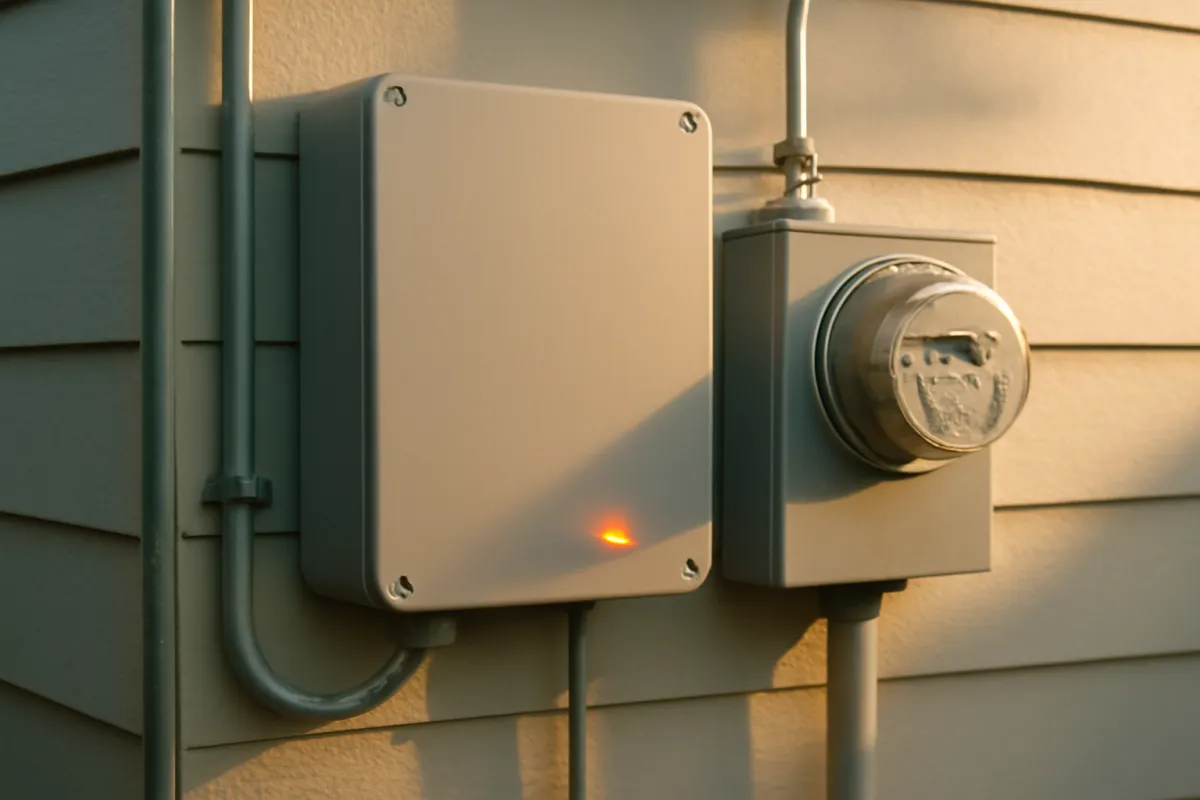
A string inverter is a single box, usually on a wall near the service panel, that takes the whole string’s high voltage direct current and converts it. One tracker serves the entire string, or sometimes two trackers serve two strings. It is the simplest and generally the least expensive arrangement, and it is well suited to a clean, unshaded roof with all modules facing the same way.
Microinverters put a small inverter on the back of every module. Each module converts to alternating current right there on the roof, and the modules are wired in parallel rather than in series. Every module gets its own tracker, so a shaded module only loses its own output, and there is no high voltage direct current anywhere on the roof. The tradeoff is many more electronic devices, all mounted in a hot outdoor location.
Optimisers are a middle path: a small device on each module that handles the tracking and conditions that module’s output, feeding a conventional string inverter that does the actual conversion. You get the per module tracking benefit while keeping one central conversion box.
The choice mostly comes down to shade, roof complexity and how many different roof planes are involved, and it changes both cost and the failure profile. Our head to head on microinverters versus string inverters works through when each one earns its price.
Why your inverter shuts down when the grid does
A grid connected inverter builds its output wave by following the grid’s own wave. It is a follower by design: it reads the frequency and phase from the utility connection and synchronises to them. Take the grid away and there is nothing to follow.
There is also a safety requirement pointing the same direction. If your inverter kept energising the wires during an outage, it would be pushing power onto lines that line workers have every reason to believe are dead. Grid connected inverters are therefore required to detect the loss of the utility signal and disconnect within a very short window, a behaviour usually called anti islanding.
The consequence catches new owners off guard on the first storm. A perfectly healthy array on a bright afternoon produces nothing for the house during a blackout unless the system was specifically built to keep running, which means a battery and a device that can isolate your house from the grid and then form its own reference wave. Some inverters also offer a small daytime only outlet that works without a battery, at limited power and only while the sun is out. Our explainer on whether solar works in a power outage covers the equipment that changes the answer, and our comparison of home battery backup versus a generator covers the alternative.
How the house takes solar first, without deciding to
Once the inverter’s alternating current reaches your electrical service panel, people imagine some kind of routing decision: does this go to the house or to the grid? There is no decision and no switch. Electricity takes every available path in proportion to how easy each path is, and your appliances are electrically nearer than the utility transformer down the street.
The practical effect is that any load running in your house is served by your own production first, automatically. If your array is making three kilowatts and the house is drawing one, the extra two flow out to the grid. If the house is drawing five, your three are absorbed instantly and the grid quietly supplies the missing two, in the same instant, through the same wires. The switchover is not a switchover at all; it is a continuous blend, changing every time a compressor cycles or a kettle goes on.
This is why the same amount of production can be worth different amounts to different households. A house with someone home during the day, a heat pump running, or an electric car charging at noon consumes a larger share of its own production directly. A house that is empty from eight until six exports most of its midday output and buys back its evening usage. Under full retail net metering the difference barely matters. Under any export rate below retail, it matters a great deal, and it is the reason batteries and load shifting come up at all.
The meter, and what net metering actually measures
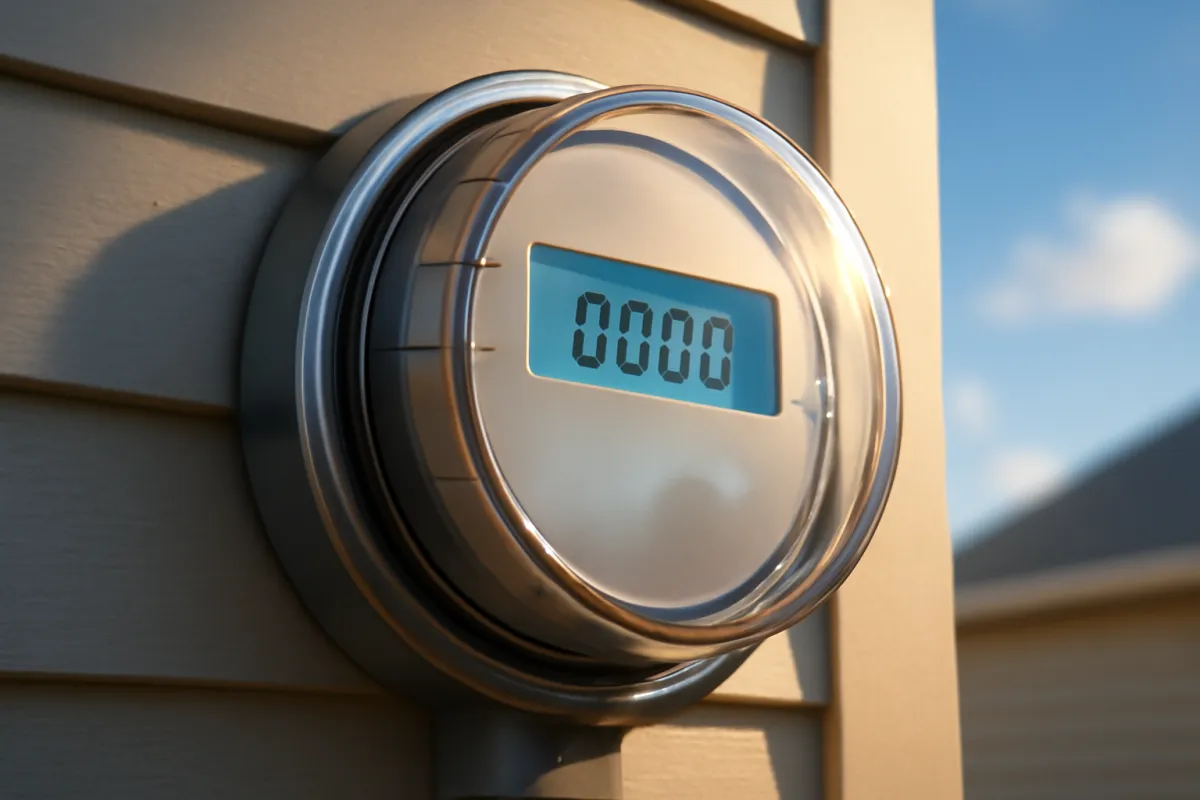
The utility meter sits between your service panel and the grid, and modern ones measure flow in both directions. It does not know or care that you have solar. It knows only how much energy crossed it, in which direction, and when.
What that measurement becomes on your bill is a policy question. Under traditional full retail net metering, exported kilowatt hours are credited at the same rate as imported ones, so the meter effectively runs backwards and you settle up on the net over a billing period or a year. Under newer export tariffs, exports are credited at a separate, generally lower rate, and the timing of the export can matter as well, with credits worth more during high demand hours. The rules differ by state, by utility, and often by the date your system was connected, with existing customers sometimes grandfathered onto older terms.
Because those rules change and vary, treat any specific credit rate you read anywhere, including here, as illustrative. The authoritative source is the tariff sheet for your own rate schedule from your own utility, and the interconnection agreement you sign. Our explainer on what net metering is and how the credits work describes the mechanism and what to look for in the paperwork, and our walkthrough on reading your electric bill shows where the export line actually appears.
Where your surplus actually goes
When your meter registers export, the energy is not being banked in a warehouse. It flows onto the local low voltage distribution wires and is consumed almost immediately by the nearest thing drawing power, which in practice means your neighbours’ houses on the same transformer.
The credit on your bill is an accounting construct layered on top of that physical fact. Your utility is not holding your July kilowatt hours until January; it sold them to the house next door in July and wrote you a credit. That distinction explains several things that otherwise look arbitrary: why credits can expire or be trued up annually, why they may be worth less than retail, and why a utility with lots of midday solar on one circuit starts caring about voltage rise on that circuit.
It also frames the battery question honestly. A battery is the only way to actually keep your own surplus for your own later use, moving the value from an export credit you do not control to avoided evening consumption you do. Whether that trade pays depends on the size of the gap between your retail rate and your export credit, which is exactly the calculation our explainer on whether solar batteries are worth it walks through.
Why heat makes panels produce less
This is the single most counterintuitive part of the chain, and it follows directly from the junction physics described earlier. The cell’s voltage comes from that built in field across the junction. Raising the temperature gives the electrons in the silicon more thermal energy of their own, which makes it easier for them to cross the junction in the wrong direction. That leakage undercuts the standing charge separation, and the cell’s voltage falls.
Current actually rises very slightly with heat, but the voltage loss dominates, so power drops. Datasheets state this as a temperature coefficient of power, commonly a few tenths of a percent of output per degree Celsius above the reference temperature.
The magnitude is bigger than it sounds, because rooftop cells run far hotter than air temperature. Dark glass in still air in full sun can sit well above ambient, and the losses arrive precisely when the sun is strongest. This is why systems often post their best single day peaks in cool bright spring weather rather than midsummer, and why panels are mounted on rails with an air gap beneath rather than laid flat on the shingles. It is also why a hot climate does not simply mean more solar; it means more sunlight hours partly offset by warmer, less efficient cells.
Why shade costs far more than its area
Shade is a series wiring problem, not a coverage problem. Cover five percent of an array’s area with shadow and you rarely lose five percent of the output. Because the cells in a chain share one current, the shaded cells become the bottleneck for their whole group, and bypass diodes limit the damage by cutting out a group at a time rather than by scaling smoothly.
The result is a step function. A shadow that touches one cell group costs that group. A shadow drawn out along the panel in the direction that clips all three groups can cost most of the panel. And on a string inverter with a single tracker, a badly compromised module drags the string’s chosen operating point away from what the sunlit modules would have preferred.
Two design responses follow. Reduce shade at the source with trimming and thoughtful panel placement, accepting that some obstructions cannot be moved. Or use module level electronics so each module tracks its own knee and a shaded module only costs its own output. That second option is why an installer looking at a roof with a chimney, a plumbing vent field and a tall neighbour’s oak will quote optimisers or microinverters without being asked. Shade also shifts through the year as the sun’s arc changes, which our explainer on solar in winter and cloudy weather covers alongside the seasonal angle effects.
Soiling, angle and the rest of the daily tax
Several smaller losses stack on top of the physics ones, and together they matter as much as any of them individually.
Soiling is dust, pollen, salt spray, bird droppings and traffic film on the glass. Light rain handles most of it in most climates, which is why routine cleaning is often unnecessary; long dry seasons, agricultural dust and heavy pollen are the exceptions. The step by step in our walkthrough on cleaning solar panels safely covers when it is worth doing and how to avoid making it worse.
Angle costs output twice. The cosine effect means a beam arriving at a slant spreads its energy over more glass area, so each square foot receives less. On top of that, glass reflects a larger share of light as the angle gets shallower, so morning and evening light is partly bounced away before it enters the cell. Antireflective coatings reduce this but do not remove it.
Then there are the mundane ones. Wire resistance costs a slice on the way to the inverter. Conversion costs a few percent. Modules never match each other perfectly, so mismatch loss appears in any series string. Snow blocks light while it sits, though it usually slides off dark tilted glass quickly. And the panels age, losing a small fraction of a percent of output per year, which is the subject of our explainer on how long solar panels last.
Why nameplate watts are a lab rating, not a promise
Every module’s printed wattage comes from a standardised laboratory measurement, so that any two products can be compared on the same terms. The conditions are a fixed full strength light level, a cool reference cell temperature, and an ideal light spectrum and angle. That is a fair measuring stick and a poor forecast, because your roof does not hold those three conditions simultaneously for even a minute.
The chart below is an illustrative sketch of what a nominally four hundred watt module might actually deliver in different conditions. Treat the figures as a teaching example rather than a specification.
What a nominal four hundred watt module might actually deliver
Illustrative instantaneous output under different conditions, in watts. Bars scaled to the lab rating.
The lab rating is a shared measuring stick, not a forecast. Note that the cool clear day beats the hot one even though the hot one feels sunnier, and that light cloud costs far less than most people assume.
The practical takeaway is that nameplate watts are for comparing modules, and a derate factor is for predicting energy. Any honest production estimate multiplies the array’s nameplate kilowatts by local peak sun hours and then by a derate in the region of three quarters to four fifths. Our explainer on whether panels work on cloudy days goes deeper on the diffuse light case in particular.
Where the sunlight actually goes: the derate stacked
It helps to see the derate as a stack rather than a single mysterious number. The breakdown below apportions one hundred nameplate direct current watts into what actually reaches the house as alternating current and where the rest went, averaged over a year on an ordinary roof.
Where one hundred nameplate watts end up, averaged over a year
Illustrative apportionment of nameplate direct current watts on a typical unshaded roof. Segments sum to 100.
This is the derate factor of roughly 0.80 used in every sizing calculation, unpacked into its parts. Heavily shaded or soiled roofs push the delivered share lower; clean, cool, unshaded ones push it higher.
Notice which slices you control. The heat loss is close to fixed for a given roof and climate, adjustable only through mounting height and airflow. The wiring and conversion losses are set at design time. Soiling and shade are the parts an owner can genuinely defend, and a system fault is the part that turns a normal derate into an abnormal one. That is the case for monitoring: without a production baseline you cannot tell an ordinary eighty percent year from a seventy percent year caused by a failed optimiser, a point our walkthrough on monitoring solar production develops.
A worked example: one roof from photon to bill
Put the whole chain into numbers. Every figure here is illustrative and chosen to be easy to follow, not a prediction for any real house.
Take twenty two modules rated at four hundred watts each. That is 8,800 watts, or 8.8 kilowatts of nameplate direct current capacity. The site gets an average of 4.5 peak sun hours a day, which is a way of compressing a whole day’s varying sunlight into an equivalent number of hours at full test strength.
Ideal energy, ignoring every loss, is 8.8 kilowatts times 4.5 hours times 365 days, which is about 14,450 kilowatt hours a year. Apply the derate of 0.80 from the stack above and you get roughly 11,560 kilowatt hours a year of alternating current delivered to the house. The missing 2,890 kilowatt hours are the heat, angle, soiling, wiring and conversion losses, all accounted for.
That works out to about 31.7 kilowatt hours on an average day, though real days swing far above and below it. Say the household uses about 11,000 kilowatt hours a year, so on an annual basis this array roughly covers its own consumption.
Now split the production by where it goes. Suppose 35 percent of it is consumed directly by the house as it is produced, which is a plausible share for a home that is quiet during weekdays. That is about 4,050 kilowatt hours self consumed and about 7,510 kilowatt hours exported.
At a retail rate of 17 cents per kilowatt hour under full retail net metering, every kilowatt hour is worth the same 17 cents whether it was used or exported, so the annual value is about 1,966 dollars. Now change one rule and nothing else: credit exports at half the retail rate. The self consumed 4,050 kilowatt hours are still worth about 688 dollars, but the exported 7,510 are now worth about 638 dollars, for a total near 1,327 dollars. The array did not change, the sun did not change, and roughly 639 dollars a year moved because of a tariff line.
That is the honest summary of the whole chain: physics decides how much energy you make, and policy decides what a large share of it is worth. The companion tool on this page runs these same steps on your own module count, sun band, self consumption share and rate, and the savings calculator works the other direction, starting from your bill.
What breaks in the chain, and where to look first
Knowing the chain makes troubleshooting mostly a matter of asking which link is failing.
If output is zero, suspect the conversion and connection links first. Inverters trip offline on grid disturbances and usually restart themselves; a persistent fault code, a tripped breaker on the solar circuit, or a disconnect left open after work on the house are the common causes. Panels almost never all fail at once.
If output is merely low, the shape of the shortfall is the clue. A shortfall that appears at the same time each day points at shade from something that has grown or been built. A shortfall that appears in hot weather and recovers in cool weather is temperature behaving normally. A steady proportional shortfall across all conditions points at soiling, or at one string or module level device out of service. A shortfall that arrived suddenly and stayed points at a hardware failure, which is what warranty coverage exists for, and our explainer on solar panel warranties separates the product, performance and workmanship pieces.
If the production looks right but the bill does not, the problem is downstream of the physics entirely, in rate structure, billing period truing up, or a self consumption share different from what was assumed. That is a paperwork investigation rather than a roof one, and it starts with the bill and the tariff sheet rather than the array. Sizing questions, meanwhile, are best answered before installation: our walkthrough on how many solar panels you need turns usage into an array, and the savings calculator does the first pass in a few seconds.
The bottom line
Solar panels work because light packets free electrons inside deliberately contaminated silicon, and a permanent internal electric field sorts those loose charges so that the only route back to equilibrium runs through your wiring. Everything after that is plumbing: cells stacked in series into modules for usable voltage, modules stacked into strings for efficient transmission, an inverter reshaping one way current into the synchronised wave your house and the grid share, and a service panel that hands the result to whatever is switched on before letting the remainder cross the meter.
The losses are not defects. Some of the sunlight carries too little energy to do the job and some carries too much, heat undercuts the junction voltage exactly when the sun is strongest, shallow morning light reflects off the glass, dust intercepts a little, series wiring lets the weakest cell throttle its chain, and conversion takes its few percent. Together those explain why the nameplate is a comparison tool and the derate is the forecast.
What that leaves you with is a clean division of responsibility. Physics sets how much energy your roof can make, and you influence it through orientation, shade management, mounting and equipment choice. Policy sets what a large share of that energy is worth, and you influence it through self consumption, storage and understanding your tariff. Get both halves in view and a solar quote stops being a leap of faith and becomes a calculation you can check. Start with your own numbers in the companion above, then run your bill through the savings calculator to see what size array the first half of that equation actually calls for.
This explainer is educational material about how photovoltaic systems function, not electrical, engineering, tax or financial advice, and it is not a substitute for a site assessment by a licensed professional. Every wattage, voltage, percentage, kilowatt hour, rate and dollar figure above is an illustrative teaching example chosen for clarity rather than a specification, a quote, or a prediction for your home; real equipment, roofs, climates, tariffs and utility rules vary widely and change over time. Net metering and export credit rules in particular are set by your state and your utility and can differ by connection date, so confirm them against your own tariff sheet and interconnection agreement. Never open, probe or work on live solar wiring, direct current or alternating current, and leave all installation, inspection and repair to qualified licensed people.
Frequently asked questions
How do solar panels work, in one paragraph?
Sunlight arrives as packets of energy. When one of those packets strikes a treated silicon wafer, it knocks an electron loose and leaves a gap behind. The wafer is built with two differently treated layers that create a permanent internal electric field, and that field pushes the loose electron one way and the gap the other, so the charges cannot simply recombine. Wire the two faces together through something useful and the electrons flow around that circuit as direct current. Dozens of cells wired in series make a module, several modules make a string, an inverter converts the direct current into the alternating current your house uses, and your service panel feeds it to appliances first and sends the rest through the meter to the grid.
Do solar panels make electricity from heat or from light?
From light, and heat actively works against them. The conversion depends on individual light packets carrying enough energy to free an electron inside the silicon, which is a property of the light itself rather than the temperature of the panel. Warming a cell up does not add energy to that process; it makes the semiconductor leakier, so the cell's voltage sags and its power output falls. This is why a cold, bright winter day can produce more instantaneous power than a hazy, blazing afternoon, and why panels are mounted with an air gap under them rather than pressed flat to the roof.
What does the inverter actually do?
It does two jobs. First it converts the direct current from the array, which flows one way at a voltage that drifts with the light, into alternating current that reverses direction at the grid's frequency and holds the voltage your appliances expect. It does that by switching the direct current on and off very rapidly in a controlled pattern and then smoothing the result into a wave. Second, it constantly hunts for the electrical operating point where the array produces the most power at that instant, a search that runs continuously as clouds and sun angle change. A grid connected inverter also matches its output precisely to the utility's voltage and frequency, and shuts down when the grid goes away.
Why does my system produce less than its nameplate watts?
Because the nameplate is a laboratory measurement, not a forecast. It is taken with the light held at a fixed full strength intensity, the cell held at a cool reference temperature, and the light hitting the glass at an ideal angle. A real roof rarely matches any of the three at once. Hot cells cost output, morning and evening light arrives at shallow angles and partly reflects off the glass, dust and pollen block some light, wiring and conversion lose a slice, and clouds do the rest. A system delivering somewhere around three quarters to four fifths of its theoretical output over a year is behaving normally, which is why sizing math applies a derate factor rather than trusting the nameplate.
Where does the electricity go when I make more than I use?
It leaves through your service panel, passes through the utility meter in the export direction, and flows onto the local distribution wires, where it is consumed by whatever load is nearest and drawing power at that moment, typically your neighbours. It is not stored anywhere on your behalf unless you own a battery. What your utility does about it is a billing question rather than a physics question: some programmes credit the export at full retail value, others at a lower export rate, and the rules vary by state, utility and the date you connected. Our explainer on net metering covers the mechanism, and your utility's own tariff document is the only place to confirm which rules apply to you.
Does one shaded panel stop the whole system?
Not entirely, but shade costs more than its physical area suggests, and the reason is series wiring. Cells wired in a chain all carry the same current, so the weakest cell throttles the chain. Panels include bypass diodes that let current route around a shaded group of cells, which limits the damage to a portion of the panel rather than all of it. With a plain string inverter, a heavily shaded panel can still drag the whole string's operating point down. Module level electronics, meaning microinverters or optimisers, let each panel find its own best operating point so a shaded one does not set the pace for its neighbours.
Do solar panels work on cloudy days and in winter?
Yes, at reduced output. Clouds scatter sunlight rather than deleting it, so a meaningful fraction still reaches the glass as diffuse light and the cells convert it the same way they convert direct light. Heavy overcast can cut output to a small fraction of a clear day, while light cloud costs much less than people expect. Winter cuts production through short days and low sun angles rather than through cold, and the cold itself slightly helps the cells. Annual production math already assumes a mix of clear, hazy and overcast days, which is what the peak sun hours figure in any sizing calculation represents.
How long does the chain last, and what fails first?
The panels themselves have no moving parts and are usually the most durable link, degrading slowly rather than failing outright. The inverter is the component most commonly replaced during a system's life, because it contains switching electronics and often cooling hardware that work hard every sunny day. Wiring, connectors and roof penetrations are the other routine service items, and loose or corroded connections tend to show up as a gradual production shortfall rather than a hard stop. Monitoring is what turns a silent shortfall into a service call, since a failed component in a system without monitoring can go unnoticed for a whole season.