

What's on this page
- What a solar attic fan actually is
- What solar attic fans cost, illustratively
- Installed cost by mounting type
- The cost stack inside one install
- What the rated CFM number means and does not mean
- Sizing by attic volume and air changes per hour
- The two sizing rules and why they disagree
- Intake venting is the prerequisite that decides everything
- How to measure your existing net free vent area
- The depressurization problem, with the arithmetic
- Combustion safety and why this one needs a professional
- The sealed ceiling plane comes first
- What the cooling bill saving actually looks like
- Why ducts in the attic change the answer
- Climate is the biggest single variable
- Payback, honestly
- The roof and shingle longevity argument, stated as contested
- Moisture control in cold climates
- Solar attic fan versus ridge and soffit passive venting
- Solar attic fan versus air sealing and insulation
- Solar attic fan versus a whole-house fan
- Incentives: the mechanism, not a percentage
- Maintenance, lifespan and what fails
- Installation: roof penetration, flashing and warranty
- How to read a solar attic fan quote
- A worked example on one house
- Mistakes that turn a modest win into a loss
- Who a solar attic fan is actually for
- The bottom line
Short answer: A solar attic fan costs an illustrative $600 installed for a gable mount, $850 for a standard roof mount and $1,400 for a larger curb-mounted unit. The payback is poor: at $850 and roughly $24 a year of cooling savings it runs about 35 years, longer than the motor lasts, and with too little soffit intake the fan pulls conditioned air out of the house, a net loss of about $49 a year.
A solar attic fan is one of the easiest home energy products to sell and one of the hardest to justify with arithmetic. It looks like free cooling: a small photovoltaic panel bolted to a fan, no wiring, no meter, no bill, spinning hardest at exactly the hour your attic is hottest. The pitch practically writes itself, and the installed price is small enough that most buyers never run the numbers at all. That is the problem, because the numbers are where this product either quietly works or quietly costs you money.
This breakdown prices solar attic fans by mounting type on illustrative figures, sizes one properly against attic volume rather than a rule of thumb, and then spends most of its length on the two things a bid will not mention: whether your attic has enough intake venting to feed the fan, and what happens to your cooling bill if it does not. Run your own attic dimensions and electricity rate through the companion calculator as you read, because the answer swings on your soffits far more than on the fan you pick.
Key takeaways
- Installed cost runs an illustrative $600 for a gable mount, $850 for a standard roof mount and $1,400 for a larger curb-mounted unit. Roughly half the bill is the fan and its panel; the rest is flashing, mounting, labor and controls.
- Size from attic volume, not floor area alone. An illustrative 1,600 square foot attic averaging 5 feet high holds 8,000 cubic feet, and ten air changes an hour needs about 1,333 CFM.
- That fan wants roughly 4.4 square feet of net free intake area, on the order of 71 linear feet of continuous soffit vent. Most houses have a small fraction of it.
- With short intake, the fan pulls the difference out of the conditioned house through ceiling leaks. On illustrative figures that penalty runs about $74 a year against roughly $24 of saving, a net loss of about $49.
- Payback at $850 and $24 a year is roughly 35 years, longer than the motor lasts. The same money spent on targeted attic air sealing returns an illustrative $70 a year.
What a solar attic fan actually is
Strip the marketing away and the product has four parts. A small photovoltaic panel, either integrated into the fan housing or mounted separately on a bracket. A direct current motor sized to run off that panel with no inverter and no grid connection. A fan blade and shroud that move air out of the attic. And a mounting assembly: a curb, a flange and flashing for a roof unit, or a bracket and grille for a gable unit.
What is missing matters as much. There is no meter, no interconnection, no permit for electrical service and no monitoring. The panel powers the motor directly, so the fan speeds up in bright sun and slows or stops under cloud. That is genuinely elegant, because attic heat and available sunlight arrive at the same time, and it is the one design claim in this category that survives scrutiny without qualification.
The elegance is also the limit. A panel that runs a motor directly delivers whatever the sun gives it, which is far less than nameplate for most of the day. Rated performance is a peak, not an average, and that distinction runs through everything below.
What solar attic fans cost, illustratively
Pricing splits cleanly by mounting type because mounting type is what determines how much roof work is involved. A gable-mounted unit fits inside an existing gable vent opening from the attic side, needs no roof penetration and no flashing, and is the cheapest install in the category by a wide margin. An illustrative $600 installed is a reasonable planning midpoint.
A roof-mounted unit cuts a hole in the deck, sets a flanged base under the shingle courses, and depends entirely on that flashing detail staying watertight for the life of the roof. An illustrative $850 installed reflects that extra work. A curb-mounted or high-capacity unit, often with a larger separately mounted panel and a bigger motor, lands nearer an illustrative $1,400.
None of those figures include the intake venting most attics need before any of them work, which is covered later and frequently costs more than the fan. Treat every figure in this breakdown as a teaching number for comparing options, not as a quote.
Installed cost by mounting type
The chart below puts the three mounting types next to the two alternatives most buyers should be pricing at the same time, because comparing a fan only against other fans is how this purchase goes wrong.
Illustrative installed cost by mounting type and alternative
Teaching midpoints for a single-story house with an accessible roof. Bars scale against the largest line.
Widths are computed from each value against the largest line: $2,200 is 100%, so $1,400 is 64%, $1,200 is 55%, $850 is 39% and $600 is 27%. These are illustrative midpoints for comparing options, not price quotes. Real bids move with roof pitch, roof height, attic access, the amount of intake venting that has to be added, and local labor rates.
The two most expensive lines on that chart are the ones a fan salesperson will never quote, and both of them address the same underlying problem the fan is being sold to fix. That comparison is the whole argument of this breakdown, and it gets its own sections further down.
The cost stack inside one install
Inside that illustrative $850 roof-mounted job, the money splits along fairly predictable lines. Buyers assume they are paying for the fan and are usually surprised by how little of the bill it represents.
| Line item | Illustrative share | Illustrative amount |
|---|---|---|
| Fan unit with integrated photovoltaic panel | 47% | $400 |
| Roof penetration, flashing and mounting | 21% | $178 |
| Labor and roof access | 20% | $170 |
| Thermostat and humidistat control | 6% | $51 |
| Permit, cleanup and miscellaneous | 6% | $51 |
Share of an illustrative $850 roof-mounted install
Same teaching numbers, expressed as percentages of the total.
The five shares sum to 100 percent of the illustrative $850 total used throughout this breakdown. Percentages are teaching proportions chosen to show where the money goes on a straightforward roof-mounted install, not a price list from any company. A steep roof, a second story or a difficult attic hatch shifts weight toward the labor line quickly.
The practical read is that more than half the bill is roof work and labor. That is why two bids for the same nameplate fan differ so much, and why a gable mount, which skips the flashing detail entirely, prices so much lower. The same lesson applies to every solar bid you will ever read, which is the point of our walkthrough on how to read a solar quote.
What the rated CFM number means and does not mean
Every fan in this category is sold on a cubic-feet-per-minute figure, and that figure is the least reliable number in the transaction. It describes the fan spinning at full speed in full sun, moving air against almost no resistance. Your attic is not that test.
Three things pull the delivered figure down. Static pressure is the first: the fan has to pull air through soffit vents, past insulation baffles and around framing, and every one of those restrictions costs airflow. Available sunlight is the second: the panel is flat on a roof plane at whatever tilt the roof happens to be, so morning, late afternoon and any cloud cover cut the motor speed directly. Attic dust and insect screening on the intakes are the third, and they get worse over time.
The honest way to use a rated figure is as a ceiling, not an expectation. Ask the bidder what the unit delivers against a realistic static pressure and at what sun intensity the rating was taken. A bidder who cannot answer is quoting a brochure.
Sizing by attic volume and air changes per hour
Proper sizing starts with volume, and volume needs an average attic height rather than a peak height. For a simple gable roof, the average height above the ceiling is roughly half the ridge rise. A 40 foot span at a 6-in-12 pitch rises about 10 feet at the ridge, so the average height is about 5 feet.
Multiply that by the attic floor area. An illustrative 1,600 square foot attic at 5 feet average height holds about 8,000 cubic feet. Then pick an air change target. The common planning band is eight to twelve air changes an hour, and ten is the usual midpoint.
The arithmetic is then one line. Required CFM equals volume times air changes per hour, divided by 60. For our example that is 8,000 times 10, divided by 60, or about 1,333 CFM. A dark roof, a steep pitch or long unshaded afternoon exposure is commonly handled by adding roughly 15 percent, which takes the same attic to about 1,533 CFM. Put your own dimensions into the companion calculator and the requirement appears immediately.
The two sizing rules and why they disagree
You will also see a shortcut rule stated as CFM equals attic floor area multiplied by 0.7. Applied to the same 1,600 square foot attic, that gives 1,120 CFM, noticeably less than the 1,333 the volume method produced. Both rules are in circulation and they do not agree, which confuses buyers and gives bidders room to quote whichever is convenient.
The reason is simple. The floor-area shortcut has an assumed attic height baked into it. A 0.7 multiplier corresponds to a fairly shallow attic; raise the pitch and the shortcut understates the volume that actually needs moving. It is a fine screening rule for a ranch house with a low-slope roof and a poor one for a steep roof with a large volume above the ceiling.
Use the volume method, and if a bidder uses the shortcut, ask them what average attic height it assumes. The answer tells you whether they have measured your house or reached for a multiplier. The same instinct applies whenever someone sizes solar equipment from a single number, which is why our note on how to size a solar system insists on showing the intermediate steps.
Intake venting is the prerequisite that decides everything
Here is the sentence that should appear in every solar attic fan advertisement and never does. A fan cannot exhaust air that cannot get in. Every cubic foot it pushes out of the roof has to be replaced through an intake path, and if the intended path is too small, the air comes from somewhere else.
The commonly cited planning figure is one square foot of net free intake area for every 300 CFM of exhaust capacity. Net free area is the actual open area after the louvers, screens and framing are subtracted, and it is much smaller than the hole in the soffit looks. For our 1,333 CFM example, that means roughly 4.4 square feet of net free intake.
Convert that into something you can see. Continuous soffit strip venting commonly delivers on the order of 9 square inches of net free area per linear foot. Four and a half square feet is 640 square inches, which needs about 71 linear feet of continuous vent. That is most of the perimeter of a typical house, and it is a great deal more than the handful of small rectangular soffit vents most homes actually have.
How to measure your existing net free vent area
You can do this in an afternoon and it is the single most useful hour you will spend on this decision. Count every intake opening on the underside of the eaves. Measure the open area of one of each type, then multiply by the fraction that is actually open once the louver blades and insect screen are subtracted, which for a typical stamped rectangular vent is well under half.
A common small rectangular soffit vent might contribute on the order of 5 square inches of net free area once screened. Twenty of them contribute about 100 square inches, or roughly 0.7 square feet. Against the 4.4 square feet our example fan wanted, that is about 16 percent of the requirement.
Then check whether the openings are open. Blown insulation pushed into the eaves, painted-over louvers and missing baffles are the three ways a house that looks vented is not. Shine a light from the attic side and see if daylight comes back. If it does not, you have found your real problem, and it is not the absence of a fan.
The depressurization problem, with the arithmetic
When intake is short, the fan does not simply move less air. It pulls harder, and the attic goes slightly negative relative to the house below. Ceilings leak: recessed light housings, bath fan penetrations, plumbing and wiring chases, attic hatches and the top plates of every interior wall. Conditioned air you have already paid to cool starts moving up through those leaks, and outdoor air infiltrates elsewhere to replace it.
Put numbers on it. Our example house has 0.7 square feet of intake against 4.4 needed, so about 84 percent of the required intake area is missing. Suppose a quarter of the fan’s airflow, scaled by that shortfall, comes from the house: a quarter of 1,333 CFM times 0.84 is about 280 CFM of conditioned air heading into the attic.
The sensible cooling load of that is 1.08 times the airflow times the temperature difference. At 280 CFM and a 20 degree difference between indoor air and the outdoor air replacing it, that is about 6,048 Btu per hour, or roughly 432 watts at a SEER 14 equivalent. Across about 1,000 hours a year at $0.17 a kilowatt-hour, that is roughly $74 a year of extra cooling cost.
Hold that figure. It is larger than everything the fan saves.
Combustion safety and why this one needs a professional
Depressurization is not only a cost question. If the house contains an atmospherically vented combustion appliance, a natural draft gas water heater or an older furnace that draws combustion air from the room and vents up a chimney by buoyancy alone, then anything that pulls the house negative can interfere with that draft. In the worst case combustion gases spill back into the living space instead of going up the flue.
A solar attic fan is a modest air mover compared with a whole-house fan or a large kitchen exhaust hood, and it acts on the attic rather than directly on the house. But it is one more negative pressure on a house that may already have several, and the mechanism is real enough that it belongs in the decision.
This breakdown is not the place for a verdict on your house. If you have any atmospherically vented combustion appliance, have a qualified professional perform a combustion safety and worst-case depressurization test before and after adding any powered ventilation. That test is inexpensive relative to what it rules out, and it is not something to reason about from an article.
The sealed ceiling plane comes first
Every problem in the previous two sections traces to the same defect: a ceiling that leaks air. A genuinely airtight ceiling plane makes the depressurization penalty small, because there is no easy path from the house into the attic. It also makes the attic behave the way the fan brochure assumes it does.
Sealing that plane is unglamorous work. It means foaming and caulking the top plates, sealing around chimneys and flues with sheet metal and high-temperature sealant, gasketing or building an insulated box over the attic hatch, sealing bath fan and recessed light penetrations, and closing off the open chases behind soffits and dropped ceilings. None of it is visible when it is done.
The order of operations is the point. Air seal, then insulate, then vent, then consider whether powered ventilation still has a job. Doing it in the reverse order, which is what buying a fan first amounts to, installs a machine whose main effect is to exploit the defect you have not fixed.
What the cooling bill saving actually looks like
Now the positive side of the ledger, computed the same way. Assume the fan does what it is supposed to do and drops the peak attic temperature from an illustrative 130 degrees to about 115, a 15 degree reduction. Two things benefit: the ceiling below and any ductwork running through the attic.
Heat flow through a ceiling is area times temperature difference divided by R-value. With 1,600 square feet at R-30, cutting the temperature difference by 15 degrees saves 1,600 times 15 divided by 30, or about 800 Btu per hour. Note what that means: the better your ceiling insulation, the less a fan can possibly save you, because the ceiling was already blocking the heat.
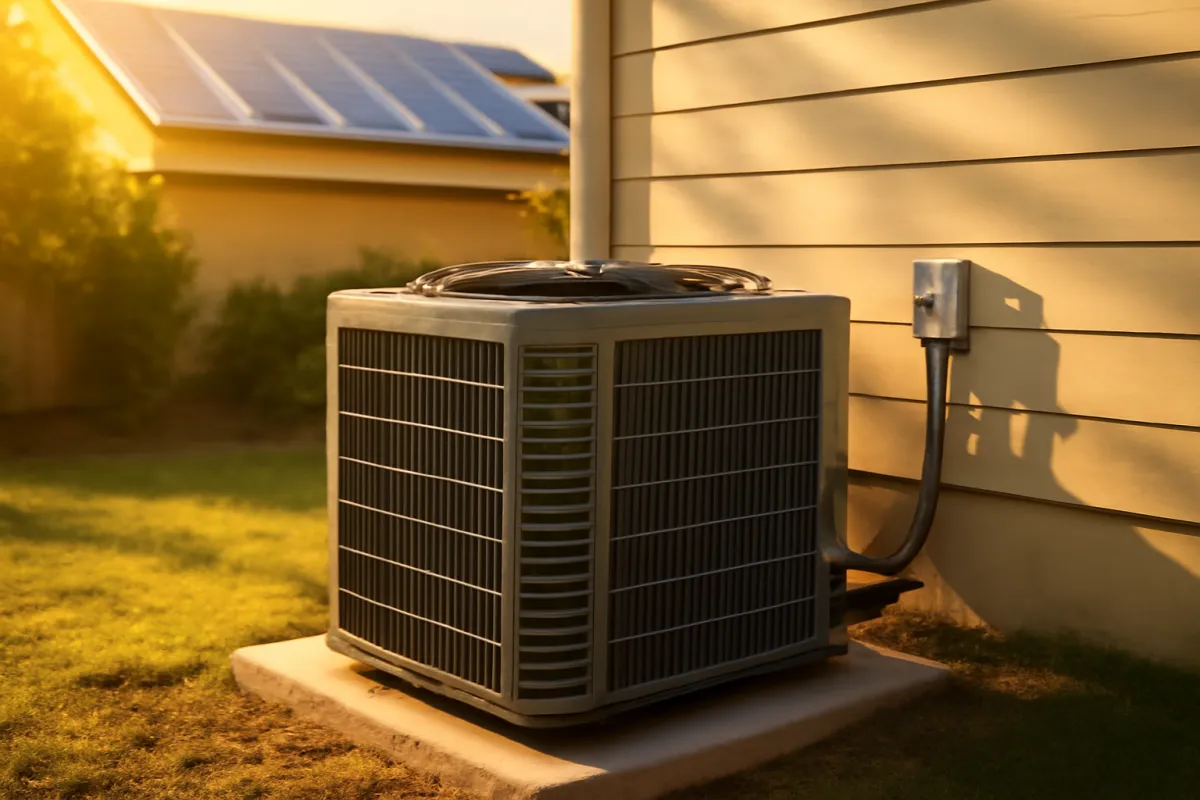
Convert to money. Combined with the duct effect covered next, the total is about 2,000 Btu per hour, which at a SEER 14 equivalent is about 143 watts of compressor input avoided. Over about 1,000 hours a year that is roughly 143 kilowatt-hours, and at $0.17 a kilowatt-hour, about $24. If kilowatt-hours are not yet intuitive, our explainer on what a kilowatt-hour is is the shortest way to fix that.
Why ducts in the attic change the answer
If your air handler and ductwork live in the attic, the arithmetic improves materially, and this is the strongest legitimate case for the product. Supply air moving through a duct at around 55 degrees inside a 130 degree attic gains heat across every foot of that run, and insulation on flexible duct is thin.
Use illustrative numbers. Around 150 linear feet of duct averaging roughly a foot in outside diameter presents about 480 square feet of surface at about R-6. Cutting the temperature difference by 15 degrees saves 480 times 15 divided by 6, or about 1,200 Btu per hour, which is larger than the ceiling effect on the same house.
That is why the same fan can be a marginal purchase on a house with ducts in a conditioned basement and a defensible one on a slab house with everything overhead. It is also why sealing and insulating those ducts, or better still moving them inside the conditioned envelope during a renovation, beats cooling the space around them. A duct that leaks supply air into the attic is losing conditioned air directly, and no amount of attic ventilation recovers it.
Climate is the biggest single variable
Nothing in this category travels well between climates. In a hot dry climate with a long cooling season, a big attic temperature swing, a duct run overhead and a high electricity rate, the fan has real work to do and does it during the hours that matter. In a mild coastal climate with a short season and a small temperature swing, there is very little load to remove.
Humidity flips the picture again. In a hot humid climate the air the fan pulls into the attic carries moisture, and if the ceiling leaks, the conditioned air it displaces from the house has to be re-cooled and re-dried. Latent load does not show up in the sensible arithmetic above, so the real penalty in a humid climate is larger than the $74 figure suggests.
In a cold climate the summer benefit is small and the winter behavior is the concern, which gets its own section below. The general rule is that this product is at its best in exactly one climate profile and at its worst in most of the others, and no national average price captures that.
Payback, honestly
Put the cases side by side on the same illustrative figures and the picture is not close.
| Case | Illustrative cost | Illustrative annual result | Simple payback |
|---|---|---|---|
| Roof-mount fan, intake already adequate | $850 | $24 saved | 35 years |
| Roof-mount fan, typical short intake | $850 | $49 lost | never |
| Fan plus the soffit work it needs | $1,450 | $24 saved | 60 years |
| Hot dry climate, ducts in attic, high rate | $850 | $76 saved | 11 years |
| Targeted attic air sealing instead | $850 | $70 saved | 12 years |
| Ridge and soffit passive venting | $1,200 | $30 saved | 40 years |
| Air sealing plus R-30 to R-49 top-up | $2,200 | $120 saved | 18 years |
Read the second row carefully, because it is the most common real-world configuration. The gross saving is about $24, the depressurization penalty is about $74, and the net is a loss of about $49 a year for as long as the fan runs. That is not a slow payback, it is a negative one.
Read the fourth row too, because it is the honest strong case. A leakier ceiling at R-19, a bigger duct run, about 1,600 cooling hours and a rate near $0.24 a kilowatt-hour produce roughly $76 a year and an 11 year payback, which is inside a plausible motor life. Our note on when solar equipment pays off uses the same framing for photovoltaic arrays, where the numbers are considerably kinder.

The roof and shingle longevity argument, stated as contested
This is the second-line argument every seller reaches for when the bill savings look thin, and it deserves to be handled carefully rather than repeated. The claim is that a cooler attic means a cooler roof deck, a cooler deck means cooler shingles, and cooler shingles age more slowly.
The mechanism is not imaginary. Asphalt shingles do age faster hot than cold, and deck temperature is one input into shingle temperature. But it is not the dominant one. A shingle in direct sun is heated primarily from above by solar radiation on a dark surface, and the air temperature a few inches below the sheathing moves it far less than the sales pitch implies. Reasonable people disagree about how much life a few degrees buys.
There is a checkable version of this question, and it is not the general claim. Some shingle warranties carry attic ventilation requirements, and those requirements are typically written in terms of net free vent area rather than powered ventilation. A fan may not satisfy a requirement written that way, and in some cases installers have argued the opposite. Read your own warranty document, ask the manufacturer in writing, and treat any verbal assurance as worthless. Our note on how solar warranties are written makes the same argument about reading the actual document.
Moisture control in cold climates
In a cold climate the point of attic ventilation is not temperature, it is moisture. Water vapor that escapes the house into the attic must be carried away before it condenses on the cold underside of the sheathing, and a cold deck is also what prevents the melt-and-refreeze cycle behind ice dams.
A solar fan is poorly suited to that job for a structural reason: it runs on sunlight. It is off all night, weak on short overcast winter days, and least active during exactly the long cold stretches when moisture accumulates. Passive ridge and soffit venting works on the stack effect and wind, which do not stop at sunset.
There is a worse failure mode. A fan controlled by a humidistat can switch on in winter, pull warm moist indoor air up through ceiling leaks, and deposit that moisture on cold framing and sheathing. The mechanism that makes the summer depressurization penalty expensive makes the winter one damaging. Ice dams are an insulation and air sealing problem first, and our note on how solar behaves in winter covers the related question of what a snow-covered panel does to output.

Solar attic fan versus ridge and soffit passive venting
The default comparison should be against doing the same job with no motor at all. A continuous ridge vent paired with continuous soffit venting creates a passive path driven by buoyancy and wind: hot air leaves at the peak, replacement air enters at the eaves, and the whole assembly runs without electricity, without a motor to fail and without any capacity to depressurize the house.
The long-standing convention in residential building codes expresses the requirement as a ratio of net free vent area to attic floor area, commonly one to 150, reduced to one to 300 where the venting is balanced between high and low openings or a vapor retarder is present. For a 1,600 square foot attic, the tighter ratio is about 10.7 square feet of net free area and the reduced one about 5.3, split roughly half low and half high. Confirm the version your jurisdiction enforces with your building department rather than with a contractor.
Passive venting is not a bill-saving purchase. On illustrative figures a $1,200 upgrade returning about $30 a year pays back in around 40 years. It is bought for durability, code compliance and warranty terms, and its real advantage over a fan is that it cannot make the house worse.
Solar attic fan versus air sealing and insulation
This is the comparison that reframes the whole decision. Take the $850 you were going to spend on a roof-mounted fan and spend it on targeted attic air sealing instead: top plates, chases, the hatch, the bath fans, the recessed cans, the flue penetration. On illustrative figures that returns something like $70 a year across heating and cooling in a mixed climate, a payback near 12 years, and it works in every season and at every hour rather than only on sunny afternoons.
Spend $2,200 on air sealing plus an insulation top-up from R-30 to R-49 and the illustrative return is about $120 a year, an 18 year payback. Slower in percentage terms, but it delivers a permanently quieter, more comfortable house with no moving parts and it makes every other measure work better.
The deeper point is that these measures and the fan are not independent. Air sealing removes the mechanism that makes the fan expensive. Insulation reduces the ceiling heat flow the fan was supposed to cut, which shrinks what the fan can save. Do the envelope work first and the case for the fan gets weaker, which is the honest reason it is usually sold first.
Solar attic fan versus a whole-house fan
These two products are constantly confused and they do opposite jobs. An attic fan moves air out of the attic and is not supposed to move air out of the house. A whole-house fan is designed to move air out of the house, pulling cool evening air through open windows and exhausting it through the attic, and it is sized in the thousands of CFM.
A whole-house fan can genuinely displace air conditioning in a climate with cool nights and dry evening air, and its savings can be an order of magnitude larger than anything discussed here. It also has real requirements: open windows for intake, an insulated and sealed damper for winter, and a house without atmospherically vented combustion appliances or a professional assessment if it has them.
If your actual goal is a lower cooling bill rather than a cooler attic, the whole-house fan is the product to price, and it is a different purchase with different risks. Every small solar add-on lives or dies on the same test, which is whether the thing it displaces was expensive enough to matter, and our breakdown on solar pool heating cost runs that test on the other end of the product range. Do not let a solar attic fan be sold to you on whole-house fan benefits, and be suspicious of any pitch that blurs the two.
Incentives: the mechanism, not a percentage
This breakdown quotes no incentive percentage and no eligibility rule, deliberately. Every figure above is the price before any credit or rebate.
The mechanism worth understanding is that residential clean energy credits apply to defined categories of qualifying property, with rules about what counts as part of the qualifying system and what counts as an ordinary home improvement. Solar-powered ventilation equipment sits near the boundary of those categories, the treatment has been argued more than one way, and whether only the photovoltaic component counts is part of the argument. Rules and rates change with legislation.
So do this instead of taking a number from a bid. Read the current guidance published by the tax authority itself, check your state energy office for state programs and your utility’s own pages for utility rebates, then ask your tax professional whether your situation qualifies. If a seller states a percentage, ask for the written citation. That request resolves the question faster than any debate. The same discipline applies to the property tax questions covered in our note on how solar affects property taxes.
Maintenance, lifespan and what fails
Solar attic fans have few parts and a predictable failure order. The motor bearings go first, usually announcing themselves with noise before they stop. An illustrative 10 to 15 year motor life is a reasonable planning assumption for a unit running most sunny days, with dust, heat and vibration as the accelerating factors.
The photovoltaic panel typically outlasts the motor comfortably, which is why replacement motors are sold separately for many units. The flashing is the component that matters most and gets the least attention: a roof penetration that starts weeping is a far more expensive problem than a dead fan, and it can go unnoticed for a long time above an insulated ceiling.
Maintenance is minimal but not zero. Keep the panel surface clear of leaves and debris so the motor gets full sun, check the intake vents annually for insulation blocking them, and look at the flashing whenever anyone is on the roof for another reason. The panel cleaning question is the same one we cover for arrays in our note on keeping solar panels clean, at a much smaller scale.
Installation: roof penetration, flashing and warranty
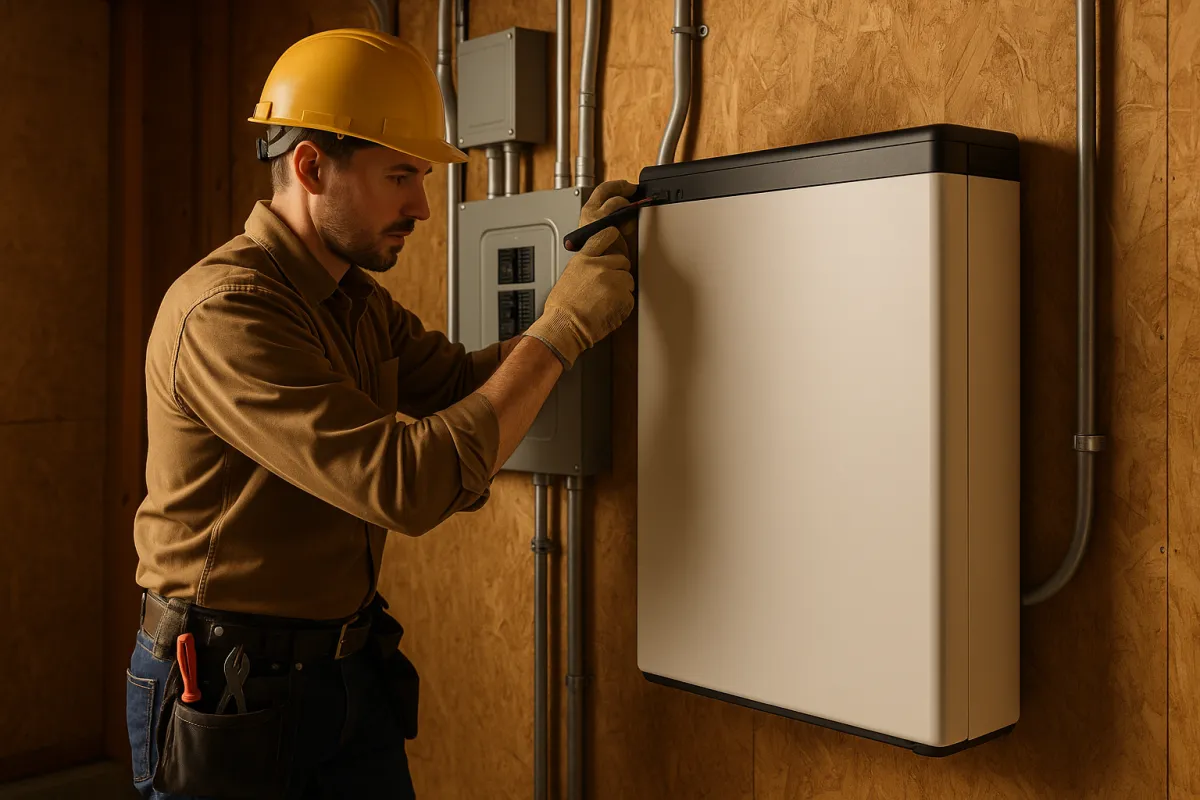
A roof-mounted fan is a hole in your roof, and the quality of the detail around that hole determines whether it is a twenty year installation or a leak. The flange has to go under the shingle courses above and over the courses below, sealed appropriately for the shingle type, with the deck cut cleanly and the framing left intact.
Two questions belong in every bid. First, who is responsible if the penetration leaks, and for how long: the fan manufacturer warrants the fan, not your roof, and the installer’s workmanship warranty is the document that matters. Second, whether your existing roofing warranty is affected by another party cutting into the deck.
Timing is the third consideration. If the roof is within a few years of replacement, wait and have the roofer do the penetration as part of the new roof, when the flashing can be integrated properly and the responsibility sits with one trade. That is the same argument we make about photovoltaic arrays in our note on roof replacement with solar panels.
How to read a solar attic fan quote
A one-page quote for a product this small usually hides more than it states. Six items should appear in writing before you sign anything.
The attic volume used and the air change target applied, stated separately, so you can check the CFM figure rather than accept it. The measured existing net free intake area and the amount required for the fan being proposed, with the shortfall named. The cost of correcting that shortfall, quoted as a line, even if you decline it.
Then the mounting type and the exact flashing method for your shingle type. The workmanship warranty term on the penetration, in writing, separate from the manufacturer’s warranty on the fan. And the control strategy: thermostat only, thermostat plus humidistat, or a hybrid with an alternate power source, with the winter humidistat behavior explained.
An $850 item rarely needs financing on its own, but sellers do fold small add-ons into a larger financed package, and when that happens the fee structure described in our note on solar loans and their traps applies to the fan as much as to the array.
A bidder who supplies all six is doing the job properly. A bidder who supplies a fan model and a price is selling you a box. Two or three bids compared on those six items will tell you more than any amount of brochure reading, and our note on choosing a solar installer applies the same test at larger scale.
A worked example on one house
Put the whole thing together on the example house. Attic floor area 1,600 square feet, average height 5 feet, volume 8,000 cubic feet. Ten air changes an hour requires about 1,333 CFM. At one square foot of net free intake per 300 CFM, the fan needs about 4.4 square feet of intake, which is roughly 71 linear feet of continuous soffit vent.
The house has about twenty small soffit vents contributing roughly 0.7 square feet net free, about 16 percent of what is needed. Installed cost of the roof-mounted fan is $850. Gross saving from a 15 degree attic temperature reduction across an R-30 ceiling and 480 square feet of R-6 duct is about 2,000 Btu per hour, or roughly $24 a year at 1,000 hours and $0.17 a kilowatt-hour.
The intake shortfall drives about 280 CFM of conditioned air into the attic, costing about $74 a year. Net result: a loss of about $49 a year on an $850 purchase. Correcting the intake at an illustrative $10 a linear foot for the roughly 60 feet of additional venting costs about $600, taking the total to $1,450 for a $24 annual saving and a payback near 60 years. Run your own version in the companion calculator.
Mistakes that turn a modest win into a loss
- Buying the fan before measuring the intake. This is the mistake that produces the negative row in the payback table. Measure net free area first, always.
- Accepting a CFM figure with no volume behind it. A rated number without a stated attic volume and air change target is a brochure line, not sizing.
- Assuming the floor-area shortcut applies to a steep roof. The 0.7 multiplier has a shallow attic baked into it and understates a high-volume attic.
- Treating shingle life as a certain benefit. It is contested, and the warranty version of the question is usually written in net free area terms that a fan does not satisfy.
- Running a humidistat through a cold winter. That control setting can move house moisture into the attic through the same leaks that cost you money in summer.
- Ignoring combustion appliances. If the house has an atmospherically vented water heater or furnace, get a professional depressurization test rather than reasoning about it.
- Skipping the air sealing comparison. The same $850 spent on the ceiling plane returns more, works year round, and removes the mechanism that makes the fan expensive.
- Cutting a new roof penetration into a roof near replacement. Wait for the roofer and let one trade own the detail.
Avoid those eight and the fan you buy will behave roughly the way the bid described.
Who a solar attic fan is actually for
A picture emerges once every piece is on the table, and it is narrower than the marketing suggests.
You are a reasonable candidate if you live in a hot climate with a long cooling season, your ductwork runs through the attic, your ceiling is already air sealed, and your soffit venting is genuinely adequate or you are budgeting to make it so. That combination produces the strong case in the payback table, roughly an 11 year return on illustrative figures, and the fan is doing real work.
You are a poor candidate if your intake venting is short and you are not fixing it, if your ceiling leaks and you are not sealing it, if you have an atmospherically vented combustion appliance and no plan to test it, or if you live in a cold climate and the actual problem is moisture. In those cases the fan ranges from a waste of $850 to an active liability.
Between those poles sit the many buyers for whom this is a comfort purchase: a cooler attic for storage, a slightly cooler upstairs bedroom, a quieter feeling of doing something. That is a legitimate reason to spend $850, provided it is named honestly rather than dressed up as a payback. Price your own case in the companion calculator, then get two bids that state the six items listed above.
The bottom line
A solar attic fan costs an illustrative $600 installed on a gable, $850 on a roof mount and $1,400 for a large curb-mounted unit, with roughly half the bill going to flashing, mounting, labor and controls rather than to the fan. Size it from attic volume at eight to twelve air changes an hour, which puts a typical 8,000 cubic foot attic near 1,333 CFM, and then check the number almost nobody checks: the roughly 4.4 square feet of net free intake area that fan needs, which is on the order of 71 feet of continuous soffit vent.
If that intake is missing, the fan makes up the difference through your ceiling. On illustrative figures the gross saving is about $24 a year, the depressurization penalty is about $74, and the net is a $49 annual loss. Fix the intake first and the same fan pays back in roughly 60 years including the fix, or about 35 years if the venting was already there. Only the hot dry climate case with ducts overhead and a high rate gets inside a plausible motor life, at about 11 years.
Air seal the ceiling, confirm the intake, price passive ridge and soffit venting against the fan, verify any warranty or incentive claim at its source, and buy a solar attic fan for a cooler attic rather than for a return. Then run your own attic dimensions and rate through the companion calculator and let the arithmetic settle it.
WattBarn publishes this breakdown so a solar attic fan can be evaluated with a tape measure and a calculator instead of a brochure. The installed prices, CFM requirements, net free area figures, attic temperatures, Btu calculations, efficiency assumptions, annual savings, penalties, payback periods and equipment lifespans printed above are illustrative teaching numbers chosen to show how the pieces relate, not quotations, measurements of your property or forecasts of your bill. Attic ventilation interacts with roof structure, insulation, moisture movement, roofing warranties and, where atmospherically vented combustion appliances are present, with occupant safety, and those are matters for a qualified contractor, a building performance professional and your local building department rather than for any article. Incentive treatment of solar-powered ventilation equipment is unsettled and changes over time, so confirm the current rules at their official sources and with a tax professional before treating any credit as money you will receive.
Frequently asked questions
How much does a solar attic fan cost installed?
A gable-mounted solar attic fan commonly lands near an illustrative $600 installed, a standard roof-mounted unit near $850, and a larger curb-mounted high-capacity unit near $1,400. Roughly half of that is the fan and its integrated photovoltaic panel, and the rest is roof penetration, flashing, mounting, labor and the controls. Those midpoints assume an accessible roof and an existing electrical situation that needs nothing changed, which is not always true. Treat them as teaching figures for comparing options rather than quotes, and expect real bids to move with roof pitch, height, access and local labor rates.
How many CFM does my attic need?
The common planning rule is to move the attic's air volume eight to twelve times an hour, so calculate the volume first and work backward. An illustrative 1,600 square foot attic with an average height of 5 feet holds about 8,000 cubic feet, and ten air changes an hour works out to about 1,333 cubic feet per minute. A dark roof, a steep pitch or a long hot afternoon exposure is often handled by adding roughly 15 percent on top of that. Ask any bidder to show the volume they used and the air change target they picked, because a CFM number quoted without both is a number pulled out of the air.
Do I need more soffit vents for a solar attic fan?
Almost certainly, and this is the single item that decides whether the fan helps or hurts. A commonly cited planning figure is one square foot of net free intake area for every 300 cubic feet per minute of fan capacity, so a 1,333 CFM fan wants roughly 4.4 square feet of intake. At about 9 square inches of net free area per linear foot, that is on the order of 71 feet of continuous soffit venting, which is far more than most houses have. If the intake is short the fan makes up the difference from wherever it can, and the path of least resistance is often the conditioned house below.
How much will a solar attic fan save on my cooling bill?
Less than the marketing implies, and in a badly vented attic the net can be negative. On illustrative figures, dropping a peak attic temperature from about 130 to about 115 degrees over an R-30 ceiling and a duct run in the attic cuts roughly 2,000 Btu per hour of cooling load, which at a SEER 14 equivalent is about 143 watts. Across about 1,000 hours a year at $0.17 a kilowatt-hour that is roughly $24 a year. A hot dry climate, a long season, a leakier ceiling and a higher rate can push that toward an illustrative $76, which is the strong case rather than the typical one.
What is the payback period on a solar attic fan?
On the illustrative figures used throughout this breakdown, an $850 roof-mounted fan saving about $24 a year takes roughly 35 years to pay back, which is longer than the motor is likely to last. In the strong case, a hot dry climate with ductwork in the attic and a high electricity rate, the same fan saving about $76 a year pays back in about 11 years. If the intake venting has to be added first, add roughly $600 and the payback stretches near 60 years. The honest summary is that this is rarely a financial purchase, and it should be bought for attic temperature, moisture control or comfort instead.
Will a solar attic fan make my shingles last longer?
That claim is contested rather than settled, and it should be treated as such. Shingle surface temperature is driven mostly by direct sunlight striking the top of the shingle, not by the air temperature under the deck, so cooling the attic side moves the shingle less than the sales pitch implies. Some shingle warranties do carry attic ventilation requirements, but those requirements are usually written in terms of net free vent area rather than powered ventilation, and a fan does not automatically satisfy them. Read your own warranty document and ask the manufacturer directly before you count roof life as a benefit.
Is a solar attic fan a good idea in a cold climate?
The winter job of attic ventilation is keeping the roof deck cold and dry, and a solar fan is the wrong tool for it because it is off at night and weak on short overcast winter days, which is exactly when moisture accumulates. Worse, a fan fitted with a humidistat that runs in winter can pull warm moist indoor air up through ceiling leaks and condense it on the cold underside of the sheathing. Ice dams are an insulation and air sealing problem, not a fan problem, and adding a fan to a leaky ceiling can make the moisture picture worse. Air seal the ceiling plane first and let passive venting do the winter work.
Does a solar attic fan qualify for a tax credit?
This breakdown deliberately quotes no percentage and no eligibility rule, because the treatment of solar-powered ventilation equipment has been argued more than one way and the rules change. The mechanism to understand is that residential clean energy credits apply to defined categories of qualifying property, and whether a fan of this type falls inside a category, and whether only the photovoltaic component counts, depends on how the equipment and the installation are characterized. Confirm the current rules against the tax authority's own published guidance and ask your tax professional about your situation. Never let a salesperson's claimed percentage become a line in your budget without a written citation.