
What's on this page
- Two different machines wearing similar marketing language
- What a portable power station actually is
- What a home battery actually is
- Capacity measured two different ways
- What a portable power station can realistically run
- What a home battery can realistically run
- Recharging a portable power station versus recharging a home battery
- Cost comparison across the sizes that exist
- Installation: unbox it versus a licensed electrician
- Portability versus permanence
- Where a portable power station still needs a permit
- Lifespan and cycle counts
- Pairing a portable power station with solar panels
- How a plug-in solar panel differs from both of these
- Who should buy a portable power station
- Who should buy a home battery
- Can you reasonably own both
- Battery chemistry and why it matters more on a portable unit
- A worked example: two households, two needs
- Noise, weather, and where each one can go
- What a portable power station cannot do
- Common mistakes
- Monitoring and smart features
- The bottom line
Short answer: A solar generator, more accurately called a portable power station, is a self-contained battery with its own inverter and outlets that you carry to where you need power and charge from a wall outlet, a car, or an add-on solar panel. A home battery is a much larger unit, commonly 10 to 15 kilowatt-hours, permanently wired into your house's electrical panel by a licensed electrician to power existing circuits. They share marketing language but solve different problems: one is portable, finite, and inexpensive; the other is fixed, substantial, and sized for real household backup.
Shopping for a solar generator for home backup and running into home battery results too, or the other way around? The confusion is built into the marketing, not your research. “Solar generator” is a popular, loosely used label for what the industry more precisely calls a portable power station, a product category that has nothing structurally in common with the permanently wired home battery systems covered in our home battery backup versus generator briefing, beyond both containing a lithium battery and both sometimes pairing with solar panels.
This briefing draws the line between the two clearly, prices both honestly, and works through what each one can and cannot realistically power. If what you actually want is a combustion-engine standby or portable generator compared against a home battery, our existing comparison covers that separate question in full; this briefing is specifically about the portable, battery-only product that borrows the word generator without burning any fuel. If a home battery looks like the right fit by the end, our Powerwall cost briefing and our battery economics briefing take the next step, and the savings calculator prices a battery against your own rates.
Key takeaways
- A portable power station is a battery with a built-in inverter and outlets you carry and charge separately; a home battery is permanently wired into your house to power existing circuits.
- Portable units commonly hold 200 to 3,000 watt-hours and cost $300 to $3,000 illustratively; home batteries commonly hold 10,000 to 15,000 watt-hours and cost $12,000 to $18,000 installed.
- A portable power station needs no permit or electrician for ordinary use; a home battery is an electrical project requiring both.
- Neither is the same product as a plug-in solar panel, which generates power from sunlight in real time rather than storing it for later use.
- Many households reasonably own both: a portable unit for camping, work sites, and short outages, a home battery for whole-circuit backup across longer events.
Two different machines wearing similar marketing language
“Solar generator” is doing a lot of unearned work as a product name. It contains no combustion, generates nothing on its own, and is, structurally, a battery, an inverter, and a set of outlets built into one portable box. The “solar” part refers only to the fact that most models accept an optional solar panel accessory for recharging, the same way the unit also accepts a wall outlet or a car’s power system. Marketing copy leans on the word because it signals clean, modern, off-grid capability, not because the device generates power the way an actual generator or a rooftop solar array does.
A home battery carries none of that ambiguity in its name, but shoppers researching backup power routinely land on both product categories in the same search and assume they are shopping for different sizes of the same thing. They are not. A home battery is a fixed, substantial piece of household electrical infrastructure. A portable power station is a consumer appliance you could, in principle, buy at a big-box store and carry out under one arm. Keeping that distinction in view from the first search saves a lot of wasted comparison shopping.
What a portable power station actually is
Open one up, figuratively, and a portable power station is three things in one case: a lithium battery, commonly lithium iron phosphate in higher-end models for better cycle life and thermal stability, an inverter that converts the battery’s stored direct current to the alternating current most household devices expect, and a panel of outlets, typically a mix of standard AC outlets, USB ports, and sometimes a car-style 12 volt socket, all built into a single portable enclosure with a carrying handle.
You charge it from whatever source is convenient: a wall outlet overnight, a car’s 12 volt outlet while driving, or an optional solar panel accessory sold separately, usually a folding, briefcase-style panel rated anywhere from 60 to 400 watts depending on the power station’s size. Then you carry it to wherever you need power, a campsite, a job site with no outlet, a desk during a home office outage, and plug devices directly into its own outlets. Nothing about it connects to your home’s wiring unless you deliberately add a backfeed inlet, a modification covered later in this briefing.
What a home battery actually is
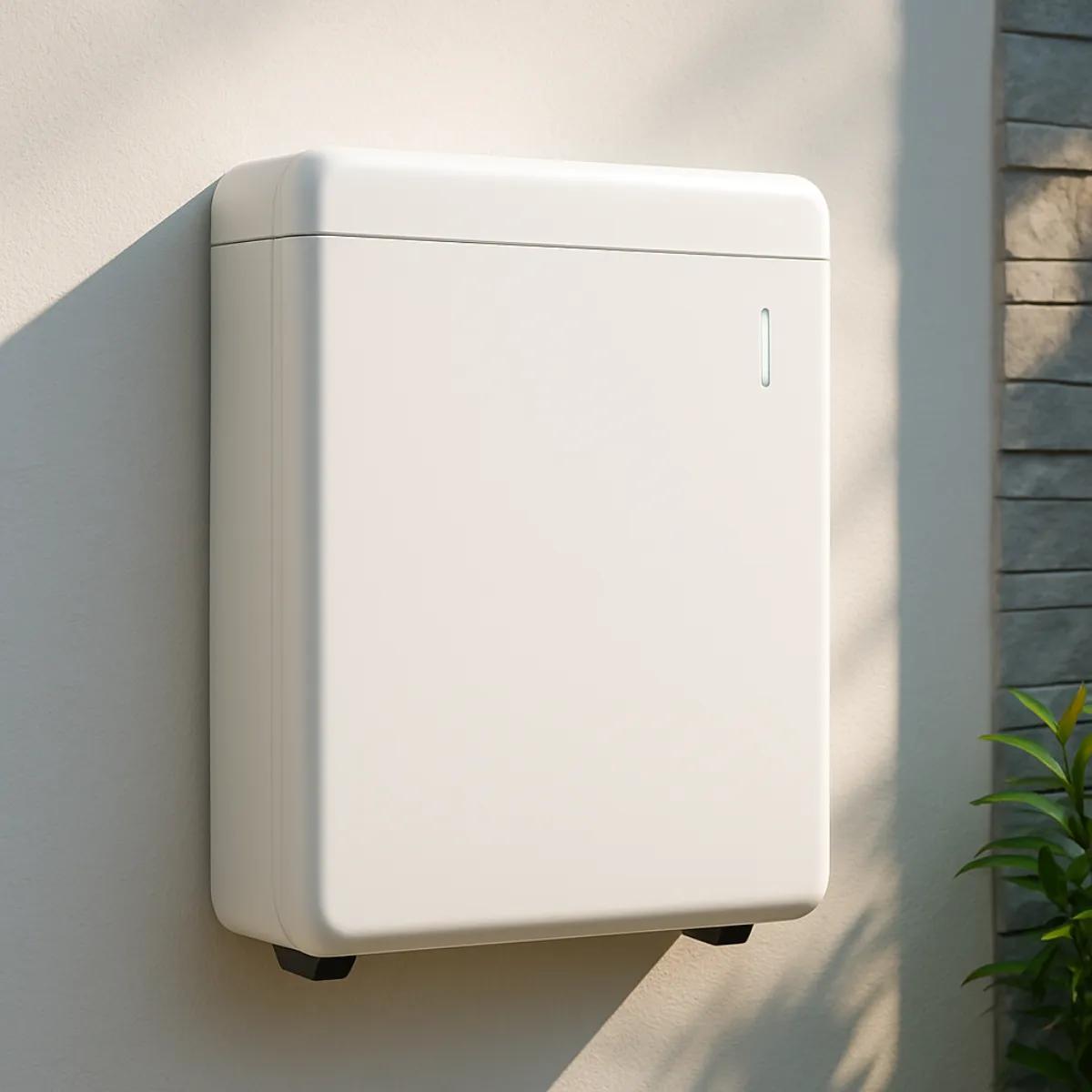
A home battery, the kind our Powerwall cost briefing and battery storage cost briefing price in detail, is a wall-mounted unit, commonly in the 10 to 15 kilowatt-hour capacity class per unit, permanently installed by a licensed electrician and wired into your home’s existing electrical system through a critical-loads panel or a smart panel that defines which circuits it backs up. It does not have its own outlets you plug devices into directly; instead, it powers the outlets and circuits already in your walls, the same ones a generator or the grid itself would power.
When paired with rooftop solar, a home battery recharges from the panels during the day and can island the house during a grid outage, a capability our home battery backup briefing covers at length. When not paired with solar, it still recharges from the grid itself, typically overnight on cheap off-peak power, and discharges during expensive peak hours or during an outage. Either way, it is a piece of household infrastructure with a multi-thousand-dollar installation project attached, not a box you unbox and start using the same afternoon.
Capacity measured two different ways
Portable power stations are almost universally rated in watt-hours, a measure of total stored energy, commonly 200 to 3,000 watt-hours for consumer models, with a handful of larger, wheeled units reaching higher. Home batteries are almost universally rated in kilowatt-hours, the same unit, just a thousand times larger in scale: a single 13.5 kilowatt-hour unit holds 13,500 watt-hours, roughly 4.5 to 27 times the capacity of a typical portable power station depending on which size you compare.
That scale gap is the single fact that explains almost every other difference in this briefing. A portable unit’s modest capacity is exactly what makes it light enough to carry and cheap enough to buy without a loan. A home battery’s much larger capacity is exactly what requires it to be permanently installed, professionally wired, and priced like the household infrastructure project it is.
What a portable power station can realistically run
Divide watt-hours by watts to get hours of runtime, the same arithmetic our home battery and generator briefing runs for larger systems. A common 1,000 watt-hour portable power station running a 65 watt laptop-charging load lasts over fifteen hours. The same unit running a 150 watt mini fridge lasts a little under seven hours. Point it at a 900 watt window air conditioner, and it empties in a little over an hour.
Runtime of a 1,000 Wh portable power station at common loads
Same unit, three different devices. Illustrative; your own model's rated capacity and the device's real draw will move these numbers.
Small electronics and light loads are where a portable power station earns its keep. Heat and cooling loads empty it fast, the same pattern that limits small home batteries against central air conditioning.

What a home battery can realistically run
Run the identical division problem at home-battery scale. A 13.5 kilowatt-hour battery, 13,500 watt-hours, against an illustrative trimmed critical load of about 1,500 watts covering a refrigerator, a sump pump, internet gear, and some lighting, lasts roughly nine hours flat out, and often longer in practice since those loads cycle rather than drawing continuously. That is the same math and the same illustrative household our home battery and generator comparison works through for the combustion-generator comparison, repeated here because it is the right anchor for comparing against a portable unit’s much smaller numbers.
Add central air conditioning to that critical load and a home battery’s runtime shrinks sharply too, the same vulnerability a portable power station shows against a window unit, just starting from a much larger capacity base. The pattern holds at both scales: cooling and heating loads are disproportionately hard on any battery, portable or fixed, because they draw continuously and draw hard.
Recharging a portable power station versus recharging a home battery
A portable power station recharges from whatever source is nearest: a wall outlet, commonly a few hours for a full charge depending on the unit’s charging circuitry, a car’s 12 volt system while driving, slower but available anywhere, or an optional solar panel accessory, the slowest common path, often taking the better part of a sunny day for a full recharge from a small folding panel. None of these paths require any home wiring work; you simply connect a cable.
A home battery recharges from the grid itself, typically scheduled for cheap off-peak overnight hours when not paired with solar, or from a rooftop array during daylight when it is, a recharge loop our home battery and generator briefing describes as the single biggest technical advantage a battery holds over a combustion generator during an extended outage. That recharge path is automatic and continuous once installed; there is no cable to plug in or panel to unfold, because the whole system is wired together permanently from the start.
Cost comparison across the sizes that exist
Portable power stations span a wide price range tied closely to capacity. As illustrative figures, a small 200 to 300 watt-hour unit commonly runs $150 to $300, a mid-size 1,000 watt-hour unit commonly runs $700 to $1,200, and a large 2,000 to 3,000 watt-hour unit, often on wheels, commonly runs $1,800 to $3,000. None of these prices include installation, because there is none to include.
Home batteries price very differently. As illustrative figures matching our Powerwall cost briefing and battery storage cost briefing, a single 10 to 15 kilowatt-hour unit commonly runs $12,000 to $18,000 fully installed, and whole-home coverage requiring two or more units roughly doubles that figure. Per watt-hour of capacity, the portable unit is usually the pricier of the two on a pure storage basis, since its price also buys a built-in inverter, a carrying case, and zero-install convenience; the home battery’s much larger capacity spreads its cost across more watt-hours even before counting the labor and permitting embedded in its installed price.
Where a home battery's installed cost goes
Illustrative share of a typical single-unit installed price. A portable power station has no equivalent install, permit, or gateway line.
A portable power station's entire price sits in the hardware line, with no installation, permit, or gateway cost attached, which is the structural reason it costs hundreds rather than tens of thousands of dollars.
Installation: unbox it versus a licensed electrician
A portable power station’s installation is opening the box. There is no permit, no electrician, and no inspection, because nothing connects to your home’s fixed wiring. You charge it, use it, and store it, the entire relationship with the device from purchase to disposal.
A home battery’s installation is a genuine electrical project: wall mounting, a critical-loads panel or smart panel to define what circuits it backs up, inverter integration if it is not pairing with an existing solar inverter, and a utility interconnection application, typically a day or two of licensed site work followed by inspection, the same process our permitting and interconnection briefing documents in full for solar projects generally. Skipping that process on a home battery is not an option the way it is for a portable unit; the device is wired into your house’s electrical service, and doing that without a permit and a qualified electrician is both illegal and dangerous.
Portability versus permanence
This is the trade each product is built around. A portable power station goes wherever you go: into a car for a camping trip, to a job site with no power, or simply from room to room during a short outage to keep a lamp and a phone charger running near wherever you are sitting. That mobility is the entire value proposition, and it is why the category exists separately from home batteries at all.
A home battery goes nowhere. It is bolted to a wall, wired into your electrical service, and tied to that specific property for the life of the installation, the same way the rooftop solar array it often pairs with is tied to that roof. Selling the house generally means leaving the battery behind as part of the sale, a consideration our home value briefing touches on for solar equipment generally. Neither trade-off is wrong; they simply serve opposite use cases, one mobile and one fixed.
Where a portable power station still needs a permit
The clean “no permit needed” answer above has one real exception worth flagging plainly. A portable power station used exactly as designed, charged from an outlet or a car, devices plugged into its own built-in outlets, needs no permit because nothing touches your home’s wiring. The moment you add a backfeed inlet or a manual transfer switch to run the unit’s output into your house’s circuits through the breaker panel, the same way our outage briefing describes for other backup equipment, you have created an electrical project subject to the same permit and licensed-electrician requirement as any other backfeed setup, regardless of how small the power station itself is.
That modification is popular among portable power station owners who want to run a refrigerator or a few household circuits without running extension cords through windows, and it is a legitimate use case. Just recognize that doing it crosses the line from a consumer appliance into an electrical project the instant a cable connects to your panel rather than to a device directly.
Lifespan and cycle counts
Both products age primarily by charge cycles rather than a fixed calendar, but the practical lifespans differ with the hardware. Consumer portable power stations commonly carry a few hundred to around two thousand full-charge cycles before capacity degrades meaningfully, depending on battery chemistry, with lithium iron phosphate models at the upper end of that range. For a unit cycled occasionally for camping trips or infrequent outages, that can mean a working life of many years; for one cycled daily as a primary power source, degradation arrives faster.
Home batteries are built for a different duty cycle and carry correspondingly longer warranties, commonly around ten years and guaranteeing a stated share of original capacity, often around seventy percent, at the end of that term, the same warranty structure our home battery and generator briefing covers for backup-focused systems. A home battery cycling daily for bill-saving arbitrage spends its cycles earning money along the way; one held purely for backup barely cycles at all and ages mainly by calendar time instead.
Pairing a portable power station with solar panels
Most portable power stations accept an optional folding solar panel accessory, commonly 60 to 400 watts depending on the power station’s size, letting you recharge off-grid instead of relying only on a wall outlet or a car. This genuinely works for extended camping trips, remote work sites, or stretching a unit’s usefulness through a multi-day outage with intermittent sun, but set expectations honestly: a small accessory panel recharging a portable power station is a slow trickle, commonly many hours for a meaningful charge even in good sun, nothing like the recharge rate a full rooftop array provides to a home battery.
It is also worth being explicit that this pairing is a completely different arrangement from a plug-in solar panel feeding your home’s wiring directly, covered in full in that separate briefing. A portable power station’s solar accessory charges the station’s own internal battery; it does not feed your home’s circuits at all, and the station then discharges that stored energy back out through its own outlets whenever you need it, wherever you have carried it.
How a plug-in solar panel differs from both of these
Three products, one overlapping vocabulary, worth untangling one final time. A plug-in solar panel generates electricity from sunlight continuously while the sun is up and feeds it directly into your home’s wiring through an outlet, with no meaningful storage; it produces nothing after dark and does nothing during a grid outage, since its safety shutoff disconnects it the instant the grid goes down. A portable power station is pure storage with no generation of its own, charged from any source you choose and discharged through its own outlets wherever you carry it. A home battery is large-scale storage permanently wired into your house, often paired with a full rooftop array for daily recharge and whole-circuit backup.
If the goal is quietly trimming an electric bill over years with no backup capability, the plug-in panel is the right category. If the goal is portable, finite power for camping, work sites, or a few devices during a short outage, the portable power station is the right category. If the goal is genuine whole-circuit backup across a multi-day outage, the home battery, likely paired with solar, is the right category. None of the three substitutes well for either of the others.
Who should buy a portable power station
The clearest case is someone who wants backup for a handful of small devices, lighting, phone and laptop charging, a CPAP machine, a Wi-Fi router, during outages that are typically short, plus genuine use for camping, tailgating, or a job site with no power access. The price point, commonly hundreds rather than thousands of dollars, and the zero-installation convenience make it an easy yes for that use case, with no electrician, no permit, and no long-term commitment to a specific property.
It is a poor fit for anyone expecting it to run a refrigerator for days, power a sump pump through a multi-day event, or substitute for whole-home backup. Those jobs belong to a home battery or, for very large or very long outages, the standby or portable generator comparison our home battery and generator briefing covers separately.
Who should buy a home battery
The clearest case is a household that already has or is planning rooftop solar, wants genuine backup for refrigeration, a sump pump, internet, and several rooms of lighting across outages that can run many hours to a few days, and is prepared for a multi-thousand-dollar installed project with a licensed electrician and a permit. Our battery economics briefing runs the daily bill-savings side of that decision in full, since a home battery, unlike a portable power station, can also earn money on ordinary days by shifting cheap stored power into expensive evening hours.
It is a poor fit for a renter, a condo owner with no ability to install permanent equipment, or anyone whose actual need is occasional, portable power rather than fixed household backup. That household is far better served, and far less out of pocket, with a portable power station instead.
Can you reasonably own both
Yes, and it is a genuinely sensible combination for many households rather than a redundant one. A home battery covers the job it is built for: whole-circuit backup across hours to days, paired with solar for daily recharge and bill savings along the way. A portable power station covers a different job entirely: camping trips, job sites, a reading lamp and a phone charger during the first hour of an outage before you have even confirmed the home battery has kicked in, or backup for an apartment or room that the home battery’s wiring does not reach.
Priced together, a $15,000 home battery and a $1,000 portable power station add a small fraction to the total for meaningfully broader coverage, the same logic our home battery and generator briefing applies to pairing a home battery with a modest portable combustion generator for the rare event that outlasts the battery. The products are complements, not competitors, once their actual jobs are named honestly.
Battery chemistry and why it matters more on a portable unit
Most home batteries sold today use lithium iron phosphate chemistry, prized for its long cycle life, thermal stability, and reduced fire risk compared with older lithium-ion formulations, a detail that matters enough at household scale that manufacturers lead with it in marketing. Portable power stations split between the same lithium iron phosphate chemistry in higher-end models and older nickel manganese cobalt lithium-ion chemistry in cheaper ones, and the difference shows up directly in the cycle-count figures discussed earlier: a lithium iron phosphate portable unit commonly outlasts a nickel manganese cobalt one by a wide margin under repeated charging.
The practical buying guidance is simple: check the chemistry on the spec sheet before comparing two portable power stations on price alone, since a cheaper nickel manganese cobalt unit that needs replacing in a third of the cycles is not actually the better value once you count what it costs to own across the same number of years. A home battery buyer rarely has to think about this, since the home battery market has standardized heavily on lithium iron phosphate at the scale these units operate, but a portable power station buyer is choosing between both chemistries in the same aisle, often at a price difference that looks larger than it is once cycle life is counted.
A worked example: two households, two needs
Household one rents a two-bedroom apartment with no ability to install permanent equipment and no interest in one. Their outages are rare and short, and their real use case is weekend camping trips three or four times a year plus the occasional few hours without power at home. A $900, 1,000 watt-hour portable power station with a folding 100 watt solar accessory covers both: at camp, it runs a lantern, a phone, and a small cooler’s charge for a full weekend; at home, during a short outage, it keeps a lamp, a router, and device charging running for the better part of a day. Total cost: under $1,000, with no installation and no permit.
Household two owns a single-family home with rooftop solar already installed, lives somewhere outages run several hours to a couple of days a few times a year, and wants the refrigerator, sump pump, and internet to keep running without a generator in the yard. A 13.5 kilowatt-hour home battery, installed for an illustrative $15,000, covers a roughly 1,500 watt critical load for about nine hours on stored charge alone, longer with the panels recharging it during a daylight outage, and earns several hundred illustrative dollars a year in rate arbitrage on the days nothing goes wrong, arithmetic our battery economics briefing runs in full. Neither household bought the wrong product; each bought the product shaped like its actual need.
Noise, weather, and where each one can go
Neither product burns fuel, so neither one produces exhaust, carbon monoxide, or the 60 to 70 decibel engine noise our home battery and generator briefing documents for a standby unit. That shared trait is one of the few places portable power stations and home batteries genuinely resemble each other: both run silently, which matters at 2 a.m. during an outage regardless of which scale of product you own.
Where they diverge is weather exposure. A portable power station is built to be carried indoors, into a tent, a car, or a garage, and most models are not rated for sustained outdoor exposure to rain or direct weather, so leaving one outside through a storm risks the electronics even though nothing about its operation demands fuel or ventilation. A home battery, by contrast, is commonly rated for outdoor wall mounting and built to handle sun, rain, and a meaningful temperature range as part of its design, since it lives permanently on an exterior wall or in a garage. If a portable unit is part of your outage plan, bring it inside before the weather arrives; a home battery has no equivalent decision to make, since it was never going anywhere.
What a portable power station cannot do
Beyond the runtime limits already covered, a portable power station has a few hard ceilings worth naming plainly so a purchase does not disappoint. It cannot power hardwired equipment such as a well pump, a furnace’s blower motor, or a garage door opener unless those devices happen to have an accessible plug, since the station has no connection to your home’s circuits without the backfeed modification discussed earlier. It cannot sustain a heavy continuous load, a space heater, a full-size refrigerator with an aging compressor, or central air conditioning, for more than a fraction of an outage, the same arithmetic the runtime chart above makes clear.
It also cannot grow with you the way a home battery installation can. Outgrowing a portable power station means buying a second or larger unit outright, with no trade-in path and no way to expand an existing one’s capacity the way some home battery systems allow a second unit to be added to an existing gateway. And unlike a home battery, a portable power station earns nothing on the days nothing goes wrong: it sits in a closet unless you are using it, with no daily rate-arbitrage value the way our battery economics briefing describes for a grid-tied home battery. None of this makes it a bad product; it simply means its job is narrower than its marketing sometimes suggests, and knowing the ceiling before buying prevents the single most common source of buyer’s remorse in this category.
Common mistakes
A short list of avoidable errors accounts for most of the confusion and regret in this category. Assuming “solar generator” means the same thing as a home battery. The marketing language overlaps; the products, prices, and installation requirements do not. Buying a portable power station expecting it to run a refrigerator for days. Its small capacity is built for light loads and short durations, not multi-day whole-circuit backup.
Buying a home battery for a need a $900 portable unit would have solved. If the actual use case is occasional, portable, small-device backup, a home battery’s installation cost and commitment are wildly oversized for the job. Confusing either product with a plug-in solar panel, a third, structurally different category covered in full in our plug-in solar panel briefing, that generates power rather than storing it. Adding a backfeed inlet to a portable power station without a permit, turning what was a zero-permit appliance into an unpermitted electrical modification. Expecting a small accessory solar panel to recharge a portable power station quickly, when realistic recharge times from a small folding panel commonly run many hours even in good sun.
Monitoring and smart features
Both products increasingly ship with an app, but the apps are doing different jobs. A portable power station’s app, where one exists, typically shows remaining charge, input and output wattage in real time, and basic settings like charge limits or a flashlight toggle, functioning as a convenience layer on top of a device you can also fully operate from its own front panel with no phone at all.
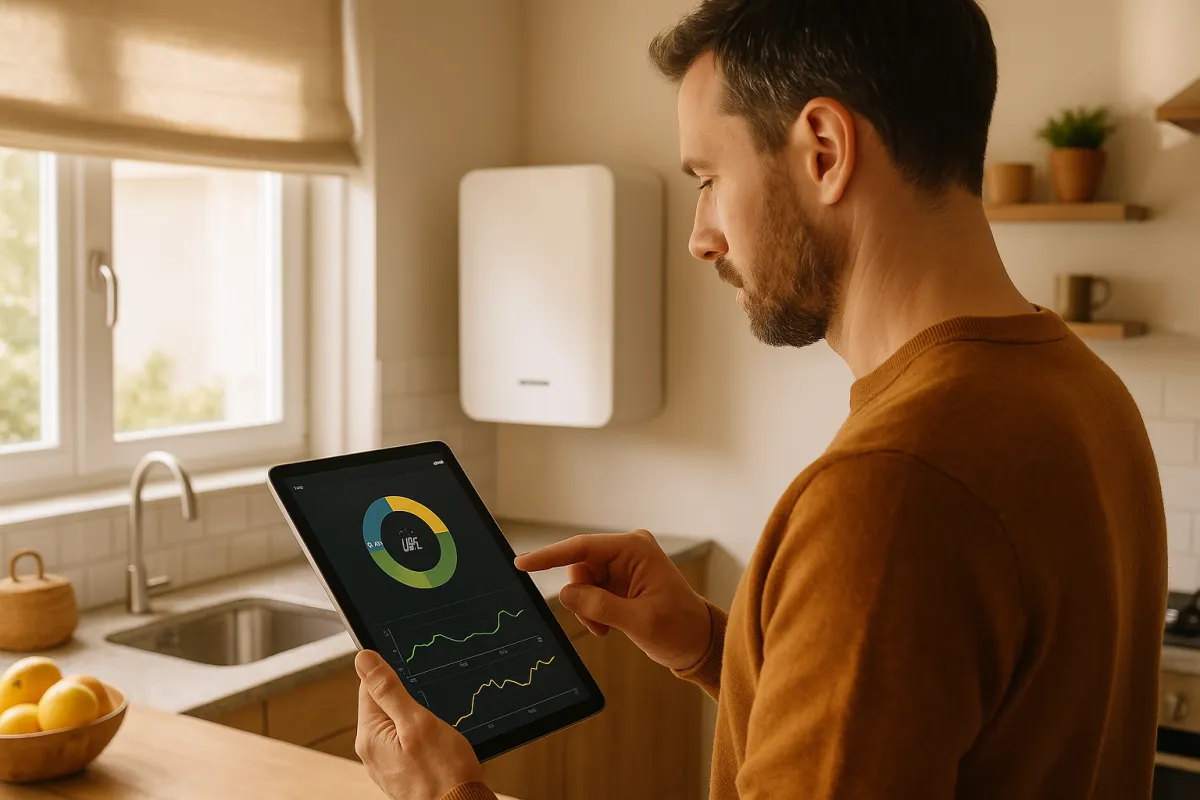
A home battery’s monitoring app is closer to a dashboard than a remote control: historical charge and discharge patterns, solar production if paired with panels, grid import and export, and often a projection of how many hours of backup remain at the current household load during an outage, the same kind of monitoring our production monitoring briefing covers for solar systems generally. That richer feature set reflects the bigger, more integrated job the hardware is doing; a portable power station simply has less to report because it is doing less.
The bottom line
A solar generator and a home battery share a battery and, loosely, the word solar, and almost nothing else. A portable power station is a self-contained, inexpensive, zero-installation appliance built for small loads and genuine portability: camping, work sites, and short outages where a few devices matter more than whole-home coverage. A home battery is a substantial, professionally installed piece of household electrical infrastructure built for whole-circuit backup across hours to days, usually paired with rooftop solar for daily value beyond just outages.
Match the product to the job rather than the marketing. If the need is portable and occasional, the portable power station wins on price and simplicity every time. If the need is fixed, whole-circuit backup, the home battery is the only product in this briefing actually built for it, and our battery economics briefing and the savings calculator are the right next stop to price it against your own rates and outage history.
WattBarn publishes this briefing to inform, not to advise. Capacities, prices, and runtimes above are illustrative sketches: specific models, your local labor and equipment pricing, and your actual device loads will produce different numbers. Any modification that connects a portable power station to your home’s wiring, including a backfeed inlet or transfer switch, is an electrical project requiring a permit and a licensed electrician, and a home battery installation always requires both. This briefing is not electrical or safety advice for your specific property or equipment.
Frequently asked questions
What is the difference between a solar generator and a home battery?
A solar generator, more precisely called a portable power station, is a self-contained box with a battery, an inverter, and its own outlets built in. You carry it to where you need power and plug devices directly into it, charging it from a wall outlet, a car, or an add-on solar panel. A home battery is a much larger unit permanently wired into your house's electrical panel by a licensed electrician, and it powers your home's existing circuits and outlets rather than being carried anywhere. They share the word solar in casual marketing, but they are different products solving different problems.
Can a portable power station power a whole house?
Not a typical one. Consumer portable power stations commonly range from a few hundred watt-hours up to around 3,000 watt-hours of capacity, enough to run a laptop, a phone charger, a small fridge, or a handful of lights for hours, but not a central air conditioner, an electric water heater, or a whole home's worth of circuits at once. A home battery, commonly 10 to 15 kilowatt-hours per unit and often installed in multiples, is the product sized for whole-circuit or whole-home backup, a distinction our home battery and generator comparison covers in detail.
How much does a solar generator cost compared to a home battery?
As illustrative figures, a consumer portable power station commonly runs $300 to $3,000 depending on capacity, bought off the shelf with no installation cost. A home battery commonly runs $12,000 to $18,000 fully installed, including the unit, a critical-loads panel, permits, and electrician labor. Per watt-hour of capacity, the portable unit is usually the more expensive of the two, since you are paying for portability and a built-in inverter and outlets, while the home battery's cost spreads a larger capacity across a bigger upfront commitment.
Do I need a permit for a portable power station?
Generally no, for the device itself. A portable power station is a consumer appliance you plug things into directly, with no wiring into your home's electrical system, so it typically falls outside the permitting and interconnection process our permitting briefing describes for rooftop solar and home batteries. The exception is if you modify it to back-feed your home's wiring through an inlet or transfer switch, which turns it into an electrical project requiring the same permit and licensed-electrician involvement as any other backfeed setup.
Can a portable power station be charged by solar panels?
Yes, most models accept an optional folding or portable solar panel accessory sold separately, letting you recharge the unit from sunlight instead of only a wall outlet or a car. Charging speed from a small accessory panel is modest, commonly taking many hours for a full recharge even in good sun, so solar charging works best as a slow trickle for extended off-grid use rather than a fast recharge between uses. It is a genuinely different charging path from a rooftop array feeding a home battery, which recharges at a much higher rate from a much larger panel area.
How long does a portable power station last in an outage?
Divide its watt-hour capacity by your actual load in watts. A 1,000 watt-hour unit running a 150 watt mini fridge lasts a little under seven hours; the same unit running a 65 watt laptop charging load lasts over fifteen hours. It empties fast against any heavy load like a space heater or a window air conditioner, commonly under an hour or two, which is the core limitation that separates a portable power station from a home battery sized for a house's critical circuits over many hours or days.
Is a solar generator the same as a plug-in solar panel?
No, and this is the single most common confusion in the category. A plug-in solar panel generates electricity from sunlight in real time and feeds it directly into your home's wiring through an outlet, with no meaningful storage of its own. A solar generator, meaning a portable power station, is a battery you charge separately and then carry somewhere to run devices from its own built-in outlets, independent of your home's wiring entirely. One offsets your bill quietly over years; the other provides portable, finite backup power on demand.
Should I buy a portable power station or a home battery for emergencies?
It depends on the shape of the backup you actually need. A portable power station suits short outages, camping, work sites, and keeping a handful of small devices running, and it costs far less upfront with zero installation. A home battery suits keeping your refrigerator, sump pump, internet, and several circuits running for many hours across a multi-day outage, and it costs far more but does a fundamentally bigger job. Many households reasonably own both for different purposes rather than treating them as competing choices.