
What's on this page
- What a plug-in solar panel actually is
- How a plug-in system differs from a rooftop array
- Why a microinverter is what makes plug-in possible
- How much power a plug-in panel realistically produces
- Where interconnection rules and utility permission stand
- Balconies, railings, and where the panel actually goes
- What it takes to plug one in safely
- Realistic savings for an apartment or small balcony setup
- Portable kits versus semi-permanent plug-in systems
- Who actually benefits from a plug-in system
- HOA rules and landlord permission are a separate question
- Safety basics worth taking seriously
- What a plug-in system cannot do
- Why the federal tax credit does not apply here
- Plug-in solar compared with a full rooftop array
- Plug-in solar compared with a portable power station
- What to check before buying a kit
- Weather, seasons, and realistic expectations
- Common mistakes
- A worked example
- The bottom line
Short answer: A plug-in solar panel is a small, usually one to four panel system with a built-in microinverter that outputs standard household current through a regular plug, instead of being wired permanently into your main panel by an electrician. It works for balconies, patios, sheds, and small outdoor spaces, it produces a modest trickle of power, commonly a few hundred to roughly 1,600 watts of nameplate capacity, and it saves real but small money, commonly tens to a couple hundred dollars a year. Whether it is legal to use without a formal interconnection agreement depends entirely on your utility and local rules, and that question has no single national answer.
Searching for a plug in solar panel because a rooftop array is not an option, whether you rent, live in a condo, or just have a balcony and a sunny afternoon? You are not alone, and the search volume behind that exact phrase and its cousins, balcony solar panel, solar panel for apartment, confirms it: a lot of people want in on solar without owning a roof. The honest answer is that a real product category exists for this, it genuinely works, and it also gets oversold by marketing that blurs it with a completely different product, the portable power station. This briefing separates the two, prices the real savings with arithmetic instead of adjectives, and walks through the legal and practical questions that decide whether one belongs on your balcony.
Plug-in solar is a small-scale cousin of the full rooftop systems covered throughout WattBarn’s other briefings, including our breakdown of what a full rooftop array costs and our explanation of how solar actually works. The physics are identical; what changes is scale, mounting, and the regulatory path. If you eventually move somewhere a rooftop array makes sense, the savings calculator is the place to size that project honestly, but this briefing is about the smaller question in front of you right now.
Key takeaways
- A plug-in solar panel pairs one to four small panels with a microinverter and a standard plug, producing commonly 100 to 1,600 watts of nameplate capacity with no built-in storage.
- Legality hinges on local utility and interconnection rules, which vary widely and have no single national answer, so confirm directly before buying anything you intend to wire into a household circuit.
- Realistic annual savings on a common two-panel kit run roughly $60 to $150 illustratively, a genuine but modest dent in a typical electric bill, not a replacement for it.
- A plug-in solar panel and a portable power station are different products marketed with overlapping language; one generates power from sunlight in real time, the other stores energy in a battery you charge separately.
- No federal tax credit applies to any solar property, plug-in or rooftop, placed in service after December 31, 2025, since section 25D was terminated by Public Law 119-21.
What a plug-in solar panel actually is
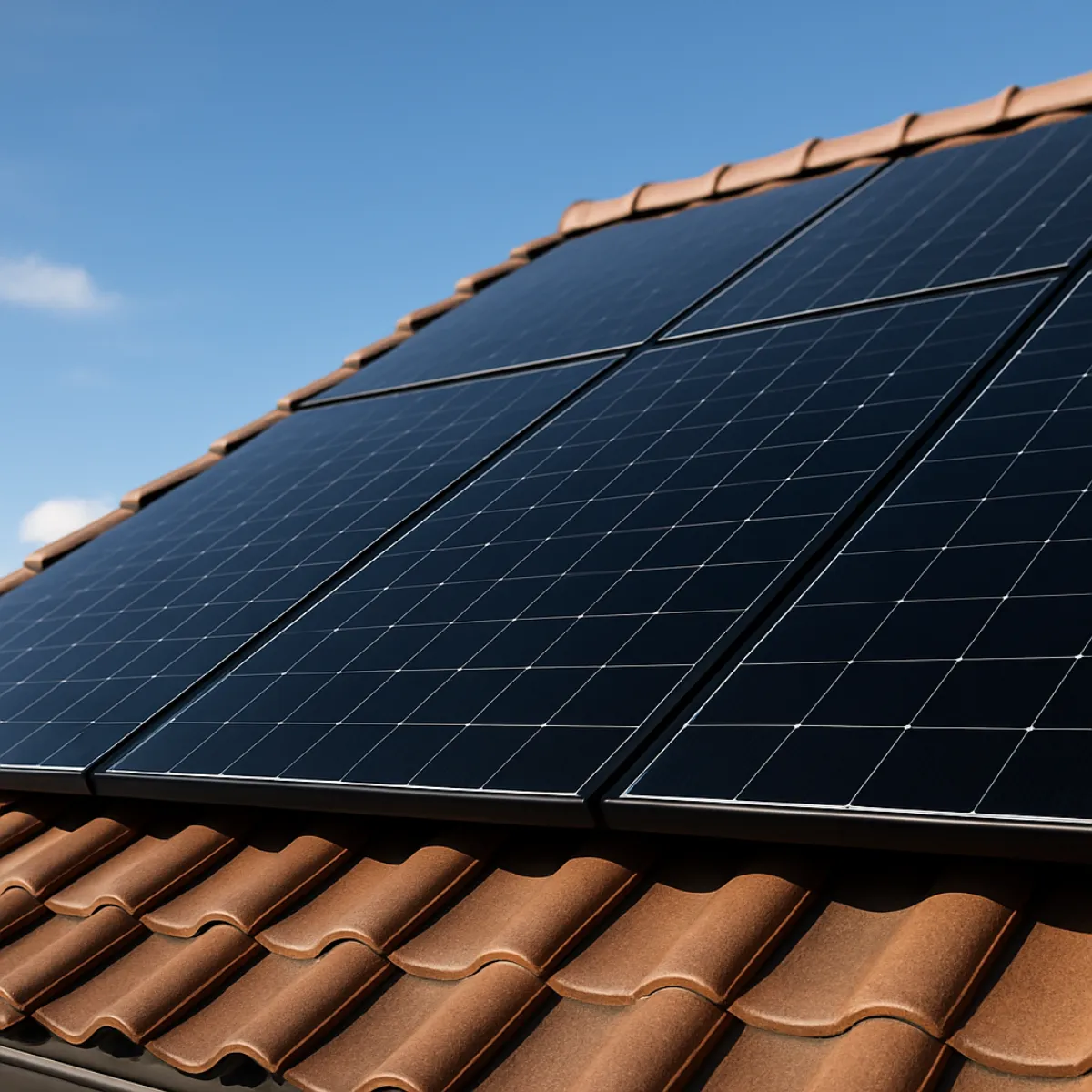
Strip away the marketing and a plug-in solar panel is three components. A photovoltaic panel, identical in principle to the ones on a rooftop array, just smaller and usually rated lower in wattage. A microinverter, a small electronics box bolted to the back of the panel or sitting inline on its cable, that converts the panel’s raw direct current into the alternating current your home’s outlets expect. And a cord ending in a standard household plug, the same NEMA-style plug as a lamp or a toaster, instead of a wire that an electrician lands directly inside your main electrical panel.
That last detail is the entire product category. A conventional rooftop system is wired permanently into your home’s electrical service by a licensed electrician, inspected, and connected to the grid under a formal interconnection agreement with your utility, a process our permitting and interconnection briefing covers in full. A plug-in system skips that wiring step entirely. You plug it into an outlet that already exists, the same way you would plug in a space heater, and the microinverter’s output flows backward through that outlet into the circuit it is on, offsetting whatever else that circuit is drawing at the moment.
How a plug-in system differs from a rooftop array
Size is the most obvious difference. A rooftop residential array commonly runs 5,000 to 10,000 watts of nameplate capacity, sized against a household’s full annual electricity usage. A plug-in kit commonly runs 100 to 1,600 watts, sized against whatever a single outlet and the simplified interconnection rules in your area allow. That is roughly a tenth of the capacity or less, and the savings scale down proportionally.
Installation is the second difference, and it is the one that makes the category attractive. A rooftop array takes a design visit, a permit application, a crew on your roof for a day or more, an inspection, and a utility interconnection process that our permitting briefing documents can run weeks to months depending on jurisdiction. A plug-in kit takes the time it takes to set a panel on a stand or clip it to a railing and plug in a cord, commonly under an hour, with no electrician required for the panel itself in most documented simplified-rule jurisdictions.
Ownership and mobility are the third difference. A rooftop array is bolted to a specific roof and effectively stays with the house. A plug-in panel and stand can move with you to a new apartment, a different balcony, or into storage for the winter, which matters enormously for the renter who does not know whether this address is a five-year home or a one-year stop.
Why a microinverter is what makes plug-in possible
The microinverter deserves its own explanation because it is doing work most buyers never think about. A bare solar panel produces direct current at a voltage that has nothing to do with your home’s wiring, and connecting it to a household circuit without converting and synchronizing that output correctly is both dangerous and useless, since a plain DC panel cannot simply be wired into an AC outlet.
The microinverter solves two problems at once. It converts direct current to alternating current, and it synchronizes that alternating current’s frequency and phase to match the grid’s own, a process called grid-tied synchronization that happens automatically and continuously inside the inverter’s electronics. It also, critically, includes an anti-islanding safety feature: if the grid goes down, whether from a neighborhood outage or because a utility worker has de-energized the line for maintenance, the microinverter detects the loss of grid signal and shuts the panel’s output off within a fraction of a second, exactly as a full rooftop inverter does. That feature is what makes a plug-in panel safe to leave connected unattended, and a reputable kit will carry UL 1741 certification, the recognized US safety standard for grid-interactive inverters, as evidence this protection is built in and tested.
How much power a plug-in panel realistically produces
Nameplate wattage is a laboratory number measured under ideal lab conditions. Real-world output depends on your sun hours, the panel’s angle and orientation, shading, and simple conversion losses in the inverter and wiring, the same factors our efficiency briefing walks through for full rooftop arrays. A reasonable illustrative assumption for a balcony-mounted panel, which is rarely at an ideal tilt and often faces a single fixed direction with no adjustment, is about 80 percent of the theoretical daily output you would get from multiplying wattage by sun hours.
Work the arithmetic on a common 400 watt kit, two 200 watt panels, at four peak sun hours, a reasonable mid-latitude illustrative figure: 400 watts times 4 hours times 0.8 efficiency, divided by 1,000 to convert to kilowatt-hours, lands at about 1.28 kilowatt-hours a day. Scale that up or down with the chart below for smaller and larger common kit sizes.
Illustrative daily output by common plug-in kit size
At 4 peak sun hours and an 80 percent system efficiency factor. Your own sun hours and shading will move these numbers.
A four-panel, 800 watt kit still produces well under a tenth of a typical rooftop array's daily output. Enter your own panel count and sun hours in the calculator above to replace these illustrative figures with your own.
Where interconnection rules and utility permission stand
This is the section with the least satisfying honest answer, and it is worth saying plainly rather than papering over: whether you can legally plug a solar panel into your own outlet without a formal utility interconnection agreement depends on where you live and who your utility is, and there is no single number or rule that applies everywhere. Some utilities have adopted simplified, lighter-weight interconnection processes for very small inverter-based systems below a locally set wattage threshold, recognizing that a few hundred watts poses a different safety profile than a full rooftop array. Others have not, and technically expect the same interconnection paperwork for a 200 watt plug-in panel as for a 10,000 watt roof, even if enforcement in practice looks very different from the rooftop case.
The practical path is a phone call, not a web search. Call your utility’s customer service or interconnection department, describe exactly what you are considering, a small plug-in inverter-based panel under some number of watts, and ask directly whether it needs an interconnection agreement, a permit, or neither. Get the answer in an email if you can, since rules and enforcement both shift over time and a dated written answer protects you if a question ever comes up later. Treat any number you read online, including illustrative figures in this briefing, as a starting point for that call rather than a rule to rely on.
Balconies, railings, and where the panel actually goes
The physical mounting question is simpler than the legal one, but still has real constraints. Balcony-rail clamp kits, sold specifically for this use, let a panel hang vertically or at a shallow angle off an exterior railing, facing outward. That orientation is rarely the ideal tilt angle for your latitude, which is part of why the illustrative efficiency factor above assumes real-world losses rather than a laboratory best case, but it is often the only option available on a multi-story building.
Ground-standing kits are the alternative for a ground-floor patio, a small yard, or a shed roof, and they let you tilt the panel toward the sun far more effectively than a fixed vertical balcony mount, which can meaningfully improve the daily output arithmetic above. Weight and wind matter in both cases: a panel is a flat surface that catches wind like a sail, and a rail clamp or stand rated for your local wind exposure, properly secured, is not optional. A panel that comes loose in a storm is a liability on a balcony several floors up, not just a broken product.
What it takes to plug one in safely
Beyond the legal interconnection question, there are mechanical safety basics worth taking seriously regardless of what your utility says. Use a dedicated, properly rated outdoor-rated extension cord if the panel cannot reach an outlet directly, since an undersized cord run outdoors in weather is a fire risk independent of solar. Plug into a GFCI-protected outlet wherever one is available, the same ground-fault protection standard required for other outdoor and wet-location circuits, since it protects against the same shock hazards a solar connection can introduce if a cable is damaged.
Do not plug a grid-tied plug-in panel into a surge protector, a power strip, or an outlet already carrying a heavy load without checking that circuit’s total capacity, since the point of the device is to add current to that circuit, not to compete with other equipment on an already-stressed line. And confirm the kit’s microinverter genuinely carries UL 1741 or equivalent certification before buying, since that certification is what verifies the anti-islanding shutoff behaves correctly, the single most important safety feature in the entire product.
Realistic savings for an apartment or small balcony setup
Take the 400 watt, two-panel illustrative output from earlier, about 1.28 kilowatt-hours a day, and multiply by 365 days for roughly 467 kilowatt-hours a year. At an illustrative $0.17 per kilowatt-hour, our what is a kilowatt-hour briefing covers where that figure comes from on an actual bill, that is about $79 a year, or roughly $6.60 a month. Against a kit that commonly costs $600 to $1,200 illustratively, that is a payback period in the range of eight to fifteen years, longer than most consumer electronics get kept, which is the honest context a kit’s marketing rarely volunteers.
Scale up to a four-panel, 800 watt kit and the daily output roughly doubles to 2.56 kilowatt-hours, or about 934 kilowatt-hours a year, worth roughly $159 annually at the same rate. The arithmetic scales close to linearly with panel count, which is useful: whatever your own kit size, sun hours, and local electricity rate are, the calculator on this page rebuilds this exact math with your own numbers rather than the illustrative ones used here.

Portable kits versus semi-permanent plug-in systems
Not every plug-in setup is identical, and the category splits into two practical shapes. A fully portable kit, panel plus a folding or lightweight stand plus a standard extension cord, can be set up in minutes, moved to chase the sun across an afternoon, and packed away entirely when you move out. It trades some output, since nobody adjusts a folding stand with the precision of a fixed mount, for maximum flexibility and zero footprint left behind.
A semi-permanent plug-in system, panels clamped to a railing or fixed to a small roof structure with a dedicated weatherproof outlet installed specifically for it, produces more reliably and tends to survive weather better, but it starts to resemble a small construction project rather than a weekend purchase, and it is exactly the category most likely to cross into permit and landlord-approval territory discussed above. Decide which shape fits your situation before shopping, since kits and mounting hardware are marketed differently for each.
Who actually benefits from a plug-in system
The clearest case is a renter or condo owner with a south, east, or west-facing balcony who wants a genuine, if modest, solar presence without a multi-year commitment to one address. The second clearest case is a homeowner with a small shed, detached garage, or outbuilding that draws a little power, a well pump, a chicken coop heater, a workshop light circuit, where a plug-in panel can meaningfully offset that specific small load even if it would never dent a whole house’s usage. A camper or RV owner is a close cousin of this use case, though that application more often reaches for the portable power station category covered below rather than a grid-tied plug-in panel, since an RV usually is not connected to utility power in the first place.
The weakest case is someone expecting a plug-in kit to meaningfully reduce a typical household electric bill. The arithmetic above is honest about the ceiling: even a generous four-panel kit produces under a thousand kilowatt-hours a year, against a typical US household’s roughly 10,800 kilowatt-hours, a figure our kilowatt-hour briefing breaks down in full. A plug-in system is a genuine, small contribution, not a substitute for the rooftop math our cost briefing runs for a full system.
HOA rules and landlord permission are a separate question
Legal permission to operate a small inverter-based system and contractual permission from whoever controls your building’s exterior are two completely different approvals, and conflating them is a common and avoidable mistake. A jurisdiction with fully permissive plug-in solar rules can sit inside a building whose lease or HOA covenant flatly bans anything mounted to a railing, a balcony floor, or an exterior wall, regardless of what the utility says is allowed.
Ask in writing before buying, not after a kit shows up. Many landlords and HOAs who reject a railing-mounted installation will still permit a free-standing unit kept entirely within your own floor space or patio, since that avoids any alteration to shared or exterior building elements. Framing the request that way, a free-standing panel rather than a mounted one, often clears an objection that a clamp-on kit would not.
Safety basics worth taking seriously
Beyond the plugging-in mechanics covered earlier, a few safety basics are worth restating because kit marketing tends to undersell them. Never run a plug-in panel’s cord through a window or door in a way that prevents the door or window from closing and sealing properly, since that compromises weatherproofing and, on a fire escape or emergency exit, can be a genuine safety code violation independent of anything solar-specific. Keep cords off walking surfaces where they become a trip hazard, especially on a shared balcony or stairwell.
Inspect the mounting hardware periodically for corrosion, loosened clamps, or UV-degraded cable insulation, the same maintenance habit our panel maintenance briefing recommends for full rooftop arrays, just on a shorter and easier inspection since the whole setup is within arm’s reach rather than on a roof. And never attempt to open, modify, or bypass the microinverter itself; any wiring work beyond using an existing outlet is electrician territory, not a weekend project.
What a plug-in system cannot do
A plug-in panel, by itself, provides zero backup power during an outage. The same anti-islanding shutoff that makes it safe to leave plugged in unattended also shuts its output off the instant the grid goes down, exactly as a full rooftop inverter does without a battery, a behavior our power outage briefing explains in detail for the rooftop case. If backup power during an outage is the actual goal, a plug-in solar panel is the wrong product entirely; a portable power station, covered in full below, or a proper home battery, covered in our home battery backup briefing, are the products built for that job.
A plug-in system also cannot run a whole apartment’s worth of major appliances, cannot be sized up indefinitely without eventually crossing into formal interconnection and electrician territory, and cannot be financed, leased, or claimed against a tax credit the way a rooftop array can, since the entire category is built around a cash-purchase, consumer-electronics buying pattern rather than the financed-project pattern our solar loan briefing and lease versus buy briefing describe for full systems.
Why the federal tax credit does not apply here
The federal Residential Clean Energy Credit under section 25D, which for years let homeowners claim a share of a qualifying solar system’s cost against their federal tax bill, was terminated by Public Law 119-21 and is not available for any qualifying solar property placed in service after December 31, 2025. That cutoff applies to plug-in systems exactly as it applies to a full rooftop array, and our IRS Form 5695 briefing covers who can still legitimately claim a credit computed before that cutoff for a system that was placed in service earlier.
It is also worth noting that even before the cutoff, the credit’s program rules generally expected a permanently installed system meeting documentation requirements that many consumer plug-in kits, sold through general retailers without an installer’s paperwork trail, were never marketed or documented to satisfy. Either way, the practical answer for anyone buying a plug-in kit now is the same: price it on its own merits, with no tax credit to improve the arithmetic.
Plug-in solar compared with a full rooftop array
Our cost briefing breaks a typical rooftop bid into roughly 35 percent hardware, 20 percent labor, 20 percent sales and marketing, 15 percent design and margin, and 10 percent permitting. A plug-in kit collapses nearly that entire structure into the hardware line alone: no crew, no sales visit, no permitting fee in jurisdictions with a simplified process, which is exactly why a $900 two-panel kit and a $21,000 rooftop array are not different sizes of the same purchase, they are different kinds of purchase entirely.
A rooftop array's dollar, for comparison
Approximate share of a typical professionally installed rooftop bid, from our cost briefing. A plug-in kit collapses most of this down to the hardware line alone.
A plug-in kit skips most of the non-hardware 65 percent in jurisdictions with a simplified process, which is the structural reason it costs hundreds rather than tens of thousands of dollars, not evidence it produces a comparable share of the power.
The honest trade is capacity for simplicity. A rooftop array, sized correctly, can offset most or all of a household’s usage over a year, the math our savings calculator runs against your own bill. A plug-in kit offsets a genuinely small slice, commonly under 10 percent of a typical household’s usage even at the larger four-panel size, in exchange for no electrician, no permit in favorable jurisdictions, no roof commitment, and the ability to take it with you when you move.
Plug-in solar compared with a portable power station
This is the comparison most worth clearing up, because the two products are routinely marketed in the same breath and solve almost opposite problems. A plug-in solar panel generates electricity from sunlight continuously while the sun is up and sends it directly into your home’s wiring in real time; it stores nothing, and it produces nothing after dark. A portable power station, sometimes marketed as a solar generator, is a battery, full stop, that you charge from a wall outlet, a car’s power system, or an optional add-on solar panel, then carry somewhere to run devices directly from its own outlets, independent of your home’s wiring entirely.
Our full comparison of a solar generator against a home battery works through that second product in detail, including what it can realistically power and how its economics differ from both a plug-in panel and a full backup battery. The short version for this briefing: if the goal is quietly trimming a bill over years, a plug-in solar panel is the right category. If the goal is portable backup power for a camping trip, a power outage, or a device that needs to run somewhere without an outlet nearby, a portable power station is the right category, and the two are not substitutes for each other despite the overlapping marketing language.
What to check before buying a kit
A short checklist separates a kit worth buying from one that will disappoint. Confirm the microinverter carries UL 1741 or equivalent grid-interactive safety certification, since that is the single feature protecting you and utility workers during an outage. Confirm the actual panel wattage and read any claimed daily or monthly output figure skeptically against the sun-hours arithmetic covered earlier in this briefing, since marketing copy commonly quotes laboratory-ideal numbers rather than realistic ones.
Check the mounting hardware’s wind and weight rating against your actual balcony or stand location, and confirm the cord length and outdoor rating match your real distance to an outlet. And before ordering anything, make the two calls that matter most: your utility, to confirm the interconnection rule that applies to you, and your landlord or HOA, to confirm the mounting method you are planning is actually allowed. Both calls are free, and both save you from returning a kit you cannot legally or contractually use the way you planned.
Weather, seasons, and realistic expectations
A balcony-mounted panel is exposed to the same weather our winter briefing and cloudy-day briefing describe for rooftop arrays, just at a fixed angle you probably cannot adjust seasonally the way a rooftop installer would tilt a ground mount. Expect winter output to drop well below the illustrative four-sun-hour figure used throughout this briefing in northern latitudes, and expect a vertical or near-vertical balcony-rail mount in particular to lose more to a low winter sun angle than a properly tilted ground stand would. None of this makes the product pointless; it just means the honest annual savings figure is an average across a year that swings considerably season to season, not a flat number every month delivers equally.
Dust, pollen, and city grime also matter more on a small system than people expect, simply because there is less total surface area to absorb the loss. A light wipe-down every few weeks with a soft cloth and water, the same light-duty version of the cleaning routine our panel cleaning briefing covers for rooftop arrays, keeps a balcony panel closer to its realistic output than letting months of urban dust accumulate on a surface that is, after all, within easy reach.
Common mistakes
A handful of avoidable errors account for most plug-in solar regret. Assuming online forum answers about legality apply to your location. Interconnection rules are set locally by individual utilities and jurisdictions, and a rule that is true in one state or even one utility territory can be false fifty miles away. Skipping the landlord or HOA conversation. A legally compliant setup can still violate a lease, and the cheapest fix is asking before buying, not after a notice arrives. Buying based on nameplate wattage alone. The realistic daily output arithmetic in this briefing, not the number printed on the box, is what decides whether the economics make sense for your situation.
Mounting without checking the wind rating. A panel that becomes a projectile off a high balcony in a storm is a genuine liability, not just a product loss. Expecting backup power during an outage. A plug-in panel’s anti-islanding shutoff means it does nothing when the grid is down, a limitation covered in full above. Ignoring the UL 1741 certification question. It is the single feature that makes leaving a plug-in system connected unattended safe, and a kit that does not clearly document it is a kit worth skipping regardless of price.
A worked example
Consider an illustrative renter on the third floor of an apartment building with a south-facing balcony and an outdoor GFCI outlet already installed near the railing. After confirming with the utility that systems under 500 watts in the building’s service territory fall under a simplified process with no formal interconnection agreement required, and confirming in writing with the property manager that a free-standing, non-mounted panel on the balcony floor is permitted, the renter buys a two-panel, 400 watt kit for an illustrative $850, including a weighted ground stand rated for the local wind exposure.
At an illustrative four peak sun hours a day and the 80 percent efficiency factor used throughout this briefing, the kit produces about 1.28 kilowatt-hours daily, or roughly 467 kilowatt-hours across a year. At the renter’s $0.18 per kilowatt-hour rate, that is about $84 a year in avoided electricity purchases, a payback period of roughly ten years on the $850 kit. The renter is explicit with themselves that this is not a financial investment competing with other uses of that money; it is a small, visible, portable step toward generating some of their own power, priced honestly rather than oversold, and one they can take with them to the next apartment.
The bottom line
A plug-in solar panel is a real product category solving a real problem: genuine solar generation for someone who does not own a roof. It works by pairing a small panel with a microinverter that outputs standard household current through a plug, skipping the electrician and permanent wiring a rooftop array needs. What it produces is modest, commonly a few hundred to a little over two kilowatt-hours a day depending on kit size and sun hours, worth tens to a couple hundred illustrative dollars a year, not a meaningful dent in a typical household’s full electric bill.
Two questions decide whether one belongs on your balcony, and neither has a universal answer: what does your utility’s interconnection rule actually require where you live, and what does your lease or HOA actually allow. Answer both in writing before buying, confirm the microinverter’s safety certification, and run your own panel count and sun hours through the calculator on this page rather than trusting a kit’s marketing claim. Done that way, a plug-in system is an honest, modest, portable piece of the solar picture, not a substitute for the rooftop math the rest of WattBarn covers.
WattBarn publishes this briefing to inform, not to advise. Interconnection rules, permit requirements, HOA and lease terms, and utility simplified-process thresholds vary by location and change over time, so confirm current rules directly with your utility, your local building department, and your landlord or HOA before buying or installing anything. The output, savings, and payback figures above are illustrative sketches built on stated assumptions about sun hours and efficiency; your own panel, location, shading, and electricity rate will produce different numbers. This briefing is not electrical, legal, or safety advice for your specific property, and any wiring work beyond plugging into an existing outlet belongs to a licensed electrician.
Frequently asked questions
What is a plug-in solar panel?
A small solar panel, usually one to four panels in the 100 to 400 watt range each, paired with a microinverter that converts its direct current output to the alternating current your home uses, then terminates in a standard household plug instead of a wire run into your main panel by an electrician. Set it on a balcony rail, a ground stand, or a shed roof, plug it into a nearby outlet, and it feeds a small, steady trickle of power into whatever circuit that outlet belongs to while the sun is up. It does not store energy and does not power anything after dark unless paired with a separate battery.
Are plug-in solar panels legal to use at home?
It depends entirely on where you live and who your utility is, and there is no single national answer worth repeating as if it were one. Some jurisdictions and utilities have adopted simplified rules for very small inverter-based systems that skip the full interconnection agreement a rooftop array needs. Many have not, and treat any device that back-feeds a household circuit the same way regardless of size. Before buying, call your utility and ask directly whether a small plug-in inverter system needs an interconnection agreement or a permit in your area, and get the answer in writing if you can.
How much money does a plug-in solar panel actually save?
Modestly, and the honest number is small compared to a rooftop array. A common two-panel, 400 watt kit, producing illustratively around 1.3 kilowatt-hours on an average day, saves roughly $0.22 a day at a $0.17 per kilowatt-hour rate, or about $80 a year. That is real money over a decade, but it covers a sliver of a typical household's usage, not a meaningful share of it. Run your own panel count, local sun hours, and rate through the calculator on this page to see your own version rather than trusting a kit box's marketing number.
Can a renter install a plug-in solar panel without permission?
Legally being allowed to own and plug in a small inverter system is a separate question from whether a landlord or an HOA allows you to mount one on a balcony, railing, or shared exterior wall. A lease or an HOA covenant can restrict exterior alterations even where the equipment itself is fully legal to use. Ask in writing before buying rather than after, since a landlord who says no to a mounted panel will often still allow a ground-standing unit kept entirely on your own floor or patio.
Does a plug-in solar panel need a permit?
Often not for the panel and inverter themselves if the whole setup plugs into an existing outlet with no new wiring, but this is exactly the kind of local rule that varies block to block and is not something to assume. A setup that involves running a new dedicated circuit, installing a new outlet, or anything beyond plugging into an existing receptacle commonly does cross into permit and licensed-electrician territory. Confirm with your local building department before any wiring work beyond using an outlet that is already there.
What is the difference between a plug-in solar panel and a portable power station?
A plug-in solar panel generates electricity from sunlight in real time and sends it straight into your home's wiring through an inverter and an outlet; it has no meaningful energy storage of its own and does nothing once the sun sets. A portable power station is a battery, full stop, that you charge from a wall outlet, a car, or an optional solar panel accessory, then carry somewhere and run devices from directly. One is a small, fixed generating source; the other is a portable reservoir. They are often marketed with overlapping language, which is the confusion worth clearing up before buying either.
How many watts does a typical plug-in solar kit produce?
Consumer kits commonly range from a single 100 to 200 watt panel up to four-panel kits around 800 watts to 1,600 watts combined, though some jurisdictions and utilities set a lower ceiling for what qualifies for simplified, permit-light treatment. Actual output on any given day runs well under the nameplate figure once you account for sun hours, panel angle, and shading, typically landing in the range of three to five hours of near-peak output on a clear day rather than the full rated wattage for 24 hours.
Does a plug-in solar panel qualify for the federal solar tax credit?
No. The federal Residential Clean Energy Credit under section 25D was terminated by Public Law 119-21 and is not available for any qualifying solar property placed in service after December 31, 2025, which covers plug-in systems exactly as it covers a full rooftop array. Before that date, qualifying also generally required a permanently installed system meeting program rules that many plug-in consumer kits were not marketed or documented to satisfy in the first place. Either way, no federal credit applies to a plug-in kit bought now.