
What's on this page
- Why solar raises a panel question at all
- What a panel upgrade actually means
- The busbar, the main breaker, and the number that decides everything
- The 120 percent rule, as a mechanism
- A worked example: a panel that fits
- A worked example: a panel that does not fit
- What each line actually covers
- When the service entrance or mast also needs work
- Comparing your options side by side
- The load management alternative
- How a panel upgrade changes your total solar budget
- Timeline: how a panel upgrade affects your permitting pipeline
- Panel age and the independent reliability question
- A worked example from quote to switch-on
- Combining a panel upgrade with future loads
- What an inspector actually checks
- Common mistakes when budgeting for a panel upgrade
- Troubleshooting: what if the upgrade quote seems too high
- Questions to ask your electrician and installer
- Why your real quote may differ from these figures
- Who should get an electrical assessment before signing
- Documentation to keep after the upgrade
- Put your own numbers in
- The bottom line
Short answer: A standard electrical panel upgrade for solar, swapping an older panel for a new 200 amp panel at the same location, costs roughly $3,800 illustratively: about $1,500 labor, $950 for the panel and breakers, $350 for the permit, $500 for utility coordination, and $500 for minor service connection work. A full service entrance or mast replacement adds roughly $2,400 more, near $6,200 total. Not every home needs one; whether yours does depends on your panel's busbar rating against a commonly used 120 percent guideline, not on the mere fact of adding solar.
The question arrives late in most solar projects, usually after the site survey, sometimes after the contract is already signed. An electrician opens the panel, looks at a sticker most homeowners have never read, and says the busbar cannot take the new breaker without either an upgrade or a workaround. It feels like a surprise because it usually is one, a cost nobody priced into the original solar quote because nobody knew to ask about it before the panel was physically opened.
This cost breakdown exists to remove that surprise. It explains what actually decides whether your panel needs work, the mechanism behind the industry’s commonly used 120 percent guideline, what a standard panel upgrade costs line by line, what a full service entrance replacement adds on top of that, the cheaper load management alternative that avoids a full upgrade on some panels, and how a panel upgrade changes both your total solar budget and your project’s timeline. Every dollar figure here is illustrative, and you can run your own numbers in the companion calculator on this page.
Key takeaways
- Not every solar project needs a panel upgrade; whether yours does depends on your panel's busbar rating against a commonly used 120 percent guideline, not on the fact of adding solar itself.
- A standard panel upgrade runs roughly $3,800 illustratively: about $1,500 labor, $950 panel and breakers, $350 permit, $500 utility coordination, and $500 minor service connection work.
- A full service entrance or mast replacement, needed when the overhead service itself is the problem, adds roughly $2,400 more, near $6,200 total.
- A load management or current-limiting device can sometimes avoid a full upgrade for roughly $1,200 to $2,500, well under the standard upgrade's cost.
- A panel upgrade is typically its own permit and inspection, illustratively adding about three weeks to a solar project's permitting pipeline.
Why solar raises a panel question at all
A solar inverter does something most of what is already plugged into your panel does not: it pushes current into the panel from a second direction. Every ordinary breaker in your panel feeds current out to a circuit, a light, an outlet, an appliance. A solar breaker feeds current in, from the inverter toward the busbar, where it can either flow out to your home’s loads or back out through the main breaker toward the grid.
That second direction of flow is exactly what panel and busbar ratings were not originally designed to anticipate in older installations, and it is why a panel that has safely run every light and outlet in your house for twenty years can still be the wrong panel for a specific backfed solar breaker. The concern is not solar generically; it is the combined current the busbar would have to carry if the main breaker and the new solar breaker were both delivering current at the same moment.
What a panel upgrade actually means
Strip the phrase down and a panel upgrade is the replacement of your home’s main electrical panel, the metal box containing the main breaker, the busbars it connects to, and the branch breakers for every circuit in your house, with a new panel rated for a higher busbar capacity, most commonly moving from a 100 or 125 amp panel to a 200 amp panel.
It is not the same project as adding a single new circuit, which usually just needs an open breaker slot, and it is not the same project as a subpanel, which adds a second, smaller panel downstream of the main one without replacing it. A full panel upgrade touches the one piece of equipment every circuit in your home depends on, which is why it briefly takes your entire house off power during the swap and why it is treated as a significant electrical project in its own right rather than a line item inside a solar installation.
The busbar, the main breaker, and the number that decides everything
Every panel has a busbar, the metal bars inside that breakers clip onto and that actually carry current, and the busbar has its own amperage rating, stamped on a nameplate inside the panel door. That rating is not always the same as the number people informally call “my panel,” because the busbar rating and the main breaker’s rating can differ, and it is the busbar rating, not the exterior label, that matters for this calculation.
Your main breaker already claims a share of that busbar’s capacity, sized to your home’s existing service. Add a solar breaker backfeeding current from the opposite end of the busbar, and the two breakers are, in the worst case scenario where both are delivering full current at once, asking the busbar to carry more than either one alone. Whether the busbar can safely do that, under the guideline most electricians use, is the entire question this briefing is about.
The 120 percent rule, as a mechanism
A commonly used guideline in the solar industry, rooted in the National Electrical Code and widely referenced by electricians, checks whether the main breaker’s amperage plus the new solar breaker’s amperage stays at or under roughly 120 percent of the busbar’s own rating. The logic behind the number is that a backfed breaker, positioned appropriately on the busbar, is treated as adding a smaller effective burden than a simple sum would suggest, and the 120 percent allowance is the industry’s commonly cited way of expressing that margin.
This briefing describes the mechanism rather than asserting a specific code section applies to your panel, because code editions, local amendments, and how an individual jurisdiction’s inspector interprets them vary and change. What does not vary is the usefulness of understanding the shape of the check before an electrician runs the real one: busbar rating times roughly 1.2 is the commonly used allowance, and your main breaker plus your proposed solar breaker is the commonly used combined load being tested against it. Treat this as a way to understand the conversation your electrician will have with you, not as a substitute for that conversation.
A worked example: a panel that fits
Take a panel with a busbar rated 125 amps, stamped on its nameplate, carrying a 100 amp main breaker. A proposed 9.6 kilowatt inverter backfeeds through a breaker sized at 40 amps.
The commonly used allowance is 125 times 1.2, which is 150 amps. The combined load being tested is the 100 amp main breaker plus the 40 amp solar breaker, which is 140 amps. Since 140 is under the 150 amp allowance, this panel illustratively passes the check with 10 amps of headroom, and on these numbers the household may not need a panel upgrade at all, pending the electrician’s final confirmation.
A worked example: a panel that does not fit
Now take a different, older panel with a busbar rated 100 amps and a 100 amp main breaker, serving a household that wants a larger 12 kilowatt system backfeeding through a 50 amp breaker.
The allowance is 100 times 1.2, which is 120 amps. The combined load is the 100 amp main breaker plus the 50 amp solar breaker, which is 150 amps. Since 150 exceeds the 120 amp allowance by 30 amps, this panel illustratively fails the check, and the household is looking at either a panel upgrade, a load management device, or a smaller system, pending the same final confirmation from an electrician.
Illustrative cost stack, a standard 200A panel upgrade
Teaching numbers totaling $3,800. Bars scale against the largest line.
Widths are computed from each value against the largest line: $1,500 of labor is 100%, so $950 is 63%, $500 is 33%, $500 is 33%, and $350 is 23%. The five lines sum to the $3,800 illustrative total used throughout this briefing. These are teaching figures chosen to show proportions, not prices offered by any company.
What each line actually covers
Labor is the largest single line because the work is not quick: it typically includes de-energizing the service, disconnecting every existing circuit, physically removing the old panel, mounting and wiring the new one, reconnecting every circuit correctly labeled, and testing before the inspector arrives. A panel with many circuits or a cramped, hard to access location takes longer than a simple, open one, and labor pricing reflects that.
The panel and breakers themselves are a comparatively modest hardware cost; a quality 200 amp panel with a full set of breakers is a few hundred to around a thousand dollars in most markets, and the gap between a budget panel and a premium one is smaller than most homeowners expect.
Utility coordination and meter work covers the electrician scheduling a service disconnect with your utility, since your home has to be briefly de-energized at the meter for safety, and sometimes covers a meter swap if your utility requires one for the new service rating. Minor service connection work covers smaller items at the point where utility power enters your home, cleaning up or re-terminating the service conductors as needed, without a full mast or weatherhead replacement. Permit and inspection fees are set by your local building department and vary by jurisdiction, but a few hundred dollars is a reasonable illustrative range for a residential electrical permit of this scope.
When the service entrance or mast also needs work
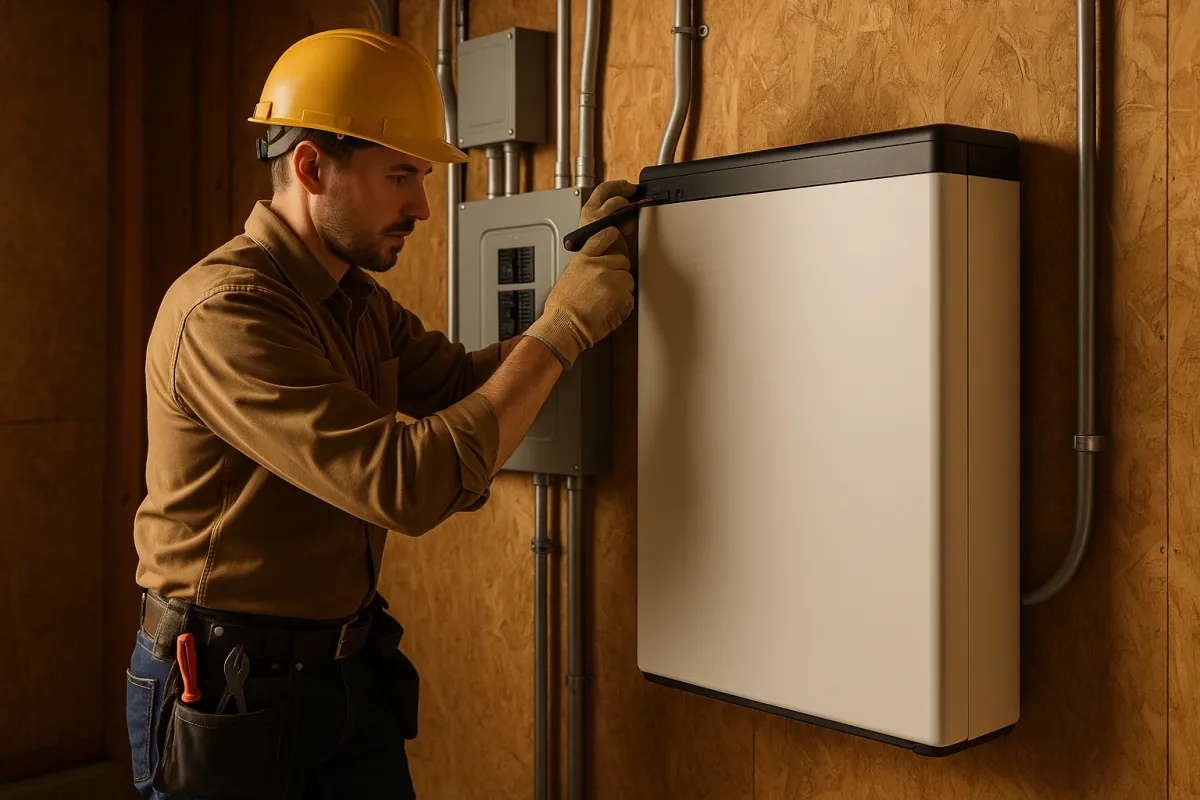
Sometimes the panel is not the only thing undersized or outdated. The service entrance, the conductors and the mast or weatherhead where utility power physically arrives at your house, can also need replacement, whether because it is rated for less current than the new panel needs, because it has deteriorated, or because the project requires relocating where service enters the building.
That is a larger scope than a panel swap alone, commonly adding roughly $2,400 to the illustrative baseline in this briefing, for a total near $6,200. The added cost covers new service conductors, a new mast or weatherhead, additional labor for work that is often higher up and more exposed than panel work alone, and sometimes a longer utility coordination window since moving or replacing a service entrance is a bigger change for a utility to schedule around than a straight panel swap.
There is no way to know in advance whether your project needs this larger scope without an electrician physically inspecting your service entrance, which is one more reason an early electrical assessment, before a solar contract is signed, is worth insisting on.
Comparing your options side by side
| Option | Typical trigger | Illustrative cost |
|---|---|---|
| No panel work needed | Busbar headroom already covers the new backfed breaker | $0 |
| Load management or current-limiting device | Busbar is tight but a device can keep combined load in check | $1,200 to $2,500 |
| Standard panel upgrade | Busbar and main breaker are both effectively undersized | $3,800 |
| Panel upgrade plus service entrance or mast replacement | The overhead service itself is also undersized, damaged, or relocating | $5,600 to $7,800 |
Read this table as a decision tree rather than a menu: most households land in exactly one row, determined by an electrician’s actual reading of the panel, not by preference. The cost difference between the lightest and heaviest rows is substantial, which is exactly why getting the assessment done early, before a full solar quote is finalized around assumptions, protects your budget.
The load management alternative
A load management or current-limiting device sits between the panel’s constraints on paper and the panel’s actual behavior in practice. Rather than physically changing the busbar’s rating, these devices, sometimes built into a smart breaker or a home energy management system, monitor current in real time and can shed or limit load before a combined current ever approaches an unsafe level, which some jurisdictions and some equipment manufacturers accept as an alternative path to the same safety outcome a panel upgrade achieves physically.
Illustratively, these devices and their installation run somewhere in the range of $1,200 to $2,500, well under the roughly $3,800 of a standard panel upgrade. The trade-off is that you are adding a piece of active monitoring equipment rather than simply increasing physical headroom, which for some households is a minor consideration and for others, particularly those planning to add a battery, an electric vehicle charger, or other large loads later, is worth weighing against a panel upgrade’s more permanent fix.
Not every inverter, panel and jurisdiction combination supports this path, so the only way to know if it applies to you is to ask your electrician and your installer directly whether your specific equipment qualifies.
How a panel upgrade changes your total solar budget
Context helps more than an isolated number does. Using the illustrative 8 kilowatt roof array figure from our solar carport cost comparison, priced around $22,400 at roughly $2.80 a watt, an illustrative $3,800 standard panel upgrade adds about 17 percent to that total project cost. The larger $6,200 scenario, with a full service entrance replacement included, adds about 28 percent.
That is a meaningful budget swing, and it is exactly the kind of cost that a rushed quote can leave out entirely, only to surface as a change order after a contract is signed. Our guide to reading a solar quote covers how to ask whether a quote has priced panel work in or assumed it away, and the honest answer should come from an electrician’s assessment, not from a salesperson’s guess at your panel’s age.
Timeline: how a panel upgrade affects your permitting pipeline
A panel upgrade is not free in calendar time either. Our permitting and interconnection briefing models a straightforward project at roughly 80 days, about 11.4 weeks, from contract to permission to operate, and separately models a panel upgrade or main breaker derate as commonly adding about three more weeks on top of that baseline, since the upgrade is typically its own permit and its own inspection rather than a step folded into the solar permit.
Discovering the need for a panel upgrade early, ideally before a solar contract is signed rather than after the crew has already shown up, keeps that three week addition from compounding with other surprises. An electrician who reads your panel at the same time your installer does its site survey, rather than afterward, is the single best lever for keeping your project on its original timeline.
Panel age and the independent reliability question
Amperage headroom is not the only reason an older panel might need attention. Panels manufactured decades ago sometimes used breaker designs and construction methods that the electrical trade has since flagged for independent reliability concerns, separate entirely from whether the busbar rating supports a solar backfeed. An inspector or electrician may recommend replacement on those grounds even when the amperage math alone would technically pass.
This briefing does not attempt to name specific manufacturers or model years, because the relevant concerns are brand and era specific and are best assessed by a licensed electrician looking at your actual panel rather than inferred from a general description. If your panel is original to a home built more than a few decades ago, ask your electrician directly whether its age or brand raises concerns independent of the amperage question this briefing focuses on.

A worked example from quote to switch-on
Take a household in a 1990s house with a 100 amp panel, a busbar rated 100 amps, proposing an 8 kilowatt array backfeeding through a 40 amp breaker. The combined load is 100 plus 40, or 140 amps, against an allowance of 100 times 1.2, or 120 amps. The panel fails the check by 20 amps, and the electrician recommends a standard upgrade rather than a load management device, since the household is also planning a battery within the next few years and wants the permanent headroom.
The upgrade quote breaks down exactly as this briefing’s illustrative stack: $1,500 labor, $950 for the new 200 amp panel and breakers, $350 permit and inspection, $500 utility coordination, and $500 minor service connection work, totaling $3,800. No service entrance replacement is needed, since the existing overhead service conductors are already rated adequately for the new panel. Combined with the $22,400 roof array, the household’s total project runs $26,200, with the panel upgrade accounting for about 15 percent of that combined total.
The permit for the panel upgrade is submitted separately from the solar permit, adding an illustrative three weeks to the project’s paperwork pipeline, so the household’s total time from contract to permission to operate runs closer to 14.4 weeks than the roughly 11.4 week baseline a straightforward project without panel work would see. The electrician schedules the swap for a single day, during which the household is without power for several hours, and the inspection passes on its first visit two weeks later. The household now has a 200 amp panel with real headroom for the battery it plans to add, rather than a second disruptive upgrade down the line.
Combining a panel upgrade with future loads
If a panel upgrade is already on the table, it is worth deciding deliberately rather than by default how much headroom to buy. A straight swap to 200 amps, the illustrative scope priced throughout this briefing, is the common choice, but it is worth having the conversation explicitly if you expect to add a battery, an electric vehicle charger, or other significant load within the next several years.
Sizing a panel upgrade for only today’s solar breaker, when a battery or a charger is realistically coming within a few years, risks paying for a second disruptive upgrade later rather than a modest amount of extra headroom now. Our briefings on adding a battery to an existing solar system and charging an EV with solar panels both cover the additional backfed or heavy loads those additions bring, and both are worth reading before finalizing a panel upgrade’s scope, not after.
The cost difference between sizing a panel upgrade for today’s needs alone and sizing it with reasonable headroom for a known future addition is usually modest, since the labor and permit lines in the cost stack above do not change much with panel capacity, and the main variable cost difference is in the breaker spaces and sometimes a slightly larger panel enclosure. Ask your electrician to quote both scopes side by side before deciding.
What an inspector actually checks
Understanding the inspection step demystifies a part of the process that otherwise feels opaque. An inspector reviewing a panel upgrade is typically checking that the new panel and its breakers are correctly rated for the service, that grounding and bonding are done correctly, that labeling identifies each circuit and clearly marks the solar disconnect where applicable, that working clearance in front of the panel meets code, and that the busbar and breaker combination matches what was represented on the permit application.
A failed inspection on a panel upgrade is usually a correction notice listing specific items, most commonly labeling, grounding, or a clearance issue, rather than a wholesale rejection of the work. The electrician addresses the listed items and schedules a re-inspection, which is the part that costs calendar time rather than money, since it depends on the inspector’s next available slot rather than on the electrician’s own schedule.
Common mistakes when budgeting for a panel upgrade
The most common mistake is letting a solar quote go final before an electrician has actually opened the panel, which means the number you signed for was built on an assumption rather than a reading of your nameplate. The second is assuming every older panel automatically needs a full upgrade, when a load management device or simply confirmed headroom can mean no panel work at all.
A third mistake is treating the panel upgrade’s permit as bundled into the solar permit by default, when in most jurisdictions it is its own line with its own fee and its own inspection, a surprise that shows up as a change order if nobody asked ahead of time. A fourth is comparing a panel upgrade quote on total price alone without checking whether it includes the service entrance scope or only the panel itself, which is exactly the gap between the $3,800 and $6,200 scenarios in the table above.
Troubleshooting: what if the upgrade quote seems too high
Start by asking for the same line-item breakdown this briefing uses: labor, hardware, permit, utility coordination, and service connection work, priced separately rather than as one lump sum. A quote that will not break down that way is harder to compare against a second bid and harder to know what you are actually paying for.
If the number includes a full service entrance or mast replacement and you are not certain that scope is necessary, ask the electrician to explain specifically what was found that requires it, and consider a second opinion before accepting the larger scenario’s cost. If the quote is for the standard scope and still runs well above this briefing’s illustrative $3,800, ask whether your home’s circuit count, panel location, or local permit fees are driving the difference, since all three are legitimate reasons a real bid can run higher than a national teaching figure.
Questions to ask your electrician and installer
Ask to see the actual busbar rating stamped on your panel’s nameplate, not just the amperage printed on the panel’s exterior label. Ask what combined load the proposed solar breaker and your existing main breaker would create, and whether that number fits under the commonly used 120 percent allowance for your specific panel. Ask whether a load management device is an option your inverter and jurisdiction support, and get its cost quoted separately from a full panel upgrade so you can compare them directly.
Ask whether the panel upgrade, if needed, requires its own permit and inspection, and get an honest estimate of how much calendar time that adds to your overall project. Ask whether the quoted panel upgrade price includes service entrance or mast work or assumes it is not needed, and ask what happens to the price if the electrician finds that work is required once the panel is actually open.
Why your real quote may differ from these figures
The $3,800 and $6,200 illustrative totals in this briefing are national teaching anchors, built to show how the line items relate to each other, and real bids move around them for reasons that are entirely legitimate. Electrician labor rates vary considerably by region and by how busy a given company’s schedule is, and that single variable affects the largest line in the whole stack more than any other factor.
Local permit fees are set by individual building departments and can differ by a meaningful margin between a small rural jurisdiction and a large metro one. A panel in a hard to access location, a basement with low clearance, an exterior wall requiring extra weatherproofing, or a service run buried deeper than usual, can all add labor hours a simple, open installation would not need. A home with an unusually high circuit count, from additions, finished basements, or detached structures with their own subpanels, also adds time, since every circuit has to be verified and reconnected correctly regardless of how straightforward the panel swap itself is.
None of that makes a higher quote suspicious by default, and none of it makes a lower one automatically a bargain. The way to tell the difference is the same line-item comparison this briefing has used throughout: ask each bidder for labor, hardware, permit, utility coordination, and service connection work priced separately, and ask what in your specific home is driving any line that looks unusual against these illustrative anchors.
Who should get an electrical assessment before signing
Any home with a panel rated under 150 amps is worth assessing early, since headroom under the 120 percent guideline gets tighter as the proposed solar breaker’s amperage grows relative to a smaller busbar. Any home planning a larger system, a battery addition, or an electric vehicle charger alongside solar is also worth assessing early, since each of those adds its own backfed or heavy load to the same busbar math.
Homes with a modern 200 amp panel and only a modest solar system proposed are the least likely to need any panel work at all, though “likely” is doing real work in that sentence, and an electrician’s actual reading of the nameplate is still the only way to know for certain. The hundred or so dollars an assessment typically costs is cheap insurance against a budget surprise that can run into the thousands.
Documentation to keep after the upgrade
Once the work is done, keep the permit with its final inspection sign-off, the electrician’s invoice with the line items this briefing has walked through, and the new panel’s nameplate information, including the busbar rating, together with your other solar paperwork. A future buyer, their inspector, or their lender may ask for evidence that the panel was permitted and inspected, and an owner who cannot produce it years later can slow down a sale. Our briefing on selling a house with solar covers what a buyer’s side typically asks for, and a documented panel upgrade is a small, easy piece of that file to have ready.
Put your own numbers in
Every figure in this briefing is a teaching number built to show how the panel math and the cost stack relate to each other, not a measurement of your specific panel or a quote from any company. Use the companion calculator on this page to enter your own busbar rating, main breaker size, and proposed solar breaker amperage, and see both whether your panel illustratively clears the commonly used allowance and what a panel upgrade would cost against your own array size.
The bottom line
Whether solar needs a panel upgrade comes down to your busbar rating against a commonly used 120 percent guideline, not to the fact of adding solar itself, and only an electrician who has physically read your panel’s nameplate can give you a final answer. When an upgrade is needed, a standard 200 amp swap runs roughly $3,800 illustratively, rising to roughly $6,200 when the service entrance or mast also needs replacing, with a load management device sometimes available as a cheaper $1,200 to $2,500 alternative.
Get the assessment done early, before a solar quote is finalized around an assumption, ask for a line-item breakdown rather than a lump sum, and budget the roughly three weeks a panel permit commonly adds to your project’s timeline. A panel upgrade is not a sign anything went wrong with your solar plan; it is ordinary infrastructure work that some homes need and others do not, and the only expensive version of it is the one nobody priced in advance.
WattBarn publishes this cost breakdown so you can interrogate a panel upgrade quote rather than accept one. The line-item costs, the 120 percent allowance mechanism, and the worked examples above are illustrative teaching figures chosen to show how the pieces relate, not quotations, measurements of your property, or a restatement of any specific electrical code section. Electrical code requirements, their local amendments, and how they apply to your panel are determined by a licensed electrician and your local building department, and incentive rules change, so verify both at their official sources rather than relying on any figure printed here.
Frequently asked questions
Does every solar installation need an electrical panel upgrade?
No, and for many homes with a modern 200 amp panel and reasonable spare breaker space, the array connects without any panel work at all. What forces an upgrade is a combination of your panel's busbar rating, the size of your existing main breaker, and how much additional current the solar system backfeeds into the panel, not the mere fact of adding solar. A panel with headroom under that combination passes without changes; a panel without it commonly needs either a full upgrade or one of the lower cost alternatives covered below. Only an electrician reading your actual panel's nameplate can tell you which situation you are in.
How much does a 200 amp panel upgrade cost?
A useful illustrative shape for a standard upgrade, replacing an older panel with a new 200 amp panel at the same location with no major service entrance work, is roughly $3,800 all in: about $1,500 in labor, $950 for the new panel and breakers, $350 for the permit and inspection, $500 for utility coordination and meter work, and $500 for minor service connection work. Add a full service entrance or mast replacement, needed when the overhead service itself is undersized, damaged or being relocated, and the illustrative total rises to roughly $6,200. Those are teaching figures for comparing options, not quotes, and real bids move with your region's labor rates, your utility's specific requirements, and what the electrician finds once the panel is open.
What is the 120 percent rule for solar interconnection?
It is a commonly used guideline, rooted in the National Electrical Code and widely referenced in the solar industry, for how much backfed current a panel's busbar can safely carry alongside its main breaker. In plain terms, many electricians check whether your main breaker's amperage plus the new solar breaker's amperage stays at or under about 120 percent of what the busbar itself is rated for, using the busbar rating stamped on the panel's nameplate rather than the amperage printed on the outside of the box. Code editions and local amendments vary by jurisdiction and change over time, so treat this as the mechanism to understand rather than a number to calculate yourself, and have a licensed electrician confirm the specific rule and the specific numbers that apply to your actual panel.
Is there a cheaper alternative to a full panel upgrade?
Often, yes. A load management or current-limiting device, sometimes built into a smart breaker or an energy management system, can monitor and restrict current in real time so that a panel which fails the simple 120 percent check on paper never actually exceeds a safe combined load in practice. Illustratively these devices and their installation run somewhere in the range of $1,200 to $2,500, well under a standard panel upgrade's roughly $3,800, though they add a piece of monitoring equipment and sometimes a small ongoing software dependency that a plain panel upgrade does not. Ask your installer whether your specific inverter and panel combination supports this path before assuming a full upgrade is the only option.
How long does a panel upgrade add to a solar project's timeline?
Illustratively, around three weeks on top of a typical permitting pipeline, because a panel upgrade is usually its own permit and its own inspection rather than a line item inside the solar permit. Our briefing on the solar permitting and interconnection pipeline models a straightforward project at roughly 80 days, about 11.4 weeks, from contract to permission to operate, and models a panel upgrade or main breaker derate as commonly adding about three more weeks on top of that. The exact figure depends on your building department's schedule and whether the upgrade is discovered before or after the main solar permit is submitted, which is itself a reason to have an electrician assess your panel early rather than after signing a solar contract.
Does a panel upgrade need its own permit separate from the solar permit?
In most jurisdictions, yes. Solar work is typically permitted as its own electrical project, and a panel upgrade, being a change to your home's main electrical service equipment, is commonly treated as a separate electrical permit with its own inspection, even when the same electrician or the same overall project covers both. Some jurisdictions and some installers bundle the paperwork into a single submission, but the underlying review is still usually evaluating two different scopes of work. Ask whichever contractor is pulling permits on your project whether the panel work is a distinct permit line, and confirm the fee and the inspection step for each.
Will a panel upgrade affect my eligibility for a solar incentive?
There is no federal residential tax credit currently in effect to apply to any part of a solar project, including a panel upgrade, since the credit under Internal Revenue Code section 25D ended for property placed in service after December 31, 2025. Before that change, whether a panel upgrade's cost counted as a qualified expenditure was a specific tax question that depended on the circumstances and was best answered by a tax professional, and that nuance is now moot for a 2026 project. If a state, utility or local incentive is still active in your area, ask its administrator directly whether electrical upgrade costs are an eligible expense, since rules vary by program and this briefing cannot state one that applies everywhere.
Can choosing microinverters avoid the need for a panel upgrade?
Sometimes, because the way current reaches the panel differs between a microinverter system and a central string inverter, and that difference can change how a panel is evaluated under a backfeed calculation. It is not a guaranteed workaround, since a panel that is already close to its limit from other large loads can still need attention regardless of inverter architecture, and the decision between microinverters and a string inverter should rest mainly on your roof's shading and layout rather than on this one consideration. Our briefing comparing microinverters and string inverters covers the production and reliability trade-offs; ask your electrician specifically whether your panel's numbers change meaningfully between the two architectures before letting it be the deciding factor.