
What's on this page
- What a solar pool heater actually is
- How an unglazed collector moves heat into the water
- What solar pool heating costs, illustratively
- The cost stack line by line
- Sizing against pool surface area
- How much roof or rack area you actually need
- The heat budget: what a pool loses every day
- Why the cover is the cheapest part of the system
- Solar versus a gas pool heater
- Solar versus an electric heat pump pool heater
- What each option costs to run per day
- Season extension is the real product
- Payback against the fuel you are displacing
- A worked example: a 400 square foot pool
- What drives the install price up
- Plumbing, pumps and the head penalty
- Controllers, sensors and automatic valves
- Freeze protection and winterizing
- Maintenance and what fails first
- How long the panels last
- Incentives, permits and what to verify yourself
- Solar pool heating versus adding more PV panels
- Mistakes that wreck the payback
- Who solar pool heating is actually for
- The bottom line
Short answer: Solar pool heating commonly costs an illustrative $3,000 to $9,000 installed, driven by collector area at roughly $12 to $25 per square foot; a 400 square foot pool at a 75 percent sizing ratio prices near $5,400. Whether it is worth it is a fuel question: on the same illustrative numbers it pays back in about 4.3 years against propane, 9.4 against natural gas and 16.7 against an efficient electric heat pump.
A solar pool heater is the least glamorous solar product a home can buy and frequently the one with the best arithmetic behind it. There is no inverter, no battery, no export credit and no monitoring app worth opening. There is a rack of black plastic mats on a roof, a valve that sends pool water through them when the sun is out, and a controller that decides when. What that simple arrangement buys you is a longer swim season at close to zero running cost, and whether it is worth the installed price depends on three things: how big your pool is, how many days a year you would otherwise have run a heater, and which fuel that heater burns.
This cost breakdown prices a solar pool heating system line by line on illustrative figures, sizes the collector array against pool surface area rather than volume, works out how much roof or rack area that actually consumes, and then runs payback against gas, propane and an electric heat pump. You can put your own pool area and fuel price through the companion calculator as you read, because the answer swings harder on your fuel than on anything a salesperson will show you.
Key takeaways
- Installed cost commonly runs an illustrative $3,000 to $9,000, driven by collector area at roughly $12 to $25 per square foot installed. A 400 square foot pool at a moderate sizing ratio prices near $5,400.
- Size against pool surface area, not gallons. Collector area of 50 to 100 percent of the pool surface is the working rule, so a 400 square foot pool needs about 300 square feet of collector at a 75 percent ratio, plus about 15 percent more roof for spacing and headers.
- Payback is a fuel question. On illustrative numbers the same system pays back in about 4.3 years against propane, 9.4 years against natural gas, and 16.7 years against an efficient electric heat pump.
- The product is season extension, not year-round heat. Unglazed collectors work a few degrees above outdoor air temperature, which is ideal in spring and autumn and worthless in a freezing January.
- A cover roughly halves the heat a pool needs and costs a rounding error next to the panels. Solar sizing rules quietly assume you use one.
What a solar pool heater actually is
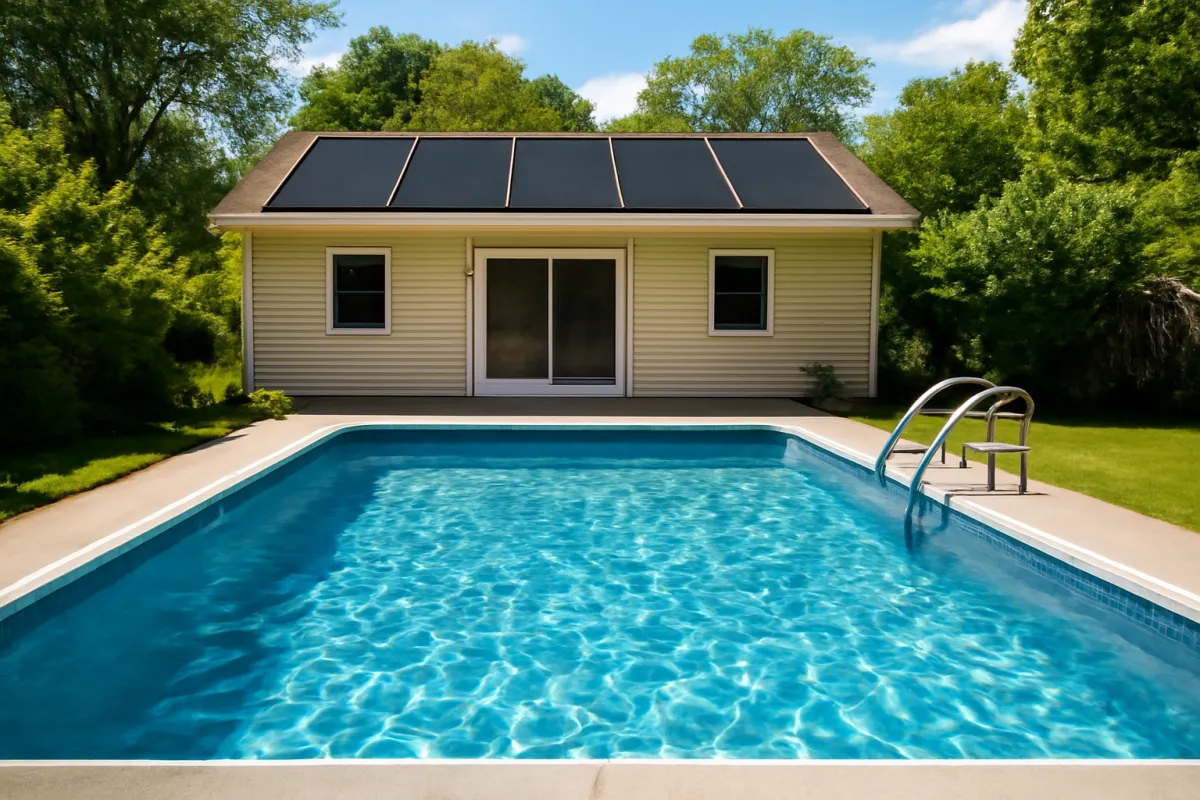
Strip away the marketing and a solar pool heating system has four parts. First, the collectors: rows of black polymer panels, each a mat of small parallel tubes bonded to a header at top and bottom, mounted on a roof, a ground rack or a shed. Second, a diverter valve that decides whether pool water goes straight back to the pool or takes a detour up through the collectors. Third, a controller with two temperature sensors, one reading the collectors and one reading the pool, which opens the valve when the roof is warmer than the water and closes it when it is not. Fourth, the plumbing that connects all of it to your existing filtration loop.
What is missing is as important as what is there. There is no burner, no heat exchanger, no refrigerant circuit and, in most residential installations, no dedicated pump. The system piggybacks on the filter pump you already run every day, which is exactly why its operating cost is close to nothing.
That simplicity has a consequence worth stating plainly. Because there is no glazing and no insulation, an unglazed collector cannot deliver water much hotter than the air around it. It is a large, cheap, low-intensity heat catcher, and the only load in a house that suits a large, cheap, low-intensity heat catcher is a swimming pool sitting at 80 to 85 degrees. Ask the same panels to make domestic hot water at 120 degrees and they fail completely, which is the design line between this and the solar water heating systems that use glazed or evacuated-tube collectors.
How an unglazed collector moves heat into the water
The physics is worth understanding because it explains every sizing rule that follows. Sunlight strikes the black polymer surface and heats it. Pool water, pushed by the filter pump, flows through the hundreds of small tubes in the mat, picks up that heat, and returns to the pool a few degrees warmer than it left. On a good day the temperature rise across the collectors is small, often only three to six degrees, but the flow rate is high, so the total heat delivered over a long day is substantial.
Because the panel has no glass cover, it also loses heat back to the air whenever the panel is hotter than ambient, and wind accelerates that loss. This is why an unglazed collector is efficient when it runs barely above air temperature and inefficient when you push it hard. It is also why a windy exposed roof underperforms a sheltered one at the same latitude, and why collector output on a warm calm October afternoon can beat output on a cool blustery one with identical sunshine.
A useful illustrative delivery figure for planning is about 900 Btu per square foot of collector per day in good sun during the shoulder season. Some installers will quote higher for a hot sunny climate and lower for a cloudy one, and the honest answer is that it varies with sun, wind and how long the pump runs. Treat 900 as a teaching number that makes the rest of the arithmetic in this cost breakdown legible, not as a specification.
What solar pool heating costs, illustratively
The installed price of solar pool heating tracks collector area more closely than any other variable. A workable illustrative range is $12 to $25 per square foot of collector installed, with a midpoint near $18. Apply that to the sizing rule in the next section and a 400 square foot pool needing about 300 square feet of collector prices out near $5,400. A small 300 square foot pool sized at the same ratio lands nearer $4,050, and a large 800 square foot pool nearer $10,800.
That per square foot figure is not constant across system sizes. Small installations price worse because the controller, the diverter valve, the sensors, the permit if one is required, and the crew’s time getting to your roof cost roughly the same whether they hang six panels or fourteen. A six-panel job can easily land at the top of the range while a fourteen-panel job on an easy roof lands near the bottom.
The chart below puts that illustrative $5,400 next to the two alternatives most buyers are actually weighing, and next to the pool cover that changes the arithmetic for all three.
Illustrative installed cost by pool heating option
Teaching midpoints for a 400 square foot pool. Bars scale against the largest line.
Widths are computed from each value against the largest line: $6,000 is 100%, so $5,400 is 90%, $3,500 is 58% and $300 is 5%. These are illustrative midpoints for comparing options, not quotes. Installed prices move with roof access, plumbing distance, gas line work, electrical service capacity and local labor rates.
Notice the last bar. The cheapest item on the chart is the one that changes the daily heat demand more than any other decision you will make, and it is covered in its own section below.
The cost stack line by line
Inside that illustrative $5,400, the money splits along fairly predictable lines. The collector panels themselves are the largest single item but nothing like the whole bill, which surprises buyers who assume they are paying for plastic. Roughly:
| Line item | Illustrative share | Illustrative amount |
|---|---|---|
| Collector panels | 42% | $2,268 |
| Plumbing, headers, valves | 20% | $1,080 |
| Roof mounting and racking | 18% | $972 |
| Controller, sensors, actuator | 10% | $540 |
| Permit, labor extras, commissioning | 10% | $540 |
Share of an illustrative $5,400 solar pool heating bill
Same teaching numbers, expressed as percentages of the total.
The five shares sum to 100 percent of the illustrative $5,400 total used throughout this cost breakdown. Percentages are teaching proportions chosen to show where the money goes on a typical roof-mounted residential system, not a price list from any company.
The practical read is that more than half the bill is labor, plumbing and hardware that has little to do with how many panels you buy. That is why quotes for the same panel count differ so widely, and why the distance from your pool equipment pad to the collectors matters more to your price than the brand name on the mats. The same lesson applies when you read any solar bid, which is the point of our walkthrough on how to read a solar quote.
Sizing against pool surface area
Pool heating sizing confuses people because pools are sold by volume and heated by surface. Almost all of a pool’s heat loss happens at the water surface through evaporation, radiation and convection, and almost none of it through the shell into the ground. A deep pool and a shallow pool of the same surface area lose heat at close to the same rate. The deep one simply takes longer to change temperature because there is more water to move.
So the rule of thumb everyone uses is a ratio of collector area to pool surface area:
| Situation | Collector ratio | Collector area for a 400 sq ft pool |
|---|---|---|
| Warm, sunny, short season, always covered | 50% | 200 sq ft |
| Moderate climate, typical shoulder-season use | 75% | 300 sq ft |
| Cool, cloudy, windy, partly shaded or long season | 100% | 400 sq ft |
Those ratios assume the collectors get most of the day’s sun and the pool gets a cover on cool nights. Strip either assumption away and you move up a band. Indoor pools, screened enclosures and pools in permanent afternoon shade are separate problems that no ratio handles well.
Panels are commonly supplied in 4 by 8, 4 by 10 and 4 by 12 foot sizes, so 300 square feet of collector is roughly seven or eight panels at the 4 by 10 size. Ask any bidder to state both the panel count and the total square footage, because the second number is the one that determines whether the system works and the first is the one that sounds impressive.
How much roof or rack area you actually need
Collector area and roof area are not the same number. Panels need gaps for headers and hardware, a path for someone to walk during service, and clearance from ridges, valleys, vents and edges. Plan on the collector area plus roughly 15 percent, so a 300 square foot array wants about 345 square feet of usable roof plane. If the only clear plane is broken by a chimney or a skylight, the usable figure falls fast and the array ends up split across two faces, which adds plumbing and cost.
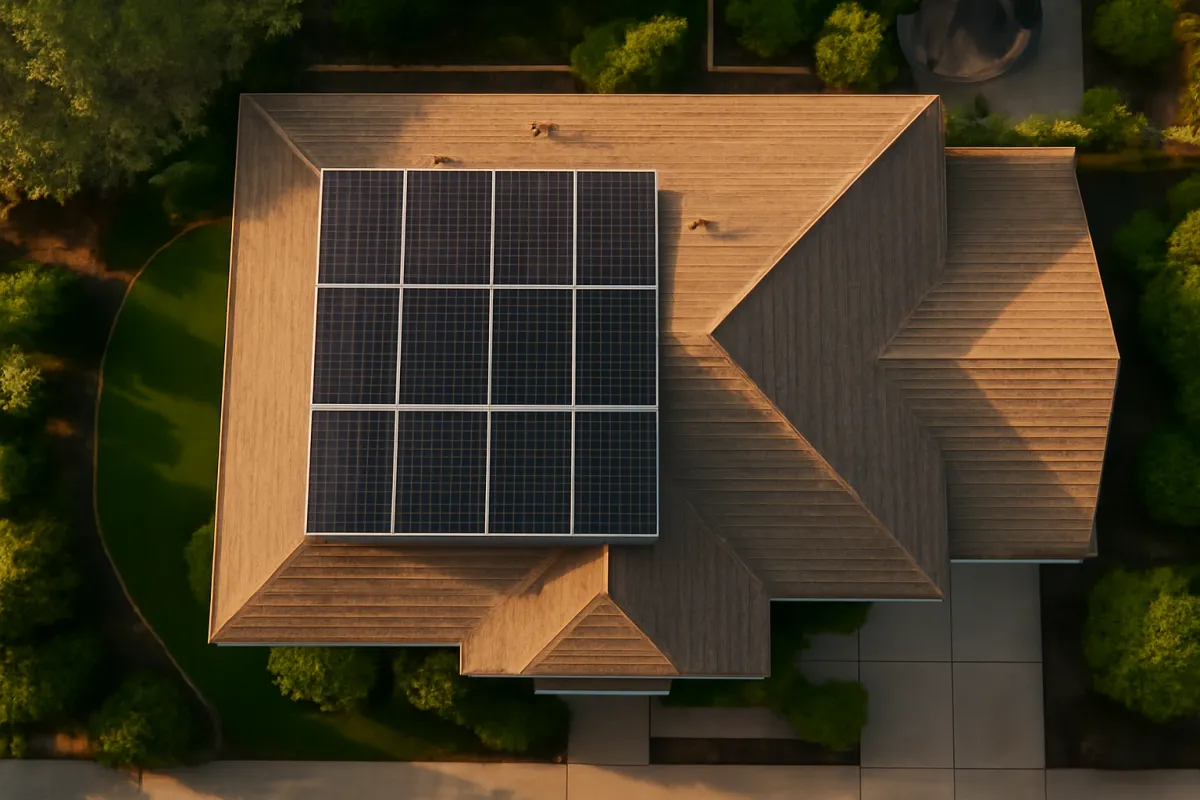
Orientation matters less here than it does for electricity. A photovoltaic array wants a steep tilt toward the sun to maximize peak output, but a pool collector wants many hours of moderate sun, because it is trying to deliver a large volume of slightly warm water rather than a high temperature. A low-slope roof facing broadly toward the sun often outperforms a steep one for this job, and east or west faces remain useful in a way they would not be for a marginal photovoltaic array.
Weight is rarely the constraint. A filled unglazed collector adds only about a pound per square foot, far less than a glazed thermal collector with a tank of water behind it. What does need attention is the fastener penetrations, which want sound sheathing and correct flashing. If your roof is near the end of its life, do the covering first, exactly as we argue for photovoltaic arrays in our note on solar panels and roof replacement.
The heat budget: what a pool loses every day
To judge whether any heater is worth buying you need a rough sense of the hole you are filling. Use an illustrative teaching figure of about 1,200 Btu per square foot of pool surface per day for an uncovered pool being held roughly ten degrees above ambient in the shoulder season, and about 600 Btu per square foot per day for the same pool with a cover on overnight. Those numbers move with wind, humidity, night temperature and how ambitious your target temperature is, but they show the shape correctly.
For a 400 square foot pool that is 480,000 Btu a day uncovered and 240,000 Btu a day covered. Every heating option is simply a different way of supplying that number.
Now put the collector array against it. At an illustrative 900 Btu per square foot per day, 300 square feet of collector delivers about 270,000 Btu a day. Against the uncovered pool that is roughly 56 percent of the daily loss. Against the covered pool it is more than the whole requirement, with margin for cloudy days.
That single comparison explains almost every disappointed solar pool owner. The panels were sized correctly for a covered pool, the cover never came out of the box, and the system now supplies half of what the water is losing, so the temperature never reaches the number that was promised. Run your own pool area and collector ratio through the companion calculator and the coverage percentage is the figure to watch.
Why the cover is the cheapest part of the system
An illustrative $300 for a solar cover and reel sits at 5 percent of the cost of the collector array and roughly halves the daily heat demand. Nothing else in pool heating comes close to that return, and no heater of any type escapes the arithmetic.
Covers work primarily by stopping evaporation. Evaporating water carries away an enormous amount of heat per pound, which is why an uncovered pool loses most of its warmth overnight even when the air is not especially cold. A cover also traps a thin layer of warm air and, if it is a translucent bubble type, adds a small amount of direct solar gain during the day.
The objection is always the same and it is fair: covers are a nuisance. A reel makes them tolerable, an automatic cover makes them effortless and expensive, and a liquid cover product makes them invisible while working less well. The honest position is that if you will genuinely never deploy a cover, you should size the collector array at the top of the ratio band, accept a longer payback, and stop treating the manufacturer’s coverage claims as applicable to your pool.
There is one more benefit worth naming. A covered pool holds its temperature overnight, so the collectors start each morning topping up a warm pool rather than rescuing a cold one. That raises the share of each day’s solar gain that ends up as usable temperature rather than replacing losses you could have prevented.
Solar versus a gas pool heater
A gas pool heater is the opposite product in every respect. It is cheap to buy, commonly an illustrative $2,500 to $5,000 installed including the gas line work, and it is expensive to run. It heats on demand regardless of weather, gets a cold pool usable in hours rather than days, and works in November if you are willing to pay for it.
The running cost is where solar takes it apart. Holding an uncovered 400 square foot pool at that 480,000 Btu a day demand through a heater at an illustrative 85 percent efficiency means burning about 565,000 Btu of gas, which is roughly 5.7 therms. At an illustrative $1.50 a therm that is about $8.47 a day. On propane at an illustrative $3.00 a gallon the same day costs closer to $18.52, because propane carries about 91,500 Btu a gallon and prices per unit of energy far above pipeline gas.
Those figures are why the propane case is the strongest one for solar pool heating anywhere in this cost breakdown, and why the natural gas case is merely good. Confirm your own gas or propane rate from a recent bill rather than using ours, in the same spirit as our walkthrough on reading your electric bill.
The two are not always exclusive. A common and sensible setup is solar as the primary heat source with a small gas heater downstream as a backup for cold snaps and for the weekend when guests are coming. That combination costs more to install than either alone and buys both cheap heat and instant heat.
Solar versus an electric heat pump pool heater
An electric heat pump pool heater is the strongest competitor solar has, and it is the comparison most buyers skip. It moves heat from the outdoor air into the pool rather than making heat, so it delivers several units of warmth per unit of electricity. A coefficient of performance around 5 at mild outdoor temperatures is a reasonable illustrative figure, though it falls as the air gets colder, which is a real limitation in exactly the shoulder season both products are sold for.
At that performance, supplying 480,000 Btu a day takes about 28 kilowatt-hours of electricity, which at an illustrative $0.17 per kilowatt-hour is about $4.79 a day. That is a little over half the cost of natural gas and about a quarter the cost of propane, and it is why displacing a heat pump with solar collectors produces the longest payback in this cost breakdown.
Installed cost for a heat pump pool heater commonly runs an illustrative $4,500 to $7,500, with a midpoint near $6,000, and it may require an electrical service upgrade that a solar collector array never will. It also has a compressor, a fan and refrigerant, which means more to service and a shorter expected life than a rack of passive mats.
The interesting move is to stop treating them as rivals. A heat pump running on solar electricity from a rooftop photovoltaic array is a genuinely strong combination, and the same reasoning we apply to running air conditioning from panels in our piece on solar panels for an air conditioner applies here.
What each option costs to run per day
Here is the same illustrative heat demand priced through every option, for a 400 square foot pool, first uncovered at 480,000 Btu a day and then covered at 240,000.
| Heat source | Uncovered pool, per day | Covered pool, per day |
|---|---|---|
| Propane heater at $3.00 a gallon | $18.52 | $9.26 |
| Natural gas heater at $1.50 a therm | $8.47 | $4.24 |
| Electric heat pump at $0.17 a kWh | $4.79 | $2.39 |
| Solar collectors | about $0.13 in pumping | about $0.13 in pumping |
The pumping figure assumes an illustrative extra 0.75 kilowatt-hours a day to push water up to the roof and back, which is what you would expect if your existing filter pump has the head capacity and simply runs a little longer or a little harder. Systems that need a dedicated booster pump land higher, which is one of the questions to settle before signing.
Two cautions on that table. First, solar cannot supply the uncovered column on its own at the sizing used here, so the honest comparison is solar plus a cover against the covered column of the other rows. Second, every fuel price in the table is illustrative and yours will differ, so the shape of the ranking matters more than the digits.
Season extension is the real product
Solar pool heating is often sold as though it were a heater. It is better understood as a season extension device. Because unglazed collectors deliver water only a few degrees above outdoor air temperature, their output collapses exactly when the weather turns properly cold. What they do superbly is take a pool that is swimmable from late June to early September and make it swimmable from mid-May to mid-October.
For most families that is the entire value proposition, and it is a good one. The weeks a solar system adds are shoulder-season weeks when the air is pleasant and the water is the only thing stopping you, not January weeks nobody was going to swim in anyway.

This is why the number of heating days per year matters more to the payback than the panel brand, the collector ratio or the installer’s discount. A household that would have run a heater 60 days a year gets half the savings of one that would have run it 120 days, from an identical system. Households that would honestly never have run a heater at all get comfort, not savings, and should judge the purchase on that basis.
The seasonal limit also has a maintenance consequence in cold climates, covered below, because a system that cannot deliver heat in winter must be safely emptied before winter arrives. Our note on how solar performs in winter makes the same seasonal point for electricity, where the answer is far more favorable.
Payback against the fuel you are displacing
Now the arithmetic that answers the title question. The collector array delivers about 270,000 Btu a day. Over an illustrative 120 heating days a year that is 32.4 million Btu of delivered heat. What that heat is worth depends entirely on what would otherwise have supplied it.
Converting each fuel to a cost per million Btu actually delivered into the water gives roughly $38.58 for propane, $17.65 for natural gas and $9.97 for an efficient electric heat pump, using the illustrative unit prices already stated and the same efficiency assumptions.
| Fuel displaced | Annual value of solar heat | Payback on $5,400 |
|---|---|---|
| Propane at $3.00 a gallon | about $1,250 | about 4.3 years |
| Natural gas at $1.50 a therm | about $570 | about 9.4 years |
| Electric heat pump at $0.17 a kWh | about $323 | about 16.7 years |
Those figures are before the modest pumping energy, which trims each of them slightly, and before any incentive. They also assume the system runs 120 days a year, so halve the days and the paybacks roughly double.
One adjustment changes everything. If you were going to buy a heater regardless, the correct comparison is the price difference, not the full price. Solar at $5,400 against a gas heater at $3,500 is an incremental $1,900, and against natural gas savings of about $570 a year that increment returns in roughly 3.3 years. Framing the purchase as an upgrade rather than an addition is the single most useful thing you can do to the math, and it is the same principle behind our breakdown of the solar panel payback period.
A worked example: a 400 square foot pool
Take a 16 by 25 foot rectangular pool, 400 square feet of surface, in a moderate climate, currently heated by a natural gas heater the owners run through May and again through September and October, roughly 120 days a year. They use a cover most nights.
Sizing: at a 75 percent collector ratio the pool needs 300 square feet of collector, about eight panels at 4 by 10 feet. Roof requirement is 300 plus 15 percent, so about 345 square feet of clear plane, which their south-facing garage roof provides with room for a service path.
Cost: at an illustrative $18 per square foot installed the system prices at $5,400. The bid splits roughly $2,268 for panels, $1,080 for plumbing and valves, $972 for mounting, $540 for the controller and sensors and $540 for permit, extras and commissioning.
Output: 300 square feet at 900 Btu per square foot per day is 270,000 Btu on a good day, against a covered demand of 240,000 Btu. The system covers the pool’s needs on sunny days with margin, and falls back on the existing gas heater on gray ones, which is why the gas heater stays connected.
Savings: 270,000 Btu a day across 120 days is 32.4 million Btu, worth about $570 a year at the illustrative gas price. Payback on the full $5,400 is about 9.4 years. If the gas heater had been due for replacement anyway at $3,500, the incremental payback is about 3.3 years.
Change one input and watch the whole picture move. Swap the fuel to propane and the annual saving rises to about $1,250 with payback near 4.3 years. Drop the heating days to 60 and payback on gas stretches past 18 years. Your own version of this example is one form fill away in the companion calculator.
What drives the install price up
Two bids for the same pool can differ by thousands, and the reasons are almost always physical rather than commercial.
Distance from the equipment pad to the collectors is the biggest one. Every extra foot of supply and return pipe costs material and labor, and a long run also costs pumping energy forever after. A pool ten feet from the house with collectors on the adjacent roof is a cheap job. A pool at the bottom of the yard with collectors on a detached garage is not.
Roof access and pitch come next. A single-story roof with easy ladder access is straightforward. A steep two-story roof requires fall protection, more crew and more time. Tile roofs need careful penetration work that shingle roofs do not.
Splitting the array across multiple roof planes adds headers, balancing valves and complexity, and can add a second penetration set. Ground racks avoid the roof entirely but add framing, footings and often a longer pipe run, which is the same trade-off we price out for solar carports on the electrical side.
Finally, the condition of your existing plumbing and pump. If the filter pump lacks the head capacity to lift water to the roof, you are buying a booster pump or a pump upgrade, and that is a line item some bids include and others quietly omit. Ask directly.
Plumbing, pumps and the head penalty
Sending pool water to a roof and back means lifting it, and that lift is real work. The static head is set by the vertical distance from the pump to the top of the collectors, and friction in the pipe adds more. A single-story roof is a modest penalty; a two-story roof with a long horizontal run can be enough to push an existing pump out of its comfortable operating range.
There are three common outcomes. The pump handles it with a slightly longer run time, which is the cheap and usual case. The pump handles it only on high speed, which raises electricity use if you own a variable-speed pump you had been running slow. Or the pump cannot handle it and a booster pump goes in, which adds hardware cost and a genuine ongoing electricity bill that eats into the savings calculated above.
Check-valves and vacuum relief matter too. When the collectors shut off, the water in them must be able to drain back or vent, otherwise you get siphoning noises, air locks and, in a freezing climate, water trapped where it should not be. This is standard practice for a competent installer and a warning sign if a bidder cannot explain it.
Controllers, sensors and automatic valves
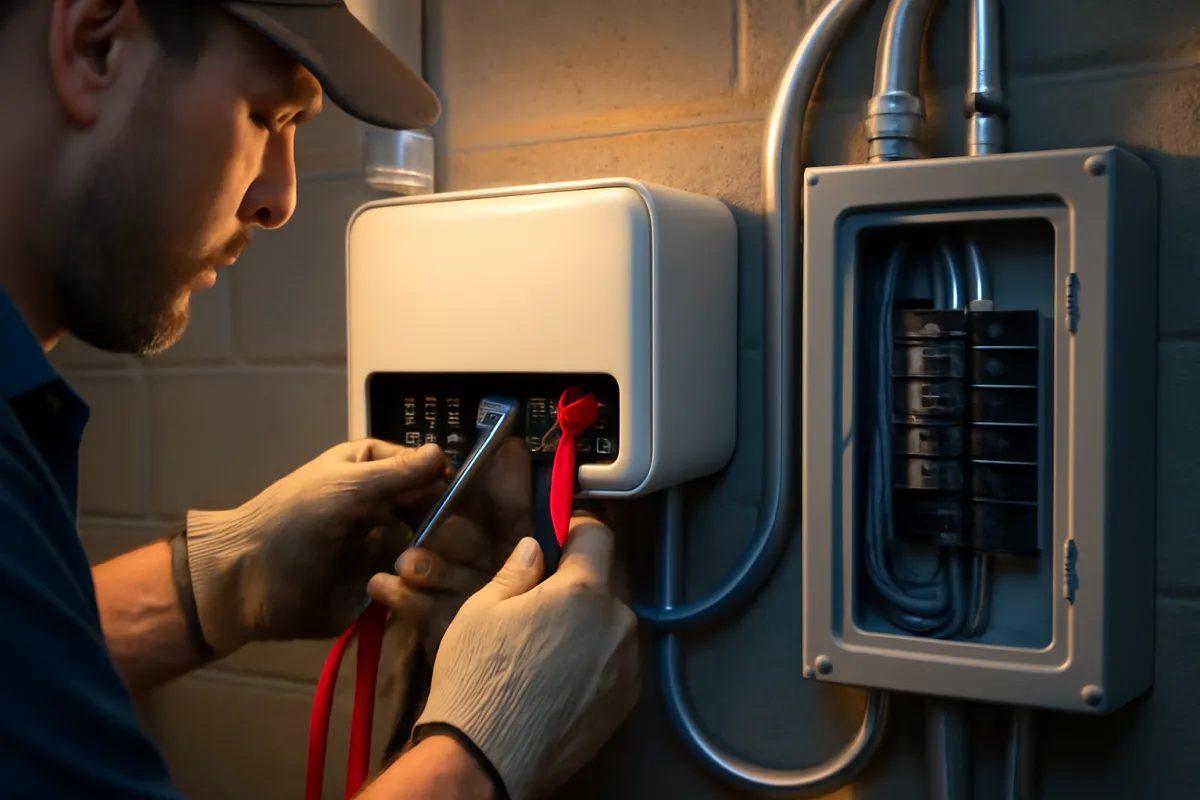
The control system is a tenth of the bill and most of the difference between a system that works and one that annoys everyone. Its logic is simple: compare the collector sensor to the pool sensor, and if the roof is meaningfully warmer than the water, rotate the diverter valve and send flow through the panels. When the difference shrinks, close the valve.
Two adjustments do the practical work. A differential setting decides how much warmer the roof must be before flow starts, which stops the valve chattering back and forth on marginal days. A target pool temperature stops the system when you have enough heat, which matters more than people expect, because an oversized array on a hot August week can push a pool past comfortable.
Sensor placement is the usual failure point. A collector sensor mounted somewhere unrepresentative, in shade or against a hot flashing rather than the panel, gives the controller bad information and the system either runs when it should not or refuses to run when it should. If your system behaves oddly, suspect the sensor before you suspect the panels.
Automatic valve actuators are wear items with a finite number of cycles. Expect to replace one at some point in the system’s life, and treat that as normal maintenance rather than a defect, in the same way we treat inverters as the replaceable part of a photovoltaic system.
Freeze protection and winterizing
In any climate that freezes, the make-or-break design detail is not sunshine but drainage. Water expands when it freezes, and water left in polymer collector tubes or in the pipes running up a wall will split them. Because unglazed pool collectors are open to the pool loop, they cannot be filled with antifreeze the way a closed-loop domestic hot water system can.
The standard solutions are gravity drain-back, where the collectors and risers are pitched so they empty automatically whenever the pump stops and the valve closes, and manual winterizing, where the system is drained and blown out as part of closing the pool. Many installations use both, with an automatic drain valve as the routine protection and a full blow-out at season end.
Get this wrong once and the repair can exceed a year of savings, which is why the freeze protection method belongs in writing on the bid, along with who is responsible for the seasonal drain. If you close your own pool, ask to be shown the procedure at commissioning rather than reading about it in October.
In frost-free climates the whole issue disappears and systems can run year round, which quietly improves the payback because heating days rise. That is one of the few cases where a warm climate helps solar economics rather than hurting them by removing the need for heat in the first place.
Maintenance and what fails first
Solar pool heating is among the lowest-maintenance equipment a pool owner can install. There is no combustion chamber to corrode, no heat exchanger to scale, no refrigerant to leak and usually no dedicated pump to service. The annual routine is a visual inspection of the panels and headers, a check that the control valve rotates fully in both directions, a sanity check on the two sensors, and confirmation that the drain path is clear before winter.
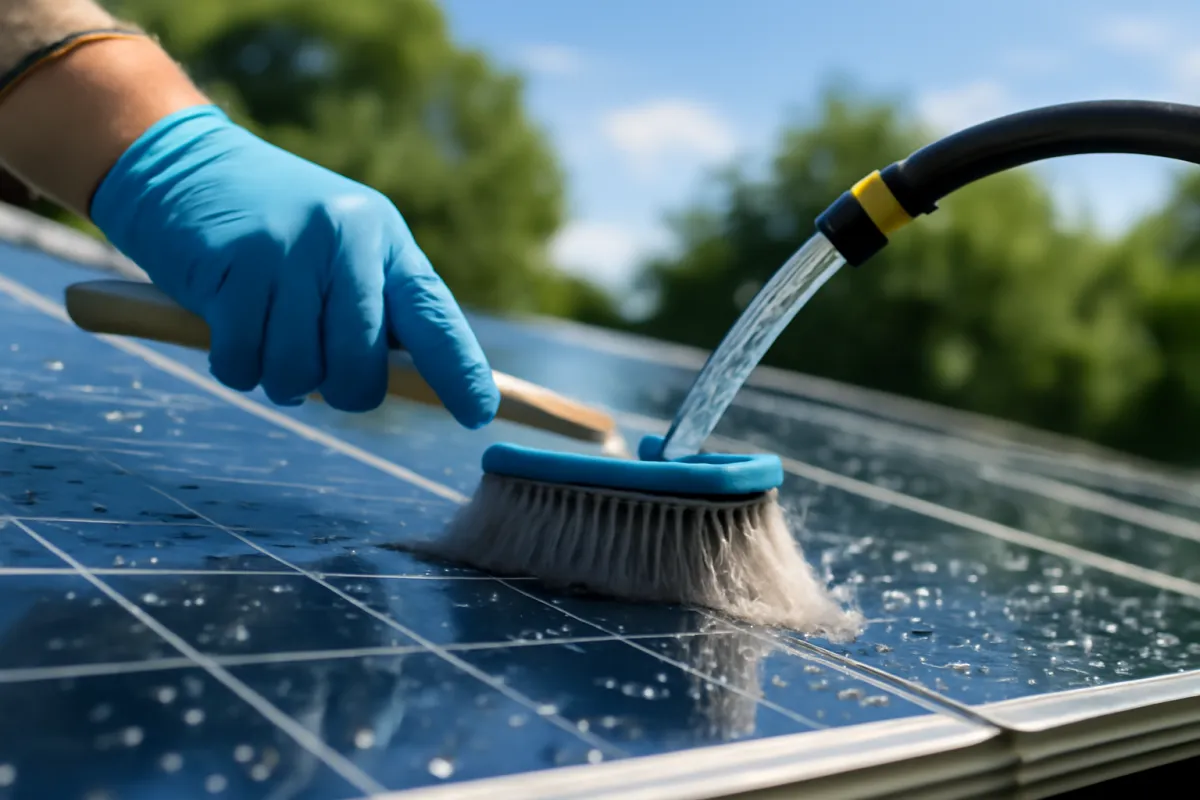
Cleaning matters less than for photovoltaic panels. A dusty pool collector loses a little output, but these systems are usually sized with margin and the water passing through does not care about a thin film the way a photovoltaic cell does. Rain handles most of it. What does matter is debris that shades panels or holds moisture against the roof, so keep overhanging branches trimmed.
The parts most likely to need attention, in rough order, are the valve actuator, the temperature sensors, the header connections and the roof penetrations. The panels themselves usually outlast all of them. Budget a small annual figure for inspection and one modest repair somewhere in the first decade, and you will not be surprised. The same maintenance philosophy underpins our note on solar panel maintenance cost for photovoltaic arrays.
How long the panels last
Unglazed polymer collectors are exposed to sunlight, heat cycling, wind and, in many places, chlorinated water on the inside. Manufacturers commonly warrant them for around ten to twelve years, and a well-installed array on a sheltered roof frequently keeps working past that. Treating them as a ten to twenty year asset is a reasonable illustrative planning assumption, with the honest caveat that ultraviolet exposure and hail are the two variables you do not control.
That expected life is shorter than the twenty-five to thirty years we discuss in our piece on how long solar panels last for photovoltaic modules, and the difference should feed straight into your payback thinking. A system that pays back in four years against propane has plenty of useful life left to bank. A system that pays back in sixteen and a half years against a heat pump may never finish the job.
Degradation is also different in character. Photovoltaic modules lose a small predictable percentage of output each year. Pool collectors mostly work at full capacity until a tube splits, a header cracks or the polymer goes brittle, at which point a panel is replaced individually. That modularity is a genuine advantage: a failed panel is a small repair, not a system replacement.
Incentives, permits and what to verify yourself
Solar thermal equipment has historically been treated differently from solar electric equipment in incentive programs, and pool heating specifically has often been excluded from residential energy credits even when other solar thermal equipment qualified. Rules change, exclusions change, and state and utility programs vary enormously.
Because of that, this cost breakdown deliberately quotes no incentive amount and no eligibility rule. Every figure above is the price before any credit or rebate. Check the current federal treatment on the official tax authority guidance, check state programs on your state energy office site, and check utility programs on your utility’s own pages, then ask your tax professional whether your situation qualifies. Do not let a bidder’s assumption about a credit become a line in your budget.
Permits are a similar local question. Some jurisdictions treat a roof-mounted collector array as a plumbing permit, some add a structural review for the mounting, and some require nothing at all for a system with no electrical service change. Your local building department is the only authority that matters, and the answer takes one phone call. The pattern is the same one we set out in our note on solar permits and interconnection, minus the utility interconnection step, which pool heating does not trigger.
If a company tells you a credit is guaranteed, ask them to put the citation in writing. That request usually resolves the question quickly.
Solar pool heating versus adding more PV panels
There is a third path that rarely appears in pool heater comparisons and deserves to. Instead of putting thermal collectors on the roof, put more photovoltaic panels there and run an electric heat pump pool heater on the electricity.
The comparison is not obvious. Thermal collectors capture far more energy per square foot of roof than photovoltaic modules do, because they skip the conversion to electricity entirely. But a heat pump multiplies each kilowatt-hour into several units of heat, which claws much of that advantage back, and the electricity is useful for everything else in the house when the pool does not need it.
On illustrative numbers, the heat pump case needs about 28 kilowatt-hours a day to cover an uncovered 400 square foot pool. Generating that from a photovoltaic array in a moderate climate takes something in the region of a 7 to 8 kilowatt system running at typical yields, which costs far more than $5,400 but also offsets your entire household bill rather than just the pool. Our breakdowns on what solar panels cost and how to size a solar system are the right place to price that path properly.
The clean summary: if the only problem is a cold pool for two months a year, thermal collectors are the cheaper tool. If you were considering a photovoltaic array anyway, adding a heat pump pool heater to it is often the better use of the same roof.
Mistakes that wreck the payback
- Sizing from pool volume. Gallons are irrelevant to heat loss. Surface area sets the demand and any bidder sizing from volume is guessing.
- Refusing to use a cover. Sizing rules assume one. Without a cover the array covers roughly half the daily loss instead of all of it, and the temperature never arrives.
- Counting savings you were never going to spend. If you would not have run a heater at all, the system buys comfort, not savings. That is a legitimate purchase, but do not call it a payback.
- Ignoring the booster pump question. A system that needs its own pump has a real electricity bill. Get the answer in writing before you compare bids.
- Skipping the heat pump comparison. Against an efficient heat pump on cheap electricity, solar pool heating has the weakest case in this cost breakdown. Price both.
- Assuming an incentive applies. Pool heating is frequently excluded where other solar equipment qualifies. Verify at the source rather than budgeting on a percentage someone quoted.
- Neglecting freeze protection. One trapped freeze can cost more than a season of savings. Confirm the drain method and who performs it.
Avoid those seven and the system you buy will behave like the one that was described to you.
Who solar pool heating is actually for
A picture emerges once all the pieces are on the table.
You are a strong candidate if you heat with propane, use the pool across a long shoulder season, and have a clear sunny roof plane near the equipment pad. That combination produces the shortest payback in this cost breakdown by a wide margin, roughly four years on illustrative figures, and the running cost afterward is close to nothing.
You are a good candidate if you heat with natural gas, would run a heater around 120 days a year, and are replacing an aged heater anyway, because the incremental comparison rather than the absolute one applies and the return lands in the low single digits of years.
You are a weak candidate if you already own an efficient heat pump pool heater and pay a low electricity rate, because the heat you would displace is cheap and the payback stretches past the collectors’ expected life. You are also weak if your roof is shaded, broken into small planes, or far from the pool equipment.
Between those poles sits a large group for whom this is a comfort purchase with a partial financial offset, and that is a perfectly rational thing to buy as long as it is named honestly. Price your own case in the companion calculator, then get at least two bids that state collector square footage, the freeze protection method and whether a booster pump is included.
The bottom line
Solar pool heating costs an illustrative $3,000 to $9,000 installed, driven mainly by collector area at roughly $12 to $25 per square foot, and a typical 400 square foot pool at a moderate 75 percent sizing ratio needs about 300 square feet of collector for around $5,400. That array wants roughly 345 square feet of clear roof and delivers about 270,000 Btu on a good day, which covers a covered pool’s shoulder-season demand with margin and an uncovered pool’s only about halfway.
Whether it is worth it is a fuel question, not a solar question. Against propane the same system returns about $1,250 a year and pays back near 4.3 years. Against natural gas it returns about $570 and pays back near 9.4. Against an efficient electric heat pump it returns about $323 and takes about 16.7 years, which is longer than the panels are likely to last. Reframe it as an upgrade from a heater you were replacing anyway and the natural gas case improves to roughly 3.3 years on the price difference.
Buy the cover first, size from surface area rather than gallons, settle the booster pump and freeze protection questions in writing, and verify any incentive claim at its official source rather than on a bid. Then run your own pool area, fuel price and honest count of heating days through the companion calculator and let the number decide.
WattBarn publishes this cost breakdown so you can interrogate a pool heating bid instead of accepting one. The per square foot prices, Btu figures, collector delivery rates, fuel costs, efficiency assumptions, payback periods and equipment lifespans printed above are illustrative teaching numbers chosen to show how the pieces relate to one another, not quotations, measurements of your property, or forecasts of your bill. Solar pool heating involves roof penetrations, structural fastening, pressurized plumbing and, in freezing climates, drainage that protects the equipment from damage, all of which are site-specific and belong to a qualified installer and your local building department rather than to any article. Incentive eligibility for pool heating equipment differs from other solar equipment and changes over time, so confirm the current rules at their official sources and with a tax professional before treating any credit as money.
Frequently asked questions
How much does solar pool heating cost?
A residential solar pool heating system commonly lands in an illustrative $3,000 to $9,000 installed, and the collector area you need drives most of that spread. A useful teaching figure is roughly $12 to $25 per square foot of collector installed, with a midpoint near $18, so a 400 square foot pool sized at a 75 percent collector ratio needs about 300 square feet of panel and prices out near $5,400. Small systems price worse per square foot because the controller, the valves, the permit and the crew mobilization cost about the same whether you hang six panels or twelve. Those are illustrative figures for comparing options, not quotes, and real bids move with roof access, plumbing distance and local labor rates.
How many solar collectors do I need for my pool?
Sizing starts from the pool's surface area, not its volume, because almost all of a pool's heat leaves through the surface. The common rule of thumb is collector area equal to 50 to 100 percent of the pool surface, with the low end suiting warm sunny climates and short seasons and the high end suiting cool, cloudy or partly shaded sites. A 400 square foot pool at a moderate 75 percent ratio therefore needs about 300 square feet of collector, which is roughly seven or eight panels at a common 4 by 10 foot size. Undersizing is the most frequent complaint, because a system that is 20 percent short does not heat 20 percent less, it simply fails to hold the temperature you wanted on the cool days you bought it for.
Is a solar pool heater cheaper to run than a gas heater?
Yes, and the gap is the entire argument for solar pool heating. Sunlight costs nothing, so the only running cost is the extra pumping energy, an illustrative $15 to $60 a year depending on whether your existing filter pump can handle the added lift or a booster pump is needed. A gas heater holding an uncovered 400 square foot pool about ten degrees above ambient might burn roughly 5.7 therms a day, which at an illustrative $1.50 a therm is about $8.47 a day. On propane at an illustrative $3.00 a gallon the same day costs closer to $18.52, which is why propane-heated pools show the fastest solar payback of any case in this cost breakdown.
How long does a solar pool heater take to pay for itself?
Payback depends almost entirely on the fuel you are displacing and how many days a year you would actually have run the heater. On the illustrative numbers used throughout this cost breakdown, a $5,400 system on a 400 square foot pool displaces about $570 of natural gas a year across 120 heating days, which is roughly 9.4 years. The same system displacing propane saves closer to $1,250 a year and pays back in about 4.3 years, while displacing an efficient electric heat pump it saves nearer $323 and takes about 16.7 years. If you were going to buy a gas heater anyway, compare only the price difference between the two, which shortens the math dramatically.
Does a solar pool heater work in winter?
Not usefully in a climate that freezes, and that is the honest limit of the technology. Unglazed collectors have no glass and no insulation, so they can only deliver water a few degrees above the outdoor air temperature, which makes them excellent in spring and autumn and useless in January. Solar pool heating is a season extension product: it typically adds several weeks at each end of the swim season rather than turning an outdoor pool into a year-round one. In freezing climates the collectors and their plumbing must drain completely before the first hard freeze, either automatically through a drain-down valve or manually as part of closing the pool.
How much roof space does solar pool heating need?
Plan on the collector area plus roughly 15 percent for spacing, headers and access, so a 300 square foot collector array wants about 345 square feet of usable roof. That is considerably more area than a solar electric array of similar cost, because unglazed collectors are cheap per square foot and work at low intensity. The roof should face broadly toward the sun for most of the day and be free of afternoon shade, though solar pool collectors tolerate imperfect orientation better than photovoltaic panels do, since a longer flatter production curve still adds heat. A filled unglazed collector adds only about a pound per square foot, but the fastener penetrations still need sound sheathing beneath them.
Do I still need a pool cover with a solar heater?
A cover is the single highest-return item in pool heating and it is assumed by most solar sizing rules. Evaporation carries away the majority of an uncovered pool's heat loss, and a cover can roughly halve the daily heat a pool needs, which means the same collector array covers a far larger share of the demand. On the illustrative numbers here, 300 square feet of collector supplies about 56 percent of an uncovered 400 square foot pool's daily loss and comfortably more than a covered one's. Buying panels while refusing to use a cover is the most expensive way to heat a pool that exists.
What maintenance does solar pool heating need?
Less than most pool equipment, because there is no combustion, no refrigerant and usually no dedicated pump. The routine items are checking the automatic control valve and its temperature sensors each season, inspecting the roof penetrations and header connections for leaks, and confirming the system drains fully before winter in a freezing climate. Collector panels themselves are largely passive and their common failure modes are ultraviolet degradation of the polymer over many years and physical damage from hail, falling branches or foot traffic. Budget a modest annual amount for inspection and treat the controller, the valve actuator and the sensors as the parts most likely to need replacement before the panels do.